YOU CAN SEE MURALS painted on walls throughout the Indian city of Bangalore (and in many other places in India). These paintings transform otherwise boring walls into something worth looking at.
Today, the 12th of November 2023 – Diwali, I visited Airlines Hotel in Bangalore. This place has an alfresco café and a large parking area. I saw some young people painting a mural. The design they were creating was a copy of a picture on the screen of a tablet or ipad. The building on which they were painting faces a long wall that marks the boundary of both the car park and the Airlines compound.
Since we last visited Airlines in February 2023, the boundary wall has been covered with a long painted mural. At first sight, this colourful painting brings to mind the work of the Dutch artist Vincent Van Gogh, who died long before it was made.
Though it resembles the style of the Dutch artist, on closer examination you can easily tell it is not by him. But its creator has certainly done a good job capturing the essence of Van Gogh’s style, and has livened up a hitherto unsightly, high breeze block wall. The other murals adorning the compound are visually engaging, but not as much as the Airlines “Van Gogh “
THE PADSHAHNAMA WAS created by Abdul Hamid Lahori (and others) and completed in between 1630 and 1637. It is an illustrated history of the reign of the Mughal Emperor Shah Jahan I (1592-1666). In 1799, a copy of this valuable manuscript was sent by Saadat Ali Khan II, the Nawab of Awadh as a gift to the British King George III. This edition has been preserved in the Royal Library at Windsor. It contains 44 intricately painted Mughal miniatures. In 1997, reproductions of the paintings in this version of the Padshahnama were published in a catalogue produced to accompany the precious book as it travelled the world in an international touring exhibition. As with many publications, the illustrations in it are subject to copyright.
One of the paintings in the Windsor Padshahnama depicts the arrival of the gifts for Nadira Banu, the bride of Shah Jehan’s son, the ill-fated Dara Shikoh. They married in 1632, a year after Shah Jehan’s wife – Mumtaz Mahal – died. The Taj Mahal was built in her honour. This painting has been lent by the Royal Collection to be displayed in a brilliant exhibition, “Beyond the Page – South Asian Miniatures and Britain, 1600 to Now”, which is being held at the M K Gallery in Milton Keynes until the 28th of January 2024. This lovely painting hangs in the first of the gallery’s five rooms.
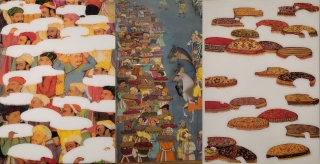
In another room, the viewer will encounter a work by Hamra Abbas (born 1976 in Kuwait). Her artwork consists of four panels. The two central panels are enlarged copies of two pages of the catalogue of the above-mentioned exhibition. One of them is the title page of the catalogue, and to its left is the “all rights reserved” page, which warns the reader that no part of the publication may be reproduced in any way at all. These two pages are flanked by two images (illegally) reproduced from the images of the original miniature in the catalogue, and then modified.
Ms Abbas has reproduced the part of the page in the Padshanahma which depicts the crowd of men bearing the bridegroom’s gifts to his bride. To the left of the two middle panels, we see the image of these bearers, but the gifts they were carrying have been removed from the image, leaving white spaces with the outlines of the shapes of the gifts, On the right side of the middle panels, we see the depictions of the removed gifts arranged against a white background. The artist has named this work “All Rights Reserved”. She devised it in 2004. By removing the gifts from the bearers, the artist has made her own interpretation of the removal of the Padshahnama from India in 1799.
The Padshahnama was not the only gift that Saadat Ali Khan II gave the British. He was crowned in 1798 by the British Governor General of Bengal, Sir John Shore. In gratitude, he ceded half of the Awadh (Oudh) kingdom to the British. Now that colonialism is being examined critically (at last), Ms Abbas’s intriguing artwork makes a subtle but powerful statement.
WE OFTEN VISIT the Tate Britain art gallery on London’s Millbank, usually to see special temporary exhibitions. Rarely, if ever, do we spend time looking at the Tate’s permanent collection. However, today, the 6th of July 2023, we met some friends who wanted to see the recently re-hung paintings in the permanent collection. The paintings are arranged in rooms in chronological order. Each artwork has an interestingly informative label, which describes the social conditions of the era in which it was created and other points about it.
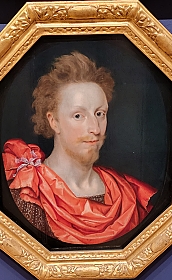
The first room of the series of galleries is dedicated to works created just before, during, and after the (Protestant) Reformation in 16th century England. I found it to be most interesting. The radical rejection of Roman Catholic religious practices involved, amongst many other things, a profound disapproval of the artistic portrayal of religious subjects. A consequence of this was that artists switched from painting religious scenes to portraiture. Just as people love being portrayed in photographs today, those who could afford it in the 16th century were pleased to have themselves immortalised in well-executed paintings. What I had never realised before was that the Reformation unwittingly gave birth to the long tradition of British portrait painting. Maybe, most people know this already, but it was news to me.
The gallery dedicated to the Reformation era has many fine portraits, by artists both known and unknown. However, one of the paintings hanging amongst the portraits is a religious scene, “An Allegory of Man”, by an unknown artist. Painted in about 1596, it would have been a highly controversial subject given the Protestant aesthetics prevailing at that time.
Although the temporary exhibitions at the Tate Britain are usually well worth viewing, the permanent collection deserves many a visit, as we discovered today.
IN 1975 I WENT to the town of Prizren in Kosovo, which was then part of the former Yugoslavia. I visited an old church in the town. Once, its internal walls had been covered with frescos. However, they had been badly defaced up to a certain height above ground level. Above that height and on the ceiling, they were intact. When the Ottoman soldiers arrived in Prizren, they used their spears to destroy the frescos, but only did so as far as they could reach. Being lazy, they did not use ladders to reach the higher parts of the church. So, the frescos beyond their reach survived.
In England, both the Dissolution of the Catholic religious establishments by Henry VIII, and later the defacement of churches by Oliver Cromwell and his followers, resulted in the destruction of many fine works of religious art. During a recent visit to Suffolk, we saw a few fine artefacts, which like the frescos in Prizren, have survived.
Bardwell
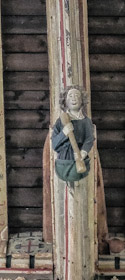
In accordance with Cromwell’s decree, many of the 15th century carved wooden angels that overlooked the nave of the parish church in Bardwell were destroyed. But, a few were left intact. Why was that? Did the workmen lose interest, or were they not paid enough? Who can say? And why was some of the 14th century stained glass left intact? Again, nobody can remember.
Over in the sleepy little town of Eye, the Parish Church contains a wooden rood screen containing beautifully painted panels that should surely have been destroyed by Cromwell’s iconoclastic vandals. Were they covered up with, say, wood panelling before the wreckers arrived, or were they removed and hidden? Luckily for us, these wonderful mediaeval paintings have survived.
Near Eye, there is a tiny church with a thatched roof in the village of Thornham Parva. It contains a rectangular wooden frame containing several mediaeval paintings that were created the 14th century. It was once the retable of an altar. Most likely, it was originally part of an altar in the Dominican Thetford Priory, which was dissolved during the reign of Henry VIII.
It is most probable that when the priory was dissolved, the retable was rescued by a Catholic family who put it in their private chapel. It passed through two other families before it was donated to the church at Thornham Parva in 1927. It is a rare surviving example of 14th century British religious painting. Interestingly, there is another series of painted panels in the Musée Cluny in Paris that resembles the Thornham Parva retable. Comparison of detailed aspects of these two sets of paintings suggests that they were both painted by the same team of artists, and were originally designed for the same location – most probably Thetford Priory.
In the space of three hours, we visited the churches at Bardwell, Eye, and Thornham Parva. All three contain artefacts of great interest and beauty which survived the religious upheavals orchestrated by Henry VIII and later by Cromwell. Once again, touring around in England has opened our eyes to its treasure house of history.
IN JANUARY 1950, the famous writer, painter, and politician, Winston Spencer Churchill (‘WC’) paid a short visit to the island of Madeira with his wife and his eldest daughter. They were accompanied by various British officials.
WC arrived on the island by sea, and stayed in the luxurious Reid’s Hotel in Funchal, which continues to flourish today. He left by seaplane a few days later to attend to affairs connected with an upcoming election in the UK.
While we were visiting the excellent photographic museum in central Funchal, we saw some photographs of Churchill, which were taken during his excursion to the picturesque fishing port of Camara de Lobos, which is a few miles west of Funchal. The photographs show WC painting a picture of the lovely bay surrounded by serried rows of houses. I have yet to see the picture, which I hope still exists.
We took a local bus to Camara de Lobos and disembarked close to a small bar named after WC. This is located close to a terrace overlooking the bay and its fishing boats. It was from here that he painted. A monument records this episode.
In 2019, a new hotel opened, the Churchill Bay. Outside its entrance, there is a sculpture depicting WC with cigar held between his lips. He is shown seated at an easel. Within the hotel’s lounge and bar, there is a fascinating collection of Churchilliana – photographs; letters signed by WC; a portrait by Felix Topolski; and contemporary artworks relating to WC.
Whether or not you are a fan of the Great WC, Camara de Lobos deserves a visit. Although there are plenty of tourists there, it manages to retain the feeling of a traditional fishing village.
TO CAPTURE A DETAILED IMAGE of a hawk attacking a bird in mid-air using photography would require a decent camera with a good lens and a high shutter speed. Yet, in about 1832 – long before cameras with high shutter speeds existed – the painter Edward Landseer (1802-1873) depicted a hawk attacking another bird high above the ground. He did not use photography. He created his picture on canvas with his paintbrushes and oil paints. His painting, “Hawking in the Olden Time”, hand in north London’s Kenwood House where I saw it today, the 11th of April 2023.
Clearly, Landseer’s image is a painting, but it contains as much detail as a reasonably good photograph. It must have taken him very much longer to execute than the fraction of a second that the event – the attack, which he captured on canvas, lasted in real life. Was his visual memory so good that he was able to hold a detailed memory of that instant in his head whilst he painted it? Although I doubt it, that possibility cannot be ruled out.
As I stood in front of the picture, pondering about it, another theory entered my head. During the nineteenth century, the art of taxidermy had reached a high degree of development. For example, the British ornithologist John Hancock (1808-1890) was an accomplished taxidermist. One of his works, “The Struggle with the Quarry”, which is in the Hancock Museum (in Newcastle upon Tyne) consists of one stuffed bird attacking another, and at first glance makes one think of Landseer’s painting. Although this was created after Landseer made his painting, the art of taxidermy had already begun to be perfected by taxidermists such as Louis Dufresne (1752-1832). So, when I was standing in front of the painting at Kenwood and thinking that Landseer might well have used a work of taxidermy as a model for his picture, I might not have been mistaken.
Kenwood House contains one of London’s best collections of old master paintings outside the city’s major public art galleries. Each time I visit it, I discover something that I had not noticed before. I am sure that I had seen the painting by Landseer, but it was not until today that I gave it more than a passing glance. Today, while walking around the house with some friends who had never been there before, we stopped in front of the painting of mid-air carnage and wondered how this image had been created before modern photography had been invented. Maybe, what I have written provides the answer.
UNBELIEVABLY, THE ARCHITECT Herbert Baker (1862-1946) demolished a major work of one of England’s greatest architects – Sir John Soane (1753-1837). Imagine the outcry if Sir Richard Rodgers decided to demolish Christopher Wren’s St Pauls Cathedral to replace it with one of his own design. Well, in the 1920s, Baker demolished most of Soane’s Bank of England to replace it with a larger building – the present Bank – which he designed.
There is a small museum in the Bank of England. Some of its rooms have been designed to recreate the kind of interiors that would have existed in Soane’s Bank building. In one of the rooms of the museum, a circular space beneath a glazed dome, there is a framed portrait of Sir Herbert Baker. Baker, who helped design New Delhi, is well known for his architectural work in South Africa. After being commissioned by the imperialist Cecil Rhodes (1853-1902) to redesign Groote Schuur, his house on the slopes of Cape Town’s Table Mountain, he was asked to design many other structures in South Africa.
The portrait depicts Baker standing at a drawing table by a window through which a building in his typical neo-classical style can be seen. At the bottom left corner of the painting, there is a depiction of a framed painting of Cape Town’s Rhodes Memorial, which Baker designed in 1906. If you look carefully at this picture within a picture, an equestrian statue can be discerned. This statue, called “Physical Energy”, was sculpted by George Frederick Watts (1817-1904), who was briefly married to the actress Ellen Terry. The statue was cast in 1902, and placed at the Rhodes Memorial in Cape Town. In 1907, another bronze cast was made, and this stands on a stone plinth in Kensington Gardens almost midway on a line connecting the statue of young Queen Victoria in front of Kensington Palace with the Henry Moore sculpture on the east bank of The Long Water (part of the Serpentine).
When we saw the portrait of Baker, we were viewing an interesting exhibition that explores the Bank of England’s many and varied links with the slave trade. The caption relating to the portrait of Baker concentrated on the small image of the memorial to Rhodes. It correctly pointed out that Rhodes had been a Prime Minister of the Cape Colony, which became part of unified South Africa in 1910. It also mentions that Rhodes: “…held racist beliefs that Africans were inferior.” In 1912, the author GK Chesterton wrote of Rhodes that he:
“… had no principles whatever to give to the world. He had only a hasty but elaborate machinery for spreading the principles that he hadn’t got. What he called his ideals were the dregs of a Darwinism which had already grown not only stagnant, but poisonous … It was not his fault that he “figured out that God meant as much of the planet to be Anglo-Saxon as possible.” Many evolutionists much wiser had “figured out” things even more babyish. He was an honest and humble recipient of the plodding popular science of his time; he spread no ideas that any cockney clerk in Streatham could not have spread for him. But it was exactly because he had no ideas to spread that he invoked slaughter, violated justice, and ruined republics to spread them.”
Well, that is something for recipients of, and those applying for, Rhodes Scholarships to ponder over.
Getting back to the Bank that Baker designed, the museum is well worth visiting not only for its temporary exhibition about slavery but also for its permanent collection of exhibits, all of which have easily understood explanatory labelling.
GIOVANNI BATTISTA TIEPOLO (1696-1770) is one of my favourite artists. I have been familiar with his works ever since my childhood, when we visited Venice annually from the late 1950s or early 1960s onwards. My parents took me from church to church to see the great master’s paintings, which I prefer to the somewhat more photograph-like paintings of Canaletto.
We used to stay in a pensione on the Fondamente Zattere, a waterfront facing across a wide canal to the Giudecca island. The Gesuati church was a few yards from where we resided in Venice. It contains ceiling panels and a wall painting, all created by Tiepolo. Often, we passed the church and almost always entered it to gaze up at Tiepolo’s ceiling. I cannot remember it, but my sibling recalls that almost every morning, early, my father used to stand quietly and alone in the church for a few minutes.
I became so keen on Tiepolo that I broke my train journey between Ostend and Vienna to spend a night in Würzburg in order to see Tiepolo’s paintings in the city’s Residenz (a palace).
This September (2022), I was walking along a narrow passageway (Calle S Domenico) when I spotted a commemorative plaque above an archway leading into a long narrow courtyard surrounded by tall residential buildings. The plaque recorded that in the courtyard there was the house in which Tiepolo was born on March 1696. Exactly in part the courtyard, the Corte S Domenico, the artist was born, I could not determine. However, I had never seen this place before and was thrilled to have stumbled across the place where one of my favourite artists was born.
FOR UNKNOWN REASONS, we were initially reluctant to bother with viewing the exhibition (at London’s Tate Britain until the 18th of September 2022) of paintings and drawings by Walter Sickert (1862-1942). However, I am glad that we did because we got to know and appreciate an artist, of whom I had heard but knew little about. That little which I did know was that for a brief while Sickert had one of the Mall Studios in Hampstead, where years later the sculptor Barbara Hepworth worked and resided with one husband, and then another. Later, Sickert moved from Hampstead to Camden Town.
Sickert was born in Munich (Germany). He and his family moved to Britain when he was 8 years old. His father, Oswald Sickert (1828-1885), an artist, introduced him to the works of important British and French artists, but Walter’s inclinations led him to study acting. However, in 1882 he entered London’s Slade School of Art (at UCL) and he became a student and assistant of the artist James Abbott McNeil Whistler (1834-1903). Soon, he began spending a lot of time in France, where he met Edgar Degas (1834-1917), whose work was to have a great influence on his style.
The exhibition at Tate Britain successfully demonstrates that Sickert was a highly competent artist. His topographical paintings (notably of Dieppe and Venice) are superb, as are the many of his portraits, some of which verge on being impressionistic, on display. His depictions of scenes within theatre show his great ability to portray light and shade. A series of paintings of nude women, some of whom are shown being in the company of often disinterested-looking men in far from elegant clothing, throw light on the shady world of the poor in places such as Camden Town and its environs.
Although some of Sickert’s paintings show features that later would become associated with artists such as the impressionists, Lucien Freud, and Francis Bacon, he is not one of the first artists that springs to mind when thinking about the great artists of the late 19th and early 20th century. Why is this the case? Despite hinting at what was to become common in the works of the Abstractionists, he never broke through the barrier into Modernism as did painters such as Braque, Picasso, Miro, Kandinsky, Matisse, and Mondrian. In no way does this detract from the brilliance seen in Sickert’s work. In a way, he was born too late to be considered as distinguished as those I have mentioned. Considered alongside 19th century artists, he shines. But, although he received many commissions, he was painting during an era when the more adventurous and innovative artists were in their heyday. That said, I can strongly recommend the exhibition at the Tate, which demonstrated to me that Sickert, a master of light and shade, was an artist who deserves much more attention than he gets today.
NOT FAR FROM the busy A13 road that links London with Tilbury and places further east, and surrounded by a sea of unremarkable dwelling houses in the London Borough of Barking & Dagenham, stands an unexpected historical Tudor architectural treasure: Eastbury Manor.
Part of a wall painting in Eastbury Manor
This beautiful Tudor mansion, built between 1560 and 1573 for Clement Sisley (or Sysley) and his family, stands on land that had been owned by Barking Abbey until its dissolution in 1539. He was a wealthy businessman connected with high-status families. Married thrice, each of his wives’ dowries added to his prosperity. The manor house remained connected with his extended family until it was sold in 1628. After that, the house and its associated extensive land had a series of owners and tenants until sometime in the 19th century when the building began to deteriorate. The various inhabitants made use of the place’s formerly large grounds for agricultural purposes: principally, grazing. The National Trust (‘NT’) bought the house in 1918, and this purchase is responsible for its survival. Owned by the NT, it was Barking’s local museum between 1935 and 1941. Now, still the property of the NT, it is maintained by the London Borough of Barking and Dagenham.
“A little beyond the town, on the road to Dagenham, stood a great house, ancient, and now almost fallen down, where tradition says the Gunpowder Treason Plot was first contriv’d …”
I checked my copy of Defoe’s book and discovered that the editor of my edition (Pat Rogers) had doubts about this connection with Guy Fawkes et al. Rogers noted that the conspiracy was largely planned in Northamptonshire.
The house, which stands on land rich in clay, is built of bricks made locally, on-site. It is built to an H-shaped plan: two parallel wings are linked by a central portion perpendicular to near their northern ends. The central part and the two wings enclose a charmingly intimate courtyard, whose fourth (southern) side is bounded by a wall connecting the two wings. Although a modern staircase and lift have been added, the house’s original timber spiral staircases were housed in octagonal towers that encroach onto the northwest and northeast corners of the courtyard: they are classed as ‘external staircases’.
The house and its garden have many fascinating features typical of Tudor architecture. For example, in the Great Hall on the ground floor, there is a huge fireplace. It is large enough for several adults to stand within it. Our informative guide directed us to look up into the large chimney. There, we could see platforms that were built to allow workmen to climb into the chimney to clean it in the era long before there were chimneysweeps with special equipment. The Tudor brick wall surrounding one of the gardens has 17 small niches. These were designed as bee boles, in which skeps, baskets where bees lived, were placed. Interesting as these and many other things are, the most amazing feature is to be seen in the so-called Painted Chamber on the first floor, which we reached using the original timber staircase.
Discovered beneath layers of paint after a fire during the 19th century, are the sizeable fragments of two exceptional wall paintings. It is believed that these were commissioned by the London Alderman Sir John Moore who died in 1603. His coat of arms is depicted on one of the pictures. Moore, who took an interest in international trade and the then proposed East India Company, used the house as his country home.
The paintings depict trompe-l’oeil walls with columns, classical figures, and archways. The latter frame depictions of countryside and nautical scenes. Apart from their great age and skilful execution, these frescos are remarkable for their use of perspective. The lady who was showing us around the Manor mentioned that these wall paintings are some of the earliest surviving examples of pictures in England displaying the kind of perspective that is now commonly used in Western European art. So-called ‘true geometric perspective’ was developed by Italian painters during the 14th and 15th centuries. Its use spread to other parts of Europe and would have been known in England by the time of Moore’s occupancy of Eastbury Manor. The surviving wall paintings were executed before his death in 1603, but by whom we might never know. It is quite possible that the artist had either been abroad or had come from overseas. Whoever painted these lovely images had a good grasp of what was then regarded as the latest way of portraying the illusion of depth and distance. Whether there are earlier examples of surviving paintings created in England (using tru perspective) than those at Eastbury Manor, I do not know. So, until I am wiser on the subject, I will accept what we were told. I have seen older surviving wall paintings in English churches, but none of them display even the slightest hint of true geometric perspective.
All in all, it is well worth venturing into the rather dull suburbs of Dagenham and Barking to visit Eastbury Manor. It might not be as glorious as other surviving Tudor edifices, such as Hatfield House, but it is no less a wonderful reminder of an era long-since passed.