
A tiny stream feeding the River Thames

NORTH LONDON IS riddled with rivers, rivulets, and streams. Some of them have been covered over and built upon, and others are still visible. One of these is Mutton Brook, which rises near East Finchley, flows through Hampstead Garden Suburb, and then merges with another watercourse – Dollis Brook – to become the River Brent. The Brent flows from near Golders Green through northwest and then west London to its mouth at Brentford, where its waters flow into the Thames.Although I did not know it when I played beside the stream as a child, the tiny Mutton Brook helps feed the mighty Thames with water.Minute as it is, as far as watercourses are concerned, it made a large impression on me in my childhood.

For much of its course, Mutton Brook flows through open spaces, such as Lyttleton Playing Fields, Fletcher’s Gardens, Northway Gardens, and a long stretch of parkland flanking the south side of the North Circular Road. Despite being fringed by suburbia and busy roads, the Brook is well separated from them by nicely planted green spaces along which walkers can enjoy the feeling of being in the country despite being in the heart of northwest London.

Until 1907, Mutton Brook would have flowed through what was then rural Middlesex countryside – fields, meadows, and woods. From then onwards, Hampstead Garden Suburb was established, and its neighbour Golders Green grew from being a small hamlet to become a large, mainly residential urban area. My recent book (see: https://www.amazon.co.uk/GOLDERS-GREEN-HAMPSTEAD-GARDEN-SUBURB/dp/B0BHG873FB/)  describes Mutton Brook in detail. It also as provides an informative description of life in Golders Green and Hampstead Garden Suburb past and present. These are places I know well because I was brought up in them, and lived there until I was thirty. My book also contains reminiscences of my life there as a child and a young man. I still visit the area frequently because some of my friends and family live there.
A WALK IN THE PARK

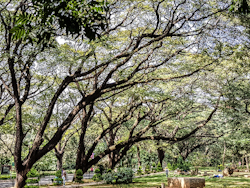
BANGALORE IS RAPIDLY BECOMING AN URBAN DESERT, but luckily there are some green oases. One of these is Cubbon Park, named in honour of Sir Mark Cubbon (1775-1861). When it was first laid out in 1870 it was called ‘Meades Park’. Now, its official name is ‘Sri Chamarajendra Park’, although few Bangaloreans would recognize that name as being Cubbon Park.

Although a few roads traverse the park, they do not detract from ots pleasant sylvan nature. And, on Sundays many of these roads are closed to make them free of traffic.

Most of the park is not laid out in an obviously planned way and much of it is pleasantly in the shade of the leafy branches of huge old trees. Wherever you go, you will encounter dogs with their owners, wild dogs, people sitting or sleeping on benches or logs, people exercising, and picnickers. During a recent visit, I saw groups of young art students sitting in circles on the ground. They were cutting up old newspapers and magazines to gather materials for collages they were preparing.

Cubbon Park has its own metro station. One of its entrances is close to both a statue of King Edward VII of Great Britain and also a disused fighter jet, advertising the products of HAL, whose offices face the park.

After passing through the security check, which is present at all metro stations, I descended to the subterranean concourse. This and other parts of the station has been decorated by artworks created, with varying degrees of skill, by students of the Shristi school of design, which is located at Yelahanka, in between Bangalore and its Kempe Gowda Airport.

I was escorted by one of the Shristi students through the metro ticket barrier to another concourse that can be entered via a station entrance near the Chinnaswamy Cricket Stadium. This particular concourse had a temporary exhibition of photos of Indians who served in British armed forces during WW2. Sadly, this exhibition looked hastily conceived and did not make much of an impact either visually or historically. The involvement of Indian troops and officers during WW2 is undoubtedly of great interest, but this exhibition did not really explore this even superficially. While I was looking at the show, a Sikh gentleman spoke with me and pointed to one of the photos on display. It showed his father, who had fought during the War.

The exhibition ends on the 22nd December, but the delights of Cubbon Park remain … at least for the foreseeable future, but for how long it is impossible to say in a city that gives more importance to real estate investments than to preservation of heritage.

Ten places to breathe and relax

Heron_500


Another list for you, now that the weather is improving.

Here are ten open public spaces in London north of the River Thames. These are places, which I particularly enjoy. They are listed in no particular order:

1 Golders Hill Park

2 Kenwood

3 Kensington Gardens

4 Regents Park

5 St James Park

6 Holland Park

7 Hampstead Heath

8 Thames Barrier Park

9 Postmans Park

10 Soho Square


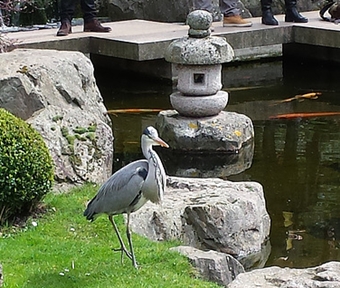
Picture taken in the Kyoto Garden at Holland Park