A short but wonderful novel by Aldous Huxley

“… WHAT IS READING but a vice, like drink or venery or any other form of excessive self-indulgence? One reads to tickle and amuse one’s mind…”

These are the words of the verbose Mr Scogan in “Crome Yellow”, a novel by Aldous Huxley (1894-1963). With novels such as this one, reading is certain to become an incurable addiction, if not a vice. First published in 1921, only a few years after the end of WW1 this short novel is not only highly entertaining and extremely witty but almost completely un-put-downable.

Huxley was 27 years old when he published “Crome Yellow”. It begins when a young man, Denis, aspiring to be a poet arrives, at Crome, a stately home where various other guests have come to spend time during the summer. The book and the stately home contain a wealth of characters whose conversations and interactions with one another provide the reader with a wealth of entertaining situations. The author manages to convey the social atmosphere prevailing amongst the upper classes immediately after WW1, as well as presenting a range of philosophical ideas both about life and art. He managed to do this with a lightness of touch that makes even the most abstruse of ideas become easily digestible by the reader.

Every now and then, Mr Wimbush, the current head of the Crome household, reads extracts from the history of the house and its aristocratic inhabitants, which has taken him 30 years to complete. These are highly entertaining. Throughout the novel, Jenny, who is almost completely deaf, scribbles away in her notebook. What she had been entering into it is surprising, and only revealed near the end of the book.  Other characters include several young ladies, Mrs Wimbush who believes in mysticism and spiritualism, Mr Scogan who cannot stop talking and has an opinion about everything, Mr Bodiham the village priest, the artist Mr Gombauld, and the spiritualist Mr Barbecue-Smith. Throughout the story, a young lady, Anne, is the object of attention by both Denis and the French artist. Between these characters and others in the book, you can be sure that Denis’s stay at Crome was anything but dull.

I picked up my copy of “Crome Yellow” at a charity shop, and am extremely glad I did. I have not enjoyed a novel as much as this one for quite a few years. I hope to read more of Huxley’s novels in the future.

Chikkamma Tours (Pvt.) Ltd: a detective story set in Bangalore

THIS BOOK WAS RECOMMENDED to me by a bookseller in Bangalore, at Bookworm, because she said that the shop is mentioned in the book. In the novel, Chikkamma Tours is a small travel company located beneath a bookshop run by Jagat Desai. One night, he is murdered. His body is found the next morning by one of the ladies who work in the office beneath the bookshop. The police are informed, but the three women who work at Chikkamma Tours decide to make their own investigation of the murder. What they discovered about themselves and the crime are the subjects of this ‘whodunnit’ novel.

Although I enjoyed reading it, this book is not a great work of literature. However, it was fun and I liked it because it captures many aspects of life in a city I visit frequently: Bangalore. As I proceeded through it, I recognised many things I know about the city and, especially, its bookshops.

Would I recommend this book? I would to Bangaloreans and to people who know the city well. However, I am uncertain that it would appeal to those who have little or no connection with the city. That said, I am pleased that the lady at Bookworm suggested I should read it.

Epic narration and a great plot: it would make exciting cinema

THE GORDON RIOTS which occurred in London in 1780 were a reaction to a law passed in 1778. The law gave rights to Roman Catholics and aroused the hostility of no-papists (anti-Catholics). The disturbances,  which resulted in much destruction of property in London were instigated by the hateful propaganda of Lord George Gordon (1751-1793).


I first became interested in the Gordon Riots when I was writing my book about Hampstead and its surroundings. The rioters headed out of London towards Hampstead on their way to Lord Mansfield’s country house at Kenwood.  Mansfield’s house in London’s Bloomsbury district had just been razed to the ground by the riotous mob, and they had hoped to do the same thing at Kenwood.  Fortunately, they were stopped just before they reached Mansfield’s country mansion.

 Given my interest in the above-mentioned,  I  was excited to find that Charles Dickens had written a novel about the riots: “Barnaby Rudge”. It was first published in 1841.


Barnaby Rudge is a peculiar character, a simpleton whose best friend is a talking raven. At first, it was not obvious to me why the novel should bear his name, but slowly his importance in this complex tale becomes evident.  Although his role is important, there are a large number of other equally important characters woven into the plot.


Dickens explores the private antagonisms between some individuals as well as attractions between others, and gradually weaves these relationships into the ever increasing rumblings that develop into riots and mindless destruction.


Dickens wrote long before cinematography was invented, yet his written descriptions of both peaceful scenes and incredible chaos have a vividness and impact that much modern cinema (especially some blockbuster Bollywood productions) are able to throw at their audiences.  And Dickens does this with words alone: without Dolby sound and dramatic photography.


In brief, I  found “Barnaby Rudge” to be a veritable tour-de-force. My enjoyment of the book was enhanced by the fact that the Penguin edition I was reading was richly supplied with notes (mainly historical) researched and written by Gordon Spence.


Before reading “Barnaby Rudge”, I knew that the Gordon Riots were a fairly horrendous episode in British history.  However, Dickens, who was writing just 40 years after they had occurred and might have known people who had witnessed them, brought this age of turmoil to life in a credibly dramatic way.

Charles Dickens and a house in Berkshire

BASILDON PARK IS an 18th century stately home in Berkshire. Now managed by the National Trust, it has had many owners including the Sykes family. Sir Francis William Sykes inherited the place from his grandfather. When his wife had an affair with the artist Daniel Maclise, Sir Francis disowned her and publicly humiliated her. Now, Maclise was a close friend of the author Charles Dickens, and at the time when Sykes was being unpleasant towards his wife, the author was working on his novel “Oliver Twist”. Dickens created the nasty criminal character called Bill Sikes to take his revenge on Sir Francis (see http://www.basildon-berks-pc.gov.uk/basildon-berks/basildons_past-20268.aspx)

Fagin

We visit Basildon Park regularly. For this reason and because of its connection with Bill Sikes, I had decided to read “Oliver Twist”. It is the third of the Dickens novels that I have read recently. It was one of the first that he wrote. Compared with the two I have already read, “Nicholas Nickleby” and “Martin Chuzzlewit”, it flows easily and is very exciting.

The first thing that struck me was how early in the book the famous “Please Sir, can I have some more” scene occurs. It is an important episode but one that people seem to remember more than the rest of the book.

“Oliver Twist” is full of wonderful characters, both good and evil. Amongst the latter, Sikes, Bullseye (a dog), Fagin, Mr Bumble, and Monks are particularly well portrayed. There is a host of characters who see the best in Oliver’s personality. Oliver and his troubled young life is brilliantly narrated, and as I turned the pages, my heart was in my mouth as I waited to see what misadventure would next befall him.

I found the novel to be fast moving and exciting. As the saying goes, it is a real ‘page-turner’. I had no idea that Dickens’s writing could be so thrilling. Having come to the end of “Oliver Twist”, I am next embarking on “Barnaby Rudge”, which I have chosen because it concerns the Gordon Riots of 1780, about which I have read in history books.

One Night at the Call Center and its author

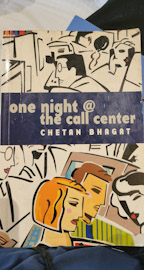
THE AUTHOR CHETAN Bhagat was born in 1974 in New Delhi. He was educated at two prestigious institutions: Indian Institute of Technology (Delhi) and the Indian Institute of Management (Ahmedabad). After graduating he had various jobs including working at the Hong Kong office of the bankers Goldman Sachs. There, he was unhappy with his boss, whom, according to Wikipedia, he:
“ … characterized the villain in his second novel One Night @ the Call Center.”

The novel about the call centre was first published in 2005. The villain is Bakshi, the head of a department of a call centre that services customers in the USA. As its title suggests, the book is about one night at the call centre and its main characters are five young people working under Bakshi. I will not give the plot away, but I can tell you that the story is both entertaining and, in parts, profound. All that I will reveal is that the problems that the five workers are experiencing and described in the novel become insignificant after they receive a telephobe call … from God. But, do not worry: the book is not a religious tract. The book deals with many things, including the perception that some young Indians have: that their country is inferior to the USA.

Chetan Bhagat is a highly creative and imaginative story teller. His plots are rich in unexpected twists and turns. He has a great eye for detail and a good understanding of the minds of young Indians and they way they perceive today’s world.

Recently, a couple of people suggested that Bhagat’s humour is inadvertent rather than intentional. I completely disagree with this point of view. He concocts humorous situations in his novels with great care and expertise, and inserts them in his stories skilfully. Like Chinese sweet and sour dishes, Bhagat’s novels contain a harmonious blend of humour and seriousness, both complementing each other intelligently.

What I particularly enjoy about Bhagat’s writing – and by now I have read four of his novels – is his easy-going narrative style. As I read his books, I felt as if he was a good friend sitting and chatting with me in a bar or cafe. His books are easy to read yet full of profound observations about life, expressed effectively but with a light touch.

A novel about Cornwall by Daphne du Maurier

I HAVE BEEN TO CORNWALL many times, and always enjoy visiting this unique part of the UK. For many years, it was the home of the author Daphne du Maurier (1907-1989). She died in the Cornish town of Fowey, where she had a house, which is still owned by her family. Despite having visited Cornwall so many times, it was only recently (October 2023) that I first read one of her novels. The one I chose is called “The House on the Strand”. It is an exciting book, which is difficult to set aside once you begin reading it.

Richard Young is spending a holiday in Cornwall in a house owned by his old friend, a scientist Magnus, who is a professor at the University in London. Magnus has developed a set of related drugs, which he and Richard decide to test on themselves. Both men experience the same effects of these hallucinogenic substances. Within minutes of drinking a dose, they are transported back to 14th century Cornwall and become witnesses to events that they later discover had been recorded in historical records. Both men become witnesses to things that were happening during that far off period in the area where Magnus’s house is located. The desire to know more and more leads both men to keep taking the drug.

Things begin to get complicated when sooner than expected Richard’s wife and his stepchildren join him in Cornwall. The drug has odd side-effects that make Richard’s wife both worried and suspicious. As the days pass, things become more and more complicated, and eventually there is a series of tragic events.

The plot is ingenious and intriguing. By transporting Magnus and Richard back to mediaeval times, the author was able to describe Cornwall today and as it might have been in those days. The novel is also about addiction and how it develops. Further, Du Maurier describes the conflict between truth, half-truth, and deception. Not only is this novel a delightful story about Cornwall but also it is a brilliant depiction of certain types of human behaviour and how it has changed over the centuries.

Richmond’s last night out was in a London pub…

IN “REGENCY BUCK” by the English novelist Georgette Heyer (1902-1974), we read in chapter II:

“Weighs something between thirteen and fourteen stone,” said Mr. Fitzjohn knowledgeably. “They say he loses his temper. You weren’t at the fight last year? No, of course you weren’t I was forgetting. Well, y’know it was bad, very bad. The crowd booed him. Don’t know why, for they don’t boo at Richmond and he’s a Black, too. I daresay it was just from everyone’s wanting Cribb to win. But it was not at all the thing, and made the Black think he had not been fairly treated, though that was all my eye and Betty Martin, of course. Cribb is the better man, best fighter I ever saw in my life.

This extract includes two names ‘Cribb’ and ‘Richmond’. Both were boxers of great renown: Tom Cribb (1781-1848) was an English world champion bare-knuckle boxer and Bill Richmond (1763-1829) was more than simply a boxer.

Richmond was an ex-slave born into slavery in Richmondtown on Staten Island, New York (USA). He was then a ‘possession’ of the Reverend Richard Charlton. Hugh Percy, 2nd Duke of Northumberland (1742-1817), an officer commanding British forces during the American War of Independence, saw Richmond involved in a fight with British soldiers in a tavern, and recognised the black man’s skill as a boxer. After arranging fights between young Richmond and other British soldiers, Percy bough Richmond his freedom and sent him to England, where he organised his education, and apprenticed him to a cabinet maker in Yorkshire. Richmond married in England and later moved to London, where, already in his forties, he began his largely successful and lucrative career in boxing.  He also owned a pub, The Horse and Dolphin, for a while. Today the Dutch pub in Soho, De Hems, stands on its site.

Soon Cribb was challenging and beating some of the best boxers of the time. However, in 1805, Richmond challenged Cribb, and lost. This led to bad relations between the two men, which lasted for years. Richmond met another former slave Tom Molineaux (1784-1818). Recognising his new acquaintance’s potential as a boxer, Richmond gave up boxing to train Molyneaux. After having narrowly lost two fights with Cribb, in 1810 and 1811, Molyneaux fired his trainer, Richmond.

After losing money on training and sponsoring Molyneaux, Richmond, by then aged 50, took to the boxing ring again. At this advanced age, he challenged and beat two younger champion boxers, Jack Davis and then Tom Shelton. After these two victories, he wanted to challenge Cribb again, but the latter had already retired. In 1820, Richmond founded a boxing academy for training amateur boxers. Amongst those he trained were two now famous literary figures: William Hazlitt and Lord Byron.

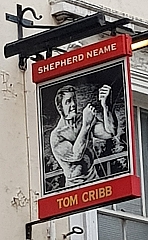
As he and Cribb aged, they became friends. It was in the pub that Cribb owned, The Union on Panton Street (near Leicester Square), that Richmond spent the last evening before his death. The Union still exists but is now named the Tom Cribb. A plaque on the outside of this hostelry commemorates Cribb’s achievements and another one records Richmond’s last night out, which was spent with his friend Tom Cribb.

A flourishing pub in Hampstead

ONCE LONDON’S HAMPSTEAD had two pubs or taverns named ‘The Flask’. This should not come as a great surprise as Flask used to be a common name given to pubs. One of them, The Upper Flask, used to be located at the top (northern) end of East Heath Road and the other, The Lower Flask’ was (and still is) on Flask Walk, a street leading off Hampstead High Street.

The Upper Flask used to be a remarkable establishment. Once called ‘The Upper Bowling Green House’ because of its good bowling green, it was a meeting place favoured by fashionable and ‘cultured’ men (mainly) and women during the 18th century. It was a summer meeting place for The Kit Kat Club, which thrived in the early 18th century and whose members included literary figures and political personalities, who supported the Whig Party. The Upper Flask figures several times in “Clarissa”, a lengthy novel by Samuel Richardson (1689-1761), first published in 1747. The place ceased operating as a hospitality business in the 1750s, when it became a private residence (www.british-history.ac.uk/vch/middx/vol9/pp81-91). In 1921, it was demolished to clear the site for building the Queen Mary Maternity Hospital (https://ezitis.myzen.co.uk/queenmaryhampstead.html), which has since become the site of a luxury housing complex.

The Lower Flask (in Flask Walk) is also mentioned in “Clarissa”, but unflatteringly as:

“… a place where second-rate persons are to be found often in a swinish condition,” (quoted from “Old and New London”, by Edward Walford, about 1880).

Unlike the lost Upper Flask, the formerly named Lower Flask is still in business, but much has changed since Richardson published his novel.

Located at the eastern end of the pedestrianised stretch of Flask Walk, the former Lower Flask, renamed The Flask, was rebuilt in 1874 (and extended in 1990; https://historicengland.org.uk/listing/the-list/list-entry/1322190). Formerly, it had been a thatched building and was a place where mineral water from Hampstead’s chalybeate springs was sold. It and Keith Fawkes’ second-hand bookshop are the only things in Flask Walk, which were in existence when I used to visit Hampstead regularly in the 1960s and 1970s. In those, now far-off, days, I remember that there used to be another second-hand bookshop and a butcher, both on the south side of the passageway. Before the 20th century, there used to be a fair held for a few days in August on the triangular open space a few yards downhill from The Flask pub. Close to The Flask, also on Flask Walk, miscreants could be found languishing in the parish stocks. Both the stocks and the fair are now but long distant memories recorded only in books published many decades ago.

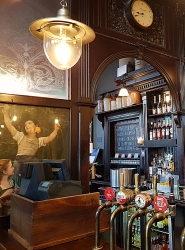
Oddly, despite visiting Hampstead literally thousands of times during the last more than 65 years, it was only on Halloween 2021 that I first set foot in the Flask pub, and I am pleased that I did. The front rooms of the pub retain much of their Victorian charm and the rear rooms are spacious. Although we only stopped for a drink, I could see that the Sunday lunches being served to customers around us looked delicious. We hope to return there soon.

Two books on Albania by an Albanian and his American wife

I have received news of two books about Albania. One, an intriguing novel, is written by American born Kim Malaj. The other, a collection of Albanian folk tales is written by her husband, Arti Malaj, who was born and brought up in Albania. I look forward to reading them in the future. Why not give them a try, and let me know how you enjoyed them?

THE NOVEL:”CASTLE OF TESKOM” by Kim Malaj

‘Shiny ember rocks are fuel for time; the dull rocks are a fool’s dime.’An old nursery rhyme, or so they think. Itra and Danae stumble across an ancient secret kept hidden behind a reflection in time near their Albanian home. A faded memory and cryptic messages have propelled them to risk an encounter with foes from Greek mythology, altering their perception of Albanian folklore and reality. Itra and Danae grapple with events set in motion centuries ago and must choose toprotect and serve or risk having the secret exposed. Will love, loyalty, and lineage be enough to hold them together, or will they lose their way in auniverse they are only beginning to understand?

Amazon: https://amzn.to/3n5Aetj

eBook: https://books2read.com/u/bpryMl

THE FOLK TALESNORTHERN ALBANIAN FOLKTALES, MYTHS AND LEGENDS

by Arti Malaj

Generations of Northern Albanian are known as great storytellers. They shared many folk tales, myths, and legends with their descendants. The collected short stories include mysterious legends of lost treasures, mystical tales of mountain fairies, superhuman powers, century-old witches, blood feuds, and more written by a twelfth-generation Albanian. The lands described in the stories are still visible today, and locals share a sense of wonder and respect the mysteries that hide beneath. Northern Albania is a true treasure of raw natural beauty and a hidden gem in Southeastern Europe.

Amazon https://amzn.to/2GcDDq2

eBook: https://books2read.com/u/b5ZNOl

Bachelor of Arts

booknarayan


Rasipuram Krishnaswamier (‘RK’) Iyer Narayan (1905-2001) was born in Madras (now ‘Chennai’) in southern India. He was a prolific writer of fiction and non-fiction. Many of his fictional works are set in the imaginary southern Indian town called Malgudi. Until recently when I bought a copy of “Bachelor of Arts” (first published in 1937 when India was ruled by the British), I had never read any of Narayan’s works. 

“Bachelor of Arts” is a delightful simply told tale about a young man, Chandran, whom we meet while he is completing his BA degree. We follow his life’s strangely interesting path after he graduates until he … well, I won’t give away the story. Despite the simplicity and clarity of the story telling, Narayan subtly changes the mood of the story as it progresses. I liked the way he did this. Another interesting aspect of this novel is the gentle way in which the author criticises the British imprerialistic attitude. I was also excited by the way Narayan, an Indian, portrays the ‘Indian-ness’ of his characters. As Grahame Greene wrote of Narayan in the introduction to the edition I read:

Without him I could never have known what it is like to be Indian.”

I agree wholeheartedly with what Greene wrote. I plan to read more of Narayan’s works as “Bachelor of Arts” has whetted my apetite successfully.