I HAVE SEEN PHOTOGRAPHS of baobab trees, but until we visited the café of the formerly named Prince of Wales Museum in Bombay, I had never seen one ‘in the flesh’. A member of the mallow family of plants, baobabs are native to Madagascar.
Baobab tree in Bombay
These trees with curious looking conical trunks were imported to India by Arab traders. Although this is the case, this baobab in Bombay is the first such tree I have seen during my 30 years of frequent visits to India.
As we sat with our cold drinks, I looked up at the high branches of the baobab, and saw something flapping about. At first, I thought it was a black plastic bag caught in the branches. Then I noticed that it was a large bat stretching its wings. I saw it was not alone, but one of a large number of bats hanging on the high branches. These large creatures had black wings and dark brown bodies.
Despite the fact we had just seen a wonderful exhibition of ancient sculptures (from India, Ancient Rome and Greece, and Assyria), finding the baobab and seeing the bats in it, made my day.
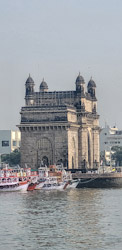
WE HAVE BEEN VERY fortunate to get a booking at the Royal Bombay Yacht Club, located next door to the world famous luxurious Taj Mahal Hotel. Our bedroom is directly opposite the front of the Gateway of India – Bombay’s best known landmark.
The Gateway was built to celebrate the arrival in India of the British King George V – Emperor of India. However, as it was only completed in 1924, the king only got to see a cardboard model of the archway. Construction of this edifice only began in 1915, when the land on which it now stands was first prepared. The Gateway’s foundations only began to be built in 1920.
The magnificent archway was designed by George Wittet (1878-1926), an architect who worked mainly in Bombay. The Gateway was designed in an Indo-Saracenic style with many features borrowed from 16TH mosques found in Gujarat.
The Gateway is a brilliant piece of architecture. In its position next to the sea, it ‘works’ successfully. It has become not only an icon of Bombay but also, I believe, of India. I find it ironic that like that other icon of India, the Taj Mahal in Agra, its construction was inspired not by Indians but by invaders of the Indian Subcontinent. Despite that, Indians love it and flock to see it.
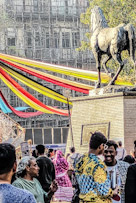
THE KALA GODHA (Black Horse) is a statue in the heart of old Mumbai. It was erected in 2017 and designed by Alfaz Miller and sculpted by Shreehari Bhosle. It stands on the site of an equestrian statue of King Edward VII, which was removed from this spot in 1965 (and can now be seen in Byculla Zoo).
The Kala Godha
The statue gives its name to an annual arts festival, The Kala Godha Festival, that has been held since.1999. It has grown over the years and attracts many visitors. People come to enjoy film, literary events, heritage walks, booksales, exhibitions, artworks, other cultural happenings, and sales of handicrafts from all over India.
Held for nine days in February, this festival is a lot of fun.
CRAWFORD MARKET IN central Mumbai was completed in 1869. Its British architect William Emerson (1823-1924) designed it in an Indo-Saracenic style, which attempted to combine Victorian Gothic and Indian architectural features.
Crawford Market
I am familiar with some of Emerson’s other buildings. One of them is the Nilambagh Palace in Bhavnagar, Gujarat. Now a hotel, we have stayed there. Another building, which is closer to our home in London, is the Clarence Wing of the St Mary’s Hospital in London’s Paddington. You can read more about the hospital in my book “BEYOND MARYLEBONE AND MAYFAIR: EXPLORING WEST LONDON”, which is available from Amazon.
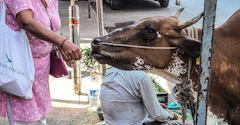
Two of the entrances to the market hall are surmounted by lovely bas-reliefs, which were created by Rudyard Kipling”s father John Lockwood Kipling (1837-1911). The building was the first in India to be lit by electricity. This was added in 1882. There is a noteworthy Gothic revival drinking fountain in the market hall. This was gifted by Cowasji Jehangir. Many cats and kittens were running around its base. No doubt at night, they threaten the rodents that might be lurking around the market. During the day, they are given tidbits by the market traders.
The market is mainly for food and household goods. When driving past it on the nearby JJ Flyover, there is usually a whiff of fish emanating from it. However, within the market, this is not noticeable.
Amongst the numerous vegetable stalls, we noticed a few selling typical European products such as lollo rosso lettuce, fresh basil leaves, and other herbs associated more with European cuisine than Indian. At one of these stalls, we spotted Chinese cabbage and pak choi. The stalls selling these described themselves as purveyors of “exotic” or “English” vegetables.
A visit to Crawford Market is always worthwhile. You are likely to be approached by porters who will offer to follow you around whilst you shop. They will carry your shopping in cylindrical baskets, which they balance on their heads. As we were ‘just looking’, we did not take up their offers.
AIR TRAVELLERS CAN FLY to the former Kingdom of Kutch (Kachchh), now part of Gujarat, by two routes. There is a scheduled flight between Ahmedabad and Bhuj, and another between Mumbai and Kandla, whose airport is close to Anjar.
Kandla, was developed as a seaport on the early 1950s at the instigation of a member of the by then former royal family of Kutch. It lies on the coast of Kutch southeast of Karachi, a port that was incorporated into Pakistan in 1947, and northwest of Mumbai. It is now the largest port in India when measured by the volume of cargo handled there.
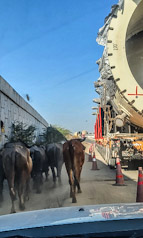
Cattle on the road
From Mandvi to Kandla Airport is 95 Km by road. We set off from Mandvi three hours before our flight to Mumbai was due to depart from Kandla. Our hosts, who use the airport frequently, told us that on average the road journey is 1 ½ hours. For the first hour of our journey, the highway was almost devoid of traffic. Along the way, we frequently switched lanes because heavy vehicles often move slowly along the outside lane without giving way to faster vehicles. We wove our way between slower vehicles, constantly overtaking and ‘undertaking’. Then after speeding along steadily, we headed towards a static queue of heavy lorries.
QuIck as a flash, our driver made a three point turn and we drove in the opposite direction tobthe rest of the traffic until we reached a gap in the central divider of the dual carriageway. We were not alone in making this manoeuvre. There were even some of the heavy goods vehicles making cumbersome manoeuvres to head away from the traffic jam. We continued our journey on the wrong side of the divider until we reached a turn off that allowed us to go under the highway and back into the correct lane.
Soon, we encountered another jam. A transporter carrying a tank as wide as one side of the motorway was inching its way onto the main road. Our driver took us off the road onto a dirt track, but this was also blocked. Another u-turn and we drove beneath the highway to a narrow, poorly tarmacced road that ran parallel to the highway. This led to a bridge beneath the main thoroughfare to reach another narrow lane that ran alongside the part of the highway running towards Kandla.
This lane offered other obstructions including large trucks and a herd of slow moving cattle. We squeezed past them and eventually rejoined the highway.
Meanwhile, the time was ticking away, and we wondered whether we would miss our flight. My spirits rose when we turned off the highway and on to a road leading to the airport. Soon, my hopes were dashed. We encountered yet another jam. However, our skilful driver managed weave his way between them. Soon, we arrived in front of the tiny airport terminal building.
Kandla Airport is primarily a military air base. Passengers use it for the one flight a day to and from Mumbai. When we disembarked there a few years ago, we walked from the aircraft to a shelter, where passengers’ check-in baggage was ready to be retrieved.
The check-in and security check is carried out in a part of a small room, the rest of which is part of the departure lounge (with a snacks stall). This hall leads to another room with seating. It is here that the departure gate is located. This simple departure lounge reminded me of Venice’s Marco Polo Airport as it was in the early 1960s.
We boarded the Spicejet two engined propellor plane after walking across the apron. The aircraft (a Q400 made by the Bombadier Company) has its own retractable staircase that we used to enter and later leave the ‘plane. After an uneventful flight lasting 1 hour and 15 minutes, we disembarked at Mumbai.
We were lucky only to have arrived a few minutes later than the scheduled time. Only three days earlier, my wife’ cousin’s flight from Mumbai to Kandla was delayed by almost 5 hours because of a technical problem discovered on the ‘plane minutes before it was due to take off. We were also fortunate because our quick-witted driver skilfully reduced the time spent stuck at significantly awful traffic jams.
NAGPADA JUNCTION IS one kilometre east of Mumbai Central Station. There are several interesting memorials located around this place where six busy roads meet. Each of them commemorates someone of the Islamic faith.
One memorial, a large rectangular bas-relief, is dedicated to the great poet Mirza Ghalib (1797-1869).
Dominating the junction is a tall flagpole from which India’s flag flutters. The base of this includes a large curved bas-relief in grey stone. The base has carvings of several important Indian freedom fighters including Mahatma Gandhi. There are also scenes of these leaders behind bars and other Indians being attacked by Britishers. The words “Quit India” can also be seen in several languages. The Quit India movement was one of many attempts to get the British to leave the huge country they ruled until 1947.
This monument and its flagpole are mainly dedicated to the memory of Maulana Abul Kalam Azad (1888-1958). In brief, he was all of the following and much more: an Indian independence activist, Islamic theologian, writer and a senior member of the Indian National Congress. Between 1947 and 1958, he was independent India’s first Minister of Education.
Lesser known than Ghalib and the Maulana, but also commemorated at Nagpada Junction is the freedom fighter Maulana Fazlul Hasan Hazrat Mohani (1875-1951). This celebrated writer of poetry in the Urdu language is best known for a slogan he created in 1921: “Inquilab zindabad”, which means “Long live the revolution”. He is also credited as being one of the first Indians to demand complete independence for India, rather than increases in the degree of the country’s autonomy whilst remaining part of the British Empire.
At first a member of The Indian National Congress, Hasan Hazrat later joined the Communist Party. He was against the Partition of India and would have preferred that India had become a confederation of states such as was the case in the USSR.
Nagpada Junction is both rich in traffic and memorials to notable Muslim men. One more memorial and a street name commemorate another Muslim, Sofia Zuber (Zubair), at this meeting place of busy. thoroughfares. She was an education superintendent for Urdu affiliated to a civic body and later a corporator from Nagpada. The short road named after her used to be a meeting place for Urdu authors and journalists.
I would not have written about this interesting traffic junction had I not noticed the Maulana Abul Kalam monument as we sped past it in a yellow and black taxi. Curious about it, we returned later and had a look around, and then ate good kebabs in the Sagar restaurant beside the junction.
BETWEEN A ZOROASTRIAN (Parsi) well and Churchgate railway station, both in central Mumbai, there stands a wonderful steel sculpture, which was financed by the Tata company (named after its Parsi founder).
The sculpture, completed in 2011, is the creation of the architect Nuru Karim and colleagues. Consisting of two closely placed spirals, it rises to a height of 11 metres. The spirals are formed using a set of triangular frames made of a type of Tata steel alloy.
The sculpture is named ‘Charkha’, which means ‘spinning wheel’, and refers to the spinning wheel which Mahatma Gandhi encouraged his followers to use to help make India self-sufficient and less dependent on British imported textiles. Each of the triangles are unique. Combined together in this sculpture, they are supposed to portray unity within diversity, and India’s rich mix of diverse cultures. In other words, the artwork is expressing the idea or hoped-for ideal that although a rich mix of different people, India is one united country.
Whether or not India has achieved this ideal, this sculpture is both aesthetically pleasing and a welcome addition to Mumbai’s incredibly rich mix of visual delights.
THE RAILWAY LINE between Bombay(Mumbai) and Thane was opened in 1853. Byculla Station was one of its original stations when trains began running along this stretch of track. At first a wooden building, it was soon replaced by the present stone structure, which was ready for use in 1857. This historic station, the oldest surviving railway station in India. was beautifully restored recently.
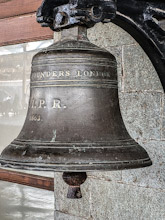
On platform 1, I spotted an old bell hanging close to one of the station’s offices. It is marked with the initials “GIPR”and the date 1863. The letters are the initials of the Great Indian Peninsula Railway company, which was incorporated in 1849. In contract with the British East India Company, its aim was to link the British Presidencies by rail. The first stretch to be built was that between Bombay and Thane.
The bell carries the name of its manufacture – “Mears & Co. Founders London”. This bell foundry, first established in the 16th century, moved to London’s Whitechapel Road in the very early 18th century. It was where one of the largest bells in St Paul’s Cathedral was made. The Mears family ran the foundry between 1784 until 1873.
The foundry ceased working in 2017. The bell at Byculla Station has by now long outlived the bell foundry in Whitechapel and the British Empire, during whose existence it was manufactured.





 yamey
yamey 