A small hamlet in Kent with many memories

GODDEN GREEN IS a tiny hamlet next to Knole Park, close to Sevenoaks in Kent. There is not much to the place, but it has a special place in my heart, and seeing the place, or even thinking about it, makes me nostalgic. You can discover why by reading my book “AN ALPHABETICAL TOUR OF ENGLAND”. The book and Kindle are available from Amazon https://www.amazon.co.uk/gp/aw/d/B0FVV6JLZ7/

A coffee house in the Indian city of Bangalore (Bengaluru)

GOING THROUGH SOME old photographs today, I came across a few taken in the India Coffee House that used to be on Bangalore’s MG Road. Here is what I wrote about the place in my book “Coracles and Crocodiles: 101 Tales of India”:

When I first visited Bangalore in 1994, there was a coffee house on Mahatma Gandhi (‘MG’) Road close to the now derelict Srungar Shopping Complex. This venerable, popular ‘hole in the wall’ was a branch of the Indian Coffee House (‘ICH’) chain. In both appearance and atmosphere, it reminded me of some of the older coffee houses I had seen Belgrade and Sarajevo in Yugoslavia (when it still existed).

At the ICH, customers sat at old wooden tables on wooden benches with hard, upright backrests. Old Coffee Board (‘ICB’) posters hung on the walls. The waiters were dressed in white jackets and trousers held up by extremely wide red and gold belts – like cummerbunds – with huge metal buckles that bore the logo of the ICB. These gentlemen wore white turbans with red and gold ribbons on their heads. In addition to (in my humble opinion) rather average quality, but low-priced South Indian filter coffee, a variety of snacks and cold drinks were also on the menu.

During the British occupation of India, admission to most coffee houses was restricted to European clients. In the late 1890s, the idea of establishing an ICH chain of coffee houses for Indian customers began to be considered. In 1936, the ICB opened the first ICH in Bombay’s Churchgate area. By the 1940s, there were at least 50 branches all over what was then British India. In the mid-1950s, the ICHs were closed by the Coffee Board. The Communist leader AK Gopalan (1904-1977) and the Coffee Board workers managed to get the Board to hand over the ICH outlets to them, and they formed a series of Indian Coffee Workers’ Co-operatives. The cooperative in Bangalore was formed in August 1957. There are now several branches in the city. The MG Road branch, which opened in 1959, closed in 2009 … “

DISCOVER more about this and many other things I have experienced in India by reading my book, which is available from Amazon:

https://www.amazon.co.uk/CORACLES…/dp/B0DJZ6DMYB

As experiences of India gradually become memories

THE BOEING JET began moving away from the oddly designed new terminal at Bangalore’s International Airport. I watched the landscape slipping past ever more quickly as we accelerated along the runway before eventually becoming detached from the soil of India. As the aeroplane rose higher and higher, random things flashed through my mind such as: eating laal maas on a rooftop in Jaisalmer; a Dutch cemetery on the coromandel Coast; hawkers wandering up and down a railway carriage in West Bengal; riding through Bangalore in a Jesus autorickshaw; being asked to bless strangers, a newly married couple, in a church in Pondicherry; tasting nolen gur in Murshidabad; attending an aarti on the Ganges; and much more. After flying over the west coast of India, all of these experiences and a whole host of others that we had enjoyed during our 88 day stay in India became, like the coastline we crossed, distant memories, which I hope will remaine etched permanently in my mind.

Blades and flames and other hazards in the kitchen

WHILE PREPARING A SAUCE for pasta today, my mind shot back to my mother in the kitchen during my childhood. Many people regarded her as being a competent cook. She was an enthusiastic follower of the recipes in cookbooks by Elizabeth David.  She bought only the best cooking utensils, and sourced many ingredients in the Mediterranean food stores that used to exist in Soho – a few remain, but many have gone. As a child, I was allowed in the kitchen to watch when my mother was cooking. The more I saw, the greater my desire to try to cook. However, this wish was not to be fulfilled while my mother was alive.

My birth and the first few months of my life were difficult as far as health was concerned. Consequently, my mother was highly protective of me, and then later also of my sibling. My mother saw danger everywhere, and not least in the kitchen. There were sharp knives, razor like tin can lids, and the risk of getting burnt either by the oven or the hot things prepared on it. We had electric hob rings because my mother was anxious about gas explosions and open flames. I was allowed to watch her cooking, but not to touch anything she was using. Curiously, even though knives were involved, I was often asked to wash the dishes, cutlery, and cooking utensils.

Sadly, my mother died at a young age. I was 28 when she went, and still residing in the family home along with my father, who had no interest in cooking. He enjoyed good food, but would have no part in preparing it. With my mother no longer around and a well-equipped kitchen, I began to experiment with cooking, and enjoyed the activity.

Over the years, I have done much cooking, and still enjoy doing it. I am not sure what made me think of my mother today as I prepared the pasta sauce, but it might have been the pan in which I was making it. For, that pan was one that my mother used often. She must have bought it back in the 1960s, and because she purchased only the best, it is still perfectly usable much more than 50 years later.

My wife is a good cook, but I do most of the day-to-day cooking. When she told a friend of ours that I do most of the cooking, the friend asked my wife:

“Don’t you feel diminished as a woman if Adam does most of the cooking?”

My wife, who is quite happy with the arrangement, replied with another question:

“Do I look like an idiot?”

Sometime later when our daughter was a toddler, she and my wife visited some friends. After a few minutes, our little one, used to seeing me cooking, came running out of the kitchen with wide open eyes, and said to my wife:

“Do you know, Mama, but the Mummy is doing the cooking in this house.”

My wife answered:

“Well, I never…”

A walk in the sunshine on a Saturday morning in north London

AFTER DAYS OF GREY skies, the sun shone without pauses today (the 30th of March 2024). This was lucky because come rain or shine, we had decided to walk south from Primrose Hill through Regents Park to Marylebone Road. Much of the way we passed places with fond memories for us. The first of these was Chalk Farm Underground station. It was near here that my wife used to live in a flat on Fellowes Road long before we married.

From the station, we walked across a graffiti-covered iron bridge that crosses the mainline railway tracks from Euston. This brought us to the eastern end of Regents Park Road (‘RPR’). Lined with shops and eateries, this curving road is where we met with our friends frequently. One of our favourite places was Lemonia – a Greek restaurant. When it first opened, it was on the south side of the road. Now, it occupies larger premises on the north side of RPR. After having coffee at Roni’s, an Israeli café that did not exist in the 1980s when we often visited the area, we walked towards the base of Primrose Hill. Today, being the Easter weekend, the road was far less busy than it is on other weekends.

Looking down from Primrose Hill

Fortified with coffee and a croissant, we ascended the steep path leading from opposite the house where Friedrich Engels once lived to the summit of Primrose Hill, which had attracted a crowd of people who had come out to enjoy the sun and the magnificent view of London to the south of the hill. While we were descending the hill towards Regents Park, a young lady, who was ascending the hill with her husband and two children, greeted us. I did not recognise her as I had not seen her for 21 years, and (then only briefly) when she was a young teenager. She is the daughter of one of my cousins, and the great-great granddaughter of my ancestor Franz Ginsberg, who was a Senator in the parliament of South Africa between the two world wars.

After reaching the bottom of Primrose Hill, we crossed Prince Albert Road, and then walked over a bridge that traverses the Regents Canal. At the south end of the bridge, we passed some enclosures (containing what looked like large wild boars or warthogs) of the London Zoo.  Then, we walked along a straight path between grassy playing fields – not particularly scenic. In the distance we could see the minaret of the Regents Park Mosque and the domes on the roof of the London Business School, where my wife studied. Eventually we reached a more attractive area close to the eastern edge of the Boating Lake, over which we crossed on a bridge. Soon, we arrived at the circular road, appropriately named the Inner Circle. It seemed to being used as an unofficial racetrack for cyclists on expensive looking bicycles. Having safely crossing the road without being hit by a cyclist, we entered the round heart of Regents Park, which contains the famous Queen Marys Rose Garden.

We took refreshments at the strange-looking Regent’s Bar & Kitchen. In plan, it is a collection of identical adjacent hexagons. The roofs of some of these have sharp conical pinnacles. From there we passed beds of rose plants. All of the roses were without flowers, A small wooden bridge crosses a stretch of water – part of a larger pond – to reach the attractive Japanese Garden Island from which you can see a man-made rocky waterfall designed as it would be in gardens in Japan.

After wandering around the Japanese garden, we headed towards the Inner Circle, which we crossed before walking south along a road called York Bridge because it crosses a body of water by means of of a similarly named Bridge. Before reaching the bridge, we passed the buildings of Regent’s University. These used to house a part of the University of London – Bedford College. Founded in 1849, it was for the higher education of women. From 1878 onwards, women studying there were awarded degrees by the University of London. In 1984, after Bedford College had merged with Royal Holloway College, its premises in Regents Park became the home of Regent’s University, which is not affiliated to the University of London. Interestingly, the wrought iron gates to Regent’s University’s grounds still bear the crests of its predecessor – Bedford College. In the 1920s, my wife’s maternal grandmother, Benabai Bhatia, who had come from India with her husband Haridas, who was studying for an FRCS, studied at Bedford College. On her return to India and after she was widowed at a young age, she became a superintendent of schools in Bombay.

After crossing York Bridge, we soon reached Marylebone Road, having had a thoroughly enjoyable walk.

Memories of Gujarat (India) at a park in north London’s Golders Green

GOLDERS HILL PARK lies halfway between Golders Green and Hampstead – both in north London. It occupies what used to be the extensive grounds of a former country house that was built in the 18th century and destroyed during WW2 (in 1940). Its fine landscaping was influenced by the great garden designer Humphry Repton (1752-1818). I have been visiting the park since my early childhood in the 1950s, when, if I remember correctly, my parents used to play tennis on the still existing tennis courts. The park has many attractions including a pond with an attractive stone bridge; a walled garden; many fine old trees; plenty of shrubs and flowers; a bandstand, which was certainly in use during my childhood; a good café-cum-restaurant; a wooded area; a stumpery; a deer enclosure; and a small zoo. The deer enclosure and the zoo were in existence when I was a young child. Today’s visitors can watch the deer and view animals such as wallabies; ring tailed lemurs; at least one kookaburra; donkeys; and a variety of exotic birds. The pond mentioned above is often visited by ducks.

Today (the 3rd of March 2024), we visited the park on a crisp, cold, sunny morning. The dew-covered lawns were full of blooming crocuses, and some of the bushes had burst into flower. Most of the trees, being deciduous, were devoid of leaves. By chance, I looked up at one of these leafless trees and saw a children’s kite caught up in its branches. Seeing this, my thoughts shifted 5000 miles from Golders Hill to Gujarat (in western India).

Wherever you go in Gujarat, you are likely to see kites caught up in the branches of trees. Unlike the kite I saw today, those in Gujarat are not the toys of small children, but part of a festival celebrated once a year, The Hindu festival, which celebrates the increase of day length a month after the winter solstice is known as ‘Uttarayan’ in Gujarat. The occasion is celebrated by kite flying. During this period of kite flying, riders of bicycles, motorcycles, and other two-wheelers face a real but, to the outsider, unusual hazard that could result in serious injury, if not death. I have described this festival and its hazards in some detail in my anthology of 101 vignettes of life and travel in India –“The Hitler Lock and Other Tales of India”.

Seeing the kite in Golders Hill Park reminded me of what I have seen in Gujarat during my several visits to that Indian state. However, although this year Uttarayan began on the 15th of January – not so long ago – I find it hard to believe that the kite I saw in the park was stranded in the tree during celebration of that festival.

[The book (& Kindle) is available from Amazon:

Trains, buses, and Bar Linda in London’s Golders Green

MUCH HAS CHANGED IN Golders Green since I was a small child in the 1950s. However, a few things have remained more or less the same. My earliest memories of Golders Green Underground station and its neighbouring open-air bus terminus date back to about 1960, when I began travelling by bus to school in Swiss Cottage.

The Underground station used to have two entrances. One, which faces the bus yard, is still in use. The other, which was approached by a long, covered walkway from beneath the bridge crossing Finchley Road, was closed to the public many years ago, but the passageway still exists. It was this entrance that my family used when using the train to travel into central London. There was also a covered staircase situated between these two entrances – this, now disused, was opened during rush hours. It led to the small parking area where the H2 bus, which serves Hampstead Garden Suburb, begins its journey. During my childhood, there was no public transport in the Suburb. Every day, I used to make the 10-minute walk to Golders Green station, passing the crematorium and the Jewish cemetery on my way.

Overlooking the eastern edge of the bus yard, is what was once the Hippodrome Theatre. When I was a lad, this was a flourishing theatre showing plays and pantomimes. Later, it was taken over by the BBC. After they left it, various religious organisations have used it for their meetings. Built in 1913, six years after the Underground was extended from Hampstead to Golders Green, this building’s exterior looks much as it did when I first remember seeing it.

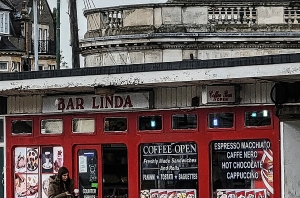
The western edge of the bus yard has always been lined with a row of single storey sheds. Most of these have been used as shops and offices for London Transport. One of them houses a small café called Bar Linda. This was not in existence when I first used to visit the station, but I believe that it opened in the 1960s. Although this friendly little place has been serving customers for many decades, the first time I ventured inside it was in about 2017 when I was about to walk around Golders Green to take photographs for a blog article I was planning to write. I have re-visited it several times since then.

Although Golders Green might not be as aesthetically pleasing as its neighbours, Hampstead and Hampstead Garden Suburb, it is an area full of interest. Much has happened there since 1907 when it began growing from a rural hamlet into a leafy suburb. You can discover much more about Golders Green – its past, my memories of it, and its vibrant present – by reading my book “GOLDERS GREEN & HAMPSTEAD GARDEN SUBURB: VISIONS OF ARCADIA”, which is available (paperback and/or Kindle, from Amazon websites, such as:

Having lunch with my father at the White House

AFTER MY MOTHER DIED in 1980, I began practising dentistry in Kent. Almost every weekend, I used to spend Saturday nights at my father’s house in Hampstead Garden Suburb. We used to have Sunday lunch together in one of his several favourite restaurants in Golders Green and Hampstead. Many of these restaurants no longer exist.

There were a few Chinese restaurants, which my father liked, in the Golders Green area. One of them was in Temple Fortune near the branch of Waitrose, which has been in existence since I was a child in the 1960s. The Chinese restaurant, which served a wonderful hors d’oeuvre that included a scallop in its shell, has long since closed.

In Golders Green Road, there were two more Chinese restaurants, both now gone. In one of them, my father was always greeted by the friendly manager (or, maybe he was the owner) with the words:

“Hallo Professor. How are you, professor?”

The food was well-prepared and tasty in both of them, just as it was in the Temple Fortune eatery.

Almost opposite the Hippodrome theatre, on the corner of North End Road and West Heath Drive, there was an Italian restaurant. Here, my father and I always received a warm welcome and enjoyed reasonably good Italian food. Currently, the site is occupied by a Turkish restaurant, which I have not yet tried.

Some weekends, we travelled up to Hampstead village. One of the two restaurants we visited occasionally was La Cage imaginaire, which still exists at its original location at the lower end of Back Lane, where it meets Flask Walk. Back in the 1980s, this place served classic French cuisine prepared to a high standard. I remember the cheese trolly which was richly supplied with ripe French cheeses. We revisited the place in about 2021 for ‘old times sake’. The management had changed and the food was nothing to write home about.

Today, the 3rd of November 2023, we ate at Mani’s in Hampstead’s Perrins Court. It was our third visit there, and the quality of the food in this busy eatery is highly satisfactory. Near the corner of Perrins Court and Hampstead High Street, there stands the Villa Bianca (‘white house’). This Italian restaurant must have first opened its doors to customers sometime in the 1980s. Never cheap, this restaurant was one of my father’s favourites in northwest London. Being a regular diner there, he was always welcomed like an old friend. Unlike many of the places where my father and I ate Sunday lunches in the 1980s and early 1990s, The Villa Bianca still exists, and is popular. Today, I looked at the menu. Although not suitable for those on a tight budget, many of the dishes did not seem much more costly than those served in far less fancy looking establishments.

DISCOVER MUCH MORE ABOUT HAMPSTEAD BY READING MY BOOK AVAILABLE FROM AMAZON, e.g., :https://www.amazon.co.uk/BENEATH-WIDE-SKY-HAMPSTEAD-ENVIRONS/dp/B09R2WRK92/

An old survivor in Hampstead

MUCH HAS CHANGED in Hampstead since I used to visit it every weekend during the early 1960s. The same is true for many places in London.

The Pimpernel on Heath Street, where my parents enjoyed espresso coffees, has long since closed. Likewise, my parents’ favourite Cellier du Midi in Church Row. Tragically, the High Hill Bookshop on the High Street disappeared many years ago, only to be replaced by yet another branch of Waterstones.

The venerable Everyman Cinema still functions, but now it is far more plush than it used to be when I was a lad. Of Hampstead’s many second-hand bookshops, only one, Keith Fawkes, remains. However, only recently I spotted Mr Fawkes sitting outside his shop, which has now been rebranded as ‘House Clearance Specialists’.

Another remnant of the Hampstead of my childhood is the Shahbhag Indian restaurant on Rosslyn Hill. Founded in 1954, my parents patronised it occasionally during the 1960s. I ate there once or twice in the late 1960s, but not since. By the 1970s, I had Indian friends, who introduced me to restaurants where the Indian food was far more authauthentic was offered at the Shahbhag. Unfortunately, many of these better eateries, many of which were on or near Warren, no longer exist.

During a recent stroll through Hampstead, I noticed that the Shahbhag was still in business. Seeing this sparked off the memories I have just described.

Introducing my NEW BOOK ABOUT MY TRAVELS IN INDIA

SOME SOUVENIRS FROM MY VISITS TO INDIA DURING THE PAST 30 YEARS

 —  A new book with a curious title  —

True love drew me to India. Since my first trip there in late 1993, I have visited the country more than fifty times.

After I married Lopa in London in October 1993, we travelled to her native land, India, a few weeks later. From the moment I first landed on Indian soil, my eyes opened wide with amazement, and ever since then, India has filled me with a delightful sense of wonder. 

You might be curious about the book’s title. This relates to a chance one-off sighting (in the 1990s) of a padlock made by an Indian company with the same name as that of Germany’s former Führer. From that day onward, whenever I have been in India and seen a shop or market stall selling locks, I have always looked to see whether any of this company’s locks are on sale.

To discover some of the many things that endear me to India and whether I ever managed to find one of these curiously named locks, you need to read my new book. Illustrated with my photographs, it contains over one hundred short prose vignettes, which can be enjoyed by both those who are familiar with the country and those who are not.

Paperback: https://www.amazon.co.uk/HITLER-LOCK-OTHER-TALES-INDIA/dp/B0CFM5JNX5/

Kindle: https://www.amazon.co.uk/HITLER-LOCK-OTHER-TALES-INDIA-ebook/dp/B0CG3DX1LP/