Do not let this drama deter you from eating meat

THE PARK THEATRE in London’s Finsbury Park was opened in 2013. We have seen many productions there and they have all been good to excellent. “The Meat Kings! (Inc.) of Brooklyn Heights”, written by Hannah Doran, is showing until 29 November 2025, is no exception, as we discovered after watching it last night (1 November 2025). A word of warning is owed to vegetarians and vegans: the play is set in the meat cutting room of a family butcher’s shop somewhere in New York City. But do not let this deter you because the main points of the play are not about carving and slicing meat.

In the play, Paula Caffarelli is the owner of Cafarelli & Sons. Her great grandfather, an immigrant from Sicily, founded the firm 100 years ago. She tends to hire people released from prison to work in her cutting room. Three of her employees are ex-convicts and the fourth is an immigrant from Mexico. One of the ex-prisoners, Billy (acted brilliantly by Ash Hunter), must earn to pay his mother’s exorbitant medical fees. David, who used to make a fortune on Wall Street but has fallen on hard times, Is Paula’s senior meat cutter. JD is the Mexican. During the play, Paula takes on a new cutter, T, also recently released from prison. At the beginning of the play, Paula’s staff fool around and take life easily. However, it is not long before Paula’s business begins to suffer economically, and her staff members reveal their personal problems. Things reach a stage where Paula needs to reduce the number of her staff, and some of her cutters begin plotting against the others.

This well-acted, superb play is both entertaining and disturbing, but never uninteresting. As the theatre’s website explained, the play:

“… carves into the dark underbelly of America’s anti-immigration policies and the brutal sacrifices that drive the pursuit of prosperity.”

It adds a note of warning:

This production contains butchery; references to prison, suicide and illness; discussions of racism & xenophobia. Also contains strong language and references of a sexual nature. Please note, this production does not use real meat.”

The play comes to a tragic end as the characters, to use an appropriate phrase, knife each other in the back. I enjoyed the play, and believe that seeing it would not disturb those who avoid eating meat. However, it might put you off crossing the Atlantic from east to west.
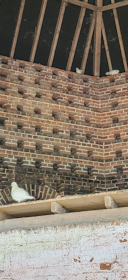
Pigeon feed at a garden in Norfolk

PIGEON FEED IN A GARDEN IN NORFOLK


ALL OVER GUJARAT in western India, where many people are vegetarian,  there are dovecotes in a wide range of designs and sizes. These shelters for the birds are to ensure their wellbeing.


In the walled garden at Felbrigg Hall in Norfolk, there is a dovecote,  which was constructed in about 1745. Within it there are 968 recessed compartments, each of which is large enough for two dove’s nests.  Cosy as this might sound, the dovecote was built for a reason that would upset vegetarians.


In the eighteenth century,  fresh meat was in very short supply during the winter months.  The doves, who nested in the dovecote in large numbers provided an endless source of fresh meat for the residents and their guests at Felbrigg Hall. And the birds’ droppings provided a source of nitrogen rich manure.


The dovecote at Felbrigg Hall was beautifully restored in 1923, and is well-maintained by the National Trust,  which owns the property. White doves still make use of the dovecote,  but, as far as I  know, do not end up on people’s dinner plates.

A DISH OF RICE AND MEAT IN HYDERABAD AND ELSEWHERE

HYDERABAD IS FAMOUS for its biryanis. One restaurant that is well-known and highly rated is Shadab, which is not far from the Char Minar in the centre of the old city. We have visited it on previous visits to Hyderabad and thought highly of its biryanis. Today, in late January 2025, we ate a mutton biryani. It was certainly very good, but not nearly as excellent as one we ate in Surat last year and another we ate at Berhampore (West Bengal) a few days ago. However, the best biryani I have eaten to date was a Moplah style biryani served at Paragon in Calicut (Kerala). Blending Arabic and Keralan flavours, this biryani, which we ate more than 20 years ago, was memorably fragrant and tasty: a symphony of flavours.

Sell the wife at Smithfield instead of divorcing her

IF YOU WISH to see the meat market at London’s Smithfield in action, either you must go to bed very late or wake up quite early, because the market is only open between 2 am and 10 am. This April, we visited it at about 1.30 in the afternoon, and there was little to see and there was hardly any odour in the air.

Back in October 2017, I walked from Clerkenwell to Smithfield, and wrote about it in a blog I published (https://londonadam.travellerspoint.com/44/). Here is what I wrote about the meat market:

At Peters Lane, Cowcross street turns southward towards to meet St Johns Street, which commences at the north side of Smithfield Market, an indoor wholesale meat marketplace. Smithfield’s central Grand Avenue is entered through an archway flanked by two heraldic dragons and a pair of stone sculptures. The Avenue runs beneath a high roof supported by ornate painted ironwork arches. Side aisles are lined with the meat dealers’ stalls and glass-covered display cabinets. In 1852, London’s livestock market was moved from Smithfield to Copenhagen Fields in Islington (off Caledonian Road, where the Caledonian Park is now located). This cleared the area for the construction of the present meat market, which was completed by 1868. Constructed in an era before refrigerators were used, the market was designed to keep out the sun and to take advantages of prevailing breezes.

I continued as follows:

In mediaeval times, Smithfield had a bad reputation. It was known for criminal activity, violence, and public executions. In the early 19th century, when obtaining divorce was difficult, men brought their unwanted wives to Smithfield to sell them, then a legal way of ending a marriage (see: “Meat, Commerce and the City: The London Food Market, 1800–1855”, by RS Metcalfe, publ. 2015).

In relation to disposing of a spouse, I quoted the following verse by an unknown author quoted in “Modern Street Ballads”, by John Ashton (published 1888):

“He married Jane Carter,

No damsel look’d smarter;

But he caught a tartar,

John Hobbs, John Hobbs;

Yes, he caught a tartar, John Hobbs.

He tied a rope to her, John Hobbs, John Hobbs;

He tied a rope to her, John Hobbs!

To ‘scape from hot water,

To Smithfield he brought her;

But nobody bought her …”

What I did not mention in my 2017 piece is that John Ashton noted in his book:

Wives at the market did not fetch good prices; the highest I know of, is recorded in The Times, September 19, 1797: “An hostler’s wife, in the country, lately fetched twenty-five guineas.” But this was extravagance, as, with the exception of a man who exchanged his wife for an ox, which he sold for six guineas, the next highest quotation is three and a half guineas; but this rapidly dwindled down to shillings, and even pence. In 1881, a wife was sold at Sheffield for a quart of beer; in 1862, another was purchased at Selby Market Cross for a pint; and the South Wales Daily News, May 2, 1882, tells us that one was parted with for a glass of ale. Sometimes they were unsaleable …”

Fascinating, but horrific when you think about it. In any case, you will be pleased to know that although I visited Smithfield with my wife a few days ago, I had no intention of selling her! Instead, we enjoyed some liquid refreshment in the nearby branch of the Pret A Manger café chain.

Biryani in Bangalore, Calicut, and Surat

SO FAR – THAT is since January 1994, the very best biryani I have eaten was at Paragon in Calicut (Kerala) in 2006. It was a Moplah recipe – Arabic and Indian flavours combined most harmoniously. Last December, I enjoyed an almost as good biryani in the restaurant of the Sifat International Hotel in Surat (Gujarat).

Biryani at Bheema’s

When in Bangalore, where we find ourselves often, we like to visit Bheema’s restaurant on Church Street. It serves Andhra-style cuisine. I have never been disappointed with the biryani dishes served there. Although not as supremely superb as the two biryanis I have mentioned already, Bheema’s delicious biryanis are way above average – in my humble opinion.

A Turkish delight in London’s Dalston

KINGSLAND ROAD AND nearby in London’s Dalston area is rich in restaurants and other eateries serving Turkish food. Early in this century, “Time Out” magazine rated the Mangal Ocakbasi (now called ‘Mangal 1’) restaurant at number 10 Arcola Street as being one of London’s best Turkish restaurants. For those who do not know, ‘ocakbasi’ means ‘fireside’ and ‘mangal’ means ‘barbecue’ or ‘grill’. When we first went to Mangal, and for many years after that, there were tables alongside the long rectangular pit filled hot charcoal, upon which meat and vegetables are grilled. Recently, the restaurant has been redesigned and the grilling area is no longer alongside the tables.

Lokma

The meat served is top quality. It seems far better than that served in the many other Turkish restaurants we have tried in London. Although there is a wide variety of main courses on offer, the range of ‘starter’ dishes on the menu is not as great as at some other restaurants. If it is starters and meze that you are after, the nearby Umut 2000 (on Crossway) is worth visiting. However, their main meat dishes are not nearly as tasty as those at Mangal in Arcola Street. Having said that, Mangal does serve an excellent freshly grilled aubergine hors d’oeuvre. Desserts are not available, but there are plenty of places along Kingsland Road offering a wide range of very sweet but tasty confectionery.

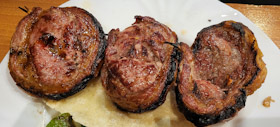
Our favourite dishes at Mangal are lokma, which is grilled rolled fillet of lamb, and yorgutlu Adana, which is pieces of semi-spicy Adana kebab in a yogurt and tomato sauce with lumps of Turkish bread. The lokma and other kebab dishes are served with generous quantities of fresh mixed salad containing many ingredients. As for drinks, you can bring your own alcohol or buy it from the restaurant. If I order a drink apart from water, I always go for Şalgam, which is a purple-coloured drink containing fermented turnip. This has a deliciously sour taste.

We first ate at Mangal in the early 2000s, when we attended a play in which one of my dental patients was acting. The theatre, The Arcola, was across the road from the restaurant, but has now shifted to larger premises on nearby Ashwin Street (close to Dalston Junction station). We loved the food at Mangal from the very first bite. We have been eating there occasionally ever since then, and the quality of the food has never once faltered. We have been there so often that the older members of its staff recognise us, welcome us warmly, and remember what we like eating. Even though this Turkish delight, frequently patronised by the artists Gilbert and George, is far from where we live in Kensington, it is well worth ‘trekking’ across London to get there.

More than meets the eye on the moor

FROM OUTSIDE IT looked like a ‘bog standard’ pub on Dartmoor. The kind of pub in which you would expect to find weary walkers and cyclists, all dressed in appropriate outdoor gear splattered with mud. The sort of place where the customers wear walking boots and thick woolly socks that reach halfway up their calves. An old-fashioned country pub with a roaring open fire. You know the kind of place, quaintly decorated with folks objects such as horse brasses, copper bed pans, Toby jugs and so on. A pub where you would find sandwiches and chips as the only solid fare. However, despite looking like the kind of hostelry just described, The Dartmoor Inn Merrivale is  quite a different ‘kettle of fish’.

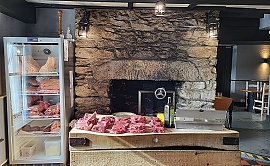
On stepping through its entrance door, the first thing you will notice is a large wooden butcher’s slap piled with raw steaks of various kinds and cuts: sirloin, rumps, chateaubriand, rib eyes, huge tomahawks, and other tasty chunks of meat. Behind this in what was formerly a fire place, there is a sophisticated charcoal grill for cooking these meaty offerings. A chef coats the meat with sprinkling of salt, oil, and herbs before grilling it. 

The pub’s decor is far from traditional.  It is simply decorated in a contemporary style with a few good artworks on the walls. The pub is owned by a local organic farm, which also has shops in Marlborough, Totnes, Tavistock, and London (in Selfridges Food Hall).

For our midday meal, we ordered a Ploughman’s Lunch contains amongst other things excellent cheddar and locally made ham, and a plate of superb barely cooked roast beef. The food could not be faulted. The staff were enthusiastic about food and were very attentive.

The Dartmoor Inn has reasonably priced rooms for overnight stays. We hope to return, spend the night, and sample the excellent looking steaks on offer.

Just as it is unfair to judge a book by its cover, one should not rate a pub by its external appearance.

Foot and mouth

Wales 1 SMALL

Before she died in 2012, we used to make annual visits to a dear friend, whom I had known since my childhood, in South Wales. She used to live in London, but when she retired, she moved to a village in the Brecon Beacons, near the River Usk. We stayed in her cottage but were encouraged to leave her in peace from after breakfast until about four in the afternoon. We did not mind this because there is plenty to explore in the area and often the weather was good at the times of the year that we visited her.

In 2001, disaster hit Wales in the form of a vicious outbreak of foot and mouth disease. In order to prevent its spread, all footpaths and many open spaces were closed to visitors. This and the appalling rain that fell relentlessly during our visit, restricted what we could do while we were allowing our guest a few hours relief from her guests. We drove around the countryside not particularly having much fun.

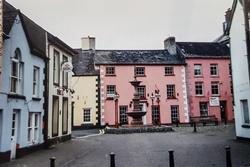
One day, we arrived at a small town with a name I am unable to pronounce correctly:  Llanwrtyd Wells. It was lunch time. We parked outside a hotel near the town centre. The floor of the lobby was covered with a grubby, well-worn carpet. We were shown into an unattractive dining room. Our hopes for having a decent meal fell as we surveyed the room’s dingy uninviting décor. The sight of incessant rain falling outside did little to enhance the dreary mood that this unappealing room was inducing.

The hotel’s owner brought us menus. We asked what he recommended. He said “steaks” and showed us the large range of meats listed in the menu. We asked his advice about which steak to choose. Then, he did something that transformed the dingy place for us.

He gave us a ‘tutorial’ about the relative merits of different kinds of beefsteak and their tastes. The least tasty, in his opinion, was the costliest cut, fillet steak. Sirloin steak was, he advised us, tastier and cheaper than fillet. However, he considered that the tastiest cut was rib-eye. He explained that the latter was marbled with fine streaks of fat, and it was this that gives it its superior taste. We ordered it and discovered he was right. He regretted that he was unable to serve the local, and in his view far superior, Black Mountain beef. This was because of the problems connected with the foot and mouth outbreak.

Whenever I buy steak, I look for rib-eye first, and if this is not available, I go for sirloin. Whenever I think of beefsteak, I always remember that dreary eatery in Llanwrtyd Wells and its helpful landlord. For a long time, I could not remember in which town in Wales, we were given our tutorial about steaks. Recently, I discovered some photographs I had taken there almost twenty years ago. In one of them, there was a pub sign that read “Neuadd Arms Hotel”. Seeing this helped me discover where we had been.

What is in a name

When I was a young child, I used to love eating slices of tongue. It was a cold meat that I really enjoyed. In those days, I never thought about the name of the meat, that is ‘tongue’.

When I was about 10 years old, I put ‘two and two together’ and realised that what I had been eating was once a living animal’s tongue. This realisation put me off eating tongue. I have hardly ever eaten tongue since that discover of what is in its name.

The curious thing is that, with plenty of knowledge of anatomy, I have no difficulties eating, say, liver or pancreas (‘sweetbreads’) or stomach (‘tripe’).

Picture from Wikipedia

Rice and meat

Hyderabad is justifiably renowned for tasty biryani although the very best version of this rice based dish that I have ever eaten was at Paragon in Calicut. There, they serve Moplah biryanis, which are both Arabic and Indian in taste.

The biryani we ate at the Café Bahar in Hyderabad was delicious. It was delicately flavoured and cooked with a light touch. To enter Bahar at lunchtime it is necessary to join a long queue that extends from the top of tje stairs at the doorway to the first floor dining room down on to the busy street outside. It is worth the wait.

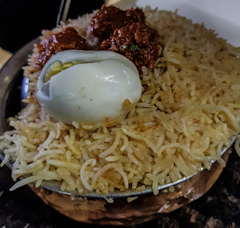
The restaurant itself is very noisy and as busy as London’s Oxford Circus at rush hour. We shared a table with a charming couple, who let us try their ‘double masala’ chicken biryani which is richly laden with extra spices. I preferred the less spicy ‘special lamb biryani’. It is made special by adding hard boiled egg and meatballs made with minced chicken.

One should not visit Hyderabad without eating at least one biryani, but avoid the much advertised Paradise restaurant chain, which is ok but nothing like as good as Bahar or Shadab (near the Charminar)