
The midday sun
Surmounts the sacred mandir
In the town’s market place
NB A mandir is a temple

The midday sun
Surmounts the sacred mandir
In the town’s market place
NB A mandir is a temple
WHILE TRAVELLING AROUND India, I have seen many trees that serve some kind of Hindu religious purpose. Often they are peepul trees, whose leaves are heart-shaped. Frequently, there is some kind of shrine next to the trunk, and often there are fine threads wrapped around the circumference of the trunk.
Near the middle of the market place in 8the Goan town of Mapusa, there is an old tree next to which there are two shrines. The tree’s leaves did not look like those of a peepul tree. What interested me was that at first sight both of the shrines, which resemble small huts, looked similar.

On closer examination, it could be seen that one of the shrines was, as I expected, Hindu, and the other was, to my surprise, Christian.
Whether this close proximity of the two shrines was pure coincidence or related to the fact that the tree provides good shade, I cannot say. Another possible explanation of the closeness might possibly be a symptom of inter-religious tolerance in this small Goan town. Who can say? Whatever the explanation for the closeness of the two shrines, it was heartening to see.

See fruits aplenty
And market fresh veg to browse
The stall overflows
IT WAS EASTER Saturday (2022), the sun was shining, the air was warm, and we paid a visit to the world famous, popular Portobello Road Market. For the first time after over two years of pandemic-induced suppression of London’s ‘joie-de-vivre’, the market was buzzing with activity, crowded with foreign tourists and local visitors. As it was before Covid19, the market was bustling and business at the stalls, which offer everything from artichokes to antiques and pancakes to paella, seemed to be brisk.

A friend, who lives in rural France, said to me a few days ago when we were walking near Leicester Square:
“It’s hard to believe that there was ever a deadly pandemic in this city.”
And as we walked along a short street in the area, he added:
“There are more people out in this street than there are living in my hometown.”
Yet, Covid infection rates are high in the UK. Friends in India have been telling us that they are thinking twice before visiting the UK because the risk of becoming infected here is so great at the moment. Recently, I have heard that approximately between 1 in 12 and 1 and 15 people in the UK are likely to be infected with a Covid19 virus, and therefore capable of spreading it to others.
Apart from personal hygiene and wearing face coverings, good ventilation is considered to be useful for reducing the risk of spreading the viruses. So, when I boarded a bus in South Kensington recently, I opened the window closest to me – each window on London buses has a label saying “Open this window”. Immediately after following this instruction, which has been given for reasons of prevention of infection, the lady sitting behind me, who was not wearing a face covering, stood up and slammed it shut. I stood up, opened it, and told her not to touch it. She said, speaking angrily with an Eastern European accent:
“You don’t need to open it. You are wearing mask and have three vaccinations.”
How she knew my vaccination status, I do not know. My wife said to her:
“Don’t you know that one in twelve are infected?”
To which the lady replied:
“Believe what you like.”
Then to my great surprise, she added:
“Covid is over”
THE BATTLE OF Portobello was fought between the British Navy and the Spanish in November 1739. It was an event during the War of the Austrian Succession. The battle’s aim was to capture the port of Portobello in Panama from the Spanish. The British were victorious.

I have been walking along Portobello Road frequently for over a quarter a century. Each time, I have passed a series of neighbouring shops collectively known as Admiral Vernon Antique Market. I thought it was an odd name until today when I noticed that it is close to an alley called Vernon Yard. Then, the penny dropped, and I began thinking about the choice of the shop’s name – an admiral on Portobello Road.
Admiral Edward Vernon (1684-1757) was born in London. He joined the Royal Navy in 1700, aged 12, and rose through the ranks. One of his many achievements was the creation of the name ‘grog’ for the commonly consumed drink consisting of rum diluted with water. Also, he made improvements to the methods of naval manoeuvres and the welfare of sailors. Another of his claims to fame was that along with Lieutenant-General Thomas Wentworth (c1693–1747) he led the British forces that captured Portobello.
Knowing this makes sense of the name of the antique shop and the name Vernon Yard. The shop and the dreary little alley are not the most magnificent of memorials to Edward Vernon. There is a more elegant one in Westminster Abbey. The most impressive item commemorating the admiral is the estate of Mount Vernon in Virginia (USA), which was once owned by George Washington’s family. It was named after Edward Vernon because one of Washington’s brothers, Lawrence (died 1752), had been under Vernon’s command during the capture of Portobello.
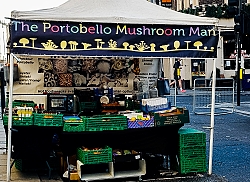
Fungi for sale
They don’t take up much room
But taste good – they really do

WEATHERVANES ATTRACT BOTH wind and my attention. The variety of forms that these wind direction indicators assume is why I enjoy looking at them. A few days ago, whilst crossing London Bridge I spotted a building with two weathervanes on its roof. They are shaped like fish. But they are not alone because the roof is decorated with more metal fish. Their presence is appropriate because between 1875 and 1982, this arcaded edifice next to the river was home to the Billingsgate fish market. Today, the place is used as a venue for gatherings of various sorts.
Writing in 1598, John Stow (c1524-1605) noted that the ward of Billingsgate was named after ‘Belinsgate’. It was then, he wrote:
“… a large water-gate, port, or harborough, for ships and boats, commonly arriving there with fish, both fresh and salt, shell-fishes, salt, oranges, onions, and other fruits and roots, wheat, rye, and grain of divers sorts, for service of the city and parts of this realm adjoining.”
He also mentions that in the reign of Edward III (reigned 1327-1377), Belinsgate was then a much-used place for mooring ships and that these all attracted harbour fees, which depended on their size.
John Timbs (1801-1875), writing in his “Curiosities of London”, published in 1867 provided more of the history of Billingsgate. He wrote that it had been a landing place, if not also a marketplace, since the reign of King Ethelred II (reigned 978-1013). In 1699, an Act of King William III declared that Billingsgate was a market for all kinds of fish, and that it should be close to London Bridge. Timbs recorded:
“The Market, for many years, consisted of a collection of wooden pent-houses, rude sheds, and benches: it commenced at three o’clock AM in summer and five in the winter: in the latter season it was a strange scene, its large flaring oil lamps showing a crowd struggling amidst a Babel din of vulgar tongues, such as rendered “Billingsgate” a byword for low abuse … In Baileys “Dictionary” we have; a Billingsgate, a scolding, impudent slut’”
In 1849, the market was enlarged, making it more spacious and less of a scrum that it had been previously. In 1850, the first Billingsgate market building was ready for use but by 1873, when it was demolished, it was already too small for its purpose. The former market building, which we see today with its rooftop fish ornaments, was designed by the City Architect Horace Jones (1819-1887) and opened for use in 1876. Jones’s most famous building, Tower Bridge, was completed after his death.
After it ceased being used as a fish market, instead of being demolished, the old Billingsgate market was:
“Given an industrial twist by architect Lord Richard Rogers, the building has undergone an amazing transformation, from the 19th century’s largest fish market to London’s premier event space.”
Thanks to that repurposing, we can still enjoy sight of fish on a roof in the heart of the City of London.
NAPOLEON BONAPARTE DIED in captivity on the tiny island of St Helena in the south Atlantic. While he was imprisoned on the island, Lieutenant General Sir Hudson Lowe (1769-1844) was the Governor of St Helena. He was buried at St Mark’s Church in North Audley Street in London’s Mayfair, where a commemorative plaque can be found by the main entrance. St Mark’s was built in the Greek Revival Style in 1825-28, designed by John Peter Gandy (1787-1850). In 1878, the church architect Arthur Blomfield (1829-1899) made considerable alterations to its interior including adding a timber vaulted ceiling over the nave.
During the 1950s and 1960s, the size of St Mark’s congregation diminished significantly. In 1974, the church was made redundant, and this is how it remained until 1994, when the church was used by The Commonwealth Christian Fellowship. It continued to serve this group until 2008. After that, it was used as a venue for occasional events. In about 2019 after a 5 million Pound restoration programme, the church underwent a surprising reincarnation.
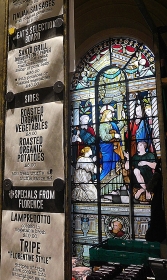
After passing beneath the grand portico supported by two columns topped with ionic capitals, one enters the church’s large vestibule. Since 2019, this has become a marketplace selling upmarket Italian delicatessen goods. Entering the body of the church is rather like taking part in a Fellini film. The floor of the nave is filled with tables and chairs and people drinking and dining. The side aisles, north and south, contain several kitchens, preparing and serving a wide variety of foods, from Turkish to Thai. On the north side of the chancel, just behind the neo-gothic stone pulpit, there is a gin bar, and facing it on the south side of the chancel, there is another bar providing alcoholic refreshments. Look upwards and you can admire the splendid timber roof supports. The wide gallery surrounding the nave at the first-floor level is home to more food stalls, each offering tempting looking fare at not unreasonable prices, especially by local Mayfair standards.
In 2019, the church became home to a branch of Mercato Metropolitano, whose first venture was converting a 150,000 square foot disused railway station in Milan during the 2015 World Expo in that Italian city. The idea of the company was:
“The development of the first Mercato Metropolitano was carefully planned to retain the site’s original appearance, which nurtured the local community’s affection for a special part of their urban history.”
(https://www.mercatometropolitano.com/mmarketplace/#the-mercato-story).
And this is what has been done at the former St Mark’s in Mayfair. Many of the church’s fittings (for example, the tiled floors, the stained glass, the monuments, the pulpit, and the sacred paintings at the east end of the chancel) have been preserved. Entering the church is like entering the scene of a lively gargantuan feast. Seeing the large number of customers on a weekday lunchtime demonstrates that Mercato Metropolitano have successfully created a great place to meet, eat, and drink. It is highly original and exciting, both visually and gastronomically.
In Chapter 21 (verses 12-13) of the Gospel according to Matthew, we learn that:
“…Jesus went into the temple of God, and cast out all them that sold and bought in the temple, and overthrew the tables of the money changers, and the seats of them that sold doves, And said unto them, It is written, My house shall be called the house of prayer; but ye have made it a den of thieves.”
I just cannot help wondering, as many of you might also be doing, what The Good Lord would have made of what can now be seen inside the Church of St Mark’s in Mayfair.
THIS IS AN EXTRACT from my latest book, “Walking West London”, which can be downloaded in its entirety (as a pdf file), free of charge and with no strings attached, from: https://adamyamey.co.uk/walking-west-london/ (just click on the green button, labelled “Download”). The sample below relates to the street market on Portobello Road:
NO LONGER A COUNTRY LANE (PORTOBELLO)

Lovers of street markets, whether they be searching for antiques, bric-abrac, jewellery, telephone covers, clothing, snacks, cafés, flowers, fruit, or vegetables, will enjoy browsing the diverse stalls and small shops that line Portobello Road. This street, which used to be called ‘Portobello Lane’ runs from Notting Hill Gate to just south of the main railway line that begins at Paddington Station. In days gone by, it ran from the gravel pits at Notting Hill Gate to the now long-since demolished Portobello Farm,which stood roughly between Orchard Close and Blagrove Road in NorthKensington.
Before the mid-19th century Portobello Lane, as it was then called, was to quote the historians Florence Gladstone and Ashley Barker (writing in1924):
“‘… one of the most rural and pleasant walks in the summer in the vicinity of London’, and within living memory it led ‘through fields to Kensal Green … cornfields and meadow land on each side … ‘”
Well, Portobello Road is no longer bucolic. It is lined with buildings along its entire length. Currently, it begins with a short section that leads off Pembridge Villas. It is here that you can stop for a drink at the Sun inSplendour pub, which was built in the early 1850s. After running a few yards westwards, Portobello Road heads off in a north-westerly direction, which it maintains with barely any deviation for the rest of its length. Number 22 was the first London home of the writer George Orwell. He lived there as a lodger in the winter of 1927.
After crossing Chepstow Villas, the road slopes downwards and soon after this the market area commences. On most weekdays, much of the market is dedicated to daily domestic needs, mostly food. On Fridays and Saturdays, the number of stalls and the variety of goods on offer increases dramatically. In normal times (i.e., when there is no pandemic), Portobello Road is choked with crowds of people from all over the world, especially on Saturdays.
In the 1860s, the Metropolitan Line (now the ‘Hammersmith and City Line’) was built. It crosses Portobello Road close to the Ladbroke Road station, which was originally known as ‘Notting Hill’ station. Rail access probably accounted for the urban development of what was once ‘Portobello Lane’. The market in Portobello Road probably began operating in the second half of the 19th century. Until the 1940s, it served people’s daily needs. Then, in the 1940s, traders selling anything from junk to antiques began trading along the road, alongside the purveyors of daily requirements, and that has how it has remained.
The architecture of Portobello Road is far from distinguished. Much of it is ‘bog standard’ Victorian suburban sprawl, but this is hardy disturbing as the eye has plenty of other things to distract it along the multicultural, bustling, colourful, sometimes quirky market street.
Next, I will point out several things worth noticing if you can take your eyes off the shops, the buskers, and the stalls in the market. The Electric Cinema on Portobello Road was first opened in 1910, making it one of the oldest still working cinemas in the UK. It was one of the first buildings in the area to receive a supply of electricity. It has an Edwardian façade. Despite having been closed for several short periods during its lifetime, it still shows films. Since its extensive repairs in 2000, it has become a luxurious space in which to watch films. It is near to Talbot Road that leads to the church of All Saints.
The Victorian church was built between 1852 and 1861 …
END OF SAMPLE. If you have enjoyed it, please download a copy of my book to learn more about London west of Park Lane.
MANY MARKET PLACES in English and Scottish towns have what is called a ‘market cross’. These are often elaborate and ornate structures. One definition of such a building is (according to Wikipedia): “… a structure used to mark a market square in market towns”. Some of them include crosses (of the Christian variety), others do not. A market cross can range in design from a simple cross or obelisk to a significant structure, sometimes serving as a covered shelter.
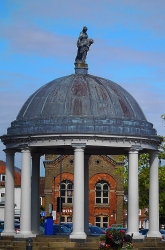
The market cross in Swaffham, Norfolk, is in the form of a circular shelter topped with a lead covered dome supported by eight plain columns with Doric capitals. The dome is surmounted by a statue of the Roman goddess of corn and agriculture, Ceres. She is depicted holding in her left hand a cornucopia filled with vegetables, and in her right a bundle of heads of corn. This market cross with its statue that harks back to pre-Christian religion does not contain or otherwise display the cross associated with Christianity.
The market cross is a distinctive and attractive feature in the centre of Swaffham’s large, triangular marketplace. Also known as the Butter Cross, it was designed by a Mr Wyatt, who might possibly have been the architect James Wyatt (1746-1813), who specialised in both neo-classical and gothic revival styles. It was completed in 1783 for the politician George Walpole, 3rd Earl of Orford (1730-1791), grandson of Sir Robert Walpole, 1st Earl of Orford (1676-1745), who became Britain’s first prime minister. George Walpole, founder of The Swaffham Coursing Club (i.e., hare coursing) in 1776, the first such club in England, was extremely extravagant. To raise money, this decadent and bankrupt fellow sold his grandfather’s collection of 204 old master paintings, which used to hang in Houghton Hall (Norfolk), to Catherine the Great of Russia in 1778. The sale was arranged by James Christie, founder of Christie’s auction house and raised £40,555. Seventy of these paintings were returned briefly to Houghton Hall for a temporary exhibition held there in 2013 (www.tretyakovgallerymagazine.com/articles/%E2%84%964-2013-41/walpole-paintings-houghton-hall-brief-homecoming).
According to a brief history of Swaffham by David C Butler, the market cross in Swaffham was known as the Butter Cross because trading in butter was carried out beneath its dome. In the 18th century, large amounts of locally produced butter were sent to London, where it and other butter from the district was known as ‘Cambridge Butter’.
Restored in 1984, the eye-catching domed structure is, according to David Butler, now a designated scheduled ancient monument. However, it appears to have been ‘de-scheduled’ and re-designated as a ‘listed building’ (https://historicengland.org.uk/listing/the-list/list-entry/1269570). I am unsure what to make of this, but that need not bother you should you happen to pass through Swaffham, the childhood home of Howard Carter, the discoverer of the grave of Tutankhamun, and the birthplace of Admiral Sir Arthur Knyvet Wilson (1842-1921), a hero of the Anglo-Egyptian War of 1882. Should you wish to sit and contemplate the decadent earl’s contribution to Swaffham, I suggest you have a refreshment at an outside table next to a café named after the Ancient Egyptian king discovered by Carter.
 yamey
yamey 