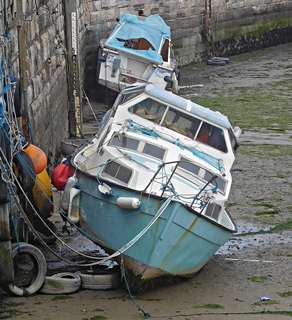
The Sunken Boat and the sea at the Turner in Margate (Kent)

I HAD NEVER HEARD of the artist Anna Boghiguian (born 1946) until we visited her exhibition at the Turner Contemporary Gallery in Margate (Kent). Anna was born in Cairo (Egypt), where she studied political and social sciences at The American University. She also studied fine arts and music at Concordia University in Montreal (Canada). The works on display at Margate until 26 October 2025 are a superb synthesis of both her interests in world affairs and artistic talents.

Anna’s show at the Turner is called “The Sunken Boat: A glimpse into past histories”. It consists of three installations, one in each of three spacious galleries. One gallery contains an installation comprising a set of sandy beaches littered with the remains of wrecked boats and sails along with other flotsam and jetsam. The walls of the room have frames containing images relating to historical and ecological events. Regarding this fascinating and beautifully composed exhibit, the gallery’s website noted that the installation:

“… the centrality of the sea in shaping histories of labour, trade, ecological collapse, and political conflict. It combines sculpture, painting, cut-out figures and sound, inviting reflection on rising sea levels and geopolitical tensions around undersea communication cables.”

Another room has a cluster of cut-outs depicting famous people of the past including Einstein, Gandhi, Queen Victoria, Napoleon, Pythagoras, and many others. Each of the cut-outs are colourfully painted and are suspended from the ceiling by fine threads, and hang above a large black and white chess board. They rotate gently in reaction to movements of the air caused by motions of the viewers.

The third gallery contained an installation that evoked being under the sea. Figures either swimming or drowning are suspended from the high ceiling. The room is lit with a blueish glow that gives the viewer the feeling of being below the sea’s surface. The floor of the gallery is a representation of the seabed, with undersea cables, marine creatures and plants, assorted debris, and other objects one might expect to find there. The lighting was chosen to evoke the reduced illumination that one can imagine exists deep below the sea’s surface. It reminded me a little of the church at Tudely (Kent) whose stained-glass windows by Chagall create the same impression. In this church, Chagall designed the windows to create the impression of being below the sea because the edifice is dedicated to the memory of someone who died by drowning. Unlike the church at Tudely, the installation at the Turner expresses a less specific, more global concern: that of the sea’s ecology at present and in the future.

Words can hardly do justice to the amazing show at Margate. Without doubt, it must be seen to be fully appreciated. The exhibition illustrates that  Anna Boghiguian is a competent and imaginative artist with a great grasp of past and contemporary political and present ecological challenges facing the waters in our seas and oceans. And she knows how to express these matters in imaginative and compelling ways,
From Cairo to Kent and Karl Marx

IN RECENT YEARS, the seaside town of Margate in Kent has become much more of a “trendy” destination than it used to be. From being yet another coastal resort, it has become a magnet for those interested in contemporary art. This is because of the presence of the Turner Contemporary Gallery, Tracey Emins’s gallery, and the Carl Freedman gallery … to mention but a few places. With the influx of tourists with sophisticated tastes, the town has become home to a range of restaurants, which is more varied than in many other seaside towns in north and east Kent.

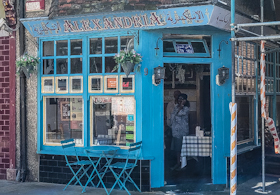
About 6 years ago, a husband and wife from Cairo (Egypt) set up a tiny restaurant on a corner plot in the old centre of Margate. It is called Alexandria Café. The owners chose the name not because they come from Alexandria, but because like the Egyptian city, Margate is by the sea.

Only open on Fridays, Saturdays, and Sundays at present, this restaurant serves beautifully prepared, tasty Egyptian dishes at very reasonable prices. We tried koshari, falafel, baba ganush, pickled tomato salad, and mint tea. Although these are all without meat, non-veg dishes are also available.

The tiny, comfortable eatery is decorated with photographs of Egyptian film stars. A small television screen was showing old Egyptian films.

A few doors away from the lovely Egyptian cafe, there is an ice cream parlour. What makes it special is that in 1866, Karl Marx stayed in the building.

We did not try the ice cream, but I can safely say that of all the places I have eaten in Margate, having visited the place many times, Alexandria is the best.

He painted artworks on the floor using a household broom

ED CLARK (1926-2019) WAS born in New Orleans. He was an Afro-American. In 1944, at the age of 17 he joined the US Army Airforces. After the war, he received US Government financial assistance for further education, help given to those who had served in the military during WW2 (the GI Bill). He studied art in Chicago before moving to Paris (France). He arrived there as a competent figurative painter, but soon became fascinated with abstraction, such as practised by Picasso, Matisse, and Braque.

Although he was a competent portraitist, Clark began to question the value of realistic figurative painting when photography could do the job so well. He moved to creating works that were mainly abstract. Many of his paintings are on display at the Turner Contemporary Gallery in Margate until the 1st of September 2024.

Ed Clark with a broom

The paintings that we viewed at Margate are exciting and most of them are almost, if not completely, abstract. For most of his creative life, Clark worked in an interesting way. First of all, he painted with his canvases spread out on the floor. This way, he explained in a film being shown at the exhibition, his paint was not subjected to gravitational pull. Most artists paint on surfaces which are far from horizontal – on easels, for example. This means that the wet paint is subject to gravitational pull before it has dried. By painting on the floor, Clark explained, this small but significant gravitational drag does not occur.

Another distinctive feature of the way Clark worked was his choice of brushes for applying the paint. He did not use artists’ paint brushes. Instead, he threw batches of paint onto his horizontal canvases and worked them into his pictures using ordinary domestic brooms, such as are normally used to sweep the floor. This is illustrated in the film, and the effects he produced using sweeping movements are beautiful and ingenious. In addition to brooms, he also applied paint with his hands, rubbing the paint into the canvas. Clark described that by working on the floor he became more intimately involved with his creations.

We had come to the Turner Contemporary to view some sculptures by Lynda Benglis, and had never heard of Ed Clark. However, after seeing the superb exhibition of his creations, we have become his fans.

A sculptor who uses both her digits and digital technology

THERE IS AN EXHIBITION of sculptures by Lynda Benglis (born 1941) at the Turner Gallery in Margate (Kent). They are produced using a combination of traditional modelling and modern technology.

First, she makes small versions of these in clay. Then she scans them digitally. Using computer software, she magnifies the 3D (three-dimensional) scan. Next, she uses a 3D printer to create exact but greatly enlarged plastic replicas of the original clay models. These are then used to create the final metal casts – the sculptures seen at the exhibition.

An artist and a gallery in a British seaside resort

THE GREAT BRITISH artist Joseph Mallord William Turner (1775 – 1851) was accurately described by the writer John Ruskin as “… the father of Modern art …” in 1843. Turner first visited Margate when he was aged 11. After about 1820, he often stayed in the town because he thought the skies over the area were the most beautiful he had seen in Europe. Between 1827 and 1847, he stayed in the town in a guesthouse owned by Mr and Mrs Booth. When Mr Booth died in 1833, Turner became a close companion of the widowed Sophia Booth, who died in 1878. He also adopted the name ‘Booth’.

The house owned by Sophia Booth, where Turner resided, is no more. Where the guesthouse once stood is now occupied by the Turner Contemporary Gallery (‘TCG’). The gallery was designed by David Chipperfield (born 1953), and opened in April 2011. Just as Turner’s paintings were considered avant-garde and even provocative when they first appeared, the TCG is a highly adventurous contrast to the rest of the old town that neighbours it. Some buildings look better inside than outside. The TCG is a good example of this. The gallery spaces are spacious and well-lit both by natural and artificial light. They were a perfect place to view the highly colourful creations of the Brazilian born artist Beatriz Milhazes (born 1960), which are on show at the TCG until the 10th of September 2023.

I believe that the presence of the TCG has elevated Margate’s status from being a simple, unexceptional seaside resort to a place that attracts a much wider range of visitors than it did in the past. As happened in London’s Islington in the 1960s, a rather mundane place has become somewhere that people now feel they ‘must visit’. Although the usual British seaside attractions can still be found in Margate, the town is now also catering for the ‘up market’ clientele. And that cannot be a bad thing because when I lived in Kent (1982-1992), apart from Whitstable (and maybe Broadstairs), most of the seaside places in north and east Kent were in decline and rather melancholy.

The opening of the TCG has done for Margate what the art Triennale has done for another previously dreary Kent town – Folkestone. Even if Turner might have been shocked to see what now stands where he spent many happy hours with Sophia Booth, I feel sure that he would have been happy to know that it has revitalised a town which he loved.

Man in the waves

GORM


At first sight, I thought I saw a man standing alone and naked out in the waves at Margate on a sunny but very windy afternoon. Crazy, I thought to brave those rollers on suchb a cold day and without a wet suit. Then, I noticed that he was coloureed green and motionless despite the battering he was getting from the sea. He was not a man, but a sculpture.

This sculpture braving the sea is Another Time  created in 2013 by the British sculptor Antony Gormley (born 1950).

The clever thing about this sculpture is placing it in the water. Though static, the waves dashing against it can create the illusion that the sculpted man is moving. Also, by putting it in the sea, the whole sea becomes an important part of the artwork.

Although I am not too keen on Gormley’s art works, this piece at Margate, just outside the Turner Contemporary art gallery satisfies me greatly. 

You can now see the sculpture and the waves in this short video:  http://www.ipernity.com/doc/adam/48815810