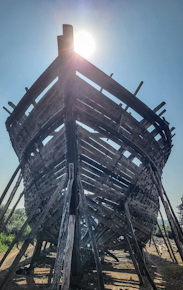
Building boats by hand at a port in Kutch, (Gujarat, India)

THE SEAPORT MANDVI in the Kutch district of the Indian state of Gujarat was founded by Maharao Khengarji I, the ruler of the kingdom of Kutch, in 1580. It became an important, thriving centre of trade for several centuries. And for over 400 years it has been a place where dhows have been built. Today, these huge wooden ships can be seen in various stages of construction along the banks if the Rukmavati River on whose shore lies the town of Mandvi.


The dhows are constructed largely by hand as they have been done for over 400 years. They are built with timber, sal wood, imported from Malaysia. Today, the timber is landed at the port of Kandla in Kutch  a d brought by road to Mandvi.


According to an article in the The Hindu  newspaper dated April 2017:

“As maritime trade grew, traders—belonging to the seafaring Kharva community of both Hindus and Muslims—developed a new expertise: boat-making and repairing to add to their traditional navigational skills.”


Furthermore ,  the arti le related, the dhows:

“… built by hand by craftsmen who are barely literate and have no training in engineering, the ships come up expertly without so much as a sketch being referred to.”

I found this to be quite amazing.


The dhows take several year to be built. When they are completed,  they are usually  towed to the Persian Gulf where they are fitted with engines. Occasionally,  engines are fitted in Mandvi.


Having been fitted with engines in the Gulf, they return to Mandvi with a small crew. Back in Mandvi,  the dhows are loaded with cargo and a larger crew before sailing back to the Middle East.  About a year after they have been completed,  the dhows are sold in the Gulf or East Africa.


Whereas in the past, the dhows had a capacity of about 40 Tonnes, some of those being built today can carry up to 2000 Tonne.


Whenever we visit my wife’s cousins, who lives close to Mandvi, we take a walk along the road next to stretch of shore where the dhows are being made. The huge timber structures, upon which men are assembling the ship using hand held tools. The workmen appear to cling to the beams of timber as they worked on the ship. They do not wear safety harnesses.


The ‘embryonic’ dhows are surrounded by piles of uncut timber as well as the planks that have been cut prior to being attached to the ships being constructed.  Apart from the building  materials, the area contains numerous stray dogs and the occasional foraging cow.


Mandvi is about 250 miles northwest of Alang (in Saurashtra,  Gujarat),  which we have visited. It is in Alang that ships that have reached the end of their lives are broken up. I was interested to read in The Hindu article that in Mandvi:

“The boat-makers use old generators discarded from dismantled ships lying in Gujarat’s Alang ship-breaking yard. These are then modified by installing gear boxes in them and converted into boat engines.”


I have no idea for how much longer  the handmade dhows will continue to be built in Mandvi. So, if you are able, a visit to Mandvi to see this traditional boat building  is well worthwhile. It is handicraft on a huge scale.

Feeding the faithful at a Hindu temple in Kutch (Gujarat)

THE DHRABUDI TRMPLE complex is near the sea about 5 miles east of the town of Mandvi (Kutch, Gujarat). It is located ated next a small Freshwater lake, where pilgrims can bathe. Our driver told us that baby boys are brought to be blessed at the temple when they reach their first birth anniversary. When we visited, we saw a group of people doing a puja in the open air. They were respecting the first death anniversary of one of their relatives.

While wandering around the temple compound, we saw a group of Rabari women seated in the shade, under a large banyan tree. The Rabari are nomadic cattle and camel herders, as well as shepherds. In India, they aremost frequently found in Gujarat, Punjab, and Rajasthan.

Worshippers come from far and wide to do pujas at the mandir. The temple offers free meals to pilgrims. These are served in a large dining hall. One wall of this is lined with numerous portraits of people who have died. We were told that diners pick up a thali and other eating utensils before lining up to be served food.

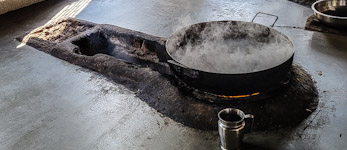
Pit containing glowing charcoal for cooking

The kitchen, which is next door to the dining hall is vast. It was spotlessly clean. I saw a few gas rings, but what really fascinated me was the other method by which food is heated up. I saw three or four pits sunk into the floor. Each one is shaped like a large spoon. Glowing charcoal is heaped in the bowl of the ‘spoon’, and can ve spread along the stem. Pots are placed above the charcoal. The arrangement reminded me of the Turkish ocakbaşı. I imagine that the cooking speed can be adjusted by varying the amounts of glowing charcoal beneath each of the enormous cooking pots.

We did not stay to join the pilgrims having lunch. Although the temple cooks kindly invited us, we had lunch awaiting us at my wife’s cousin’s home.

I always enjoy visiting place of worship. What made Dhrabudi special for me was being shown its wonderful kitchen.

The house in the desert and a fighter for the independence of India

A NARROW ROAD LEADS away from the town of Mandvi (in Kachchh, a part of Gujarat) into an arid sandy area close to the seacoast. Scrubby bushes populate most of this flat terrain. After a few miles, a red building can be seen on the horizon. As you approach it, you can see that it resembles no other in the surrounding area, or, for that manner, in any other part of India. However, if you are a Londoner, it would seem familiar, although quite incongruous.

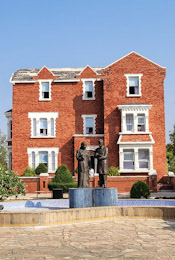
Replica of India House near Mandvi, Kachchh

The house in the desert is an accurate replica of a typical Victorian house, such as can be found in North London. In fact, it is a full-size copy of number 65 Cromwell Avenue in London’s Highgate area. The reproduction near Mandvi was built as part of a complex to commemorate Shyamji Krishnavarma (1857-1930), who was born in the centre of Mandvi.

Krishnavarma, who became a barrister and worked in various Princely States, moved to London, where he lived until about 1907. He moved to Paris, and then to Geneva, where he and his wife lived until they died.

In London, Krishnavarma lived opposite Highgate Woods. He invested wisely, and became interested in the works of English men, who had their doubts about Britain’s domination of India. He became an opponent of British rule in the Indian subcontinent. At first, his interest was mainly intellectual. However, in 1905, following the partition of Bengal, he became an activist.

One of his several activities was to purchase number 65 Cromwell Avenue. He had it adapted to become a ‘home away from home’ for Indians studying in London – they frequently had to endure the racist attitudes of English people. He named the building ‘India House’ (which should not be confused with the present Indian High Commission in London).

Apart from providing Indian food, some accommodation, and some leisure facilities, India House also hosted meetings that discussed the injustice of British rule in India. Soon, India House attracted the attention of the British police. This was because India House was becoming a nucleus or hotbed of anti-British activism. For example, some of the people who frequented the House experimented with bomb making and smuggling firearms to freedom fighters in India.

Krishnavarma left London in 1907, when he feared that he might be arrested. India House continued to be active until mid-1909 when one of its visitors assassinated an important colonial official.

Krishnavarma wrote in his will that after he was cremated, his ashes should be returned to India only after it had become independent of the British.

In the early part of this cemetery, the Chief Minister of Gujarat, then Narendra Modi, decided to bring Krishnavarma’s ashes to India – to Mandvi. Some years later, a complex to commemorate Krishnavarma was built outside Mandvi. Part if this is the replica of Highate’s former India House. The ashes of Krishnavarma and his wife are stored in urns on display in a building next to the replica.

If this story interests you and you want to know much more about India House, its replica, Krishnavarma and his fellow freedom fighters, including the currently influential VD Savarkar, you should read my, dare I say it, very informative book. I have produced two versions of it. One, the latest edition is “Indian Freedom Fighters in London 1905-1910), and is available here: https://www.amazon.co.uk/gp/aw/d/0244270716/ . The other “Ideas, Bombs, and Bullets”, which can only be delivered to addresses in India in available here: https://store.pothi.com/book/adam-yamey-ideas-bombs-and-bullets/.

A temple in Mandvi: architectural revival or survival?

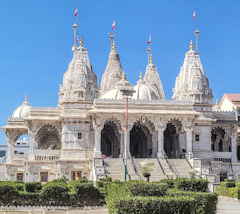
THE SWAMINARAYAN TEMPLE in Mandvi (Kutch, Gujarat) was constructed between 1991 and 1999 to replace a smaller Mandir on the site. Without going into the details of its very fine architectural and decorative features, this edifice was financed by local Kutchi followers of Swaminarayan. The Rajasthani Marble that forms the temple’s structure was hand carved by workmen, all of whom were followers of Swaminarayan. The stones that make up the building were carved in Rajasthan, transported to Mandvi where they were put together to make the edifice. This is similar to how the great temple in London’s Neasden was constructed.

Swaminarayan Mandir in Mandvi

The temple at Mandvi looks very similar to ancient Hindu temples I have seen elsewhere in India. As you look around it, you can see how the very old temples looked when they had just been built many centuries ago. Apart from the fact that Mandvi’s Swaminarayan Mandir looks recently built, a layman like myself, would find it difficult to age the building.

In 19th century England, many new churches were built in the gothic style. Like the newish temple at Mandvi, may of them faithfully reproduce the churches built in mediaeval times. The only thing that differentiates the 19th century Gothic Revival churches from their mediaeval predecessors is that they look too new to be as old as them.

In a book about Gothic Revival written by the art historian Kenneth Clark (1903-1983), he suggests that in England the use of gothic style in architecture never actually died out, and this suggested to me the Gothic Revival was really gothic survival. As far as I can gather, the same is the case for Hindu mandir architecture. If this is really the case, new temples such as Mandvi’s Swaminarayan Mandir is not the revival of the use of an ancient style of architecture, but an example of its survival. Put another way, the new temple at Mandvi is a reincarnation of its predecessor.

A palace by the sea

IN OCTOBER 2022, we visited the Isle of Wight and went around Osborne House, which Queen Victoria and her consort Prince Albert had constructed as a holiday home near the seaside on the north coast of the island. A largely unattractive Victorian pile, its saving grace is the Durbar Hall, which is a near perfect example of the Indo-Saracenic style of architecture that can be found in many places in India. Recently (in February 2023), we visited another royal summer palace located close to the sea. It is the Vijaya Vilas Palace close to Mandvi in the former Kingdom of Kutch, now a part of the Indian State of Gujarat.

The Vijaya Vilas was completed in 1927. It was built by Kutch’s ruler Maharao Kengarji III as a summer resort for his son and heir, the Yuvraj Shri Jayarajii.

Architecturally, it resembles older Rajput palaces, and is a fine example of the Indo-Saracenic style. It and its various oriental decorative and structural features were made by craftsmen from Bengal, Jaipur and other places in Rajasthan, Saurashtra, and Kutch. The predominant material used is sandstone , of which there is no shortage in Kutch. It seems that the palace suffered little damage during the 2001 earthquake, which badly affected the Maharao’s palaces in nearby Bhuj (the capital of Kutch).

Inside the palace there are rooms with furniture that would not look out of place in many English stately homes. There are many framed photographs of the royal family, their guests, and the many wild animals that were shot. One of these was a leopard that was shot by someone inside the palace. One of the window panes has a bullet hole that is said to have been made by the bullet that killed the creature. There are also photographs that record the many times that scenes in Bollywood movies were shot in the Palace.

One photograph shows the US General Dwight Eisenhower seated in a jeep. This picture was taken in Europe during WW2. I have yet to discover what, if any, connection existed between Eisenhower and the royal family of Kutch.

Visitors can visit the rooms on the ground floor, and can ascend to the roof from which there are superb views of the sea and the flat countryside around the palace. The first floor, which is private, is the residence of members of the former royal family.

Although not as old as it looks, Vijaya Vilas, is a superb example of the kind of palace typical of those older ones that can be seen in Rajasthan. To my taste, Vijaya Vilas is a much more lovely and harmonious edifice than Victoria and Albert’s seaside home on the Isle of Wight.

HUMBLE BEGINNING

GUJARAT IS THE BIRTHPLACE of several great politicians of India: Mahatma Gandhi, Vallabhbhai Patel, Morarji Desai, and Narendra Modi, to name but a few. Kutch, which until soon after 1947 was an independent princely state, is now part of the State of Gujarat. It was the birthplace of an important, but now largely forgotten, ‘father’ of Indian Independence, Shyamji Krishnavarma (1857-1930).

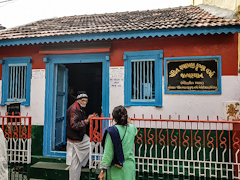
The house in which Shyamji was born is the heart of the jumble of narrow streets in the old centre of Kutch Mandvi. Unlike the large house in Porbandar where Gandhi was born Shyamji’s birthplace is a very modest dwelling. Shyamji was the son of a poor man, who spent his working life struggling to make a living in Bombay.

We were shown around Shyamji’s birth house by Hriji Karani, who has not only founded a fine school in Mandvi but also instigated the creation of a monument to Shyamji at Kranthi Teerth.

The birthplace is now a museum, which is looked after by an elderly lady. In addition to caring fir the museum she helps her grandson and some of his friends with their schoolwork. Her grandson, aged only three, was able to speak a few words pf English as well as draw the Roman numerals on his slate.

The birthplace is devoid of household effects. Their pace is taken with exhibits, mainly photographs and paintings, relating to Shyamji’s fascinating life. Amongst the photos, there is one of the Middlesex Land Registry document relating to Shyamji’s purchase of a property in London’s Highgate, the building that was known as ‘India House’ between 1905 and 1910. This was the house where Shyamji and his ‘disciples’ including VD Savarkar plotted the downfall of the British in India. There was also a photograph of the block of flats in Geneva on which Shyamji spent the last few years of his life.

Shyamji and his wife died in Geneva. In his will, he had stipulated that his ashes were to remain in Switzerland and not to return to India until the land of his birth, India, became independent of the British.

Although India became independent, free of British domination, in 1947, it was not until 2003 that the ashes of Mr and Mrs Krishnavarma were brought to India. They were collected from Geneva by Narendra Modi, then the Chief Minister of Gujarat, and brought to India. I knew that from 2010, the black marble casks containing the ashes were put on display in a specially built pavilion at Kranthi Teerth, but I had no idea where they were kept before that.

Mr Karani showed us the small room in the birth house where the ashes were kept from 2003 until 2010. This little chamber, like the inner sanctum of a Hindu temple, now contains several photographs and a reproduction of an early flag designed for India by Shyamji’s feisty revolutionary colleague Madame Bhikaiji Cama and VD Savarkar during the brief existence of India House in north London.

A large oil painting depicts Shyamji with Henry Hyndman (1842- 1921), the British socialist whose anti-colonialist ideas strongly influenced Shyamji and his followers. Hyndman delivered a speech at the opening of India House in 1905. In the background of the painting there is a portrait of BG Tilak (1865-1929), one of the most revolutionary of the earliest members of the Indian National Congress and can well described as ‘the father of Indian independence’.
Like many other traditional houses I have visited in Kutch and Gujarat, the wooden staircase leading to the upper storey is incredibly steep, almost a ladder. The upper storey of Shyamji’s birthplace was a single room with more photographs and a tiny balcony that provides a view of backs of the houses on the street below.

Shyamji left Mandvi to study in Bhuj and then Bombay before setting off for England where he became a barrister in London and a world expert in Sanskrit based at Oxford. It is unlikely that he visited Mandvi much after beginning his impressive career. I have described the remarkable life of this son of Mandvi and esrly advocate of Indian independence in my book, “IDEAS, BOMBS, and BULLETS”

Although I knew that Shyamji was born in Mandvi in a far from well off family, and I had already visited the town once before, seeing his actual birthplace, viewing its surroundings, and entering his childhood home helped me appreciate the ‘rags to riches’ aspect of his life.

IDEAS BOMBS AND BULLETS by Adam Yamey describes the life of Shyamji Krishnavarma and the centre for Indian freedom fighters that he created in North London. It is available from:
Lulu.com
Amazon
Bookdepository.com
Pothi.com (best place to purchase it if in India)
Kindle

A house in the desert

TWO YEARS AGO, we first visited Kranthi Teerth close to Mandvi in Kutch, once an independent kingdom and now a part of the Indian state of Gujarat. Kranthi Teerth is a memorial to Shyamji Krishnavarma (1857-1930) who was born in Mandvi. A brilliant Sanskrit scholar and a barrister, Shyamji became disillusioned with the British and by 1905 was advocating that India should become completely independent of the British Empire.

In 1905, Shyamji bought a large house in Highgate (North London). He converted this into a centre and hostel for Indians studying in London, a place where they could eat Indian food, meet fellow countrymen, and discuss affairs related to India. He called the place ‘India House’. The house still exists in Highgate but is now divided into flats.

Shyamji’s India House in Highate, not to be confused with the building with the same name in the Aldwych, rapidly became a centre for anti-British, anti-colonial activity until its demise by the end of 1909.

In 2009/10, a monument was created near Mandvi to commemorate the long forgotten pioneer of the Indian independence movement, Shyamji Krishnavarma. The monument includes a life size replica of the house in Highgate, which was once ‘India House’. The interior of the replica makes no attempt to copy whatever was inside India House back in the time of Shyamji. Instead, it contains portraits of numerous freedom fighters including some of those who either visited or lived in the house in Highgate when it existed as India House. There is also a collection of portraits of some of the heroes of the Great Rebellion, or First War of Indian Independence, that occurred between 1857 and ’58. One might question one or two omissions amongst the portraits (eg Jawaharlal Nehru and Gokhale), but there is a large selection of freedom fighters remembered here. Apart from the feisty Madame Bhikaiji Cama and Shyamji’s wife Bhanumati, there are no other ladies commemorated.

When I first saw the replica at Kranthi Teerth, which looks very incongruous standing tall in the flat sandy semi desert landscape, I became fascinated by its history. When we returned to London, I began researching the story of India House and its exciting contribution to the independence of India. Last year, I published a book about it: “Ideas, Bombs, and Bullets”. The title encapsulates what happened in India House: ideas were discussed; experiments in bomb making were undertaken; and guns were packed ready to be smuggled into British India.

It was interesting to revisit the portraits on display in the replica of India House after having researched my book. At our first visit, most of the persons portrayed meant nothing to me. However, seeing them again, having learnt about them while writing my book, felt rather like meeting old friends!

Yesterday, we revisited Kranthi Teerth and met Hriji Karali, whose ideas led to Narendra Modi’s encouragement of its construction. I presented the senior officials at Kranthi Teerth with a copy of my book. They appeared to be very pleased because until then they had not seen anything in English about Kranthi Teerth and the person it commemorates. My wife and I were given a warm welcome.

Apart from the replica of house in Highgate, there is a simple but spacious gallery where the irns carrying the ashes of Shyamji and his wife are reverentially displayed. These were brought to India from Geneva, where Mr and Mrs Krishnavarma died in the 1930s, by Narendra Modi in 2003 while he was Chief Minister of Gujarat.

I always enjoy visiting places more than once because each successive visit I discover more about them and thereby appreciate them with greater keenness. This was certainly true of our second visit to Kranthi Teerth.

“Ideas, Bombs, and Bullets” by Adam Yamey is available from:
Lulu.com
Pothi.com (best for purchasers in India)
Amazon
Bookdepository.com
Kindle

Picture shows setting of the replica of India House at Kranthi Teerth