Two barristers from South Africa stand together in central London

A FEW MONTHS AFTER Mahatma Gandhi was born in India in October 1869, Jan Smuts was born in South Africa’s Transvaal Republic (in May 1870).

In 1893, the young barrister Mohandas K Gandhi, the future ‘Mahatma’, arrived in Durban, South Africa, from Bombay. This was the year before Smuts graduated in law at Christ’s College in Cambridge, England. After passing the Bar examinations in late 1894, he returned to South Africa, where he became involved in politics.

Gandhi remained in South Africa from 1893 until 1915. During his time there, he practised law as a qualified barrister, fought for the rights of Indians in the country, and gradually developed his non-violent approach to protest, which he later practised during the struggle to free India from British domination. During the Second Anglo-Boer war (1899-1902), Gandhi assisted the British with caring for casualties. Meanwhile, Smuts fought with his fellow Boers.

After that war, Smuts was involved with negotiations that led eventually to the union of the four territories, which then became unified as the South Africa we know today. In 1914, the First world War broke out. Smuts fought for the British, most notably in what was then German Southwest Africa, now Namibia. Meanwhile, in 1915 Gandhi returned to India, and the rest is history.

Both Gandhi and Smuts are commemorated by statues in London’s Parliament Square. They stand near each other, but not next to each other. Jan Smuts stands on the north side of the square, and is depicted as striding towards Westminster Abbey. Mahatma Gandhi stands on the east side of the square quite close to the statue of another South African, Nelson Mandela. Gandhi appears to be gazing at the Houses of Parliament.

Seeing those statues standing in the same square today made me wonder how, if at all, Gandhi and Smuts felt about each other. I found an article in a website called “The Observation Post”, which helps understand their relationship. Here are some quotes from it:

“It’s a common misconception that Jan Smuts and Mahatma Gandhi’s relationship was one of animosity. It is a little known fact that both men actually respected each other, remaining life long admirers of one another … Gandhi tried, at all times, to look for the positive in Smuts and said of him that he had a ‘high place among the politicians of the British Empire and even of the world’.”

When Gandhi was about to leave South Africa in 1915, he sent Smuts a pair of sandals that he had made at Tolstoy Farm, a cooperative colony he set up near Johannesburg, from which he ran his campaign of satyagraha (non-violence). Smuts wore these every day when at his farm, and is recorded as having said on Gandhi’s seventieth birthday:

“I have worn these sandals for many a summer, even though I may feel that I am not worthy to stand in the shoes of so great a man.”
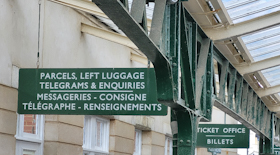
The station where Gandhi landed in England in 1931

WHEN MAHATMA GANDHI came to England in 1931, he disembarked at Folkestone in Kent. In those days there boats docked alongside a pier, and then boarded trains at a station on the pier. The pier has long since ceased to be used to service cross channel and other passenger boats, but it and the station have been preserved and converted into a tasteful leisure amenity.

A more detailed history of the pier and its station is available here: https://gujarat-travels.com/2021/10/24/where-mahatma-gandhi-set-foot-in-england-in-1931/

A café with a history on the seashore at Pondicherry

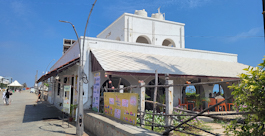
BEACH ROAD RUNS alongside the seafront of Pondicherry.  It is just over 1.3 kilometres in length. There are many buildings lining the landward side of the road (its west side), including hotels, restaurants, a memorial to BR Ambedkar, the lighthouse and the Customs House. However, there is only one  on the seaward side, close to the seashore.  Today, this building with a veranda on its sea facing side is a pleasant refreshment outlet called Le Café.  It stands a few metres south of the tall statue of Mahatma Gandhi,  also on the seaward side of Beach Road. 


The café contains some historical photographs of Pondicherry. One of them shows the long pier that commenced where Gandhi now stands. The pier was irreparably damaged during a terrible storm in the early 1950s, probably 1952. All that remains of it are some wooden stumps projecting from the sea some considerable distance away from the shore. Where Gandhi stands today was Place de la République when Pondicherry was a French colony. 


There has been a building on the site of Le Café since at least the end of the 17th century, as can be seen on a map published in 1793. For many years, the building housing the café was the Port Office of Pondicherry.  It can be seen quite clearly in a photograph taken before 1870. Then, it had only a single storey. A small upper storey has been added since then.


Sometime after the pier was polished off by the storm, the building was remodelled to serve as a café.  Run by a state managed concern, food and non-alcoholic drinks can be obtained here at reasonable prices. In the intense heat of midday and the early afternoon,  the veranda of Le Café is a pleasant place to relax in the breezes that pass through it.

The Mahatma standing by the cathedral in Manchester

THERE ARE MANY statues depicting Mohandas K Gandhi (the Mahatma; 1869-1948) all over the world. There is one in Manchester close to the city’s cathedral. A small notice next to it notes that it was gifted by the Kamani family to honour their grandfather Bhanji Khanji Kamani (1888-1979). Inaugurated in 2019, it is a project by the Shrimad Rajchandra Mission in Dharampur (Gujarat).

Shrimad Rajchandra (1861-1901) was a Jain philosopher, scholar, and reformer. Gandhi was introduced to him in Bombay in 1891, and the two men wrote to each other when the Mahatma was a lawyer and activist in in South Africa. Gandhi wrote in his autobiography that Shrimad was his “guide and helper” and his “refuge in moments of spiritual crisis”. Well, I did not know that.

As for Bhanji Khanji Kamani, the notice next to the statue in Manchester notes that he was “… a Fellow Scholar of Gandhi.” I am unclear about the meaning of this because Bhanji was about 19 years younger than the Mahatma. I wonder whether he was actually a disciple of Gandhi, rather than a Fellow scholar.

We saw the statue representing a man who advocated peaceful protest on a day when violent protests were predicted all over England.

Cotton and Abraham Lincoln and Mahatma Gandhi and Lancashire

LANCASHIRE USED TO be the centre of the cotton processing industry in the UK. Cotton grown in the southern USA and in India’s Gujarat was shipped to Lancashire, where the cotton mills used it to manufacture textiles.

In the heart of the city of Manchester, we were surprised to find a huge bronze statue of the former President of the USA, Abraham Lincoln (in office from 1861 to 1865). Lincoln played a significant role in the abolition of slavery in his country. Many of the slaves worked to grow and harvest cotton, much of which was sent to Lancashire. The processing of the cotton grown by the slaves provided employment for the workers of Lancashire. The statue was created by the American artist George Grey Barnard (1863-1938) in 1919, and is one of three castings – the others being in Louisville, Kentucky and in Cincinnati, Ohio.

Beneath the statue in Manchester and carved in the plinth, there is the wording of a letter sent by Lincoln to the working people of Manchester. Written on the 19th of January 1863, Lincoln thanked the workers of Manchester, who were supporting the abolition of slavery and at the same time suffering because of the blockade that prevented cotton reaching Lancashire from the southern states of the USA. According to one website (https://manchesterhistory.net/manchester/statues/lincoln.html), Lincoln’s blockade of the cotton exporting ports was not universally welcomed:

“To what degree the people of Lancashire gave this support willingly is questionable. Lincoln’s Union Army blockaded the southern ports preventing the Confederate supporters from trading their cotton and causing what was known as the Cotton Famine in the UK. By November 1862, three fifths of the labour force, 331,000 men and women, were idle. The British Government was encouraged to take action to overturn the blockade and riots broke out because of the hardship suffered by the workers. The Confederate Flag flew on some Lancashire mills.”

The American Civil War was not the only time that the Lancashire cotton workers had to suffer because of a freedom struggle taking place many thousands of miles away. In addition to the USA, British India was a supplier of cotton to the mills of Lancashire. Indian cotton was sent to Lancashire, and processed to make textiles that were then sold in India. Because of this, a vast number of weavers in India, who could have made the textiles, were made unemployed and impoverished.

As part of Mahatma Gandhi’s attempt to free India from British rule, he initiated a boycott of cloth and clothing made with textiles manufactured in England. This was sufficiently successful to render a great number of Lancashire textile workers unemployed – at a time when the Great Depression was hitting the country. On the 25th of September 1931, Gandhi travelled from London to Darwen, a small town (with textile factories) north of Manchester. He spent the following days speaking to people of all walks of life, explaining the purpose of his Khadi movement – the boycotting of imported textiles and the encouraging of homespun Indian textile production. Both of my wife’s grandmothers chose to wear only khadi cloth because they supportrd the freedom struggle. James Hunt described Gandhi’s visit to Lancashire in his book “Gandhi in London”, and noted that:

“Everywhere Gandhi explained that whatever the effect of his khaddar movement and boycott might have on Lancashire’s unemployment was a result of his prior concern with the greater sufferings in India. While Britain had 3,000,000 unemployed. India had 300,000.000 villagers idle every year. The average Indian income was a tenth of what the British unemployed worker received from the dole …”

Overall, despite the effects that his boycott was having, the workers of Lancashire welcomed him warmly and supported his cause.

Until we visited the Manchester Museum, which is about 1.3 miles south of Lincoln’s statue, I was unaware of Gandhi’s visit to Lancashire. The museum has a gallery dedicated to the South Asian diaspora, despite being called “the South Asia Gallery”. One of its showcases concentrates on the Mahatma’s brief visit to Darwen.

We visited Manchester in May 2024 to see an art installation curated by our daughter. We also wandered around the city, sightseeing. Little did we expect to discover connections between this vibrant city and both Abraham Lincoln and Mahatma Gandhi.

An artist from Bengal and the freedom struggle of Mahatma Gandhi

BENGALI ARTIST NANDALAL Bose (1882-1966) was chosen as the artist to provide illustrations for the ceremonial manuscript of the Constitution of India. A few copies of these images are currently (January 2024) on display at Bangalore’s National Gallery of Modern Art (‘NGMA’).

Bose was part of an international group of artists who were endeavouring to revive classical Indian culture and art. Because of this, he came into contact with Japanese artists. Their painting techniques influenced the way Nandalal painted. This can be seen in many of his works on display at the NGMA in a temporary exhibition of a selection of his Haripura Panels, which is on until April 2024.

The ear cleaner at work

In 1938, the 51st session of the Indian National Congress was held in Haripura (now in Gujarat). Mahatma Gandhi asked Nandalal Bose to paint a series of panels depicting Indian village life in such a way that the images would be easily accessible to the common people (villagers etc.). Bose obliged, creating about 400 colourful paintings on handmade paper, using organic (rather than industrial) coloured paints. 77 of these are in the exhibition at Bangalore’s NGMA.

Each of the 77 panels is a delight to behold. They look as if they have been done quickly and highly competently by an artist with a decisive mind. On many if them, the influence of Japanese painting can be discerned. However, on every panel the subject matter is unmistakably Indian. Some of the panels depict scenes from village life (fir example, a potter at work, a tailor, wrestlers, making butter, etc) and others show animals and mythological scenes. One panel depicts an ear cleaner – a man is shown cleaning a lady’s ear with a long thin instrument. Villagers visiting the pandal (temporary shelter), which was decorated with these panels, would have had no trouble recognising Bose’s scenes of daily rural life. And political delegates would have been reminded of Gandhi’s professed allegiance to the ‘common’ people of India. Seeing these wonderful panels made me think of Socialist Realism images, but Bose’s paintings have a human touch that is lacking in politically inspired art such as Socialist Realism.

The exhibition at the NGMA is well hung and nicely lit. The panels hang in the galleries which were once rooms in the elegant Manikvelu Mansion. Several informative panels provide interesting information about Bose, his art and his association with Gandhi and his attempt to rid India of British domination.

Mahatma on Madeira

UNTIL AIR TRAVEL really ‘took off’, travelling between South Africa and London involved a long sea voyage, either via the Suez Canal or via the Atlantic Ocean. Boats carrying passengers up and down the Atlantic often called in at Funchal in Madeira. Aged three, I travelled with my parents to South Africa by sea. I have seen a photograph of me dressed in a toga made from a sheet from our cabin. I was taking part in a fancy dress party to celebrate crossing the Equator.

Many years before that – in 1906 – a barrister, Mohandas Karamchand Gandhi, travelled by ship from London to South Africa. He was on his way back to South Africa, having petitioned young Winston Churchill, then Under Secretary of State for the Colonies, against the Black Act – a law promoting racial segregation. Apparently, when his ship docked in Funchal, the future Mahatma received news that his efforts had been successful, but this news turned out to be false.

On the 5th of September 2019, a bust of Gandhi was unveiled on the seafront in Funchal, close to the harbour where liners dock today. The bust, which unusually shows Gandhi without his characteristic round lens spectacles, was sculpted by Ram Vanaji Sutar (born 1925 in Gondur, Maharashtra). Sutar is also the sculptor of the massive Statue of Unity, depicting Sardar Vallabhai Patel in Gujarat. Beneath the bust there is a quotation incorrectly attributed to Gandhi; it was actually said or written by the Dutch American pacifist AJ Muste (1885-1967). The artwork was unveiled by HE Miguel Albuquerque, President of the Regional Government of Madeira and HE Nandini Singla, Ambassador of India to Portugal. It celebrates the 150th anniversary of Gandhi’s birth.

I am grateful to our friend Claus for telling us about the bust, which is not easily visible despite its position so near the waterfront: it is partially hidden by plants.

Over the years, I have visited Porbandar where the Mahatma was born; Rajkot where he went to school; Bhavnagar where he went to college; West Kensington where he lodged when studying for the Bar; Mumbai where he attempted to work as a lawyer; and the Gujarat Club in Ahmedabad where he first met Vallabhai Patel, and also set up his ashrams. So seeing him on Funchal has added to my attempts to follow in his footsteps.

Three Indian men in London’s Bloomsbury

MAHATMA GANDHI IS commemorated by a statue in Tavistock Square in London’s Bloomsbury. He is probably the most famous of three Indians with statues in Bloomsbury. Crafted by the sculptor Fredda Brilliant and presented by the Indian High Commission, it was unveiled by Prime Minister Harold Wilson in 1967.

The next most famous Indian represented by a sculpture in Bloomsbury is a Nobel Prize winner, the celebrated writer and polymath from Kolkata (Calcutta), Rabimdranath Tagore (1861-1941). The memorial depicts Tagore’s head. It was created by the sculptor Shenda Armery, and unveiled by the Prince of Wales, now King Charles III, on Tagore’s 150th birth anniversary year in July 2011. The bust stands in Gordon Square, close to University College London, where Tagore studied law briefly. His face looks away from the college towards the southeast. – towards India, his homeland. On one side of the plinth, there are some words written in Bengali script. On another side, there is a translation of this brief text (by Tagore) in English:
“Thou hast made me endless, such is thy pleasure. This frail vessel thou emptiest again and again, and fillest it ever with fresher life. This little flute of a reed thou hast carried over hills and dales and hast breathed through it melodies eternally new. At the immortal touch of thy hands my little heart loses its limits in a great joy and gives birth to utterance ineffable. Thy infinite gifts come to me only on these very small hands of mine. Ages pass and still thou pourest and still there is room to fill.”
This is from Tagore’s collection of poems – “Gitanjali”, translated into English from Bengali by the author in 1913. It was this collection that led to Tagore being awarded the Nobel Prize for Literature in 1913. In 1915, King George V awarded him a knighthood, but following the Jallianwala Bagh massacre of 1919, he renounced his knighthood to express his horror at the murders that had been perpetrated on innocent Indians by British troops in the Punjab.

Thiruvalluvar

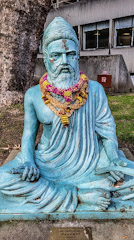
Call me ignorant but I had never heard of Thiruvalluvar, whose bust stands in a garden next to the School of Oriental and African Studies in Bloomsbury. According to a plaque next to the bust, this man was author of “Thirukkural”, which was a classic of Tamil philosophy and ethics. The bust was donated by the Governent of Tamil Nadu in 1996, and unveiled by the then Indian High Commissioner Dr ML Singhvi. Celebrated as he is in Tamil Nadu, little is known about his life. It is possible that he was born or lived in Mylapore (now a district of Chennai) in the south of India. According to Wikipedia:
“His work Tirukkuṟaḷ has been dated variously from 300 BCE to about the sixth century CE.”
As for his great work “Thirukkural”, the online version of Encyclopaedia Britannica remarked:
“…Tirukkural (“Sacred Couplets”), considered a masterpiece of human thought, compared in India and abroad to the Bible, John Milton’s Paradise Lost, and the works of Plato.”

I have described monuments to three notable men from India, but omitted one woman, whose memorial is close to those already described. The WW2 heroine Noor Inayat Khan (1914-1944) is commemorated by a bust, which, surprisingly, I have never noticed, in Gordon Square. Sculpted by Karen Newman, it was placed in the square in 2012. This artist also sculpted a bust of Violette Szabo (1921-1945), which is on the embankment of the Thames near Lambeth Palace. Both Noor and Violette worked for the British SOE, and perished in Nazi concentration camps.
Once the epicentre of the British Empire, it is not at all surprising that one comes across memorials to notable Indians whilst wandering about in London and other places in the UK.

Meeting Mahatma Gandhi in 2023

INDIA BECAME A REPUBLIC on the 26th of January 1948. Every year since then the 26th of January has been a public holiday known as Republic Day. On the 25th of January 2023, we met a senior advocate sitting in the Gujarat Club, which is next door to Ahmedabad’s Civil & Sessions Court. After showing us around the court building, he invited us to join him and his colleagues for the next day’s celebration.

The Republic Day celebrations began in the garden of the Court building at 9 am. A few soldiers, some of them armed with automatic rifles, arranged the flag raising. At 9 o clock, the Indian flag was unfurled by one of the senior judges, wearing a colourful pugree on her head, in front of a large group of senior advocates and some of the court’s staff. Many of the female advocates were attractively dressed in saris decorated with the colours of the Indian flag (green, saffron, and white). One of the ladies told us that 25 of these had been specially ordered from Agra.

When the flag was unfurled at the top of the flagpole, everyone sung the national anthem,”Jana Gana Mana”. Then everyone began taking photographs of one another. After this, we moved en-masse from the court garden to the compound of the Gujarat Club, where Mahatma Gandhi met Vallabhai Patel for the first time.

You can imagine my astonishment when I saw an elderly man who looked just like Mahatma Gandhi, both in physiognomy and in his manner of dressing. Holding a wooden staff and dressed in a white dhoti, sandals, and a shawl, he was a highly credible Gandhi lookalike.

Residing in the USA, this Gandhi impersonator has attended many Indian patriotic ceremonies. To date, he has appeared in 35 in the USA and about 60 in Ahmedabad. His presence was a huge success. Everyone wanted to be photographed alongside him. With his sturdy staff in one hand, he held his mobile phone in the other. Had they been available, I wonder whether the real Mahatma would have been happy to use one.

The lookalike took part in the Club’s flag raising ceremony, giving a short speech. After the ceremony was over, we were invited to join the advocates for a special breakfast in the Club. We were served jelebis, ganthia, kadhi, and shredded raw papaya with whole green chillies.

We were very happy to have been invited to join the advocates in their extremely enjoyable celebration of Republic Day at the Gujarat Club. This occasion increased my already great affection for the lovely city of Ahmedabad.

Geometric and meaningful

BETWEEN A ZOROASTRIAN (Parsi) well and Churchgate railway station, both in central Mumbai, there stands a wonderful steel sculpture, which was financed by the Tata company (named after its Parsi founder).

The sculpture, completed in 2011, is the creation of the architect Nuru Karim and colleagues. Consisting of two closely placed spirals, it rises to a height of 11 metres. The spirals are formed using a set of triangular frames made of a type of Tata steel alloy.

The sculpture is named ‘Charkha’, which means ‘spinning wheel’, and refers to the spinning wheel which Mahatma Gandhi encouraged his followers to use to help make India self-sufficient and less dependent on British imported textiles. Each of the triangles are unique. Combined together in this sculpture, they are supposed to portray unity within diversity, and India’s rich mix of diverse cultures. In other words, the artwork is expressing the idea or hoped-for ideal that although a rich mix of different people, India is one united country.

Whether or not India has achieved this ideal, this sculpture is both aesthetically pleasing and a welcome addition to Mumbai’s incredibly rich mix of visual delights.