Memory of a great man

AMB 4


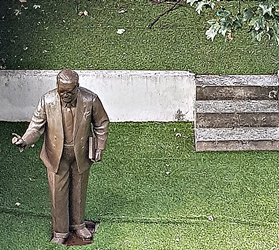
Almost wherever you go in India, you are bound to see the statue of a man wearing spectacles with round lens frames and a suit. He is always carrying a large book under his left arm. These statues depict Bhimrao Ramji Ambedkar, who was born in Mhow (now Dr Ambedkar Nagar in Madhya Pradesh) in 1891, son of an Indian army officer. He died in New Delhi in 1956. This remarkable man was a jurist, economist, politician and social reformer. He was a founding father of the Republic of India and helped formulate the Indian Constitution. He is best known for his work on promoting the rights of the ‘dalits’ (‘untouchables’) and reducing discrimination against them.

Ambedkar was awarded a doctorate by Columbia University (USA) in 1927, and another by the London School of Economics (‘LSE’) in 1922. He was called to the London Bar in 1922 as a member of Gray’s Inn. Later, he was awarded further degrees by Columbia University and Osmania University (in Hyderabad, India).

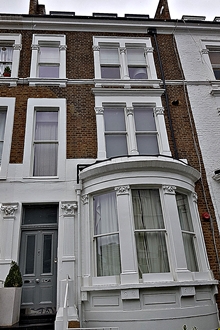
Between 1920 and 1922 while he was studying at the LSE and for the Bar, Ambedkar lived in a house at 10 King Henrys Road near Chalk Farm in north-west London. In 2015, the house was bought by the Government of Maharashtra and was then converted into a memorial to Ambedkar. It is open to the public. Visitors can learn about Ambedkar from the well-captioned photographs on the wall of the rooms that they can wander through. The upper floor contains a re-construction of Ambedkar’s bedroom including a four-poster bed, some of the great man’s books, and an old pair of spectacles, which might have belonged to him. Other rooms contain shelves of books and various memorials to Ambedkar. There is also a commemorative plaque to India’s present Prime Minister Narendra Modi, who inaugurated the memorial house in November 2015. The garden contains a typical statue of the type I have described above.

Sadly, this monument to such a great man is under threat. Some local residents have been complaining that it is annoying to have a museum amidst their overpriced bourgeois residences (see: https://www.bbc.co.uk/news/world-asia-india-49411985 ). Camden Council, in whose borough the Ambedkar house is located, are to decide on its fate at a hearing to be held in September 2019. I hope that the (racist???) objecting residents of King Henry’s Road will not be permitted to help to erase the memory of a truly great man’s stay in London.


FOR A FEW PHOTOS OF THE AMBEDKAR MEMORIAL HOUSE, CLICK HERE:
http://www.ipernity.com/doc/adam/album/1244852

Afghan cab drivers

Dolmus driver_240


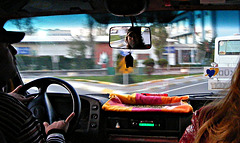
A few years ago, we hired a mini-cab (a type of taxi) to take us from Kensington to Golders Green. When we entered the cab, we heard music being played on the car’s cassette player. It sounded Russian to me. I asked the driver about it and he confirmed that it was Russian. He told us that he was from Afghanistan and had lived in Russia for a couple of years before settling in London. We began chatting as we drove northwards towards Golders Green. He told us that during the day he sold shoes in his own shop and drove his cab in the evening. We engaged in an amicable conversation.

When we arrived at our destination, I asked how much we owed him. He said:

“Nothing at all.”

“But, we must pay you something,” I said.

“No, nothing. You are my friend. I cannot ask you to pay me,” he explained.

For a few moments, I was flummoxed, at a loss as how to proceed. On the one hand, he said he did not want to be paid. On the other, he had done a good job for us, which needed rewarding. Then, I said to him, handing over a £10 note:

“If we can’t pay you, take this as a present for your children.”

He accepted the money without objection. £10 was the normal fare for that journey in those days.

We booked another mini-cab for our return journey. By coincidence, it was driven by someone from Afghanistan. Although he was not as friendly as the outward bound driver, there was nothing to complain about him. When we arrived at our home, we asked him how much we owed. He answered:

“Anything you like.”

I paid him the £10, which we usually pid for that journey, and the driver was happy with that.

Shortly before that day of Afghan mini-cab drivers, I had finished reading a book about travelling in Afghanistan., An Unexpected Light: Travels in Afghanistan by Jason Elliott. In it, he describes shopping in rural Afghanistan. The customer is not quoted a price, but has to make an offer. If the offer is too low, the seller will look insulted and hurt. If it is too high, everyone else in the shop will laugh at the customer. I suspect that it was on this basis that the two mini-cab drivers operated with us. They must have detected our familiarity with eastern ways and customs. Had we been typical Anglo Saxon customers, they might have simply quoted a price.

Keep it clean

close up of menu


We entered a popular Thai restaurant, part of a chain, in London’s West Hampstead and waited for our friends to arrive. As they were taking a long time to reach us, we ordered some prawn crackers to quell our pangs of hunger. They arrived quickly with, much to my surprise, a couple of gooey dipping sauces.

The rather unfriendly waitress who delivered our snack, pushed our cheaply produced paper menus aside and said with an abrupt tone of voice:

“Don’t dirty the menus with the sauces.”

I was surprised. Never before in over sixty years of eating regularly in restaurants all over the world have I been asked, nay ordered, to keep the menu clean. I felt that this order to maintain the integrity of the menus to be unwelcome, unfriendly, and impolite.

After eating a revoltingly over sweet meal, I told the waitress about my disgust at her extraordinary instruction when she delivered the prawn crackers. She seemed unfazed by my complaint. I will never ever enter that restaurant again! 


Photo by Terje Sollie on Pexels.com

Behind closed doors

avometer


What sparks off an enduring interest in something? I do not know the answer, but let me describe how just one of my interests became ignited.

When I entered Highgate School in north London at the age of 13 years, we were obliged to study both physics and chemistry. The classes for these subjects were held in large laboratories whose walls were lined with locked glass-fronted cupboards filled with a wide variety of scientific equipment and, in the case of the chemistry labs, jars of chemicals in a variety of colours.

At the age of about 15, that was in the late 1960s, we had to make decisions about the nature of our future studies. If you wanted to study science, you kept on classes in chemistry and physics and dropped geography and history. For a course in the arts, you kept on classes in geography and history and dropped the two science subjects. I decided on science. You may wonder why.

It was only the desire to find out more about the stuff locked in the glass-fronted cupboards that made me choose the science course. It was as simple as that! I enjoyed studying scientific subjects and continued to do so until I had completed a doctorate in one of them (mammalian physiology).

Many decades later, I revisited Highgate School and was taken on a tour of its buildings including the Science Block. I noticed that the cupboards in the chemistry and physics laboratories had been replaced. Gone were the glass-fronted cabinets. They had been replaced by cupboards with opaque doors. The contents of these wall mounted cabinets could not be seen without opening their locked doors.

I wondered whether I would have chosen to study the science subjects had I been taught in the newer laboratories where everything was hidden from view.  


Image source: ebay

A house in west London

140 small SINCLAIR


Number 140 Sinclair Road in west London, not far from Shepherds Bush Green, looks like an ordinary Victorian terraced house, which it is. However, in the first decade of the twentieth century it was home to a few Indian freedom fighters. When the seventeen year old David Garnett, the writer and a future member of the Bloomsbury Group, visited the house in 1909, he met Bipin Chandra Pal (1858-1932) the Bengali nationalist and a father of the Swadeshi movement, which promoted Indian economic independence. He shared the house with his son Niranjan Pal (1889-1959), a young Indian freedom fighter who was to become a founder of the Bombay Talkies film company. Sukhsagar Dutt (1890-1967), a young Indian revolutionary and brother of Ullaskar Dutt who was involved in the use of bombs in Bengal and Bihar and tried at Alipore (Calcutta), also lived at number 140.

In mid to late 1909, VD (‘Veer’) Savarkar (1883-1966) also lived at 140 Sinclair Road as a lodger of Bipin Chandra Pal. Savarkar, who was studying law at the time, was deeply involved in activities aimed at attempting to cause the British to leave India in order that the country became a sovereign nation. Savarkar is now best known for his contributions to the encouragement of Hindu nationalism. His book “Essentials of Hindutva”, published in 1923, is considered a seminal work by promoters of Hindu nationalism.

Savarkar moved from India House in Highgate, a centre of revolutionary Indian independence activists, to 140 Sinclair Road sometime in 1909 before the assassination in London’s Kensington of a senior Indian administrative figure, Sir WH Curzon Wyllie, in July 1909. The victim was shot at close range by Madan Lal Dhingra, a close associate of Savarkar. Savarkar was suspected of having some involvement in the plotting of Curzon Wyllie’s demise. Savarkar’s host in Sinclair Road, Bipin Chandra Pal, was firmly against what Dhingra had done, but accommodated Savarkar, who was pleased that the assassination had been successful until, as I wrote in my book “Ideas, Bombs, and Bullets”:

“… an angry crowd gathered outside, the house, Pal had to tell them that apart from being a paying guest, Veer had no other association with him. Another resident at this address, Pal’s son Niranjan, was a close friend of Veer’s and a regular visitor to India House. Niranjan’s association with India House worried Bipin greatly…

Soon after this, Savarkar shifted his home in London to a flat above an Indian restaurant in a now non-existent alleyway in Holborn.

From what I have described, the seemingly ordinary terrace house at 140 Sinclair Road has played a small role in the history of India’s struggle for freedom from the British, which was eventually gained in August 1947.

For much more information about Indian patriots in Edwardian London, I invite you to read my recently published book, “Ideas, Bombs, and Bullets”, which focusses on the Indian patriots who congregated at India House in Highgate between 1905 and 1910.


A SMALL house cover


This publication is available at:

http://www.lulu.com/shop/adam-yamey/ideas-bombs-and-bullets/paperback/product-24198568.html

or:

https://www.bookdepository.com/IDEAS-BOMBS-BULLETS-Adam-YAMEY/9780244203870

(paperback)

and

https://www.amazon.com/dp/B07W7CYKPG/

(Kindle)

An Enquiring Mind

blahnik


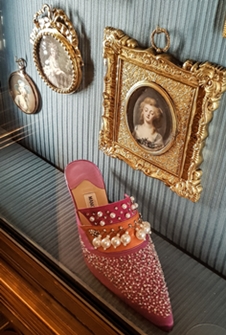
People who know me well, or even not so well, would be surprised to learn that I greatly enjoyed an exhibition of designer footwear.

The designer is Manolo Blahnik (born 1942 in Santa Cruz de la Palma, Spain), whose father was Czech and mother Spanish. His rapid rise to fame in the field of footwear design began in the early 1970s. 

The exhibition called “An Enquiring Mind” is being held at the Wallace Collection in London until the 1st of September 2019 and should not be missed.

According to a leaflet about the exhibition, Blahnik has been long inspired by the  collection of diverse fine artworks (paintings, sculpture, furniture, porcelain, armour, etc.) on display in the rooms of the Wallace Collection. The shoes he designs, especially those on display at the exhibition, reflect the artistic finesse and skillfulness of the Collection’s permanent works.

The footwear in the temporary exhibition is tastefully arranged amongst the Wallace Collection’s artworks. If one dd not know that the shoes were designed and  made in the last 50 years or less, you would believe that they came from  earlier eras when most of the Collection’s artworks were created. The shoes mingle harmoniously with creations made several hundreds of years earlier. Not only that, but also they are displayed very artistically, making the temporary exhibition a joy to the viewer.

So, even if you, like me, are put off by the idea of an exhibition of shoes, please try to make it to this superb exhibition.

A Dream


The first time I saw a performance of Shakespeare’s A MIDSUMMER NIGHTS DREAM was in the 1960s in north London (Big Wood in Hampstead Garden Suburb). It was performed by an amateur dramatic group in a clearing in a small wood. There were barely any props. The actors appeared and disappeared in and out of the trees growing around the clearing. It might not have been the very best of renderings of the play, but I found it highly enjoyable and magical. Whenever I think of the Dream, I remember that show in the woods, so long ago, with much fondness. 

Since that magical summer evening in the wood, I have seen several more performances of the play, but none of them managed to recapture for me the magical experience  that was created for me by my first viewing of the work.

A few days ago, I watched yet another performance of the Dream. This time it was at the lovely new Bridge Theatre next to the southern end of London’s Tower Bridge. The staging and acting was brilliant. The Director, Nicholas Hytner, had ‘tweaked’ the play slightly but successfully to make it more accessble to contemporary audiences. I hope that Shakespeare would have approved of this latest version. I feel that he might well have done. The ‘show’ was livened up with acrobats, who were not only superbly skilful but also great actors with clear diction, and much music. Despite these additions, the Bard’s original words were not sacrificed or edited in any noticeable way. It was not merely a play, but  a spectacular extravaganza.

There was one aspect of the performance that I did not like. The play was performed ‘in the round’ on an arena where there would normally be stalls seating. Many people had bought tickets to stand on the stage in order to take part in an immersive performance. The actors mingled with the crowd of spectators standing on the ‘stage’. Assistants and the actors themselves shifted the crowds around to make spaces for props and passages through which the actors could move. It was a case of, to use the Bard’s words, “All the world’s a stage…”. This seemed to be very popular with both the audience members immersed in the drama as well as the rest of us sitting in seats. I was not keen on watching a play where the actors are surrounded by swarms of spectators. I felt that the latter diluted the action and were a bit of a distraction. The immersive theatre technique disturbed me, but most of the rest of the audience approved of it.


My picture shows the actors and audience mingling together at the end of the play