AL SAQI BOOKSHOP in London’s busy Westbourne Grove occupies a shop with a façade that would not look out of place on a palazzo on the Grand Canal in Venice. I have already described the interesting history of this building elsewhere (https://adam-yamey-writes.com/2020/10/18/the-story-of-a-bookshop/).
62-64 Westbourne Grove, London
Further west along the Grove, well past the Planet Organic ‘wholefood’ store and Alounak, one of the Grove’s several Persian restaurants, we reach number 62-64, whose façade is almost as grand as that of Al Saqi. Unlike the latter, this building’s history is harder to ascertain. Currently, it is the premises of Aveda, a beauty salon also called Gina Conway Salon Spa. The ground floor façade of this edifice includes neoclassical columns with Doric capitals, and decorative mouldings, which include the letters ‘C’, ‘L’, and ‘M’. These are intertwined to form a logo. The first floor is fronted by three large arches separated by decorative mouldings and the top storey has three sets of windows set back behind lintels supported by short columns with Doric capitals. The salon, although modernised to suit its current purpose, has its original elaborately decorated moulded plaster ceiling and wall mouldings, some of which depict the heads of angels or putti. Nobody in the salon had any ideas about the history of this attractive building.
A photograph in the London Metropolitan Archives describes number 62 as having an Edwardian façade. When this image was created in 1974, the building was a branch of the Midland Bank, which occupied its western two thirds. The eastern third of the place was the premises of The French Kitchen and Tableware Supply Company. The bank was already in existence at this address in 1940. What was there before the bank occupied the edifice and when exactly it was built, I have not yet discovered. The building is marked as a bank on a detailed map surveyed in 1914, but not on one surveyed in 1893. However, Allan & Mortons Street Directory of 1867 revealed that number 62 was then the address of Dr Barry, who practised homeopathic medicine. Both the 1893 and the 1914 maps mark the building west of number 62-64 on the corner of the Grove and the western arm of Newton Road as being a bank at those times. This building currently houses Farmacy, a vegan eatery.
The logo ‘LCM’ on the old bank stands for ‘London, City, and Midland’, a bank founded in 1898, which was renamed the London Joint City and Midland Bank in 1918 and then the Midland Bank in 1923 (www.gracesguide.co.uk/London_City_and_Midland_Bank). In the absence of any more information and in view of the fact that the architectural historian Pevsner regarded it as “Edwardian”, it might be safe to conclude that the present building at 62-64 Westbourne Grove was originally constructed to house a bank sometime during the reign of Edward VII, i.e., between 1901 and 1910, and certainly before 1918.
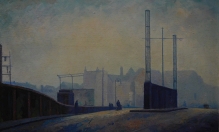
RECENTLY, WE DROVE to Southend-on-Sea in Essex to see an exhibition, “Brothers in Art”, at the town’s superb Beecroft Art Gallery. There, we enjoyed visiting a temporary exhibition of the paintings of two artists, about whom we knew nothing: the brothers Walter (1908-1997) and Harold (1911-1971) Steggles. They were members of the East London Group of artists, East End workers who created and exhibited together between 1928 and 1936. Influenced by the artists John Albert Cooper (1894-43) and Walter Sickert (1860-1942), the group produced pictures that often-depicted everyday scenes and mundane sites in a joyful way.
The Steggles were born in Ilford (east London), sons of the manager of a high-class footwear store in London’s Strand. They were not born into a family that had any history of artistic talents. At an early age, the brothers began visiting art exhibitions, including, in 1925, one at the Bethnal Green Men’s Institute Art Club at the Bethnal Green Museum. This led them to join the art classes there. Walter was 17 and Harold was 14. Unhappy with the classes at Bethnal Green, they joined the art classes conducted by John Cooper at the Bromley & Bow Institute. He encouraged the brothers to paint scenes near the institute. Soon they became members of the East London Group.
In 1928, the Group held an exhibition at the Whitechapel Art Gallery. The brothers exhibited several of their paintings at this prestigious public art venue. Many influential members of the art scene attended the show, one of them being the then director of the Tate Gallery. Several of the brothers’ paintings at the exhibition were acquired by the Tate.
The East End Group also held regular exhibitions at the Lefevre Gallery in London’s West End. The gallery, which existed from 1926 until 2002, represented leading artists including, to mention only a few, Seurat, Matisse, Degas, Picasso, Dali and Kandinski. The two brothers:
“… found themselves part of a cosmopolitan artistic milieu that included Ben Nicholson, Charles Ginner, Philip Wilson Steer, George Braque and Raoul Dufy … Before long they found themselves sought after by other galleries and Harold became a protégé of the flamboyant aesthete Eddie Marsh who lived near his office in Gray’s Inn as well as accepting a prestigious commission from Villiers David to paint the gentlemen’s clubs of St James.” (https://spitalfieldslife.com/2017/07/26/harold-walter-steggles-artists/).
Harold recalled that the first picture he sold was bought by the highly influential art dealer Sir Joseph Duveen (1869-1939) and was hung at the Tate Gallery in 1929. In 1936, Walter had one of his paintings exhibited in the Venice Biennale.
Walter and Harold sold their paintings and became prosperous enough to buy a car. This allowed them to make forays into East Anglia where they painted things they saw. Some of these East Anglian scenes were on display at the exhibition in Southend alongside their paintings of sights in London; many of these places have disappeared since WW2. Both Walter and Harold were commissioned by the Shell petrol company to create posters. These display places in England, beautifully depicted. Several of these were also on display.
Even though the brothers were successful as artists, they had to continue working in non-artistic jobs to gain a sufficient income. When Walter retired, he was able to concentrate fully on painting.
With the death of John Cooper in 1943, the East End Group declined and the works it had created faded from the artistic world’s limelight. What the group created was not as excitingly innovative as the art produced by the now better-known artists, some of which I mentioned above. However, the work of the Group and, in particular, of the Steggle brothers is of high quality and very pleasing aesthetically. It was well worth trekking out to Southend to see their paintings.
THE SHORT-LIVED POET, John Keats (1795-1821) resided briefly in Hampstead in what is now called Keats House. In my new book, “Beneath a Wide Sky: Hampstead and its Environs” *, Keats:
“… took a great liking to Hampstead and settled there in 1817. He lived in Wentworth House, which was later renamed ‘Keats House’. The house in Keats Grove was built in about 1815 and divided in two separate dwellings. One half was occupied by Charles Armitage Brown (1787-1842), a poet and friend of Leigh Hunt and the other half by Charles Wentworth Dilke (1789–1864), a literary associate of Hunt and a visitor to his home in the Vale of Health. Keats became Brown’s lodger. This was after Keats had visited his neighbour Dilke, with whom he became acquainted following an introduction by the poet and playwright John Hamilton Reynolds (1784-1852), who was part of Leigh Hunt’s circle of friends.”
Keats remained in Hampstead until 1820, when, ailing, he left for Italy to try to improve his health. Leigh Hunt (1784-1859), who lived in Hampstead’s Vale of Health, noted in his autobiography that Keats died in Rome and was buried in the English Protestant cemetery near the monument to Gaius Cestius. Amongst his graveside mourners was the poet Percy Bysshe Shelley (1792-1822), who also had spent time in Hampstead.
Had Keats not travelled to Italy, he would have probably died in Hampstead. If that had been the case, it would have been likely that he would have been buried in the graveyard of St John’s, Hampstead’s parish church on Church Row, where the artist John Constable rests in peace.
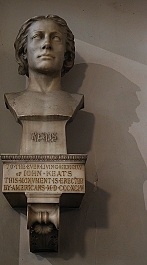
Bust of Keats in St Johns, Hampstead
Within the church there is a memorial to Keats, a bust, dated 1894, within 100 years of the poet’s birth. A gift from admirers of Keats in the USA, it was the first memorial to Keats in England. The story of the bust is related on the church’s website (https://hampsteadparishchurch.org.uk/data/keats_bust.php) as follows:
“Anne Whitney, a Boston sculptor (1821-1915) carved her original bust of Keats in 1873. The marble bust was inscribed Keats and not signed. It was exhibited the same year at Doll and Richards, Boston. It was owned by the artist until 1915 when it was bequeathed to Fred Holland Day. Day exhibited it at Boston Public Library in the loan exhibition of his Keats memorabilia in 1921 to mark the centenary of the poet’s death. The Keats bust was given by Fred Holland Day to Keats House and Museum shortly before he died, and its arrival was acknowledged by Fred Edgcumbe the curator of Keats House and Museum on 2 November 1933, the day of Day’s death. The marble replica of the bust inscribed KEATS AW (monogram) 1883 was carved by Anne Whitney in 1883. It was exhibited by F. Eastman Chase, Boston, and presented by Americans, as the first memorial to Keats on English soil, to Hampstead Parish Church on 16 July 1894. The bust remained in position until March 1992 when it was stolen. It was seen by Judith Bingham, the composer, when it was about to be auctioned at Finchley in May 1992. It failed to reach its reserve, Judith Bingham recognised its identity and it was returned to the Parish Church.”
The Keats bust is near the Lady Chapel, in which I saw a remarkable painting by Donald Chisholm Towner (1903-1985), who lived in Hampstead, in Church Row from 1937 until his death. The church’s guidebook revealed:
“The Altar Piece in the chapel was painted by Donald Towner of Church Row, in memory of his mother. True to the medieval tradition Towner used a local resident as the model for Mary, his nephew for John and his own mirror image for Christ.”
What is remarkable is that the three figures are depicted standing in Church Row. St John’s church can be seen in the background.
Apart from the bust and the painting, the church is well worth visiting to see its lovely architecture and to enjoy its peaceful atmosphere.
AUBREY WALK IS a short street in Kensington. About 260 yards in length, it leads west from Campden Hill Road. Originally, it was the approach road to Aubrey House. Until 1893, when it was given its present name, the short stretch of road was named ‘Notting Hill Grove’ (https://www.british-history.ac.uk/survey-london/vol37/pp87-100#h3-0006).
St George, Aubrey Walk
Aubrey House, at first known as ‘Notting Hill House’, was completed by the end of the 17th century. It is at the western end of the street and was attached to some springs with medicinal properties: the Kensington Wells. In the mid-18th century, the house was enlarged by its then owner, Sir Edward Lloyd. The house and its extensive grounds passed through the hands of many different owners. Between 1767 and 1788, it was the home of the diarist and political observer Lady Mary Coke (1727-1811), the daughter of the second Duke of Argyll. By the mid-19th century, it acquired its present name, Aubrey House, to commemorate Aubrey de Vere, who owned the manor of Kensington at the time of the Domesday Book.
In 1863, the house became the property of a politician and Member of Parliament Peter Alfred Taylor (1819-1891). He was a radical, a supporter of the northern states in the American Civil War, and an anti-vaccinationist. A website, british-history.ac.uk, noted:
“Peter Alfred Taylor was M.P. for Leicester from 1862 until 1884 and was a noted champion of radical causes. His wife Clementia was also famous as a philanthropist and champion of women’s rights. They were closely involved in the movement for Italian liberation and Mazzini was a frequent visitor to Aubrey House. In 1873. Taylor sold the house to William Cleverley Alexander, an art collector and patron of Whistler.”
The Taylors opened the Aubrey Institute in the grounds of the house. This was to improve the education of poor youngsters. WC Alexander (1840-1916), who bought the property, employed the artist James Abbott McNeill Whistler (1834-1903) to decorate the walls of the reception rooms of the house. Sadly, today, all that the public can see of the house, which is now a private residential complex, are glimpses over the outer wall of the roof and the upper storey windows.
Aubrey House used to be neighboured by the now demolished Wycombe Lodge and its large garden. In its place, there is a set of recently built houses arranged around a rectangular open space. This is called Wycombe Square.
Walking east from the wall of Aubrey House, we pass several places of interest including Wycombe Square. On the south side of Aubrey Walk is the club house of Campden Hill Lawn Tennis Club. This was founded in 1884, only seven years after the first championship competition at Wimbledon. Its twelve courts, six outdoor and the others indoors, are not visible from Aubrey Walk. Almost opposite the club, numbers 38-40, a 20th century art deco style building, contains the former home of the singer Dusty Springfield (1939-1999), who resided there from 1968 to 1972.
At the eastern end of Aubrey Walk there is the distinctive Victorian gothic church of St George (Campden Hill). In the middle of the 19th century, the area between Kensington Church Street and Campden Hill Road, the area containing Uxbridge Street, Hillgate Street and Place, and other small lanes, was a slum. It was where labourers in the nearby gravel pits and brickfields lived, often with several families in one tall, narrow house. Many of the folk living in this locality were destitute, which is difficult to imagine when you look at the place today. It was decided to build a church nearby to cater for the poor people living in this deprived area. This became St George’s on Aubrey Walk. The first church was an iron building, a large hut, which had been used by soldiers as a chapel on the Crimean War battlefields.
In 1862, the Vicar of St Mary Abbots, the parish church of Kensington arranged to break up his huge parish into smaller units, one of which became the ecclesiastical district of St George. John Bennett, a local builder, financed the construction of a church to replace the iron structure. The first stone of the present church, which can accommodate 1500 people, was laid in 1864. Its architect was Enoch Keeling (1837-1886). The building he designed is a rare example of ‘continental gothic’, also known as ‘Eclectic Gothic’. This style makes use of brick and stonework of various colours, both externally and internally. Its exterior gives an Italianesque impression. This is especially the case when you look at the prominent bell tower at the southeast corner of the church.
St George’s was actively involved in providing education, and social work (including a soup kitchen on Edge Street) to its congregation who lived in the nearby slums. It also played a major role in the Temperance Society, which served Kensington, Notting Hill, and Shepherds Bush. Before WW1, services at St George’s were well-attended, and a wide range of music was played. Writing in a booklet about the church, its authors, Tom Stacey and Ivo Morshead, noted:
“Elaborate settings for the choir were juxtaposed with favourites from ‘Hymns Ancient and Modern’ … The repertoire consisted of works by Stanford, Goss, Barnby, and Handel … St George’s was hardly classy at this time but it sang the same music as its more fashionable contemporary churches … Perhaps the music was above the heads of some of the congregation; yet St George’s remained a full church until the outbreak of the 1914 War.”
By the 1890s, the people that attended services at St George’s were becoming more similar to those living in other parts of Kensington because slowly but surely housing conditions were being improved and what had been a ‘down and out’ part of Kensington was ‘coming up in the world’. Many of the former slum dwellings just east of St George’s are still standing, but instead of being the residences of the poor, they are the much sought-after homes of the wealthy.
In nearby Kensington Place, east of the church, stands the parish hall, St George’s Hall. In 1901, the Victorian building was, according to a plaque affixed above its main entrance:
“… acquired and altered to commemorate the glorious reign of Her Majesty Queen Victoria born at Kensington Palace May 24: 1819”
It is now used for residential purposes.
Aubrey Walk, although short in length, has several interesting sights. In the 19th century, it linked two social extremes. At the western end was the fabulous Aubrey House and at the eastern end, the poor of Kensington flocked to attend services in St George’s Church.
ST JOHN’S IS the parish church for the C of E parish of Hampstead. The present building, designed by Henry Flitcroft and John Sanderson, was dedicated in 1747. It stands on Church Row, which is lined with elegant 18th century houses and links Heath Street with Frognal.
Church Row, Hampstead, London
The church is at the northern edge of a graveyard well populated with funerary monuments, including the grave of the artist John Constable (1776-1837). This grave is in the old part of the church’s cemetery, which was hardly used after 1878, when it was officially closed. A larger, newer graveyard is on a sloping plot across Church Row and north of St John’s. This is the burial place for a host of well-known people as well as the family of Hampstead’s Pearly Kings and Queens.
When I used to visit Hampstead in the 1960s and early 1970s, I used to ‘haunt’ a most wonderful second-hand bookshop on Perrins Lane, which leads east from Heath Street. It was owned by an old gentleman, whose name, Francis Norman, I only learnt many years after he died. Recently, I met a member of Mr Norman’s family. He told me that Mr Norman died in 1983 and is buried in the cemetery at St Johns, describing the location as: “by a wall near Harrison and the children’s playground”.
I was not sure to whom he was referring when he mentioned “Harrison”. At the church, we asked a lady about Mr Norman’s grave. Hearing that he had died in 1983, she suggested that we looked in the newer part of the cemetery. This has a wall that borders a children’s playground. When I looked around carefully, I found neither any monument to Harrison nor Norman’s gravestone.
On returning to the church and explaining our unsuccessful quest, the lady sent me to see another church official, who was working in an office attached to the church. This lady knew exactly where Mr Norman was buried. She took me into the older part of the cemetery and showed me the gravestones of Francis and his wife Sonia, which lie next to each other. They are next to a small wall and close to a large monument to the clockmaker John Harrison (1693-1776). He was the inventor of a marine chronometer, which solved the problem of how to ascertain longitude whilst at sea. His story can be read in “Longitude” by Davina Sobell. Norman’s grave is not far from that of John Constable.
Francis and Sonia Norman are amongst the few people buried in the old cemetery after it was closed in 1878. My helpful informant at the church did not know why they had been interred there instead of in the newer part.
Francis Norman was a kindly, wise, and friendly fellow, who did not mind me and several of my friends spending hours in his shop, often spending very little on his extremely reasonably priced books. I have fond memories of the time that we spent in his presence, which are described in my book “Beneath a Wide Sky: Hampstead and its Environs” (https://www.amazon.co.uk/dp/B09R2WRK92). So, it was with great pleasure that I met one of his family and was able to pay my respects at his grave.
IN THE SIXTIES, there were at least six antiquarian/second-hand bookshops in Hampstead village. Two or three of them were in Flask Walk, a quaint passageway leading northeast from Hampstead High Street. Now, there is only one in Hampstead (apart from an Oxfam bookshop), and that is Keith Fawkes’s store on Flask Walk… currently, the last of the breed.
The amiable Mr Fawkes established his shop in 1964 when there were already a few dealers of second-hand books in the village. Over the years, he has branched out into antiques and bric-a-brac whilst retaining his well-stocked bookshop. It is a treasure house of interesting books, all packed into lines of shelving separated by corridors so narrow that it is difficult for one person to squeeze past another.
Very kindly, Keith Fawkes and his bookstore manager, Sam, have agreed to display and sell a few copies of my new book about Hampstead, “Beneath a Wide Sky: Hampstead and its Environs”, which is also available from Amazon (https://www.amazon.co.uk/dp/B09R2WRK92). While researching my book, Keith provided me with some information about another former Hampstead antiquarian bookseller, the illustrious Francis Norman, about whom I will relate more in a future post. Keith is acknowledged in my book.
So, next time that you are in Hampstead, do take a stroll along Flask Walk and look in at Keith Fawkes before having a pint in the nearby Flask pub, also mentioned in my book.
YESTERDAY, 22nd February 2022, we saw an exhibition at the Pace Gallery in central London’s Hanover Square. The gallery stands facing a conventional sculptural depiction of William Pitt the Younger (1759-1806), created in bronze by Sir Francis Chantrey (1781-1841). I have been reading a great deal about Pitt in a wonderful, recently published biography of King George III by Andrew Roberts. What is being shown in the Pace gallery until the 12th of March 2022 is far from purely representational, as the exhibition’s title, “Creating Abstraction”, suggests.
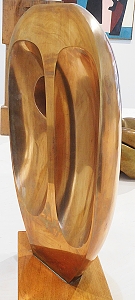
By Barbara Hepworth
The exhibition contains works by seven female artists: Carla Accardi (1924-2014), Leonor Antunes (b. 1972), Yto Barrada (b. 1971), Saloua Raouda Choucair (1916-2017), Kim Lim (1936-1997), Louise Nevelson (1899-1988), and Barbara Hepworth (1903-1975). Most of these names were new to me apart from Nevelson and Hepworth. The latter interests me greatly not only because one of her sculptures is near the gallery on the southeast corner of John Lewis’s Oxford Street department store, but also because for a while she lived and worked in an area that fascinates me: Hampstead.
There are several of Hepworth’s works on display at Pace. One of them, “Two Forms”, was created in 1934. By then, she had been living and working in Hampstead for about seven years. For the first few years, she was living with her first husband, the sculptor John Skeaping, and then after 1931 with her second, the painter Ben Nicolson. In 1939, she left Hampstead.
Hepworth was not the only ‘modern artist’ living in Hampstead in the 1930s. I have described the active and highly productive artistic scene in the area in my new book “Beneath a Wide Sky: Hampstead and its Environs”. I have also explained why it was that artists like Hepworth, her contemporary Henry Moore, and many others were attracted to Hampstead between the two World Wars. Their reasons for congregating in the area differed somewhat from those of earlier artists, such as Constable and Romney, who were attracted to the place many years before. Read my book to discover why Hampstead easily rivalled Montmartre in Paris as a ‘mecca’ for artistic activity. The book is available as a paperback and a Kindle e-book from Amazon: https://www.amazon.co.uk/dp/B09R2WRK92
MANY YEARS AGO, I read “The Gothic Revival” by the art historian Kenneth Clark (1903-1983). If I recall correctly, he wrote that it was likely that in Britain, the gothic style never truly died out before it came back into fashion in the 18th century. What we call ‘revival’ was merely the flaring up of the embers of the use of gothic designs, which had persisted despite the flowering of newer forms of architecture, such as neo-classicism. By the 19th century, the use of gothic motifs and structural features had fully revived, especially in the construction of churches and many other buildings, such as London’s St Pancras Station and the Prudential Building (near Chancery Lane).
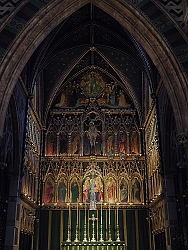
Today, the 22nd of February 2022, I revisited a slightly concealed church, All Saints, in Margaret Street, which runs north of Oxford Street and parallel to it. You can see its tall, tiled spire from afar, but the church itself is set back from the street in a courtyard. Externally, with its multi-coloured patterned brickwork it is eye-catching but inside it is fantastic.
The church was established by the Ecclesiological Society, which was founded in 1839 as ‘The Cambridge Camden Society”. The group’s aim was:
“… announced a plan to build a ‘Model Church on a large and splendid scale’ which would embody important tenets of the Society: It must be in the Gothic style of the late 13th and early 14th centuries; It must be honestly built of solid materials; Its ornament should decorate its construction; Its artist should be ‘a single, pious and laborious artist alone, pondering deeply over his duty to do his best for the service of God’s Holy Religion’ Above all the church must be built so that the ‘Rubricks and Canons of the Church of England may be consistently observed, and the Sacraments rubrically and decently administered’.”
The architect chosen was William Butterfield (1814-1900), who specialised in the ‘gothic revival’ style. The church was built on the site of a former chapel, and within the confined space available, it was accompanied by a choir school and a clergy house. The church’s spire, 227 feet high, is taller than the towers of Westminster Abbey.
The Victorian writer and art critic John Ruskin (1819-1900) was full of praise for Butterfield’s edifice in Margaret Street. He wrote about it in his “The Stones of Venice, Volume III” (published 1853), observing that it:
“…assuredly decides one question conclusively, that of our present capability of Gothic design. It is the first piece of architecture I have seen, built in modern days, which is free from all signs of timidity or incapacity. In general proportion of parts, in refinement and piquancy of mouldings, above all, in force, vitality, and grace of floral ornament, worked in a broad and masculine manner, it challenges fearless comparison with the noblest work of any time. Having done this, we may do anything; there need be no limits to our hope or our confidence; and I believe it to be possible for us, not only to equal, but far to surpass, in some respects, any Gothic yet seen in Northern countries.”
That was praise indeed.
The interior of All Saints is a riot of colour. This results from the use of stones of differing hues – some inlaid to create bold patterns and others to form images of biblical scenes, glorious stained glass, gilt work, and elaborate ironwork. This feast for the eyes must be seen to be believed. And this gem of Victorian architecture, a peaceful have and a joy to see, is merely a stone’s throw from the hustle and bustle of Oxford Circus.
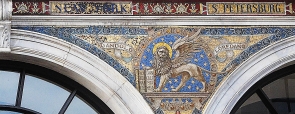
LONG BEFORE IT became the Apple Store on Regent Street in central London, I used to look at the colourful mosaics on its building’s façade. Running in a line along the top of the mosaics, which are above the four arches of the shopfront, are the names of several cities including St Petersburg. This used to intrigue me a lot in the years before Communist rule ended in Russia and the city was then called Leningrad.
The mosaics contain depictions of several coats-of-arms including and two lions, each resting a paw on an object. One of the lions has wings and rests its paw on an open book on whose pages are the words: “PAX TIBI MARCE ENVANGELISTA MEUS”. For, this creature is the lion of St Mark, symbol of Venice and its former empire. On both sides of the lion, there are depictions of streamers. One reads “DANDOLO” and the other “LOREDANO”. Both are the names of important patrician families in Venice. Two other crests also appear, one on each side of the winged lion and the two names. One is for the island of Murano and the other for the island of Burano. These two islands in the Lagoon of Venice, especially Murano, are known for their glassmaking activity.
The mosaics were originally installed when the Venetian glass-making company Salviati opened its store in this building, designed by GD Martin, on Regents Street in 1898. The business made both fine glassware and mosaics. Soon after the firm was founded in 1859, it began to be established in England. According to a company history (www.salviati.com/en/our-story/):
“It was also in London, on 21st December 1866, that the “Società Anonima per Azioni Salviati & C.” was established with the support of diplomat Sir Austen Henry Layard and historian William Drake.”
Fortunately, the lovely mosaic has survived and has been kept in good condition. I have always marvelled at it when wandering along Regent Street, but I wonder how many people rushing into Apple’s attractive looking shop notice it.
BEFORE WE MARRIED in 1993, many of our kind friends wanted to give us wedding presents. A large proportion of them wanted to choose gifts from a ‘wedding list’. For those who are unfamiliar with this kind of list, let me explain. A ‘wedding list’ is a list of items, usually available from a shop chosen by the bride and groom, from which those wishing to give wedding presents can choose. As the items are bought, the shop removes them from the list so that the likelihood of duplicate purchases is reduced.
We were a little reluctant at first, but people insisted that it would be helpful if we compiled a wedding list. We chose to have our list at a shop that we both enjoy visiting: Liberty on Great Marlborough Street, very close to Regent Street.
Above an entrance to Liberty shop
From the outside, Liberty looks like an extremely well-preserved example of Tudor architecture, too good to be true. It is not because it was completed in 1924.
Liberty was founded by Arthur Lasenby Liberty (1843-1917), son of a draper. In 1875, he opened his own shop on Regent Street. According to the Liberty website (www.libertylondon.com), he wanted:
“… a London emporium laden with luxuries and fabrics from distant lands, his dream was to metaphorically dock a ship in the city streets. To this day, a voyage of discovery awaits on the good ship Liberty, with history hidden amongst six floors of cutting-edge design, unexpected edits and beautiful wares from the world’s greatest craftspeople. In 1875, Arthur borrowed £2,000 from his future father-in-law and took a building on Regent Street, London with just three dedicated staff and plenty of ambition.”
By the time that Liberty opened his shop, the British public was fascinated by Japan and other parts of Asia. In 1885, he brought 42 villagers from India and set up a temporary ‘living village’ of artisans in the shop.
The website added:
“Liberty’s collection of ornaments, fabric and objets d’art from around the world proved irresistible to a society intoxicated at the time by Japan and the East and Liberty effected social change in interior design and dress, so much so that the Art Nouveau period in Italy is called ‘Liberty Style’.”
Liberty died before his new shop was completed. Designed by Edwin T Hall and his son Edwin S Hall, it was built in the Tudor Revival style that achieved great popularity in the 1920s. Not only is the shop’s exterior in the Tudor Revival style, but also its interior. A great dela of wood was used in the construction as the shop’s website revealed:
“… the builders Messrs Higgs & Hill were given a lump sum of £198,000 to construct it, which they did from the timbers of two ancient ‘three-decker’ battle ships. Records show more than 24,000 cubic feet of ships timbers were used including their decks now being the shop flooring: The HMS Impregnable – built from 3040 100-year-old oaks from the New Forest – and the HMS Hindustan, which measured the length and height of our Liberty building.”
Even if you do not wish to purchase anything from our long out-of-date wedding list, a visit to Liberty is rewarding not only to see the wonderful range of beautiful products on sale but also to narvel at the building and its many finely crafted decorative features.







 yamey
yamey 