HIDDEN IN A residential crescent, Philbeach Gardens, near Earls Court is a late Victorian church, whose exterior is far from attractive. However, St Cuthbert (completed 1888) has an interior which cannot fail to amaze the visitor’s eyes. The church contains what can only be described as an ‘over-the top’ array of decorative features. Some of them are typical of the Gothic Revival style beloved of Victorian church designers, and others that are typical of the Arts and Crafts Movement, which flourished in the last decades of the 19th and the first few of the 20th century.
One item in the church, which is particularly eye-catching, is made of wrought iron and hammered (repoussé) copper. It is a lectern with two large arms on either side of the leather-covered book holder. These are supports for large candles. The lectern is approached by a small set of stairs whose treads have studs on them. The studs are arranged to spell out words, which I found difficult to decipher. The part of the base facing the congregation is an intricately decorated folded screen with Arts and Crafts Style decorative motifs. Most probably handmade, the lectern, although fantastically crafted, has a very slightly amateurish look about it. It is more unusual and eye-catching than beautiful.
I would not have visited St Cuthbert had my friend, the excellent Olsi Qinami, not been conducting the London City Philharmonic Orchestra performing a concert there. The church with its colourful marble pillars and almost surreal interior is well worth a visit even if there is no concert being performed. It is a ‘must-see’ for lovers of Victorian church architecture.
THE VICTORIA LINE began carrying passengers in late 1968 when I was 16 years old. I remember when this happened and how exciting it was. Recently a new railway line opened in London: the Elizabeth Line. Originally named ‘Crossrail’, it began carrying passengers several years after it was supposed to have been completed. It is supposed to convey people from east of London to well west of the city. However, what exists now (July 2022) is not exactly what I expected. In order to travel from, say, Shenfield, at the eastern end of the line to, say, Maidenhead, west of London, you need to change trains at Paddington. Currently one section of the new line runs east from Paddington, and the other runs west from that station. Unlike Queen Elizabeth’s long continuous reign, the line named to honour her has a discontinuity at Paddington.
A visitor from abroad wanted to experience the new line today, a Sunday. He was looking forward to seeing the new station platforms on the line that heads east from Paddington. Sadly the section that fruns east from Paddington does not operate on Sundays at the moment. So, we had to head west. The Elizabeth Line trains are new, but the train follows tracks that were laid down as far back as the 19th century. Apart from being over efficiently air-conditioned, the new trains are comfortable and run remarkably smoothly.
We travelled (on a train bound for Heathrow Terminal 5) to Hayes and Harlington station, and from there headed to Barra Hall Park in the old part of Hayes. There, we enjoyed a picnic before walking to the mediaeval parish church, St Mary the Virgin. We had visited it once before, but were completely unprepared for what we saw this time. The hedges lining the path leading to the south door of the church were decorated with bunches of cut flowers. A cardboard cut-out of Queen Elizabeth II greeted us at the door. The lovely church was filled with attractively arranged bouquets of flowers. Quite by chance, we had arrived whilst the church’s 57th annual Festival of Flowers was being celebrated. We were fortunate because we arrived on the 3rd of July, the last day of the festival. The festival’s theme was “A Tribute to Queen Elizabeth”. How appropriate to have travelled to it on the Elizabeth Line.
THE ARTIST DAMIEN Hirst has given London’s art lovers a great gift. In October 2015, he opened his Newport Street Gallery (near Lambeth Bridge) to the public. Housed in a former theatre scenery workshop, which has been beautifully modernised, the gallery puts on a series of exhibitions of artworks (mainly paintings) from Hirst’s enormous personal collection, which he has been creating since the late 1980s. The current exhibition, “Cloud of Witness”, which ends on the 10th of July 2022, is of works by an artist born in Australia, who created many of his paintings in London: Keith Cunningham (1929-2014). I had never heard of him before seeing the exhibition.
Cunningham arrived in London in 1949 and enrolled at the Central School of Art and Design, where he aimed to improve his skills as a graphic designer. In 1952, having developed an interest in painting, he joined the Royal College of Art (‘RCA’), where he worked alongside now famous artists including Leon Kossoff, Joe Tilson, and Frank Auerbach. He exhibited in the prestigious London Group in 1956 and the two years following. This group had been formed as an association of modernist artists, who wished to escape the restrictive criteria of the Royal Academy. In 1964, he was invited to become a full member of the Group, but for unknown reasons he declined. By 1967, he had ceased exhibiting his work and was making his living as a graphic designer and teaching at the London College of Printing. Despite this, he continued producing paintings until his death. He kept his paintings hidden from view in a spare room. So, it is fortunate for us that Damien Hirst acquired many of them and put them on public display this year.
The Newport Street Gallery website (www.newportstreetgallery.com) describes his work succinctly:
“Cunningham’s paintings were produced in London during the post-war period, an artistic environment dominated by the likes of Francis Bacon and Lucian Freud. A student at the Royal College of Art in the mid-1950s, Cunningham worked alongside major artists such as Frank Auerbach, Leon Kossoff and Jo Tilson.
Cunningham’s sombre paintings, coated in layers of dense, sculptural brushstrokes, are populated by skulls, fighting dogs and darkly altered human figures. Like his schoolmates and teachers at the Royal College, Cunningham was interested in figurative painting, transforming the reality of everyday life into loose, slowly disintegrating forms.
His canvases, like those of Bacon, Kossoff and Auerbach, are covered in powerful strokes of dark pigments conveying strikingly expressive forms. The Cloud of Witness seeks to redefine Cunningham’s role in the London art scene of the 1950s, highlighting not only his ability but also the variety of his inspirations. To this effect, it coincides with the major show at the Royal Academy of Arts, Francis Bacon: Man and Beast, encouraging visitors to compare and contrast the works of these two artists.” Having already seen the Bacon exhibition at the Royal Academy and works by other artists mentioned in the quote, I feel that it is a good summary of what we saw at Newport Street. My favourite works in the exhibition were some of the portraits and some of the more abstract works. Undoubtedly, Cunningham was a competent artist, but having seen the exhibition, I can understand why he is not amongst the better-known artists of his generation
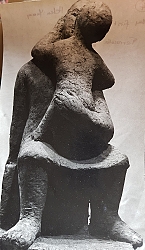
MY LATE MOTHER (Helen Yamey: 1920-1980) trained as a commercial artist in Cape Town (South Africa) before WW2. In 1948, she came to London to marry my father. In London, she painted and, according to my father, took lessons from the great Stanley Spencer (1891-1959). Around the time when I was born (1952), my mother began making sculptures. The first of these was a terracotta mother and child. Maybe, she was depicting herself with me in her arms. By the 1960s, she was working in the sculpture studios of St Martins School of Art, which was then near Foyles bookshop on Charing Cross Road. There, she was in the company of artists such as Anthony Caro, William Tucker, Philip King, and William Turnbull. At least one of these now famous artists taught my mother how to weld and solder.
My mother exhibited her works in important art galleries at least twice. In late 1961, she exhibited at the Institute of Contemporary Art in a show called “26 young Sculptors”. In 1962, she exhibited sculptures at the Grabowski Gallery, along side works by Maurice Agis and David Annesley. Although she sold a few of her creations, she did them more for pleasure than for profit.
My mother was a perfectionist. She destroyed much of what she created. However, at some time during the 1960s, she had a series of professional photographs taken of some of her mainly abstract works. These were kept in a yellow Kodak photographic paper box in a drawer in our home in Hampstead Garden Suburb. As a teenager, I used to look at them occasionally and wonder what became of some of the creations recorded in these photos.
My mother died in 1980 and my father remarried 11 years later. After remarrying, he and my stepmother moved from our home in Hampstead Garden Suburb to another house (near Primrose Hill). After the move, I used to ask him what had happened to the photographs of my mother’s sculptures and other family photos. Each time I asked, he would say that they were stored somewhere, possibly in the garage of his new home. After a while, I gave up hope of ever seeing these pictures again because it was clear to me that Dad had little or no interest in these photographs and in addition he could not imagine why anyone else would find them interesting. My father died, aged 101 and 6 months, in 2020. What with covid19 and its associated problems, we did not see his widow, my stepmother, again until recently this year (2022).
When, at last, we met her, she arrived carrying a plastic carrier bag, which she handed to me. To my great delight, it contained the box of photographs described above and another filled with family photographs taken mainly in the late 1950s. My stepmother told me that she had found them when she was sorting things in the garage of the house where she and my father had lived.
The photographs of my mother’s sculptures all bear the name of the photographer: Joseph McKenzie, ARPS (95 Blenheim Gardens, Wallington, Surrey). According to Wikipedia, Joseph McKenzie (1929-2015) is regarded as “father of modern Scottish photography”. More relevantly in the context of my mother’s works, he taught photography at the St martins School of Art.
Some of the photographs have notes written on their backs. The handwriting is my mother’s. One of the pictures, that of the mother and child has the words: “my first ever sculpture, terracotta, mother and child, 24””. Some of the other photos have information about the size and the material of the work depicted.
About 10 years before she died, my mother became disillusioned and practically gave up making sculptures. Although she made a few abstract images in pen and ink and a few carvings in alabaster, her abandonment of sculpture making as a full-time activity left a great hole in her life.
I have taken pictures of the photographs, and they can be seen on:
THE SYNAGOGUE IN Bayswater’s St Petersburg Place, a gothic revival edifice, looks no more exotic or out of place than the Victorian gothic Church of St Matthew built 1881-82 on the same street. In fact, it is another building to the north of these two that is unashamedly exotic in appearance: Aghia Sofia (Saint Sophia), the Greek Orthodox cathedral on Moscow Road. This domed building constructed for a community of prosperous Greek merchants was designed by John Oldrid Scott (1841-1913 and completed in 1877.
The first Greeks began arriving in London at the end of the 17th century. By the late 19th century (according to the website http://www.stsophia.org.uk), members of the Greek community in London:
“… were distinguished for their industry and their business acumen, and … soon became for the most part financially independent. They now wished to enjoy a more comfortable life, both for themselves and their families. They kept their offices in the City, but took up their private residences in other parts of London. The favourite districts were Lancaster Gate and Bayswater. These districts, which today are almost in the centre of the unending metropolis, were then only on its fringe, and to go from the City to Hyde Park, for instance, was considered a long excursion, which was undertaken, normally, only on holidays, as a relaxation and in order to enjoy the fresh country air.
After three decades had passed from the founding of the Church of Our Saviour [in the City near London Wall], no one any longer had his private residence in the City; and whereas previously all had lived within a very short distance of the Church, now five whole miles divided the Church from the residential district of the faithful.
For the men, in particular, who had every day to make the journey to the City, a tiring one with the means of transport then available, it was hard to undergo the same fatigue on Sundays also, when they were supposed not only to perform their religious duties, but also to rest from the labours of the week. Moreover, the number of the Greeks had greatly increased, and there was scarcely room for them all in the Church then existing. These various difficulties made it imperatively necessary to build a new larger Church, situated closer to the residences of the Brothers.”
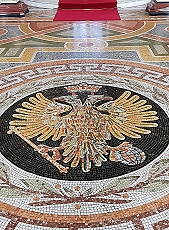
Just as the Jewish people, who had also settled in Bayswater, far from the older synagogues in the City and established a new one near their new homes, the Greeks did the same. Moscow Road’s St Sophia’s church interior is filled with icons and other religious paintings is colourful and attractive. Instead of frescos on the walls, which were believed to be at risk of damage from London’s damp climate, the church’s interior is lined with mosaics. Some of the earliest of these were designed by Arthur George Walker (1861-1939). In 1926, the Russian born mosaic artist Boris Vasilyevich Anrep (1883-1969) created some more mosaics for the cathedral. The marble floor of the edifice is also attractive.
KENSINGTON COURT IS between the Whole Foods department store and Curry’s electrical store, both on High Street Kensington. The doorway to a brick building with white stone masonry trimmings is beneath a carved stone notice that reads “Electric Lighting Station”.
This was an outhouse converted in 1888 to an electricity generating station by a local resident, an electrical engineer Rookes Evelyn Bell Crompton (1845-1940). According to the RBKC website (rbkc.gov.uk):
“A dynamo transmitted direct current on bare copper mains through subways to the houses to charge batteries or accumulators. This quickly expanded to become the Kensington and Knightsbridge Lighting Company, housed in a basement below street level and continuing as a substation until 1985. It has since been converted into private premises and the exterior restored. This quickly expanded to become the Kensington and Knightsbridge Lighting Company, housed in a basement below street level and continuing as a substation until 1985. It has since been converted into private premises and the exterior restored. ”
The original generating equipment was designed and installed by Crompton. Now no longer in use to produce electricity, it is an example of one of the earliest surviving generating stations in the UK.
WALKING BY THE THAMES along Chiswick Mall is always enjoyable whatever the weather. The landward side of the street is lined by houses, many of them well over 100 years old. One of them is called Said House. At first, I imagined that the ‘Said’ referred to someone or something in the Arab world, but it seems that this is not the case.
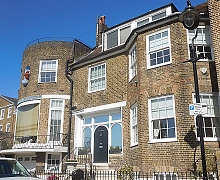
Said House on Chiswick Mall
The façade of Said House is dominated by an overly large bay window with a vast single pane of curved glass. The building’s earliest structures date back to the 18th century, but much has been done since to distort its appearance. Pevsner said that the building was Victorian, but “georgianised” in about 1935 by Darcy Braddell (or by Albert Randall Wells [1877–1942]). One of its early inhabitants was an artist, Katherine Parsons. The actor and theatre manager Sir Nigel Playfair (1874-1935) was also one of its inhabitants. It was for him that the modifications, including the western wing with its bay window, were made.
The origin of the house’s name is uncertain, but one source suggests that it is so-called because its title deeds refer to “the said house”. This is the only explanation of the name that I can find having searched the Internet thoroughly.
There is a terracotta urn in an alcove high above the bow window. A passer-by with a strong Irish accent despite having lived in Chiswick for 65 years told me that this was something to do with Josiah Wedgwood (1730-1795). This might possibly be the case, but I cannot be certain about it. Wedgwood’s associate Thomas Bentley (1731-1780) did live in Chiswick. According to Lloyd Sanders in his “Old Kew, Chiswick and Kensington” (published 1910):
“Bentley was in failing health when, in 1777, he took up his residence at Chiswick, possibly to be near his friend, and three years afterwards he died. He was buried in Chiswick church, where Wedgwood raised a monument to his memory with a medallion portrait by Scheemakers.”
I have not yet discovered precise location of Bentley’s house. But that should not stop you from taking a stroll along Chiswick’s lovely Mall and enjoying the glorious display of flowers in bloom especially during spring and early summer.
The pedestrian crossing signals in London’s Trafalgar Square are fitted with a variety of different green lights, such as can be seen in the two examples in the photograph. I have not seen these sorts of green signals anywhere else in London. They are a part of a project to promote ‘diversity’ in London.
SERAMPORE NEAR CALCUTTA was a Danish colony, or at least under Danish administration, between 1755 and 1845. It was then known as ‘Frederiknagore’. When we visited the place briefly in 2019, we were struck by the similarity of the type of design of its Church of St Olave (built 1806) and that of the far better-known St Martin-in-the-Fields (built 1721-26) on the east side of London’s Trafalgar Square. Although there are similarities between the two churches, there are also many differences. One of them is that the interior of St Olave’s is far plainer that that of St Martin’s. Even though many thousands of miles apart, there is a tiny aspect of Asia in the church on Trafalgar Square.
In the southwest corner of St Martin’s, I spotted a memorial, which aroused my curiosity. It is a simple green cloth-covered square notice board surrounded by a wooden frame in which various things are carved. These include the words “Requests for prayer”; carved plant motifs; Chinese pictograms; and the words “Praise God for his servant Florence Li Tim-Oi DD. 1907-1992. The first woman ordained in the Anglican Communion 25 January 1944”. There were several notices and a couple of plastic drinking cups pinned on the board.
Florence was born in Aberdeen, Hong Kong during a time that most Chinese parents favoured male children. However, her parents were unusual in that they challenged the then current prejudice against girls. As a student, she joined the Anglican church, probably after hearing a preacher (in Hong Kong) asking for women to dedicate their lives to working for the Christian ministry. At her baptism, she chose her English name, Florence, to honour the late Florence Nightingale. After studying at the Canton Theological College, she was eventually, in 1941, ordained as a deaconess. At that time, she was sent to the then Portuguese colony of Macau to help refugees fleeing there from war-torn China.
When the Japanese occupied Hong Kong, it became impossible for ordained Anglican priests to reach Macau. Although she was not yet ordained, Florence had to perform all the functions normally carried out by an ordained priest. In January 1944, she met Hong Kong’s Bishop Raymond Hall in an unoccupied part of China. There, the bishop, realising that there was no Anglican priest in Macau and that Florence had the ‘gift of priestly ministry’, ordained her as an Anglican priest. In so doing, on the 25th of January 1944, Florence made history by becoming the first woman to be ordained as an Anglican priest. This was 30 years before the ordination of women was permitted by the Anglican Church in the rest of the world. So, her ordination was frowned upon by some leaders of the Anglican Church.
After WW2 was over, Florence lived and ministered in China. In Maoist China, churches were closed (from 1958 to 1974), and during the so-called Cultural Revolution, Florence led a miserable life, as did many other Chinese people. She was sent to a farm to work with chickens and her home was raided several times. After a long time, she was allowed to retire from the farm and was given permission to leave China. In 1983, she was taken to Canada, where she assisted in the religious activities of a church in Toronto. By then, the Anglican Church in Canada had approved of the ordination of women. On the 40th anniversary of her ordination in China, she was reinstated as a priest. In later life, Florence served at the Anglican Cathedral in Toronto, where she lived the rest of her life.
I do not know when the memorial noticeboard commemorating Florence was installed in St Martin-in-the-Fields. However, on the 25th of January 2014, a service was held in the church to mark the 70th anniversary of her ordination as the first female Anglican priest. I am pleased that I spotted the somewhat unobtrusive notice board because if I had missed seeing it, I might never have known about this remarkable woman of faith.






 yamey
yamey 