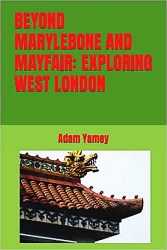
BEFORE THE YEAR 1800, the West End was truly the western end of London. West of Mayfair and Marylebone, there was countryside: woods, fields, private parks, farms, stately homes, villages, and highwaymen. After the beginning of the 19th century, the countryside began to disappear as villages grew and coalesced and the city of London expanded relentlessly westward. What had been rural Middlesex gradually became the west London we know today. My new book, illustrated with photographs and maps, explores the past, present, and future of many places, which became absorbed into what is now west London: that is London west of Park Lane and the section of Edgware Road south of Kilburn. Some of the places described will be familiar to many people (e.g., Paddington, Kensington, Fulham, and Chelsea). Other locations will be less known by most people (e.g., Acton, Walham Green, Crane Park, Harmondsworth, and Hayes). Many people have seen the places included in my book when they have looked out of the windows of aircraft descending towards the runways at Heathrow, and many of them will have passed some of these places as they travel from Heathrow to their homes or hotels. My book invites people to begin exploring west London – a part of the metropolis less often on tourists’ itineraries than other areas. “Beyond Marylebone and Mayfair: Exploring West London” is aimed at both the keen walker (or cyclist) and the armchair traveller.
Beyond Marylebone and Mayfair: Exploring West London is available as a paperback from Amazon here:
BETWEEN HAMPSTEAD AND Belsize Park, there is a narrow footpath running north from Tasker Road. One side of it is lined with a terrace of low buildings known as Mall Studios. Built in 1872 by Thomas Battersby, they were designed as artists’ studios. Each of them contained small waiting rooms; costume rooms; and a lobby. Each studio had three skylights and large north facing windows to capture the kind of light favoured by many artists. Following the advice of the artist Walter Sickert, who had lived there, the artist John Cecil Stephenson (1889-1965) settled into number 6, Mall Studios in March 1919. It was to remain his home until he died. In 1927, Barbara Hepworth became his neighbour in number 7, and at around that time, the influential art critic and writer Herbert Read moved into number 3. Nearby, Parkhill Road became home (for various lengths of time) to other artists including Henry Moore, Ben Nicholson, Naum Gabo, Piet Mondrian, Hans Erni, and other artists who have since become famous.
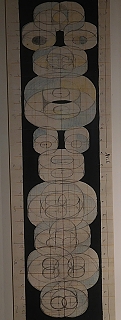
By John Cecil Stephenson
Whether it was the proximity of his artistic neighbours, who were pioneers of 20th century modernist art, or something else in his artistic evolution, Stephenson departed from his previous ‘straightforward’ portraiture and landscape painting and created works characteristic of what is now known as the ‘Modernist’ style. Although some of his works created after the late 1920s are to some extent figurative, most of his output was mainly abstract and constructivist. During WW1, Stephenson left London’s Slade School of Art temporarily to work in munition factories in Bishop Auckland (County Durham), the town where he was born. His experiences of working with industrial machinery and observing the efficiency and speed of the mechanised production processes is reflected in some of the paintings he produced later.
Stephenson, son of a grocer, was less well known than his neighbours. He produced art that bears favourable comparison to the works produced by them. Until the 18th of September 2022, there is a wonderful small exhibition of his works in a gallery within Hampstead’s charming Burgh House. The catalogue, edited by Sacha Llewellyn, Paul Liss, and George Richards, not only contains a fine collection of photographs of the exhibits but also provides a superb introduction – better than others I have seen – to the story of the pioneering role of Hampstead in the evolution of modern art in England. Burgh House, which contains several rooms comprising a museum of the history of Hampstead, also hosts excellent exhibitions such as the current survey of Stephenson’s works. Its well illuminated Peggy Jay Gallery provides a space for contemporary artists, many of them local, to display their works. Beneath the two storeys of cultural experiences, the basement of Burgh House is home to a pleasant café where anything from a cup of coffee to a wholesome meal can be obtained. And amongst the interesting range of books in the small bookshop, you can find copies of my book “Beneath a Wide Sky: Hampstead and its Environs” on sale (if they have run out, tell them to ask me for more, and then get your copy from Amazon).
FROM THE STREET, the Gate Cinema in Notting Hill Gate does not look like much from the aesthetic viewpoint. However, although the box-like building containing the cinema is typical of unexciting 1960s architecture, the auditorium is a real treasure. Its beautifully decorated interior was converted in 1911 from a former Italian restaurant, which had been designed in 1861 by William Hancock. The ceiling is adorned with plaster mouldings depicting fruits and foliage. The dull exterior housing this lovely auditorium contains in addition to the cinema, the foyer, and offices. It was built in 1962 by the architects Douton and Hurst. Unlike the walls and ceiling, the seating in the cinema is modern and comfortable. One small problem is that there is not much of a rake so that if you are unlucky enough to have someone tall in front of your seat, your view of the screen might be obstructed if you do not lean to the left or right.
To celebrate the 1st of August (2022), we watched a prize-winning film made in Iran in 2021. Its title (in English) is “Hit the Road”, and it is a ‘road movie’. Its four main actors, who are the characters making a long journey across Iran, are superbly credible. Although it portrays the stunning landscapes of Iran beautifully, there is much more to it. Subtly and intelligently, it reveals how delicately the filmmakers view the sophisticated nature of Iranian life and culture. It is easy to make the mistake of viewing Iran solely as a menace and threat to western civilisation. This film and others that I have seen, which were made in Iran after the downfall of the Shah’s regime, might occasionally have aspects critical of the current status quo, but they also demonstrate that the great cultural heritage for which Persia has been known for many centuries persists today. “Hit the Road” does allude delicately at several problems that plague Iran today, but so gently are these allusions made that they were either missed or ignored by the censors in the country where the film was made.
“Hit the Road” should not be missed. If you are in London, why not see it at the Gate, and before the lights dim enjoy the well-conserved early 20th century décor of the auditorium.
A FEW WEEKS AGO, we were going to meet friends at a Chinese restaurant in London’s Chinatown. As we had arrived in the area far too early for our rendezvous, we decided to pass some time looking at pictures in the nearby National Gallery. We headed for the rooms containing paintings from the Renaissance era, which we had not visited for a long time because usually, for reasons that I cannot fully explain, we look at works created in later periods. We entered one of the rooms and I stopped in front of a couple of paintings that brought childhood memories flooding into the forefront of my mind. Both artworks are lovely creations of the early Renaissance painter Piero della Francesca (‘Piero’; c1415-1492).
In the National Gallery, London
In my childhood and early adulthood, I lived at 36 Hampstead Way in Hampstead Garden Suburb. The front door was under a covered porch and reached up a few stairs that led up from the street. The front door opened into a hallway with red polished stone flooring and a few pictures hanging on its walls. At the end of the hallway, facing the front door, there was a large high-quality photographic reproduction of the “Montefeltro Altarpiece”, painted by Piero. This coloured picture had been bought in Florence (Italy) from Alinari, the famous photography company that specialised in taking good photographs of artworks. The feature of the picture that always fascinated me was the egg suspended from a scallop shell above the head of the Madonna. I have learned recently that the egg depicted is an ostrich egg, symbol of the new Venus: i.e., the Virgin Mary. It has also been suggested that it is not an egg but a pearl, which is a reference to the Immaculate Conception (pearls are created in oyster shells without sexual intervention!).
Also in the hall, there was a smaller coloured reproduction of another of Piero’s paintings: “The Flagellation of Christ”. Mounted on board and glazed with a shiny varnish, this reproduction was smaller than the original. So, every time I entered or left our home, I used to see these two images originally created by Piero. They were a part of my life.
My parents loved Italy. We visited Florence and Venice every year except 1967, the year after Florence had suffered from a devastating flood. My mother was a sculptor, and my father was a serious amateur art historian with a special interest in the Italian Renaissance. Hence, their love of Florence and the art treasures it contains. Piero was amongst their favourite artists.
Piero was born in Borgo Santo Sepolcro (‘Sansepolcro’) in Tuscany, which is about 47 miles southeast of Florence. Once when we were staying in Florence, we made an excursion to Arezzo, where there are some frescos by Piero, and then to Sansepolcro. There, we visited the Museo Civico that contains one of Piero’s great works: “The Resurrection”. None of us, my parents, myself and my sister, had seen it ‘in the flesh’ before.
For my father, Piero was not the only reason for our visit to Sansepolcro. In addition to his deep interest in the history of art, Dad was one of the world experts in the history of … wait for it … double-entry bookkeeping. This system of accounting has been a cornerstone of business since it was invented by the mathematician Luca Pacioli (c1447-1517), whose life overlapped that of Piero. Not only that, but Luca was also born in Sansepolcro. Apart from his advances in accounting methods, Luca also wrote various mathematical treatises including “Summa de arithmetica, geometria. Proportioni et proportionalita”. The second volume of this was Luca’s rewriting of a work by Piero. And the third volume was an Italian translation of “De quinque corporibus regularibus”, which had originally been written by Piero. Apparently, in both cases Luca made no mention of Piero as their author.
Although Piero and Luca figured often during the years I lived with my parents, I have not thought about either of them for a long time. It was only when we entered the National Gallery to pass time whilst we waited for our friends that seeing the paintings by Piero evoked childhood memories.
ALL THAT REMAINS now are the French words ‘moules’, ‘huitres’, and ‘langouste’ (mussels, oysters, crayfish). They are written in large white capital letters attached to a brick wall overlooking Leicester Place, which is a short street running between London’s Leicester Square and Lisle Street.
I am glad these words have not been removed,not only because I enjoy consuming shellfish and crustaceans but also because they provide a reminder of an establishment that thrived between the 1950s and 2006, when it closed for ever: Manzi’s restaurant.
Run by an Italian family, the eatery was famous for its seafood. Although I only ate there a few times, it was always an enjoyable experience.
Another restaurant, which has also closed, was on Lisle Street near Manzi’s. It was a Chinese restaurant called Mr Kong. Like Manzi’s, it had seafood on its menu. Their mussels in black bean sauce were superb. Kong’s also had a vegetarian menu – Chinese vegetarian dishes. I am not a lover of veg dishes, but the vegetarian offerings they rustled up at Kong’s were outstandingly tasty.
Usually, I often remember Mr Kong when I visit Chinatown around Gerrard Street, but it was only when I noticed the French words on the wall that memories of Manzi’s came flooding back.
LONDON’S WEST END includes the part of the city that contains areas such as Chinatown, Theatreland, Covent Garden, Leicester Square, Oxford Street, Mayfair, Soho, Fitrovia, and Bond Street. Before the 19th century, the western boundary of London was Park Lane, which runs along the west edge of the West End.
The west edge of London in about 1809: the dashed line that runs from north to south runs along Edgware Road and Park Lane. West of this libe was Hyde Park and open fields
Until the end of the 18th century and even during the early years of the 19th, west of Park Lane and the West End was the Middlesex countryside, which was dotted with villages such as (for example) Paddington, Kensington, Chelsea, Hammersmith, Fulham, Acton, Ealing, and Southall. In between these then separated places there were farms, heathlands, parks, stately homes (such as Chiswick House and Osterley Park), and highwaymen.
During the 19th century, several things happened. London expanded in all directions and spread into what had been countryside. The small villages in Middlesex grew in size. Some of them coalesced. Canals and railways were built, and along with them, building in areas that had previously been rural, caused them to become urban. In brief, London spread relentlessly westward. What was called the West End, and is still so-called today, was no longer the west end of the city of London.
Although many previously rustic settlements (such as Paddington and other places mentioned above) became engulfed in the metropolis, most of them have retained at least a few reminders of their pre-urban past. Currently, I am putting the finishing touches on a book about London west of the West End. In it, I hope to help readers discover more about London’s western spread and what has survived it (despite being surrounded by the city’s western expansion).
SADLY, THE CHARTERHOUSE was closed to the public when I walked through London’s Charterhouse Square on a Monday in July. As I walked clockwise around the grassy space in the middle of the (not so square) square, I spotted a building with a curvy brick façade with windows, many of which have both curved steel frames and glass panes.
The building, a block of flats which has Art Deco features, is called Florin Court. Although it looks recently built, it was constructed in 1936. It was designed by Guy Morgan (1903-1987) and Partners. Morgan had worked with the better-known architect Edwin Lutyens until 1927. Two years earlier, Morgan and Partners designed another block of Art Deco style flats in Highgate Village: Cholmeley Lodge. Although I was unable to enter Florin Court, I have read (on Wikipedia) that it contains 120 flats; it has a communal library, roof garden as well as a basement swimming pool. The reason that the structure looks so new is that it underwent extensive restoration work in 2013.
“Best known as ‘Whitehaven Mansions’, its exterior used as the residence of Hercule Poirot in the television adaptations of Agatha Christie’s novels.”
I have never watched this television show, but I am pleased that I stumbled upon this lovely example of Art Deco architecture in the heart of one of the older areas of the City of London.
Here is an excerpt from my new book about Hampstead in north London:
For many centuries, Hampstead has been the haunt of people involved in creative pursuits. So, it was no surprise that the former Express Dairy opposite Louis (patisserie) had at least one interesting cultural connection. In February 1916, the Bolshevik revolutionary Maxim Litvinov (1856-1951) proposed to his future wife Ivy Low in the café inside that branch of Express Dairy. Ivy, a novelist, was born, please note, in 1889 (she died in 1977). At the time he became acquainted with Ivy, Litvinov was with Lenin in London. Ivy did occasional typing for Maxim, and it was not long before they were attracted to one another. Passionate about cinema, he took her to watch films with him and one day he ‘popped the question’ in the Express Dairy. After they married, they lived in Hampstead until the outbreak of the Russian Revolution in October 1917. They did not return to Russia immediately because in January 1918 Maxim Litvinoff was made First Proletarian Envoy to the Court of St. James’s.
According to Zinovy Sheinis in his biography of Maxim first published in 1988, Maxim often went to Hampstead to meet his friends the Klyshkos, who lived on Hampstead High Street. Nikolai Klyshko (1880-1937) was a Bolshevik revolutionary of Polish parentage, who had settled in London and was a fluent Russian speaker. For a brief period, Litvinov lived in Hampstead with Klyshko and his English wife. Sheinis wrote about Maxim’s meeting with Ivy:
“They had met at a friend’s house. Then at a gathering of the Fabian Society. Litvinov was impressed by her knowledge of Tolstoy and Chekhov. Putting on weight, red-haired, of average height, well-mannered, and not very talkative, he made a big impression on the young writer. Her mother, the daughter of a colonel in the British Army, naturally wanted a different match for her daughter and certainly did not want to see her married to an insecure emigre from Russia. As for his religious background, Ivy Lowe simply never gave it a thought. She was herself from a family of Hungarian Jews who had taken part in the Kossuth uprising; in her girlhood she had been a Protestant, then had been converted to Catholicism. The choice of religion was her private affair and concerned no one else.”
After their marriage, they lived in a house, owned by Belgian refugees, in Hampstead’s South Hill Park (number 86). While there, Sheinis related:
“Friends sometimes gathered there in the evenings to discuss the political news; then an argument would flare up, developing into a fierce squabble. It always seemed to Ivy that her husband and his guests would any moment start flinging chairs at one another. At the very height of the dispute, when it was almost at boiling-point, she would leave the kitchen, go into the room, and announce that tea or coffee was ready. The disputants would calm down and drink their tea in peace.”
He also wrote that Ivy:
“… was not interested in and did not understand the political activities of her husband and his friends. To her, it was an alien world. In London, after the October Revolution, she asked her husband if he knew Lenin. Maxim replied that he had known Lenin for a long time. But she had no idea that letters from Lenin were coming to their house and that her flat was the headquarters of Bolshevik emigres.”
Later, they lived in a tiny house in West Hampstead. After that, Litvinov, having become a Soviet diplomat, moved from Hampstead. Despite not being officially accredited by the British, Sheinis noted:
“The Litvinovs were even invited to receptions. Though Soviet Russia was not yet recognised, its powerful influence reached standoffish London, Ivy Litvinova recollected.”
By 1921, the Litvinovs with their two young children, at least one of whom was born in Hampstead, settled in Moscow. Although Litvinov held high governmental posts in the Soviet Union and outside it (as a Soviet diplomat), he and Ivy, like so many other citizens in Stalin’s Russia, were constantly in fear of being arrested and/or killed.
ONE OF LONDON’S FEW remaining pre-1666 (Fire of London) buildings is the church of St Bartholomew the Great close to Smithfield Market. Founded in the 12th century, the building has many Norman (Romanesque) features. It also contains some contemporary artefacts including “Colloquy” (a work made from glass) by Sophie Arkette, and “St Bartholomew. Exquisite Pain” (a work in gilded bronze) by Damien Hirst.
By Damien Hirst
Beyond the chancel at the east end of the church there is the spacious Lady Chapel. During the Reformation (after about 1529), this part of the church was closed off from the rest of it, and used as commercial premises. In the 18th century, it was used as a printer’s workshop owned by Mr Palmer. Benjamin Franklin (1706-1790), one of the founding fathers of the USA, worked as an apprentice in this printing works in 1725. Then, he was lodging nearby in Little Britain. While he was working in the converted Lady Chapel, he wrote his philosophical pamphlet, “A Dissertation on Liberty and Necessity, Pleasure and Pain.” Franklin wrote:
“At Palmer’s I was employed in composing for the second edition of Wollaston’s “Religion of Nature.” Some of his reasonings not appearing to me well founded, I wrote a little metaphysical piece in which I made remarks on them. It was entitled “A Dissertation on Liberty and Necessity, Pleasure and Pain.” I inscribed it to my friend Ralph; I printed a small number. It occasion’d my being more consider’d by Mr. Palmer as a young man of some ingenuity, tho’ he seriously expostulated with me upon the principles of my pamphlet, which to him appear’d abominable.”
The workshop was purchased by the church and restored as a Lady Chapel in 1897. An information panel next to it provides its history and connection with the young Franklin. It was by pure chance that I came across this London link with the American Revolution on the 4th of July.
The newly opened Elizabeth Line is supposed to link east and west London. However if you wish to travel from a station east of Paddington to one west of it (or vice-versa), you have to change trains at Paddington. This is far from simple. The section of the line that runs west from Paddington is on one side of Paddington mainline station, and the section that runs east is far across the mainline station concourse at a lower level.
Platform lighting at Paddington Station (Elizabeth Line)
Today, I asked an official whether the east and west branches of the Elizabeth line will ever be connected, so as not to need to change trains at Paddington. He said that the infrastructure (tracks etc) are already in place, but there is a problem that still needs to be solved. The problem is that the signalling system on the western part of the line is completely different from that on the eastern part. Surely, someone could have solved this problem during the many years it has taken to construct the Elizabeth Line(s)?