I WAS FOURTEEN IN 1966. That year, Selfridges in London’s Oxford Street opened the Brass Rail restaurant on the ground floor, with windows facing Orchard Street. Its speciality was then, and still is, salt beef. I recall visiting the place once or twice with my mother back in the 1960s. In those days, I did not particularly care for the taste of salt beef. For some reason, maybe the cost of the place, we did not frequent the Brass Rail.
Winding the clock forwards several decades, I now enjoy eating salt beef occasionally. Today, the 22nd of March 2023, we needed to go to Selfridges for something, and as we were there, I suggested that we ate at the Brass Rail. Unsurprisingly, the eatery has changed its appearance considerably since the 1960s, but it is still located in the same part of Selfridges as it was originally. Its tables are enclosed in an area lined banquettes upholstered with red fitted cushions. The service was brisk and attentive. We ordered Reuben sandwiches in rye bread. These are generously filled with warm salt beef, sauerkraut, Swiss cheese, gherkin, and Russian dressing.
The Reuben was enjoyable, filling, and quite tasty. However, I felt that the taste of the salt beef was overpowered by that of the dressing and the other ingredients. Good though it is at the Brass Rail, I prefer eating the bagels crammed full of salt beef, which are served at the 24 hour Beigel Bake in Brick Lane. At half the price of the Brass Rail, but without the great service, they are more than twice as enjoyable.
MY MOTHER SETTLED in London in about 1951, a year before I was born. The UK was still recovering from WW2, and life was not too easy. There were shortages of food. I remember my mother telling me that during the early 1950s, relatives in South Africa used to send parcels of food, including, as I can still recall, tinned guavas. The postman used to lug these heavy packages to our home in Hampstead Garden Suburb. My mother used to feel guilty that she was lucky enough to be receiving food that few others could not obtain, and used to open the parcels and give the postman a couple of tins from them. Soon after I was born, my mother, already a painter, began making sculptures. Somehow or other, she managed to get permission to work in the sculpture studios at the St Martin School of Art, which was then located on Tottenham Court Road. She was not enrolled as a student, but worked alongside, and received help from, several sculptors who have now become famous. Amongst these were Antony Caro, Phillip King, William Turnbull, and Elisabeth Frink, who became a family friend.
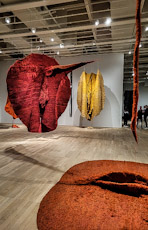
Most of my mother’s sculpting was done during the 1950s and 1960s. This was a period when many people, including British sculptors, were simultaneously recovering from the horrors of war; fearful of the Cold War and the possibility that it might develop into a war with atomic weapons; and looking towards the future. Sculptors reacted to this situation in various ways as can be seen at an exhibition being held in the Marlborough Gallery in London’s Mayfair until the 22nd of April 2023. Called “Towards a New World: Sculpture in Post-War Britain”, this show to quote the gallery’s press release:
“… emphasises the international impact of a group of young sculptors and artists who merged past trauma, present anxieties, and future hopes into a new visual language.”
Lyn Chadwick
The artists whose works are on display include, amongst others, Elisabeth Frink, William Turnbull, Reg Butler, Bernard Meadows, Kenneth Armitage, Lyn Chadwick, Graham Sutherland, and Francis Bacon.
Apart from some of the works by Reg Butler and Bernard Meadows, the artworks on display exhibit what the art historian Herbert Read described as: “…the iconography of despair, or of defiance; and the more innocent the artist, the more effectively he transmits the collective guilt. Here are images of flight, or ragged claws ‘scuttling across the floors of silent seas’, of excoriated flesh, frustrated sex, the geometry of fear.”
The Geometry of Fear was the name of a group of British artists who exhibited at the 1952 Venice Biennale.
Bernard Meadows (1915-2005) was a name that was new to me. He was Henry Moore’s first assistant. Later, he taught Elisabeth Frink at the Royal College of Art. He was a member of the The Geometry of Fear group but as the press release explained he differed from most of its members: “While the distorted human figure became a prominent motif for many of the artists associated with the ‘geometry of fear’ group, for others, like Bernard Meadows, it was animal imagery that resonated most with the collective societal trauma of the war. Visceral depictions of birds and crabs acted as vehicles to express human emotion.”
I enjoyed seeing this exhibition. The works are well-displayed in the spacious, well-lit rooms of the Marlborough. After viewing the exhibition, I wondered about my mother’s sculptures, most of which now only exist in photographs. Her first sculpture, a terracotta mother and child, was figurative but veering towards the abstract. As time passed, her work became increasingly abstract, and tended to be closer to being brutalist rather than naturalist. Although I never heard her mention The Geometry of Fear, I wonder whether her artistic sympathies lay with them rather than with any other ‘school’ of artistic activity.
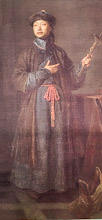
I BET YOU DID NOT KNOW that Michael Alphonsus Shen Fuzong (c1658-1691) was the first documented person from China to visit England. I did not know that he met King James II in 1687. Furthermore, did you know that the Chinese sculptor Tan-Che-Qua (c1728-1796) from Canton, who visited London between 1769 and 1772, not only exhibited at London’s Royal Academy but also met King George III before returning to his native land. Maybe, I might have stumbled across these two notable men from China by accident had I not visited the British Library today (the 20th of March 2023), but this is highly unlikely. Until the 23rd of April 2023, there is a fascinating, well-displayed exhibition called “Chinese and British” at London’s British Library.
Beginning with the earliest Chinese visitors to Britain, this splendid exhibition charts the growth and considerable achievements of Chinese people who chose to live in Britain. John Hochee (1789-1869) was one of the first people from China to have settled permanently in England. He arrived from Canton in 1819, worked as a property manager with John Fuller Elphinstone (1778-1854; son of William Elphinstone a Director of the EIC: see https://www.rh7.org/factshts/hochee.pdf), whom he probably met whilst working for the East India Company in China. Hochee married an English lady, Charlotte Mole, and James (1832-1897), one of their seven children, became a surgeon. John was naturalized in Brighton in November 1854.
Since Hochee (Ho Chee) settled in Britain, many more people from China have followed in his footsteps. The exhibition at the British Library illustrates this well. Early settlers included many who had worked on ships and had landed in Liverpool or London. Chinese communities became established in the 1880s, notably in London’s East End. The Chinese in Britain established businesses to serve their community and their British neighbours. Chinese restaurants and laundries figured largely amongst the early enterprises. With the advent of laundrettes in the 1950s and 1960s, the Chinese laundry business faded away, but still today the Chinese are very important in Britain’s catering industry. It was after WW2 that restaurants and take-aways really took off in Britain. These outlets supplied both British and Chinese food. Many of their workers and owners were from Canton and Hong Kong.
During WW1, nearly 100,000 Chinese men provided support for The British Army in Europe – digging trenches, burying the dead, and other tasks. Some of these men had signed 3-year contracts, which obliged them to return to China after the war, which most of them did. The exhibition devotes some space to the activities of these men.
Apart from what I have already described, the exhibition has displays illustrating the many other achievements of the Chinese British. One exhibit that particularly amused me was a selection of books in English by Chinese British authors. They were displayed on a ‘lazy Susan’, a revolving serving platform often found in the centre of round tables in Chinese restaurants.
All in all, I am very pleased that a post on Instagram alerted me to this interesting exhibition, and I encourage everyone to visit it.
ANYONE FAMILIAR WITH London will know that except for some parkland, the city is a built-up urban environment all the way west from Marble Arch to Acton and further beyond. This is also the case from Hyde Park Corner to Heathrow Airport. However, this has not always been the situation.
When John Rocque (1709-1762) drew his detailed, accurate maps of London in the 1740s, Paddington was a small village separated by open countryside from what was then London. In those days, Kensington was a village reached from London by a country road flanked on its northern edge by Hyde Park. And from Kensington to Hammersmith would have been a ride along a road running between a series of agricultural fields and orchards. And to the north of Hammesrsmith, Shepherds Bush was an open space around which there were only a few well-separated houses. And as for Notting Hill Gate, Rocque did not even bother to name this road junction in the middle of the countryside.
By 1826/27, when C & J Greenwood published their detailed map of London, Earls Court was still a country hamlet; Kensington a small town; and there was barely any development around what is now Notting Hill Gate. However, by 1826 Paddington was beginning to grow and was no longer separated from Marylebone by open countryside. Additionally, the northern edge of the eastern end of Bayswater Road was losing its rural nature and being built upon.
In brief, as the 19th century progressed, London spread west. As it did so, urban development covered what had been open countryside and places that had been separated from London began to become part of it. Places like Kensington, Earls Court, Shepherds Bush, Hammersmith, and places further west were no longer separated by open countryside. Instead, they became engulfed by the expanding metropolis.
My book “BEYOND MARYLEBONE AND MAYFAIR: EXPLORING WEST LONDON” describes in detail how the villages and towns to the west of Park Lane and what is known as ‘The West End’ became engulfed by London’s westward growth. It reveals the history of these places; what they are like today; and what remains of their existence before they became joined to London, as it spread from Mayfair and Marylebone to Heathrow and beyond.
BEYOND MARYLEBONE AND MAYFAIR: EXPLORING WEST LONDON
By Adam Yamey
is available as an illustrated paperback and Kindle from Amazon:
ONE OF THE MANY JOYS of living in London is the ability to view exhibitions in the city’s commercial galleries, many of which can be found in Mayfair and the West End. These galleries display artworks, which are mainly for sale, or occasionally borrowed from places away from London. The exhibitions are of a temporary nature. Visiting them allows members of the public to view works, which might never be on public view again in London because they will be sold to private collectors, big corporations, or to galleries and museums abroad. When we are in London, my wife and I try to visit several of the commercial galleries at least once a week. At the recommendation of our daughter, whose employment is in the world of art, we paid a visit to Pace Gallery in Hanover Square to see an exhibition that will continue until the 15th of April 2023.
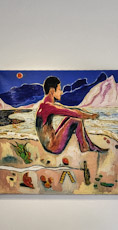
The artist, whose works are being displayed in the spacious modern rooms at Pace, is Gideon Appah. He was born in 1987 in Accra, Ghana. His training as an artist was at the Kwame Nkrumah University of Science and Technology in Ghana. His first major exhibition was in 2022 at the Institute of Contemporary Art at Virginia Commonwealth University in Richmond, Virginia (USA). His paintings have also been exhibited in many other places.
All of Appah’s works on show at Pace are oil and acrylic on canvas. They are all highly colourful and include, with one exception, figures in a variety of landscapes. The figures are positioned in landscapes that have an intensity that makes them look slightly unreal, yet completely compelling. One of the pictures we particularly liked is “Night Vision” which depicts a brightly lit town on a hill at night reflected on a sea of still water. The leaflet issued by the gallery describes Appah’s work as “dreamlike”, and this was also my opinion. On the whole, the dreamy nature of the works is quite distinct from that seen in the works of the great Surrealists of yesteryear. Appah portrays his scenes with the clarity and strangeness that I associate with the dreams I experience. His works are intriguingly eery, but not scary. If you can get to Pace, do so to enjoy the well-executed and fascinating works by this artist from Accra.
THE JAPAN HOUSE in London’s High Street Kensington first opened in 2018, and its aim is to increase people’s awareness and knowledge of Japan, the Japanese, and their culture. Until the 11th of June 2023, the Japan House is host to a superbly laid-out exhibition of Kumihimo – Japanese silk braiding. The braiding is a complex form of plaiting, using dyed silk threads. When, for example, hair is plaited or braided, three or more strands of hair are intertwined to form a plait. Practitioners of Kumihimo plait great numbers of often different coloured threads to create braids with beautiful repeating patterns. The most expert craftsmen and craftswomen can braid patterns using up to 140 different threads.
The exhibition shows how the threads are dyed, then spun into bobbins before finally being woven into braids. The braider uses a stand that holds the reels of thread. The threads are then plaited over each other in a repeating sequence to produce a patterned braid. Great concentration is required to maintain the sequence without making errors. A weight is hung onto the braid to hold it straight and taut whilst it is being created. In addition to examples of the various types of braiding stands, there are well-made videos illustrating braiders at work. There are many examples of finished products, including belts, fashion items, armour plating, and modern artworks. All of them are intricately patterned and incredibly beautiful.
The exhibition was set up by a Tokyo-based company, Domyo, which has been producing braided silk cords since 1652 AD. Kumihimo was a technique imported into Japan between 538 and 794 AD from the Asian mainland, and then refined and developed in Japan
When I learned that I was to visit an exhibition of braiding, I was not filled with enthusiasm. However, as soon as I entered the basement exhibition area, I realised that I was about to see a fine and most interesting display. Not only is there great beauty in the exquisitely detailed braiding, but this was also the case for the way the exhibits have been arranged. To summarise, see this exhibition if you can!
HAMPSTEAD’S BURGH HOUSE was constructed in 1704 and retains many of its original architectural features. Several of its rooms house a fascinating museum with exhibits relating to the history of Hampstead. I have visited the museum many times, but it was only today (the 9th of March 2023) that I noticed a model penguin on display. This used to stand inside High Hill Bookshop, which was located on Hampstead High Street. Founded by Ian Norrie in 1956, it remained in business until 1988.
During my childhood, in the 1950s and 1960s, I used to visit Hampstead almost every Saturday morning with my parents and my sister. We used to park the family car near to Jack Straws Castle, which is close to Whitestone Pond – one of the highest spots in London. Then, we would walk down Heath Street and along the High Street until we reached High Hill Bookshop. My parents were keen to encourage my sister and I to read. Therefore, every time we visited the bookshop, we had to choose one book each, which they purchased for us. I cannot recall all of the books I chose, many of them Puffin paperbacks, but I do remember that during these visits I gradually built up my collection of the adventures of Tintin by Hergé.
According to an article (https://jessicanorrie.wordpress.com/2017/08/04/the-best-independent-bookshop-in-london/) by Norrie’s daughter, Jessica Norrie, there was a party for Penguin Books held in the shop in 1960. The model penguin, which I saw in Burgh House today, was in attendance at that party back in 1960. I was eight in 1960, but I am afraid that I cannot remember seeing the penguin. It must have been in the shop during some of my visits, but then my interest in choosing a book was greater than looking for model penguins.
The penguin in the museum is black and white. On the white section of the bird’s belly, there are words, including “October 12th, 1960. High Hill Bookshop Silver Jubilee Party” and, also, some signatures. One of the signatures is that of Allen Lane, founder of Penguin Books. He died 10 years after the party. Another signature is that of the novelist Olivia Manning, There are several other signatures, but I found them too difficult to decipher.
Seeing the penguin at Burgh House brought back happy memories of my childhood and, at the same time, made me sad because High Hill Bookshop was irreplaceable. Waterstone’s, which followed in its wake, although well-stocked, lacks the charm of Ian Norrie’s wonderful creation.
LONDON IS RICH in memorials. Some of them commemorate well-known figures and events and others make the observer aware of lesser-known aspects of history. One of these obscurer memorials is on number 218 Sussex Gardens, next to St James Church and not far from Paddington Station. It was placed on the building, which was rented by the Ukrainian Canadian Servicemen’s Association (UCSA) [Союз Українських Канадійських Вояків] in 1943.
According to an informative website (www.ukrainiansintheuk.info/eng/03/ucsa-e.htm), the UCSA was: “…formed on 7 January 1943 in Manchester, to cater for the social and cultural needs of Ukrainian Canadians serving overseas. Initially the association had 37 members. By the end of the war there were 1,500 active members and over 3,000 additional names on the association’s mailing list.” That is clear enough, but I wondered about the story of the Ukrainian Canadians. In 2016, there were more than 1.4 million Canadians with Ukrainian ancestry. Canada has the third largest population of Ukrainians after Russia and Ukraine. Almost certainly, 1891 marked the start of the migration of significant numbers of Ukrainians to Canada. Back in those days, the territory, which is now the republic of Ukraine was divided between the Austro-Hungarian and Russian Empires. They were welcomed in Canada as the country needed workers to populate and cultivate the prairies.
The UCSA occupied the house in Sussex Gardens from late 1943 until early 1946. The website quoted above revealed that the UCSA: “… organised social gatherings, or “get-togethers”, for its members, initially in Manchester and later also in London. A choir and a dance orchestra were organised at the London club, and a library and reading room were maintained there. The association’s activities also included visiting sick and wounded Ukrainian Canadians, compiling lists of those who had died or were taken prisoner, and looking after the graves of the dead (at various cemeteries in the UK, including Brookwood Military Cemetery near Woking, Surrey). From September 1943 the association published an UCSA Newsletter.” As WW2 drew to a close, the UCSA also provided assistance to Ukrainian displaced persons and refugees from mainland Europe.
The memorial plaque on 218 Sussex Gardens was placed in September 1995, long before Russia began its current conflict with Ukraine. Unlike the statue of the Ukrainian Saint Volodmyr, which stands in Holland Park Avenue, the building near Paddington did not have any pro-Ukraine flags or other patriotic items affixed to it. The plaque is a discrete memorial to an aspect of the history of WW2, about which I knew nothing until today.
MAHATMA GANDHI IS commemorated by a statue in Tavistock Square in London’s Bloomsbury. He is probably the most famous of three Indians with statues in Bloomsbury. Crafted by the sculptor Fredda Brilliant and presented by the Indian High Commission, it was unveiled by Prime Minister Harold Wilson in 1967.
The next most famous Indian represented by a sculpture in Bloomsbury is a Nobel Prize winner, the celebrated writer and polymath from Kolkata (Calcutta), Rabimdranath Tagore (1861-1941). The memorial depicts Tagore’s head. It was created by the sculptor Shenda Armery, and unveiled by the Prince of Wales, now King Charles III, on Tagore’s 150th birth anniversary year in July 2011. The bust stands in Gordon Square, close to University College London, where Tagore studied law briefly. His face looks away from the college towards the southeast. – towards India, his homeland. On one side of the plinth, there are some words written in Bengali script. On another side, there is a translation of this brief text (by Tagore) in English: “Thou hast made me endless, such is thy pleasure. This frail vessel thou emptiest again and again, and fillest it ever with fresher life. This little flute of a reed thou hast carried over hills and dales and hast breathed through it melodies eternally new. At the immortal touch of thy hands my little heart loses its limits in a great joy and gives birth to utterance ineffable. Thy infinite gifts come to me only on these very small hands of mine. Ages pass and still thou pourest and still there is room to fill.” This is from Tagore’s collection of poems – “Gitanjali”, translated into English from Bengali by the author in 1913. It was this collection that led to Tagore being awarded the Nobel Prize for Literature in 1913. In 1915, King George V awarded him a knighthood, but following the Jallianwala Bagh massacre of 1919, he renounced his knighthood to express his horror at the murders that had been perpetrated on innocent Indians by British troops in the Punjab.
Thiruvalluvar
Call me ignorant but I had never heard of Thiruvalluvar, whose bust stands in a garden next to the School of Oriental and African Studies in Bloomsbury. According to a plaque next to the bust, this man was author of “Thirukkural”, which was a classic of Tamil philosophy and ethics. The bust was donated by the Governent of Tamil Nadu in 1996, and unveiled by the then Indian High Commissioner Dr ML Singhvi. Celebrated as he is in Tamil Nadu, little is known about his life. It is possible that he was born or lived in Mylapore (now a district of Chennai) in the south of India. According to Wikipedia: “His work Tirukkuṟaḷ has been dated variously from 300 BCE to about the sixth century CE.” As for his great work “Thirukkural”, the online version of Encyclopaedia Britannica remarked: “…Tirukkural (“Sacred Couplets”), considered a masterpiece of human thought, compared in India and abroad to the Bible, John Milton’s Paradise Lost, and the works of Plato.”
I have described monuments to three notable men from India, but omitted one woman, whose memorial is close to those already described. The WW2 heroine Noor Inayat Khan (1914-1944) is commemorated by a bust, which, surprisingly, I have never noticed, in Gordon Square. Sculpted by Karen Newman, it was placed in the square in 2012. This artist also sculpted a bust of Violette Szabo (1921-1945), which is on the embankment of the Thames near Lambeth Palace. Both Noor and Violette worked for the British SOE, and perished in Nazi concentration camps. Once the epicentre of the British Empire, it is not at all surprising that one comes across memorials to notable Indians whilst wandering about in London and other places in the UK.
THE RAILWAY LINE between Bombay(Mumbai) and Thane was opened in 1853. Byculla Station was one of its original stations when trains began running along this stretch of track. At first a wooden building, it was soon replaced by the present stone structure, which was ready for use in 1857. This historic station, the oldest surviving railway station in India. was beautifully restored recently.
On platform 1, I spotted an old bell hanging close to one of the station’s offices. It is marked with the initials “GIPR”and the date 1863. The letters are the initials of the Great Indian Peninsula Railway company, which was incorporated in 1849. In contract with the British East India Company, its aim was to link the British Presidencies by rail. The first stretch to be built was that between Bombay and Thane.
The bell carries the name of its manufacture – “Mears & Co. Founders London”. This bell foundry, first established in the 16th century, moved to London’s Whitechapel Road in the very early 18th century. It was where one of the largest bells in St Paul’s Cathedral was made. The Mears family ran the foundry between 1784 until 1873.
The foundry ceased working in 2017. The bell at Byculla Station has by now long outlived the bell foundry in Whitechapel and the British Empire, during whose existence it was manufactured.