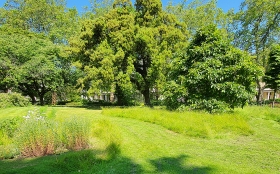
YESTERDAY EVENING, WE took a stroll in Kensington Gardens when the temperature was beginning to drop. The sun was low in the sky. This caused some parts of trees to be shadowed by neighbouring trees so that lovely patterns of light appeared on them. One any particular tree, part of its foliage was brightly coloured because the rays of the sun could reach it, and other parts appeared dark green because the sun could not reach them. All this is obvious when you see it described in words, but wonderful when you see it in life.
PS: It is light effects such as these that make it difficult for artists to paint trees
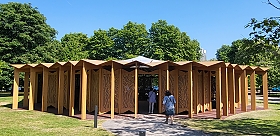
EVERY YEAR SINCE 2000, the Serpentine Gallery in London’s Kensington Gardens has commissioned the construction of a temporary pavilion in its garden. These pavilions have two things in common. One is that they contain a café and the other is that it must be designed by a noteworthy architect who has never had one of his or her creations constructed in England. Almost all the pavilions constructed to date have been examples of adventurous and exciting architecture. This year’s architect is Lina Ghotmeh, who was born in Lebanon and now works in her studio in Paris.
Given the French name “À table”, the circular timber pavilion was conceived as a place for people to sit together and chat, just as they would around a dinner table. Given this aim of the architect, it succeeds. To enhance her aim, the specially designed tables and chairs are arranged in a circle. As my wife said, it is the homeliest of all the pavilions built to date. Unlike some of the earlier pavilions, one does not feel that one is entering an unfamiliar, or even alien, environment. Despite its welcoming nature and very human scale, the pavilion’s design is far from mundane. Although it is far from being amongst the most visually spectacular of the temporary buildings, it is pleasing to the eye. I will certainly visit it again before it is dismantled on the 29th of October 2023.
BETWEEN 1983 AND 1994, I owned a house in Gillingham, Kent. It was not an exceptional building, but it had a long back garden – 180 feet in length and about 22 feet wide. Much of the garden was covered with a lawn bordered by plant beds. When I first moved in, I attended the garden keenly even though I had little idea about gardening. As soon as I unearthed weeds, they re-appeared. It was most disheartening. I discovered that planting shrubs was the best way to hide the weeds, about which I soon stopped worrying.
As for the lawn, I acquired a mowing machine, and for some months, or maybe years, I trimmed the grass regularly. Then, I found that whenever I cut the lawn, my nose would start streaming and I would have fits of sneezing. I realised that I had a grass allergy. So, I decided to cease mowing the lawn. I let the grass grow higher and higher. When it reached its greatest height, people sitting in the garden would be hidden by it. At the end of the year, the grass collapsed and more or less disappeared – only to begin growing again the following spring. I let nature take its course, and ceased worrying about it until a deputation consisting of my immediate neighbours came to my house to complain about my unruly lawn and garden. One of them, an elderly lady, was convinced that all the weeds and insects in her garden had come from mine.
One summer evening, I came home after dark and as it was a pleasant evening, I stood in my back garden looking up at the stars. As I did so, I was aware of a slight smell of burning. The following day, one of my neighbours saw me in the street as I was setting off for work. He told me that the neighbour on the other side of the garden had set fire to mine, hoping that the flames would kill the weeds. Luckily, he had spotted the conflagration, and extinguished it before it did too much damage.
Following the neighbours’ complaints, I conceived an idea about how to deal with my lawn. I decided that I would let it grow without interference, but I would mow a narrow sinuous path along its length. The idea was that I could then explain to the neighbours that the wild grass was part of my garden design. Meanwhile, my shrubs increased in size steadily and the weeds flourished. In the warmer months of the year, whenever I strolled in my garden, clouds of butterflies used to billow from the luxuriant vegetation.
Today, in June 2023, whilst walking in Kensington Gardens, I noticed that much of the grass was growing wild – not being mowed. Here and there, the gardeners had trimmed small areas of grass with a lawnmower, much as I used to do back in Gillingham in the 1980s.
To be honest, I let my garden grow wild because I could not be bothered to spend hours of my life making it look neat and tidy. Today, what I was doing – letting the plants ‘do their own thing’ – is known as ‘wilding’. Maybe, unwittingly I was a pioneer of wilding.
LONDON’S KENSINGTON GARDENS is bounded to the north by Bayswater Road and to the south by Kensington Gore (overlooked by the Royal Albert Hall and the Albert Memorial), which becomes Kensington Road. Within the park and running almost parallel with its southern boundary is the South Flower Walk (also known as The Flower Walk). The Northern Flower Walk, which runs near and parallel to Bayswater Road was once used by royalty. According to a document published on the Royal Parks website, this was:
“… a delicious and appealing place to stroll for the monarch on the way to … the site of the Bayswater ‘Breakfasting House’…”
The breakfasting house no longer exists. I am not sure whether the South Flower Walk can boast of such an illustrious past. However, when it is in full bloom, it outdoes its northern counterpart in colourfulness and variety of its flora.
Although the whole of Kensington Gardens makes for a pleasant place to stroll, a walk along the South Flower Walk provides and exceedingly pretty perambulation.
EVERY SUMMER SINCE 2000 except for the year 2020, the Serpentine Gallery in London’s Kensington Gardens has hosted a special event. On each of these years between June and October, a temporary pavilion has been erected near to the original Serpentine Gallery (now known as Serpentine South). No two pavilions have looked the same. However, what they have in common is that each one of them is the first ever completed structure erected in England by the pavilion’s designer/architect.
This year (2022), the pavilion, called “Black Chapel”, was designed by the American artist Theaster Gates (born in Chicago in 1973). In the past, we have seen exhibitions of his works hosted in the White Cube Galleries at both Masons Yard and in Bermondsey. Many of his exciting artworks have impressed us greatly. So, it was with high expectations that we went to see his pavilion.
At first sight, we were disappointed by the Black Chapel. It is a huge black cylinder with three apertures. Two of them are entrances and the third is a circular orifice in the centre of the tall structure’s circular, domed ceiling. A segment of the cylinder is walled off and serves as a café servery. Benches line the lower parts of the wall of the rest of the building. Seven large, flat rectangular, metallic paintings (or plates) are attached to a part of the internal wall, and there is a large bell just outside one of the pavilion’s two entrances.
Today, many people like to have art explained to them. For me, it is my visceral reaction to an artwork that is more important than its intended meaning or the artist’s intentions. The ‘meaning’ of a work of art is, for me, secondary to the way I am affected by it. For those, who seek meaning in art, this is what the Serpentine’s website has to say about the pavilion:
“The structure, realised with the support of Adjaye Associates, references the bottle kilns of Stoke-on-Trent, the beehive kilns of the Western United States, San Pietro and the Roman tempiettos, and traditional African structures, such as the Musgum mud huts of Cameroon, and the Kasubi Tombs of Kampala, Uganda. The Pavilion’s circularity and volume echo the sacred forms of Hungarian round churches and the ring shouts, voodoo circles and roda de capoeira witnessed in the sacred practices of the African diaspora.”
Interesting as this might be, it neither increases nor diminishes my appreciation of the Black Chapel. Theaster Gates’s Black Chapel is less exciting visually than some of the past pavilions. Although our initial impressions of this seemingly simple structure were not particularly favourable, after spending a little time in it, the place grew on us and now we hope to visit it again.
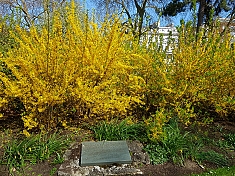
THE NORTH FLOWER Walk in Kensington Gardens runs east from the Italian Gardens. It is both close to, and parallel to, Bayswater Road. About 280 yards west of the Italian Gardens, there is a small, low rectangular memorial stone in a flower bed next to the North Flower Walk. In springtime, a large bush behind it bursts into yellow flowers. It is a forsythia plant.
The North Flower Walk used to be a part of what was once the ‘berceau’ or ‘walk of shade’. According to a document published on the Royal Parks website, this was:
“… a delicious and appealing place to stroll for the monarch on the way to … the site of the Bayswater ‘Breakfasting House’…”
Today, the Walk is filled with walkers, their children, their dogs, joggers, and the occasional cyclists.
The memorial stone celebrates the botanist and horticulturalist William Forsyth (1737-1804). A founding member of The Royal Horticultural Society (founded 1804), he was also the Curator of The Chelsea Physic Garden (from 1771) and Superintendent of various royal gardens including those of Kensington Palace (from 1784). The plant genus Forsythia, a member of the olive family (Oleaceae), was named in his honour.
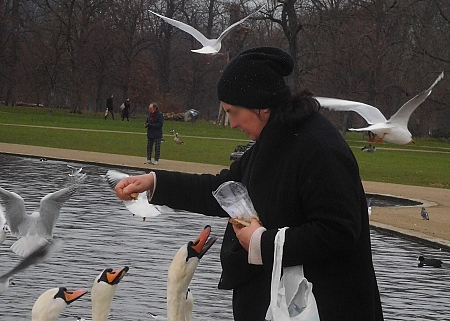
THE TEMPERATURE HAS dropped. Fear of the Omicron variant of the covid19 virus has meant that less people are out and about in London. This was the case in Kensington Gardens today, the winter solstice. The wildfowl that gather around its not so round Round Pond wait eagerly for visitors to distribute tasty morsels. Today, I saw a lady feeding the birds. So many were attracted to her that sometimes her head seemed lost in a cloud of noisy gulls. In front of her, swans extended their necks, attempting to reach her hands. Undaunted, this animal lover continued carrying out her kind gesture.
LANCASTER GATE IS ten minutes’ walk or a three-minute bus ride away from where I have lived for over 29 years. I have passed it innumerable times, yet I have never explored it. Yesterday, the 30th of October 2021, I decided it was high time that I took a closer look at the place. The name refers to an entrance to Kensington Gardens as well as a nearby network of streets. The network includes a long street extending from east to west between Craven Terrace (near Paddington Station) and Leinster Terrace. The section of road between Craven Terrace and Bayswater Road is also called Lancaster Gate. Midway along the long east-west section of the Gate, there is a wide street, almost a square or piazza, that leads to Bayswater Road. This rectangular piazza is south of a rectangular loop to the north of the east-west section, in the centre of which there is a 20th century building called Spire House. If this sounds confusing, then please look at a map!
What I have called the ‘piazza’ opens out onto Bayswater Road. In the middle of it, there is a monument topped with the weather worn sculpture of a seated child, probably male. The sculpture sits above a bas-relief depicting the western façade and the dome of London’s St Paul’s Cathedral. Below, on the south side of the pedestal, there is a bas-relief, depicting the face of a man with a bushy moustache and a long luxuriant beard. Weather and/or pollution has worn away details from his portrait. At first sight, I thought that it was a representation of George Bernard Shaw as an old man, but it is not. It is, according to the almost undecipherable inscription beneath it, the face of Reginald Brabazon, the 12th Earl of Meath, who lived from 1841 to 1929. The words on the plinth include that he was “a patriot and a philanthropist”.
Brabazon was Anglo-Irish and born in London (https://en.wikipedia.org/wiki/Reginald_Brabazon,_12th_Earl_of_Meath). Educated at Eton, he became a diplomat, but resigned from the Diplomatic Service in 1877. Ten years later, he joined the House of Lords as a Conservative peer. Reginald and his wife, Mary, devoted much of their lives to relieving human suffering and ameliorating social conditions. Amongst his many good works was the establishment (in 1882) of a charity called the Metropolitan Public Gardens Association, whose aim was the preservation of public open spaces and the creation of new ones, which might explain why the memorial to him faces Hyde Park. The Portland stone monument, known as The Meath Memorial, was designed by Joseph Hermon Cawthra (1886-1971) and unveiled in 1934.
A few feet north of Brabazon’s memorial, which stands on a wide traffic island, there is a slender stone column topped by an ornate octagonal structure surmounted by a shiny metal crucifix. The base of this column reveals that it is was built as a WW1 memorial. In the pavement between the two memorials, the City of Westminster has set several informative panels about the history of Lancaster Gate. The development of Lancaster Gate, originally known as ‘Upper Hyde Park Gardens’, began in the late 1860s, an initiative of the developer Henry de Bruno Austin. Many of the houses he built have rich stucco facades and porches supported by neo-classical style pillars. Quite a few of them are now hotels. These buildings are interspersed with a few newer buildings, presumably where the originals were bombed during WW2. However, most Lancaster Gate’s houses are those built in the 19th century.
The name Lancaster Gate was chosen to honour Queen Victoria, who was amongst many other things, the Duchess of Lancaster.
Before Lancaster Gate was developed, it was mostly agricultural land. Until 1775, the composer, actor, botanist, and playwright John Hill (1716-1775) had his Physic Garden here. By 1795, visitors flocked to the area to enjoy the springs and fresh air at the Bayswater Tea Gardens, which later was renamed the Flora Tea Gardens, and then the Victoria Tea Gardens. This establishment closed in 1854.
At the southern end of the loop and towering above the plaza with its two monuments, there is a tall church tower with a spire. This is all that remains of the Christ Church, Lancaster Gate, whose construction began in 1854. The last service to be held in the church was in 1977, by which time the roof was badly infected with dry rot. The church was demolished, but the tower retained. Where the body of church stood, there is now a block of flats. Opened in about 1983, it is appropriately named Spire House. Its 20th century architecture is quite attractive and contrasts dramatically with the stuccoed Victorian buildings that face its west, north, and east sides. Spire House has external concrete supporting pillars that suggest an updated version of the flying buttresses used in mediaeval church architecture.
Lancaster Gate is a relatively unspoilt example of mid-Victorian town planning and worthy of a short visit. While walking around the area, I only spotted one blue plaque, commemorating a resident worthy of note. It recorded that the “Chemical Scientist” Sir Edward Frankland (1825-1899) lived in Lancaster Gate from 1870 to 1880. He was one of the founders of organo-metallic chemistry and a discoverer of Helium. Also, he took an active interest in the problem of pollution of rivers and the quality of London’s water. I trust that he would be pleased to know that fish have returned to London’s once filthy River Thames.
After exploring Lancaster Gate and its sea of stuccoed facades, head east into Craven Street, where you can find several cafés and at least one pub.






 yamey
yamey 