A palace by the sea

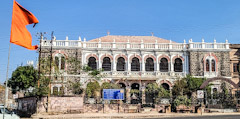
IN OCTOBER 2022, we visited the Isle of Wight and went around Osborne House, which Queen Victoria and her consort Prince Albert had constructed as a holiday home near the seaside on the north coast of the island. A largely unattractive Victorian pile, its saving grace is the Durbar Hall, which is a near perfect example of the Indo-Saracenic style of architecture that can be found in many places in India. Recently (in February 2023), we visited another royal summer palace located close to the sea. It is the Vijaya Vilas Palace close to Mandvi in the former Kingdom of Kutch, now a part of the Indian State of Gujarat.

The Vijaya Vilas was completed in 1927. It was built by Kutch’s ruler Maharao Kengarji III as a summer resort for his son and heir, the Yuvraj Shri Jayarajii.

Architecturally, it resembles older Rajput palaces, and is a fine example of the Indo-Saracenic style. It and its various oriental decorative and structural features were made by craftsmen from Bengal, Jaipur and other places in Rajasthan, Saurashtra, and Kutch. The predominant material used is sandstone , of which there is no shortage in Kutch. It seems that the palace suffered little damage during the 2001 earthquake, which badly affected the Maharao’s palaces in nearby Bhuj (the capital of Kutch).

Inside the palace there are rooms with furniture that would not look out of place in many English stately homes. There are many framed photographs of the royal family, their guests, and the many wild animals that were shot. One of these was a leopard that was shot by someone inside the palace. One of the window panes has a bullet hole that is said to have been made by the bullet that killed the creature. There are also photographs that record the many times that scenes in Bollywood movies were shot in the Palace.

One photograph shows the US General Dwight Eisenhower seated in a jeep. This picture was taken in Europe during WW2. I have yet to discover what, if any, connection existed between Eisenhower and the royal family of Kutch.

Visitors can visit the rooms on the ground floor, and can ascend to the roof from which there are superb views of the sea and the flat countryside around the palace. The first floor, which is private, is the residence of members of the former royal family.

Although not as old as it looks, Vijaya Vilas, is a superb example of the kind of palace typical of those older ones that can be seen in Rajasthan. To my taste, Vijaya Vilas is a much more lovely and harmonious edifice than Victoria and Albert’s seaside home on the Isle of Wight.
A grand canyon in India

I HAVE VISITED the famous Grand Canyon in the USA, and seen it after a heavy snow fall. I have also seen a fabulous canyon in New York State, a few hours drive away from Buffalo. However, it was not until the first of February 2023, that I heard of, and then visited a grand canyon in Kutch, which is now part of the Indian State of Gujarat.

The canyon, named Kadiya (aka Kaliya) Dhro, is 73 Km north of the coastal city of Mandvi, and 33 Km northwest of Bhuj. Although the canyon is many, many thousands of years old and had been known to locals forever, its existence only became widely known in 2020. It was then that Varin Suchday, founder of the Kutch Travel Club stumbled across it. He had heard it discussed by local tribes people, whilst he was assisting them during the covid19 crisis, and with considerable difficulty, he managed to find it in the midst if the poorly mapped, arid semi-desert countryside.

We drove from Mandvi to a dusty parking area about 4 Km from the canyon. Several battered jeeps wait there to take visitors to the site. We boarded a well-worn Mahindra jeep, which was driven by a young fellow who looked to be about 15 years old; his voice had not yet broken. He drove us skilfully along sandy tracks strewn with rocks, precarious slopes, potholes, and other hazards. We held on to the Mahindra’s metal structural elements to avoid being thrown out of the constantly jolting and tilting vehicle, which had neither doors nor seatbelts. The tortuous track threads its way across dried up beds of streams; over boulders and sharp projecting stones; and past branching cacti and thorny bushes. Every now and then, other faster jeeps overtook us on this perilous, winding path. Other vehicles travelling in the opposite direction either waited for us to pass or vice-versa. After about thirty minutes of this exciting journey, we reached a parking area near the canyon.

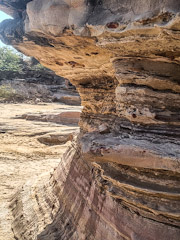
The canyon is in the district of Ulat village, which we did not visit. A fast-flowing river, in which our driver spotted a crocodile, has over the millennia formed the canyon. Like the Grand Canyon, but far smaller, its walls are horizontally striated. The striations vary in colour. Here and there, you can see roundish rock formations that look like huge mushrooms. Their stalks are also striated. Parts of the riverbed that are not submerged are rocky platforms with patterns of grooves resembling crazy paving. The striations result from the alternate layers of shale and sandstone combined with the effects of sea air (for more detail, see: https://zeezest.com/travel/kaliya-dhrow-in-kutch-is-a-geological-wonder-to-behold-zee-zest-1054).

We visited the canyon on a Wednesday morning during the school term, so the place was not crowded. I have been told that on Weekends and during school holidays, large crowds of people come to view the interesting geological formations. We saw less than twenty other tourists, mostly Indian. Many were standing precariously on the rocks close to the water, posing for pictures probably destined to appear on Facebook and/or Instagram. I took many photographs of this lovely place.

I am extremely grateful that my wife’s cousin, who lives in Mandvi, arranged for us to visit the canyon, a geological jewel hidden deep in the Kutch desert. Although far off the ‘beaten track’, it is a highly worthwhile destination. A word of advice: the ride in the jeep is not a good idea for those with unhealthy backs!

Running in the family

WHILE WANDERING THROUGH the large rambling bazaar in Mandvi, which is in the former Kingdom of Kutch (now part of Gujarat), we came across a workshop where bandhani textiles for clothing were being made.

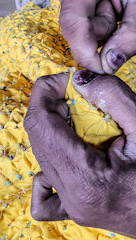
Making a knot for bandhani dyeing

Bandhani is a method of producing patterned dyed silks and cotton. Put simply, a piece of cloth, already dyed one colour or not at all, is prepared as follows. Parts of the cloth are gathered up to form tight bundles fastened by fine threads. The bundles, which look like small pimples are distributed to form patterns. The tied cloth is then dyed. The dye reaches all parts of the cloth except those enclosed in the tiny bundles. When the bundles are untied the patches of the cloth that had been shielded from the dye remain the original colour. This process can be repeated several times using different dyes to create an interesting pattern.

The shop the looked at, Khatri Ibrahim Siddik & Co, is the oldest bandhani workshop in Mandvi. It has been run by the same family for fifteen generations .

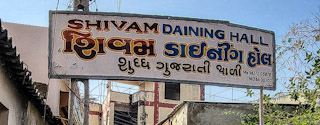
During our recent visit (January 2023), we have come across several businesses that have passed from generation to generation. In Bhuj, the Shivam Daining (sic) restaurant is run by chefs whose great grandfathers, grandfathers, and fathers, have all been cooks to the Maharaos of Kutch. Likewise, there is a bakery in Bhuj with an ancient wood fired stove. This business has passed through at least four generations. Nearby, there is a knife, scissors, and sword maker, who is the fourth or fifth generation of a family, which has been in this trade for over more than a century.

I am certain that there are plenty more examples of families in Kutch specialising in skills that have been passed from one generation to the next. I wonder whether these skills are in the genes, or simply taught by one generation to the next, and so on.

A cook from Kutch in Norway

THE SHARAD BAUG HOMESTAY is in the extensive, luxuriant, verdant grounds of the Sharad Baug Palace. Badly damaged in the 2001 earthquake, the palace is a short walk from the excellent homestay. This accommodation is owned and run by members of the royal family of the former Kingdom of Kutch.

Close to the homestay in the middle of a field, there is another ruined edifice. This was formerly used as a guesthouse by important guests of the ruler, the Maharao. For some time, the poet Dara Shiko (1615-1659) hid from his brother (the future emperor Aurangzeb) in this building.

Near the ruined palace, there is a building, which was the last Maharao of Kutch’s sitting room and dining hall. Now, the building houses a small museum filled with exhibits relating to the royal Jadeja family. Amongst these, there are several items connected with the last ruler of independent Kutch when he spent some time in Norway.

After Kutch had joined India soon after 1947, its last Maharao, Madansinhji (1909-1991), was appointed India’s ambassador to Norway. There are photographs relating to his stay in Norway in the museum. There is also a Christmas card in Norwegian and a certificate issued by the Oslo Tennis Club. He served in Norway between 1957 and 1960.

While in Norway, Madansinhji was served by his chef from Bhuj, a member of the Yadav family. For many generations, the Yadavs have been chefs, specialising in non-veg food.

When we first visited Bhuj, in 2018, we were recommended to eat in a simple, small restaurant in the bazaar of Bhuj. Named Shivam Daining (sic), it serves very tasty pure vegetarian food. We returned to eat there several times during our recent (January 2023) stay in Bhuj. While chatting with its chef and his relatives, we learned that the man who produces the excellent food is a grandson of the Mr Yadav, who cooked for Madansinhji in Norway. Although the family have a tradition of cooking meat and fish, they do not offer it at Shivams because they rightly feel that there is little demand for non-veg food in the mainly vegetarian city of Bhuj.

Without knowing it when I booked the Sharad Baug homestay, it turned out that it and one of our favourite restaurants in Bhuj had at least one common connection, and that is Norway.

An illustrious ancestor

QUEEN VICTORIA’S SON Prince Alfred (1844-1900) visited India in December 1869. In his honour several schools in India were founded in his name. In the present State of Gujarat, there are at least 3 still in existence. One is in Rajkot, another in Bhavnagar, and one in Bhuj (formerly the capital of the Princely State of Kutch).

Alfred High School in Bhuj

In Bhuj, we have a friend, Pramod Jethi, who is a historian of Kutch. Some of what I am about to relate is based on information kindly provided by him. Much of the rest is gleaned from what my wife’s family have told me.

My wife’s mother’s great grandfather was one Laxmidas Ravji Sapat (aka Sampat), who was born in the mid-19th century, or a bit earlier. Along with Gokaldas Parekh, Laxmidas was one of the first teachers in the Alfred High School in Bhuj (founded by Rao of Cutch, Pragmalji II in 1870). It is likely that he was its headmaster for a time. I have yet to see it, but his portrait hangs in the school. One of my wife’s relatives, also a descendant of Laxmidas, arranged to have it restored a few years ago.

In 1890, Laxmidas left the school. Later, along with his son-in-law, Cullyanji Murarji Thacker, he went to London (UK) to become a barrister. He studied for the Bar at Middle Temple and was called to the Bar on the 27th of June 1900, along with his son-in-law. Mr Thacker, who was my wife’s mother’s grandfather. The two men received financial help for their studies from the Kutch Royal family.
Both men were members of the Bhatia community in Kutch. Back at the end of the 19th and the early 20th it would have been unusual for a man and his son-in-law to travel out of India together to study.

Laxmidas, after leaving the Alfred School, became appointed as police chief of Bhuj, then diwan (Prime Minister) of Jaisalmer, and after that Chief Justice of Jodhpur. Apparently, he was very successful in reducing dacoitry in the Kingdom of Kutch and also Jaisalmer.

Recognising that the dacoits robbed because they were impoverished and starving, he helped make arrangements that reduced these poor peoples’ need to steal. It was this success that attracted other rulers of Princely States to offer him employment.

Regarding Jaisalmer, I discovered this quote:
“On his retirement, one Laxmi Das Raoji Sapat, who had lately served as Police Commissioner in the Kutch State, was appointed as Dewan of Jaisalmer”
This was in 1903.

As for Mr Thacker, he was successful enough to have owned a large house with two separate kitchens (one veg, the other for meat), and to have employed an English governess for my wife’s maternal grandmother, Benabhai, who married the surgeon Haridas Bhatia FRCS (died of septicaemia whilst on duty in 1926).

Incidentally, Benabhai was sent to London to study at the former Bedford College at the same time as her husband was studying for his FRCS. This contrasts with Mahatma Gandhi, who went to study in London, leaving his wife behind in India.

In January 2023, whilst spending a short time in Bhuj, we took a look at the elegant exterior of the city’s Alfred High School, which adjoins the Bhuj Museum. Badly damaged in the earthquake of 2001, the school building has been well restored. A less attractive, newer building was built to enlarge the school. On a future and lengthier visit to Bhuj, we hope to be able to view the portrait of Laxmidas that hangs inside the school.