THE EARLY WORKS OF artists, who became famous for their successful experimentation in style and expression (such as Matisse, Picasso, Van Gogh, Miro, and Hockney), began by making quite conventional figurative pictures – always competently executed. Such was also the case with the artist Philip Guston (1913-1980), who was born in Canada, son of Jewish parents who had migrated from Czarist Russia. Born ‘Goldstein’, he later changed his surname to ‘Guston’. His family moved to Los Angeles (USA) in 1922. His childhood was filled with trauma: his father committed suicide, and soon after that his brother was killed in a motor accident. He began to be involved with art as a way of dealing with these sad events. In the 1930s, he engaged with political activity, fighting racism and anti-Semitism at a time when the Ku Klux Klan was enjoying some prominence. Several of his paintings depict hoods, such as were worn by the Klan.
There is a retrospective exhibition of Guston’s works at London’s Tate Modern until the 25th of February 2024. The paintings are exhibited chronologically on the walls of eleven interconnecting display areas. Like the artists listed at the beginning of this piece, Guston’s early works are figurative and very beautifully painted. Many of these powerful images reflect his concerns about the adverse political developments he observed during the 1930s. Later, in the 1940s, he became friends with artists like Mark Rothko and Willem de Kooning, and he moved successfully from figurative painting to abstraction. He became well-known as an abstract artist. After that, in the 1960s, his art seemed to my eyes to go downhill.
Guston’s later works, which are partly figurative and partly abstract, and created in and after the late 1960s, were undoubtedly created to send messages to the viewer. However, I found them to be crudely executed in comparison with his earlier abstract and much earlier figurative works. Whether this crudeness was deliberate or reflected a decline in the artist’s ability I cannot say. These later works express the artist’s personal crises and his reaction to injustices and other global catastrophes, but they did not do much for me from an aesthetic point of view. Had I left the exhibition without seeing them, my admiration for Guston would have been higher than it is having seen them.
THE HIGH STREET runs through Sandwich (Kent) from south to north. At its northern end, it runs beneath an archway next to a former toll bridge across the River Stour. After 1977, the toll was abolished. Under the archway, which is part of the mediaeval barbican (built c 1470) that used to be a gateway through the town wall, there are several notices of interest.
One of the notices records the fact that tolls were collected from users of the bridge from 1759 to 1977, and the last toll was collected from the Mayor Councillor on the 30th of September 1977. Near this memorial, there is a table of tolls dated June 1905. Interesting as these two signs are, it is the third one that was a complete surprise to me. It read:
“This plaque is to commemorate Richborough Transit Camp 1939-1940 where 5000 men found refuge from Nazi persecution on the Continent. During the Second World War most of them volunteered to fight for the Allied cause.
Erected in gratitude to the citizens of Sandwich and East Kent who, as in the past, welcomed the refugees.”
I noted that this brief notice made no mention of the identities of the refugees. However, another plaque, attached to the nearby Bell Hotel, clarified the situation. The hostelry was:
“… A meeting place for Jewish refugees from the Kitchener Camp, Richborough, Sandwich 1939-40”
The Kitchener Camp was a former army barracks located north of the Stour, not far from the toll bridge, on the west side of Ramsgate Road. There is now no trace of it because it was demolished after the end of WW2. During 1939, 4000 mainly German and Austrian Jewish men were accepted for accommodation in the camp on condition that they would not be granted UK citizenship or work, and must emigrate to the USA. The camp received no government funding. It was paid for by Jewish organisations including The Central British Fund for German Jewry (founded 1933). At the start of WW2, 887 of these men volunteered to join the Pioneer Corps, which carried out light engineering projects at the battle fronts. After the Dunkirk episode in May 1940, the British public became suspicious of German speaking refugees because they were worried about the possibility that some of them might be involved in spying and sabotage. So, those, who were not enrolled in the war effort, were shipped out to internment camps in Australia and Canada, and then Kitchener was closed.
During its brief existence, the Kitchener Camp, which began accepting refugees on the 20th of January 1939, became a hive of cultural activity as can be discovered by looking at the highly informative website – https://kitchenercamp.co.uk/ There were concerts and a cinema provided by the Odeon Cinemas, run by it’s the Jewish founder Oscar Deutsch. I had never heard of the Kitchener Camp (aka ‘Richborough Tansit Camp’) until I spent a few days in Sandwich recently. Regarding the plaque commemorating it beneath the arch of the barbican, it mentions 5000 men, but reliable sources always refer to 4000 Jewish men. This puzzles me, as it was placed by the Jewish Community of Great Britain ( according to https://www.warmemorialsonline.org.uk/memorial/263444/).
MY FIRST VISIT TO Fort Kochi (Fort Cochin) in Kerala was in 1994. By then, I already knew that there was one or more Jewish communitis in Fort Kochi (‘Kochi’). As we drove into Kochi, I noticed many six-pointed stars, all identical to Jewish Stars of David (‘Magen David’). For a while I was amazed by the sight of so many of what I believed then to be Jewish shops and other establishments. Not long after this, I became aware that like the Om and the swastika, the six pointed star is a commonly used Hindu symbol. For example, the Canara Bank, not a Jewish outfit, uses the six pointed star as its logo.
Several communities of Jewish people lived in Jew Town, which is in the district of Mattancherry. Today, flocks of tourists visit the area to explore its numerous handicraft shops and the beautifully preserved Dutch (Paradesi) Synagogue, whose floor is paved with blue and white tiles made many centuries ago in Holland.
Apart from the much-visited synagogue, there are very few other buildings that have recognisable marks that indicate their former Jewish connections. On previous visits, I spotted what must have been another synagogue; a house bearing Magen Davids; and a locked up, well maintained Jewish cemetery.
Today, the 10th of February 2023, I spotted a building with Hebrew lettering above its main door. This edifice, which is undergoing restoration, is close to the Masjid Aisha on Jew Street, and about 0.5 miles south of the Dutch Synagogue. In need of much work, this is what remains of the Kadavumbhagam Mattancherry Synagogue (constructed by 1544 AD).
Kadavumbhagam Synagogue under restoration
Another building with well-documented Jewish connections, but no obvious marks, is currently being used to house exhibitions contemporary with the 2022/23 Kochi Muziris Art Biennale. Called the Kashi Hallegua House, this grand dwelling is about 150 yards south of the Dutch Synagogue. Above its carved wooden framed front door is the date 1761. This was during the period that the Dutch were the dominant European presence in the area: they were intimately connected with Kochi between 1663 and 1814.
For over 250 years, the Dutch house, formerly known as Krathi Veedu, was home to many generations of the Hallegua family. From where they originated, I have not yet found out but they were Paradesi – European Jews who arrived in Kerala from abroad, as opposed to Jewish people whose origins were other than European (no one knows from where they arrived in Kerala).
The last Jewish residents of the house, 85 year old Mrs Juliet Hallegua and her daughter Yael, left for Israel in 2019. The place was then purchased by Edgar Pinto, who converted the huge family home into an art gallery. Although the furnishings used by the Hallegua family have been removed, many of the original wooden window frames and cupboard doors are in place. The kitchen, now a gallery space, has a huge oven and a special carved stone workspace used for grinding food ingredients with a stone rolling pin.
The two Hallegua women were amongst the last of the Kochi Jews living in the town. There was another, Sarah Cohen (1922-2019) who lived very close to the Dutch Synagogue. Until she was in her nineties, she had a shop selling tablecloths and other handmade cloth items, many of them with Jewish decoration. Today, the only Jews in Kochi’s Jew Town are visiting Jewish tourists, a few of whom might have had ancestors who lived there.
Since our last visit in 2019, a couple of shops have opened. Named Shalom, their signboards bear the Jewish six pointed star. The company sells ready-made garments, but I suspect that apart from the name, it has no Jewish connections … but I might be wrong!
During the late 1990s, our then young daughter had a baby-sitter called Bridie. Although Bridie was already well into her eighties when we first met her, she was a remarkably sprightly lady. Born in a rural part of the west of Ireland, she came to England in her late teens. On arrival in England, she and her husband were cared for by the Salvation Army in exchange for taking a pledge never to drink alcohol again. Bridie never reneged on this promise. To earn a living in London, where she settled, she became a domestic servant. Hearing that I had been brought up in northwest London’s Golders Green, she told me the following story.
War memorial clocktower in Golders Green
Sometime before WW2, Bridie was employed as a maid in a Jewish household in Golders Green. She looked after the family’s children and carried out many household duties. Even though it was not a particularly wealthy family, Bridie recalled that she wore uniforms when on duty. There was one outfit that she wore in daytime and in the evening, she changed into another. As she did with our daughter, Bridie became fond of the family’s two young sons.
Many years later, when Bridie had become a grandmother and our daughter’s baby-sitter, she used to spend her spare time travelling around London by bus (making use of her old age free bus pass). One day, she was waiting for a bus at the stop closest to Golders Green’s Sainsbury’s (on the site of the Ionic cinema), when a well-dressed late middle-aged man in the queue said to her:
“Goodness! Is it you, Bridie? We have not seen each other for so many years.”
After a moment, Bridie realised that she was being addressed by one of the two boys, whom she had looked after in the house in Golders Green before the War. Just then, a bus arrived, and as her former charge was about to embark, he shouted:
“This is my bus. Are you taking it, Bridie?”
Bridie misheard what he had said, and by the time she realised, the bus had pulled away, leaving her at the bus stop. She told me that if she had known he was taking that bus, she would have joined him. As far as I know, she has never seen him again.
THERE IS SOMETHING curious about a small building on Kensington Park Road (near to London’s Portobello Road). Above its centrally located, west-facing front door, there are three tall windows topped with semi-circular arches. In each of these windows, there is a circular pane of glass painted white.
If you look at the circular panes carefully, you will notice that, almost obscured by the paint, there is a six-pointed star, the Jewish Magen David. Inside the building, there is a large hall flanked by galleries at the first-floor level. The galleries are supported by metal columns topped with decorative capitals. High up on the east wall of the building, there is a circular stained-glass window. The glass depicts a Magen David: it has not been concealed by paint.
In the former synagogue on Kensington Park Road
Did you know that this building, now much modified, was one of two synagogues in the Bayswater/Notting Hill area of west London? The other, still functioning, is on St Petersburgh Place near Bayswater Road.
I will not tell you any more about these two synagogues, one defunct and the other working, and west London Jewish communities, because you can read about them ( and much more) in my book “Beyond Marylebone and Mayfair: Exploring West London”. You can buy the book from Amazon (https://www.amazon.co.uk/BEYOND-MARYLEBONE-MAYFAIR-EXPLORING-LONDON/dp/B0B7CR679W/), or if you prefer to support independent bookshops, you can order a copy from a lovely bookshop near the former synagogue on Kensington Park Road: Lutyens & Rubinstein (21 Kensington Park Rd, London W11 2EU).
IT IS PLEASANT to stroll beside the Thames along Chiswick Mall. Occasionally, we take a look at the graveyard of Chiswick’s St Nicholas Church. On a recent visit to this place, we walked deeper into it than usual and spotted a grave marked by a remarkable sculpture.
The idyllic, romantic, leafy churchyard by the river is chock full of graves. Several of them caught my attention. One is that for the artist William Hogarth, who lived close-by. His monument is protected by a cast-iron fence. An urn on a plinth decorated with an artist’s palette and brushes. It was erected after the death of his sister in 1781 (who is also commemorated on this monument) and was restored by a William Hogarth of Aberdeen in 1856. Another painter, Philippe Jacques de Loutherbourg (1740-1812), who was born in Strasbourg, is buried with his wife Lucy de Loutherborg (née Paget). Like Hogarth’s, their decaying monument on the north side of the cemetery is surrounded by cast iron railings. In 1789, Philippe gave up painting temporarily to develop his interest in alchemy and the supernatural. Later, he and his wife took up faith-healing. The remains of yet another painter, James Abbott McNeill Whistler (1834-1903), lie in the cemetery.
Private Frederick Hitch (1856-1913) is less famous than these artists. He was awarded the Victoria Cross for his brave actions during the Battle of Rorke’s Drift (January 1879) in the Anglo-Zulu War fought in South Africa. He is also buried in this large cemetery.
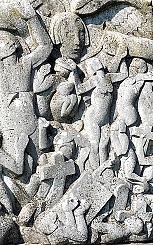
Amongst the more recent graves is the one with the unusual sculpture. It is that of Baronet Percy Harris (1876-1952), who was a Liberal politician. Son of a Polish immigrant, he was born in Kensington, and died there after a long career in parliamentary politics. According to a website listing British Jews in WW1, Percy was Jewish, yet his grave is distinctly Christian in sentiment. Aesthetically, his grave is the most remarkable one in the cemetery next to St Nicholas. It includes a semi-abstract, vorticist carving of The Resurrection of the Dead, created by the sculptor Edward Bainbridge Copnall (1903-1973) in the 1920s. Harris had acquired it for display in his garden long before it was moved to adorn his grave.
Although Percy Harris was born Jewish, he is buried in the graveyard of a Church of England parish church. Despite searching the Internet, including reading his extensive entry in the Dictionary of National Biography, I cannot determine whether or not he converted to Christianity sometime during his life.
I HAVE WATCHED AND GREATLY enjoyed many plays by Tom Stoppard. So, it was with high expectations and great excitement that I booked good tickets for his latest play, “Leopoldstadt”, which is about a tragic period during Austria’s history, a time that interests me greatly. The play follows the history of a Jewish family living in Vienna between the late 19th century and about 1955. Like many Jewish families living in Germany and Austria, they were determined to appear increaslingly less Jewish and ever more like their gentile neighbours, a process known as ‘assimilation’. As Amos Elon demonstrates in his wonderful book, “The Pity of it All”, the more assimilated the Jewish people became, the less they were tolerated by their mostly anti-Semitic neighbours. Stoppard’s play attempts to portray this sad state of affairs in “Leopoldstadt”. His play was more like a history lesson than a compelling work of drama.
“Leopoldstadt” was being performed in London’s magnificent Wyndhams Theatre. Frankly, although there were a few wonderful scenes in the play, I was mostly disappointed. Although it was clearly a heartfelt and moving exploration of part of his family’s history, Stoppard has written far better and subtler plays in the past.
NOT MUCH REMAINS of Ramsey Abbey in a part of Cambridgeshire, which used to be in the former county of Huntingdonshire. Like most of the monastic institutions in England, Ramsey Abbey was ‘dissolved’ by Henry VIII. Ramsay was closed in 1539.
Founded in 969 by Bishop Oswald of Worcestershire (died 992), this abbey in the Fens achieved great importance, rivalling Ely and Peterborough. Three centuries before the first college (Peterhouse) was established at Cambridge in 1284, Ramsey was a renowned centre of scholarship. In addition to theological matters, the scholars at Ramsey studied a wide range of other subjects. One of the most eminent scholars, Abbo of Fleury (c945-1004), was brought to Ramsey by Oswald in 985. Abbo brought much knowledge from both the Classical world and the Arabic world to Ramsey, where he stayed for 18 months. Another leading scholar was Byrhtferth (c970-c1020), who was well-known for his studies of English history. He also wrote a scientific compendium in about 990. This included material about mathematics, properties of matter, astronomy, and medicine.
Geoffrey of Huntingdon, who lived in the 13th century, was Prior of Ramsey Abbey for about 38 years. He was a scholar, with great fluency in the languages of Latin, Greek, and Hebrew. When the Jewish people were expelled from Britain in 1290, he bought from them as many Hebrew texts as he was ablee to find, including from the synagogues at Huntingdon and Stamford. Under Gregory’s influence, Ramsey became a centre of Hebrew studies. From the books and texts collected at Ramsey, a priest, Laurence Holbeach (died c1420), compiled a Hebrew dictionary in about 1410.
When Ramsey was dissolved in 1536, the dictionary was amongst the many scholarly works taken (or stolen) from the monastery by Robert Wakefield (or ‘Wachefeld) of Oxford, where he taught Hebrew from 1530 until his death. Wakefield, who died a year later, was a renowned English orientalist and Hebraist who taught at famous universities including Cambridge, Oxford, Paris, Louvain, and Tübingen. What became of this dictionary, I have not yet been able to discover.
Whether the dictionary remains in existence or not, I cannot say, but I do know that by visiting the small town of Ramsey, the visitor can see some remains of the former abbey. These include the remains of a gatehouse, which is now looked after by the National Trust and the Church of St Thomas à Becket, now a parish church. The latter was already constructed in the 12th century. It was probably originally built as a hospital or infirmary for the abbey, but by 1222, it had become a parish church. The aisles were rebuilt in the 16th century and the current west tower was built in 1672. The church contains some lovely stained-glass windows both behind the high altar and on the eastern part of the southern wall. These windows, created in the early part of the 20th century, were made by Morris & Co, a company founded by William Morris.
The former abbey has a connection with Oliver Cromwell (1599-1658), who was born in the nearby town of Huntingdon. In 1540, the estate of the former Ramsey Abbey was sold to Sir Richard Williams (1510-1544), also known as ‘Sir Richard Cromwell’. This man, who was Oliver Cromwell’s great grandfather, demolished most of the abbey, which was:
“… turned into a quarry, the lead from the roofs being melted down into fodders and ingots for sale to the highest bidder. Gonville and Caius college in Cambridge was built from the stone and Kings and Trinity were partly rebuilt. Stone from the Abbey also found its way into many local churches and other buildings” (https://ramseyabbey.co.uk/richard-cromwell/)
Richard’s son Henry built a Tudor house on the former abbey’s grounds. Henry’s son Oliver (born 1562), who was an ardent Royalist, much to the embarrassment of his nephew Oliver Cromwell, the famous Parliamentarian and ruler of England (the ‘Lord Protector’), lived in the house his father had built. This, the manor house, was sold to Coulson Fellowes in 1737 by the then owners, the Titus family. In 1804, the architect Sir John Soane enlarged the house. The building was further enlarged in 1839. Now the building houses Ramsey’s Abbey College. Currently the building looks far from being Tudor and by looking at its exterior, one cannot guess that it contains some remains of the early mediaeval abbey, on which it was built.
As a notice beside the remains of the gatehouse aptly states:
“After existing for nearly four centuries as the grounds of a private residence it is most fitting that a large part of the abbey site is now occupied by the Abbey College. The eighty or so monks in their black habits have been succeeded by a far greater number of students. Across the generations Ramsey has been the home of scholars who have sought to expand their knowledge of the world …”
I am certain that Bishop Oswald would be pleased to know although his scholarly establishment was closed by a King with dubious intentions, Ramsey continues to be a place of scholarship.
LESS THAN 580 FEET long, Rathbone Street runs parallel to part of London’s Charlotte Street. Short though it is, it is not lacking in interest. The quiet thoroughfare was originally named ‘Glanville Street’, before being renamed Upper Rathbone Place, and then its present name (www.british-history.ac.uk/survey-london/vol21/pt3/p12). Rathbone after whom Rathbone Place and Street were named was a carpenter and builder, Thomas Rathbone (died 1722), who lived in a house on the Place around 1684. Rathbone Street was laid out 1764-65 (www.ucl.ac.uk/bartlett/architecture/sites/bartlett/files/chapter31_hanway_street_and_rathbone_place.pdf). During the late 18th and early 19th centuries, Rathbone Street was occupied by various artists including the sculptor M Bordier and the painter John Rubens Smith. Today, various vestiges of the past can be seen on the short street.
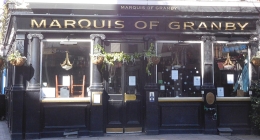
The Marquis of Granby pub at the southern end of Rathbone Street was named in honour of Lieutenant-General John Manners, Marquess of Granby (1721-1770), who fought heroically at the Battle of Warburg (1760) during The Seven Years War (1756-1763). He became Commander of the British Army in 1766. There are many pubs named after him because, it is said, he set up many of his soldiers as publicans when they retired from military service. The pub bears old boundary markers marking the demarcation line between the parishes of St Pancras and St Marylebone. The pub now stands in both the Boroughs of Camden and Westminster. In the past, the pub’s customers have included Dylan Thomas and TS Eliot. The building housing the pub was already built by 1765.
There are two other pubs in Rathbone Street. One of them halfway along it is The Newman Arms, another haunt of Dylan Thomas and also frequented by George Orwell. Established in the 1730s, this pub features in two of Orwell’s novels: “1984” and “Keep the Aspidistra Flying”. Once upon a time, the pub was a brothel. A painting depicting a prostitute in period costume covers a bricked in upper storey window. Across the road from the pub there is a plaque on a building that bears the words: “Hearts of Oak Benefit Society” and the date 1888. This marked the rear entrance to the offices of the Society. Its main entrance was 15-17 Charlotte Street (www.londonremembers.com/memorials/hearts-of-oak-benefit-society-w1). At the north end of the street, there is a third pub, The Duke of York. Bearing the date 1791, it was where the author Anthony Burgess was drinking when he witnessed an attack by a gang bearing razors (https://en.wikipedia.org/wiki/The_Duke_of_York,_Fitzrovia). The pub’s sign bears a portrait of someone who is far younger than the pub, the current Prince Andrew. This pub is the only one with the name The Duke of York which has a pub sign depicting the current Duke of York. The pub was originally named to honour an earlier Duke of York.
Rathbone Street, short as it is, contains three pubs. Its continuation southwards towards Oxford Street, Rathbone Place, contains two pubs and another drinking place, once a pub but now named The Liquorette, in a stretch of road even shorter than Rathbone Street. Thus, there used to be 6 pubs within a stretch of roadway 364 yards in length.
Returning to the south end of Rathbone Street, its southwestern corner, we reach what first got me interested in this short lane. During WW2, there was a London Auxiliary Fire Station, Sub Fire Station 72Z, on this spot. During the night of the 17th of September 1940, it was hit by a bomb dropped by the German Luftwaffe. The building burst into flames. Seven firemen lost their lives. However, two men were saved by the brave actions of Fireman Harry Errington, who was later awarded a George Cross to recognise his bravery. He rescued two of his comrades from the flaming ruins. Harry Errington (formerly ‘Ehrengott’) was son of Jewish immigrants living in Soho. Harry, son of Baila and Shepsel Ehrengott who arrived in London from Poland in 1908, was born in Soho in 1910 (https://british-jewry.org.uk/New%20Member%20Area/BJ%20News/100806/Microsoft%20Word-B-JNews8final.pdf).
After training to become an engraver, he had to abandon this because his lungs became affected by nitric acid fumes. Then, he joined a relative, a tailor in the Savile Row firm of Errington and Whyte. He became a master tailor. Then, WW2 broke out. Mike Joseph wrote in the “B-J News” of August 2006:
“It was in 1940 that Harry earned true celebrity status. Having joined the Auxiliary Fire Service at the outbreak of the Second World War a year earlier, he was one of several firemen on duty in a basement rest-room during an air raid, when the building collapsed. An enemy bomb had scored a direct hit, and twenty people died, including six firemen; Harry was lucky: he was only knocked out! When he came round, the building was on fire. He could have escaped with little difficulty, but two of his comrades were trapped under rubble: how could he leave them? He wrapped a blanket round his head against the flames and, digging with his bare hands, managed to free one of the men. He dragged him to safety, upstairs into the street, and then, although he was already badly burned, went back and rescued the other man.”
Harry was true to the words quoted from the Book of Joshua, which are written on one of the two commemorative plaques marking the former fire station in Rathbone Street:
“Be strong and of good courage.”
Harry returned to tailoring when the War was over but remained in touch with the London Fire Brigade. When he died in 2004, he was the last surviving Jewish holder of the George Cross.
Though less lively than nearby Charlotte Street in ‘normal’ times, Rathbone Street is worth a detour, if only to quench your thirst in one of its three pubs. I wonder whether Harry Ehrengott and his colleagues made use of any of these drinking holes during the odd quiet moments between their brave firefighting tasks.
SOME ‘POSHER’ JEWISH people in west London tended to live around Bayswater. These prosperous members of the Jewish community arrived in Bayswater in the 19th century as the district began to be urbanised. Many of them had drifted westwards from Bloomsbury and the City (www.british-history.ac.uk/vch/middx/vol9/pp264-265). This migration placed them at an inconvenient distance from the synagogues they had been used to attending. So, in 1863, Bayswater Synagogue (at corner of Chichester Place and Harrow Road) was consecrated. This new place of worship was a branch of both the of the Great Synagogue (in the City north of Aldgate) and the New Synagogue (originally near Leadenhall Street, and then later in Great St Helens Street). Like so many Jewish buildings in mainland Europe, this synagogue was destroyed by the forces of Nazi Germany, during WW2.
New West London Synagogue
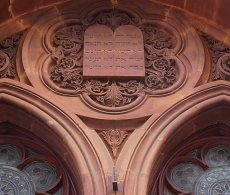
In 1879, an offshoot of the now demolished Bayswater Synagogue was consecrated in St Petersburg Place, a short distance from the main road known as Bayswater. This, The New West End Synagogue, is now one of the oldest surviving functioning synagogues in Great Britain. At first sight, you might easily be mistaken for thinking that the huge red brick building with Victorian gothic architectural features, a rose window, and twin bell towers, is a church. And maybe that was the intention of the community that commissioned the building. Upwardly mobile Jewish people in Victorian England might well have preferred not to advertise their religious beliefs too much in a society that then had many prejudices against Judaism and other non-Christian religions. The synagogue in St Petersburg Place looks no more exotic or out of place than the Church of St Matthew a few yards north on the same street. In fact, it is another building to the north of these two and within sight of them that is unashamedly exotic in appearance, Aghia Sofia, the Greek Orthodox cathedral on Moscow Road, which was consecrated only three years after the synagogue.
The desire of some Jewish people to ‘meld’ seamlessly with British ‘high society’ was not confined to England. Amos Elon writes about this in his inciteful book about the ‘emancipation’ of Jews in Germany, “The Pity of it All”, and what a dreadful fate it led to. It is my impression that amongst the few Jewish people, mostly of British and German origin, living in Victorian South Africa, there was the belief that economic and social advancement was not hindered by being somewhat discreet about their religious beliefs. This changed during the final few decades of the 19th century when many Jewish people began arriving from parts of the former Russian Empire, many from what is now Lithuania. Often much poorer than their co-religionists, who were already well-established in South Africa, they were far less reticent about expressing their religious beliefs and critical of the ‘established’ Anglo-German Jewish community, who had, in their eyes, become rather too lax about Jewish religious observance.
Returning to Bayswater and its mainly prosperous Jewish families, we can now travel less than a mile northwest to reach the northern end of Kensington Park Road, close to Portobello Road, in nearby Notting Hill, to reach the site of another, now disused, synagogue. This building, still standing but now repurposed, was not designed to mislead the onlooker into believing it was a church. As was the case in South Africa during the last few decades of the Victorian era, large numbers of Jewish people began arriving in London from Eastern Europe, and many of them settled in the crowded East End. In 1902, A Jewish Dispersion Committee, set up by the (Jewish) banker and philanthropist Sir Samuel Montagu (1832-1911), tried to attract some of these new arrivals to settle in areas away from the East End, like Notting Hill (www.british-history.ac.uk/vch/middx/vol1/pp149-151).
The former Notting Hill Synagogue at numbers 206/208 Kensington Park Road was opened in 1900 (www.jewishgen.org/jcr-uk/london/notting_fed/Index.htm), a little ahead of the formation of the above-mentioned committee. Presumably, it was worth opening because there must have been sufficient Jewish presence in the neighbourhood. By 1905, it had 281 members and ten years later, there were 250. Its ritual was Ashkenazi Orthodox, the same as that at the New West End Synagogue, but the congregants were less wealthy than those who attended the latter. Many of them were market stallholders or artisans, such as tailors and shoemakers (http://www.ladbrokeassociation.info/Churchesandotherreligiousbuildings.htm#Synagogue). They lived in what were at the beginning of the 20th century far less salubrious dwellings than many of those, who worshipped in St Peterburg Place. Although I do not know for certain, I doubt there was much socialising between the Jewish communities of Bayswater and Notting Hill.
The Notting Hill Synagogue was housed in a former church hall. Its memorial stone dated the 27th of January 1900 was laid by Sir Samuel Montagu. Although it was a discreet building externally, its interior with galleries for the women and girls was elaborate and attractive as can be seen in old photographs (www.jewishgen.org/jcr-uk/london/notting_fed/Photographs.htm). We have walked past it many times without realising it was once a place of worship until a friend told us recently about its former incarnation.
During WW2, the synagogue was severely damaged by a German bomb. It was restored and reconstructed. During the Notting Hill race riots in the late 1950’s, during the time that the fascist Oswald Mosely (1896-1980) was campaigning as a candidate in the election for the parliamentary seat of the local constituency, Kensington North, he set up his office close to the synagogue. On the 31st of January 1959, one of his supporters daubed the synagogue with the words used by the Nazis: “Juden raus”. Despite these traumatic events, the synagogue continued to thrive until the 1990s, when the size of the local Jewish population had declined. Rabbi Pini Dunner (born 1970), who had been invited to help in performing the ritual in 1992, when the synagogue, under the leadership of its charismatic Stuart Schama, was falling into decline, wrote:
“Notting Hill Synagogue was nothing like any shul I had ever seen. The congregants consisted of a motley group of mainly octogenarian men, characters out of some East End Jewish sit-com, each with his own catchphrase, many of them not quite sure why they were there week after week.”
The synagogue then closed, and amalgamated with the Shepherd’s Bush, Fulham & District Synagogue. Since its closure, the synagogue has been used as a ‘health club’. Currently (March 2021), the building bears the name ‘Teresa Tarmey’, a company that supplies various treatments (www.teresatarmey.com/).
The transformation of the former synagogue into a trendy beauty salon reflects that of Notting Hill from a relatively impoverished area into a prosperous area with high property prices, which is beginning to make Bayswater seem less attractive in comparison. The synagogue in St Petersburg Place continues to thrive. One of my cousins, who lives many miles from it, told me that it was well worth travelling to because its congregation is vibrant and life-enhancing, which is good to know because the mainly residential area surrounding the synagogue is usually rather sleepy.





 yamey
yamey 