Getting fixed in Bangalore (Bengaluru), India

KALIM REPAIRS JEWELLERY in Jewellers Street in the Commercial Street district of Bangalore (Bengaluru). He sits on the pavement on the shaded east side of the street in the morning and in the afternoon,  he moves to the west side to keep out of the sun. He can mend almost every kind of jewellery. When restringing necklaces, he uses both his hands and his feet, to keep the thread taut.


Kalim at work

Kalim is one of many people we visit in the Commercial Street area to get repairs done. These craftsmen include tailors, a bag repairer, dyers, darners, watch repairers, locksmiths, and jewellers. We have known all of them for years.


The great thing about these skilled workers is that they will skilfully repair almost anything. On the UK,  people like this are few and far between.


You can read about these wonderful people in and around Commercial Street in my book “88 DAYS IN INDIA: A JOURNEY OF MEMORY AND DISCOVERY”.

The book is available from Amazon https://www.amazon.co.uk/88-DAYS-INDIA-JOURNEY-DISCOVERY/dp/B0FKTFBFM2/

He moves with the sun on Jewellers Street in Bangalore

JEWELLERS STREET RUNS in a north/south direction. In the morning, the sun shines on the west side of the street and in the afternoon, on the east side. As its name suggests, the street is lined with many shops selling jewellery.

Jewellery breaks sometimes, but it can often be repaired. K is a jewellery repairer. In the morning he sits working in the shade on the pavement on the east side of the street, outside a particular shop. In the afternoon, you will find him outside a shop close to a silver and hold plating shop on the west side of the street.

K squats bare-footed alongside his trays of tools and materials, and mends a wide variety of jewellery. When re-threading necklaces and bracelets, he uses his toes to hold one end of the thread. We visit this friendly, highly skilled man whenever we are in Bangalore, usually with items if jewellery that have broken since our last visit to the city.

The loss of an earring made by a jeweller in Bosnia

ONE MORNING IN Kutch (part of Gujarat), we set off to see a historical monument not far from the town of Mandvi. On the way, we stopped at a cash machine (ATM) to withdraw some cash.

We inserted the debit card and the appropriate PIN code. After keying in the amount we wanted, the machine made the normal noises, and then asked us to remove the cash and our card. To our great dismay it delivered no cash. Yet, we received an SMS stating we had just withdrawn the amount of cash we had keyed in. This worried us greatly.

Fortunately, there was a branch of our bank near the ATM. We spoke with the manager, and explained what had happened. After taking a few details, he resolved the situation and instructed the cashier to give us the cash we had wanted. From his desk, he also managed to ascertain that the ATM had suffered a technical problem.

We drove on towards our intended destination. Despite information on the Internet and on noticeboards, all of which suggested that the place would be open, it was closed. The watchman at the gate explained that the attraction was closed for repair. However, he let us go in for a couple of minutes, after telling us that if anyone saw us enter, he would be in big trouble.

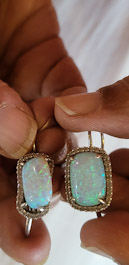
After this second mishap of the day, our driver took us to see a lovely Hindu temple a few miles away. As we began walking around the place, my wife noticed that one of her earrings had become detached. It was one of a pair that a jeweller in Sarajevo (Bosnia) had made. The pair had been made by the uncle of one my Bosnian dental patients, who, having been pleased with my dentistry, had given them to me to present to my wife. These earrings were of great sentimental value, and Lopa was most unhappy to have lost one.

After retracing our steps in the temple compound and failing to find the piece of jewellery, we decided to return to the bank and the ATM, where during the panic of the debit card problem, it might have fallen. On the way, we returned to the closed visitor attraction. We asked the watchman of he had spotted the earring. He had not.

So, we decided to search the part of the driveway, where we had stopped earlier. Lopa and I looked around in vain. Then, our driver joined the search. Within a couple of minutes, he found the earring in the gravel of the roadway. Sadly, either something had driven over it or stepped on it. The earring was intact but the silver stone setting had been distorted. We will have it repaired by Kalim, our skilful jewellery repairer in Bangalore.

They say things happen in threes. That was the case that morning in Kutch. Fortunately, two of the three problems were resolved in a good way.

She wore it a Diwali party in London

AN ARTICLE IN “The Ahmedabad Times” newspaper, dated 18th of November 2023, discussed what the British Prime Minister’s wife, Mrs Sunak, was wearing at a recent Diwali party in London. Over her tasteful blue sari she was wearing a pearl necklace, which was attached to a golden pendant.

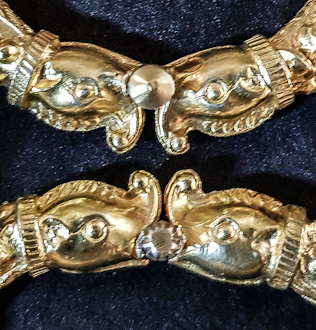
The pendant is a Hindu mythological creature, a ganderberunda. This is a bird with two heads – a double-headed eagle. It is the symbol of the Indian State of Karnataka. It is also a national symbol of places including Albania, Serbia, and Montenegro. It was also a symbol used by the Holy Roman Empire.

I wonder if Mrs Sunak was aware that the double-headed eagle is also a national emblem of Russia, against whom Rishi Sunak and his government are providing much military assistance.

Of Merlin and rollerskates

KENWOOD HOUSE IS NEAR both Hampstead and Highgate in north London. It offers the visitor the chance to view not only its lovely grounds and fine interiors designed by the architect Robert Adam (1728-1792), but also a fabulous collection of paintings, many by world famous artists including, to mention but a few, Rembrandt, Frans Hals, Van Dyck, Vermeer, Reynolds, and Gainsborough.

Merlin (painted by Gainsborough) and the invalid cahir he invented

One of the paintings by Thomas Gainsborough (1727-1788) is a portrait of the inventor John Joseph Merlin (1735-1803). The latter was born in Huy (Belgium), and as a young man, he worked in Paris making clocks and mathematical instruments. In 1760, he moved to England to work as a technical advisor to the then new Spanish Ambassador to London. By 1766, he was working with the London jeweller James Cox. Then, he was creating mechanical toys including the Silver Swan, an automaton, still working, that can be seen at the Bowes Museum in Barnard Castle (Durham).

In addition to these ‘toys’, Merlin invented some useful items. These included roller skates; various clocks including one that was powered by changes in atmospheric pressure; improvements to keyboard musical instruments; playing cards for blind people; prosthetic devices; and a self-propelled wheelchair known as ‘the Gouty Chair’. There is an example of this ingenious wheelchair on display beneath Merlin’s portrait in Kenwood House. In my book about Hampstead and its environs, I described it as follows:
“Two handles at the ends of its armrests are connected by rods and cogwheels to some wheels on the floor below the chair. The occupant of this chair could rotate the handles, and thereby propel this early form of wheelchair around the room.”

In the same room as the invalid’s chair, there is another of Merlin’s creations: a skeleton clock made by him in 1776. This kind of timepiece is one, whose working parts are not concealed by casing or any other features that usually hide them.

The portrait of Merlin, painted in 1781 by his friend Gainsborough, shows him in a red jacket, holding a small beam balance in his left hand. Apparently, this was one of his creations. This precision instrument is the only clue that the subject of the painting had anything to do with jewellery or instrument making. His right hand is tucked into his jacket:

“… a customary gesture to signify a polite yet firm manner.” (https://artuk.org/discover/artworks/john-joseph-merlin-17351803-191713)

The painting hangs in Kenwood House because it, like many of the others on display there, were part of the collection of the philanthropist and brewer (of the Guinness beverage) Edward Cecil Guinness, 1st Earl of Iveagh (1847-1927), who bought the house in 1927, and bequeathed it and his collection of paintings housed within it to the nation. You can discover more about Kenwood and nearby Highgate village in my book “Beneath a Wide Sky: Hampstead and its Environs” (https://www.amazon.co.uk/dp/B09R2WRK92 OR https://www.bookdepository.com/BENEATH-WIDE-SKY-HAMPSTEAD-ITS-ENVIRONS-2022-Adam-Yamey/9798407539520 )

Gifts of the grateful

In the 1980s, I visited my friends in the former Yugoslavia frequently. Also, I visited Albania and what is now independent Kosovo. During my trips, I picked up a large vocabulary of Serbo-Croat, including quite a selection of outrageous swear words. Grammar has always been beyond me in foreign languages, and often in my own. My interest in Albania and my brief visits to Albanian-speaking parts of the Balkans resulted in me acquiring some vocabulary in Albanian, but far less than in Serbo-Croat. Until the 1990s, I believed that my fragmentary knowledge of these languages would be useless outside the Balkans.
gift 2

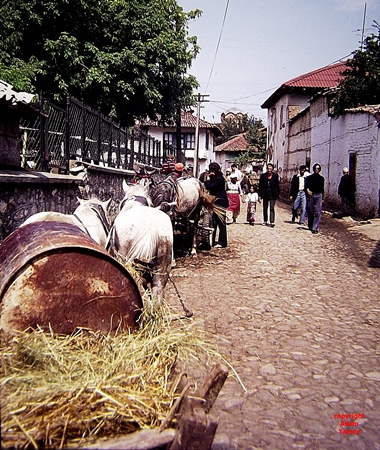
Prizren in Kosovo, pre-1990

During one trip to Belgrade, a friend arranged for me to be an observer in a clinic of a leading oral surgeon. I turned up at a large hospital and spent a couple of hours watching the surgeon reviewing a series of his patients. Although I was grateful to be allowed to watch the great man, I learned little that was relevant to practising dentistry. However, one aspect of this clinic interested me greatly. As each patient entered the consulting room, he or she presented the surgeon with a gift: a bottle, a large piece of cheese, a ham, etc.

The last patient to enter, a man in a somewhat shabby suit, entered and sat in the dental chair without having presented a gift. After his mouth had been examined, the surgeon took the patient and me out into a corridor. We walked through the hospital to a room with locked doors. My host unlocked it, we entered, and he locked the doors behind us. After a brief conversation, the patient handed the surgeon a small brown envelope, which he thrust into his jacket pocket. Then, after the doors were unlocked, the patient went one way, and we went another way. As we walked along the corridor, my host patted the pocket containing the envelope, and before bidding me farewell, said: “Pornographic photographs.”
gift 5 saraj

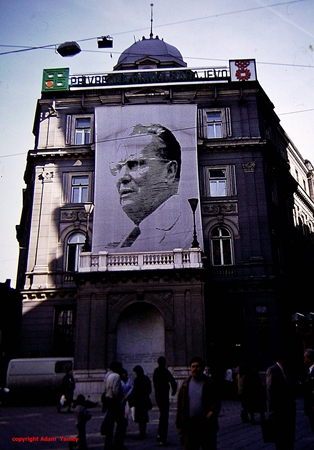
Poster of Marshal Tito in Sarajevo, Bosnia in the 1980s

My last visit to Yugoslavia was in May 1990.  Soon after that, wars broke out in the Balkans, and the former Yugoslavia disintegrated painfully to form smaller independent states. In the early to mid-1990s, there was terrible strife in Bosnia. Many people fled as refugees to places including the UK. In the late 1990s, Kosovo suffered badly from warfare between the Serbs and the ethnic Albanians. Many of the latter fled to the UK.

I moved from one dental practice outside London to another in London, an inner-city practice, in 2001. A significant number of my patients there had come from the former Yugoslavia as refugees. I was the only person in the practice who could greet them in Serbo-Croat or Albanian. Maybe, I was only one of a few dentists in London at that time who had this ability.

To the Albanian speakers my vocabulary was restricted to words such as ‘hello’ and ‘good-bye’, which brought smiles to their faces. Following a trip to Communist Albania in 1984, I recalled the Albanian words of political slogans such as “Long live Enver Hoxha”, “Enver’s party”, and “Long live the Peoples’ Party of Albania.” As many of my Albanian patients had come from Kosovo rather than Albania, these slogans meant little to most of them.

gift 3 travnik

Travnik, Bosnia, 1975

My limited Serbo-Croat was more extensive than my Albanian. I could entertain some of my Bosnian and Serbian patients with polite small-talk. Many of the ex-Yugoslav patients, like those I had seen long before in Belgrade, brought me gifts. Even those, with whom I felt I was not getting along with well, brought me, usually, bottles of home-made alcohol (e.g. rakia, slivovitz, and loza) that had been distilled by relatives who had stayed behind in the former Yugoslavia. These strong alcoholic drinks were delicious, smooth, and delicately flavoured. One fellow plied me with DVDs of the latest Hollywood and other films that he had ‘pirated’. One lovely lady from Bosnia presented me with a pair of earrings, which her uncle had made, to give to my wife. She wears these often, and she is very grateful.
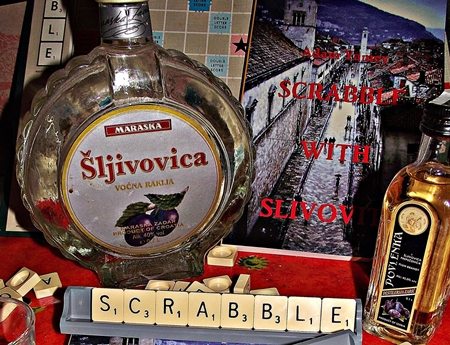
gift 4

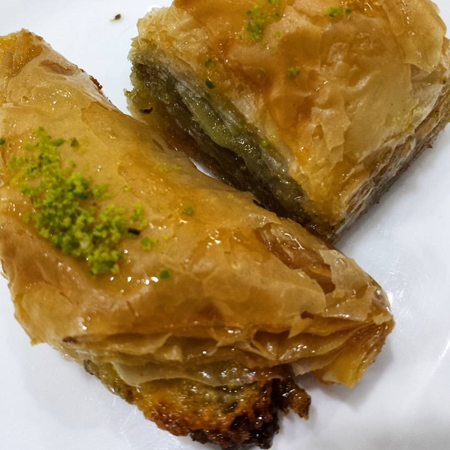
Many Middle-Eastern patients also felt that it was appropriate to bring me gifts. Thus, a lot of delicious baklava and other similar confections came my way. Delicious as these were, they were neither good for my teeth nor for my general health. A Hungarian family kept me supplied with large gifts of paprika powder, and there was a Romanian gentleman who brought me nice bottles of wine. Incidentally, the only words of Romanian I know are “thank you” and “railway timetable”. Once, we employed a Romanian dental nurse and I told her my Romanian party-piece “Mersul trenurilor.” She pondered for a moment and then replied “Ah, the programme of the trains.”

Once, my dental nurse, a friendly West Indian lady, and I were standing near a window facing the main road when a delivery van stopped nearby. A man was delivering trays of baklava to a nearby shop. I said to my nurse: “Why don’t you see if he’ll give us some to try?” She returned with a tray of baklava. Carelessly, because I was in a hurry to see my next patient, I put a large lump of baklava into my mouth, and then bit hard on it. As I was doing this, I heard a deafening bang in my head. The baklava was not too fresh. I had split a molar tooth into two parts, the smaller of which was loose in my gum.
gifts 1

Baklava

Unlike this disastrous piece of confectionary, the gifts kindly given to me by my patients did no harm. Furthermore, what I believed to be a useless tiny vocabulary of Balkan languages proved to be quite useful.  

Finally, you might still be wondering whether anybody ever took me aside to present me with an envelope containing pornographic photographs. To satisfy your curiosity, I can tell you that nobody did.