Faces of India for Queen Victoria

THE CORRIDORS LEADING to the spectacular Durbar Room in Osborne House on the Isle of Wight are lined with portraits of people born in pre-independence India, either painted or photographed during the 19th century. Most of these images depict members of the Indian aristocracy (e.g., rulers of Princely States). A few depict less exalted persons, such as craftsmen and the designer of the Durbar Room.
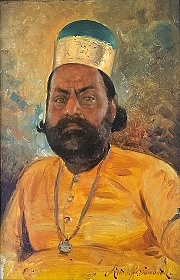
Maharajah Duleep Singh (1838-1893), who surrendered the Koh-i-Noor diamond to Queen Victoria, is portrayed in a few pictures, notably one by the famous German artist Franz Xaver Winterhalter (1805-1873). Many other paintings were created by the Austrian painter Rudolf Swoboda (1859-1914). Queen Victoria liked his painting style and commissioned him to create more than 40 portraits of Indian people. In 1886, the queen paid for him to travel to India, and gave him £300 in travelling expenses. Her instructions to the young artist were:

“The Sketches Her Majesty wishes to have – are of the various types of the different nationalities. They should consist of heads of the same size as those already done for The Queen, and also small full lengths, as well as sketches of landscapes, buildings, and other scenes. Her Majesty does not want any large pictures done at first, but thinks that perhaps you could bring away material for making them should they eventually be wished for.” (www.rct.uk/collection/403755/gulzar).

Many of these can be seen hanging in Osborne House. Amongst his many Indian portraits, there is at least one painted not in India but in England. Queen Victoria had several servants, who were born in British India and the Princely States associated with it. The best known of these ‘imported’ servants was her favourite Mohammed Abdul Karim (1863-1909), her ‘munshi’ (teacher), who helped her study Hindustani, which she learned to write competently in the Urdu script. Amongst Swoboda’s paintings of Indians hanging in Osborne House, there is one of a non-Indian, a lady from Cyprus, and another, a Cape Malay woman from  Cape Town (South Africa). Why they are there, I have not yet found out, but maybe Swoboda spotted them at the Colonial Exhibition held in London in 1886.

Not all the portraits of Indians are painted. Some of them are hand-coloured photographs. A few of these photos are signed by their creators, one of which was the photographic studio of Gobind Ram and Oodey Ram in Jaipur. Along with a studio in Calcutta the Ram brothers were pioneers in photography in 19th century India. One source (www.indiatoday.in/lifestyle/whats-hot/story/tryst-with-colonial-india-205124-2014-08-22) stated:

“Apparently, studio photography was practised by many Maharajas as a means of leisure, mostly using their courtesans as subjects. The Ravi Varma Studios of Calcutta and Gobind Ram-Oodey Ram Studio in Jaipur are just two examples.”

As can be seen at Osborne, these photographers also made portraits of the maharajahs and their families.

Although Queen Victoria loved Osborne House, I cannot see its appeal apart from the wonderful Durbar Room. For me, seeing this lavishly decorated hall and the collection portraits of the Indian people are the main delights of this otherwise rather gloomy residence.
Bringing India to Queen Victoria in England

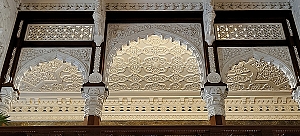
OSBORNE HOUSE ON the Isle of Wight was one of Queen Victoria’s favourite residences. Apart from one room within it, I was not overly impressed by the place. That room, which alone is a very good reason to visit Osborne, is the ornate Durbar Room. Entering this vast hall is like stepping inside an exuberantly decorated Maharajah’s palace somewhere in India. It is a superb example of the Indo-Saracenic style, which is according to one definition (on Wikipedia) was:

“… a revivalist architectural style mostly used by British architects in India in the later 19th century, especially in public and government buildings in the British Raj, and the palaces of rulers of the princely states. It drew stylistic and decorative elements from native Indo-Islamic architecture, especially Mughal architecture, which the British regarded as the classic Indian style, and, less often, from Hindu temple architecture.”

The Durbar Room was built not in India but in the country that ruled it at the time. It was designed not by a British architect but by a man from British India – Ram Singh (1858-1916), who was born in Rasulpur in the Punjab (now a village in Pakistan). His skills were recognised at a young age when he was seen working in a woodcarver’s shop in Amritsar. The man who spotted his talent was Rudyard Kipling’s father, the art teacher Lockwood Kipling (1837-1911). At the time, Lockwood was the first principal of the Mayo School of Industrial Arts, Lahore (established in 1875). He enrolled Ram as a student. Ram Singh was a successful student and soon became assistant drawing master at the school and Lockwood’s protégé. The two men collaborated in many important projects including designing Aitchison College in Lahore, the Mayo School in Lahore, and both the Indian Passage and ballroom at Bagshot Park (near Windsor). The work he had done in England led to him and Lockwood Kipling being given the commission to design the Durbar Room at Osborne.

The Durbar Room was designed to accommodate large ceremonial occasions and to reflect Queen Victoria’s exalted position as Empress of India, a role created by the British Parliament in 1876. This room, completed in 1891 as an extension of Osborne House, with its riotous array of mainly Mughal-style plasterwork decorations might have served yet another purpose. By the time it was completed, Victoria had never visited India, and at the age of over 70 years was unlikely to do so (and never did). In a way, the Durbar Room brought India to Victoria, and judging by its appearance, did so very well.

Vanished from Ventnor

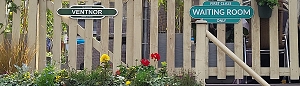
THERE WAS A TIME when one could take a train from London to Portsmouth, cross the Solent by ferry to Ryde on the Isle of Wight, and then take another train from Ryde to Ventnor. This was before 1966 when the station at Ventnor was closed forever. A century earlier, in 1866, this station opened to rail traffic. The closure was part of an extensive plan (devised by Dr Richard Beeching [1913-1985]) to reduce Britain’s railway mileage.

The station, the southern terminus of the isle of Wight Railway, with its associated sidings was located on the site of an old quarry. It was almost completely surrounded by high cliffs. Trains reached it from Shanklin by emerging from a 1312-yard-long tunnel running beneath St Boniface Down. It must have been dramatic emerging from the tunnel to find oneself in the space surrounded by vertiginous rocky walls.

Today, the entrance to the tunnel, through which water pipes now run, is hidden by dense foliage. Nothing remains of the tracks, and only a small part of the former station building (ticket office etc.) remains. The space once occupied by the platforms and railway lines is now occupied by an assortment of buildings, comprising an industrial estate.  Trains still run between Ryde and Shanklin, but Ventnor station has all but vanished.

A gnomon on the esplanade

FOR THOSE WHO DO NOT know, a gnomon is the part of a sundial that casts a shadow.

The gnomon on the Esplanade at Ventnor

In 1851, Sir Thomas Brisbane (1773-1860), who gave his name to a city in Australia, donated a tall gnomon to the town of Ventnor on the Isle of Wight. In sunny conditions, this object casts a shadow on a line marked on the pavement at noon GMT (1 pm BST). Sir Thomas had spent some time in Ventnor during the mid-19th century, and sadly his daughter Eleanor Australia MakDougall Brisbane died in Ventnor in 1852 at the young age of 29.

As we are discovering during our visit to the Isle of Wight, the sun does not always shine in Ventnor (or anywhere else on the island). Recognising this problem that renders the gnomon useless when the sun is not shining, the town erected a short clock tower near to the gnomon in 1870. This clock was rebuilt in 2001. It bears a plaque commemorating Fred Blake (1924-2001), who, along with his father (Adolphus) and grandfather (James), were: “… proud to maintain this barometer for over 120 years”.

We did not see the gnomon working because of cloudy weather conditions, and the two faces of the clocks displayed different times and neither of them appeared to be working. The barometer seemed to be working. It is curious features such as the gnomon that help make towns on the English coast endlessly fascinating.

Transported back to childhood on the Isle of Wight

IN THE EARLY 1970s, I used to travel on the London Underground’s line from Golders Green to Euston or Warren Street, both stations being near University College London, where I was a student. Back in those days, smoking was permitted on the Underground. Each Northern line tube train had two carriages for smokers. I have never smoked, but I used to travel in the smokers’ carriages because they were usually emptier than the other ones in which smoking was forbidden. Thinking back on this, I suppose that I must have been passively smoking on the Underground. On the other hand, because there were fewer people in the smoking carriages, my chances of catching other people’s airborne germs must have been reduced.

From an early age, before I became a daily commuter, I liked travelling in the rear carriages of the Northern Line tubes. These carriages contained control panels, which the train’s guards operated to open and close the doors and to inform the driver when the train was ready to leave. As a child, I was fascinated by watching the guard at work. Actually, there was little else to watch after the tube entered the tunnel after leaving Golders Green. Incidentally, what was the rear carriage, was also the front carriage when the train changed direction on reaching the end of a line.

The Northern Line trains I have been describing were built by Metro-Cammell in 1938. By the end of the 1980s, the trains were taken out of service and newer units began operating on the Northern Line. The 1938 trains were shipped out to the Isle of Wight, where they carried passengers on the Island Line. After many years of service on the island, the sea air caused these venerable trains to corrode and deteriorate. In the early years of the 21st century, they were taken out of service.

In late October 2022, we visited the train museum at Havenstreet on the Isle of Wight. One of the exhibits is a collection of old train carriages and engines in a large shed. Amongst these exhibits is one of the former Northern Line carriages built in 1938. Visitors are permitted to enter it. I was delighted to find that the example on display was one of the rear carriages containing the guard’s control panels. Seeing these again after so many years was a curiously moving experience. I felt for a moment that I had been transported back to my childhood days, when travelling in these trains used to fill me with wonder.

Coloured cliffs and the Needles rocks

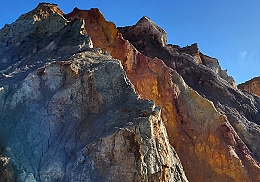
NEAR THE WESTERNMOST point on the Isle of Wight, lies Alum Bay. From its pebble beach, the Needles rock formation with their light house can easily be seen. Turn your back on the Needles and you will see that the bay and its beach have a backdrop of folded cliffs. These are not any old cliffs. They are multi-coloured.

The colouration of the cliffs is caused by the presence of oxidised iron compounds formed under different conditions.

The beach from which the coloured cliffs can be seen can be reached two ways. Either by foot, using a series of staircases, or by travelling on a spectacular set of chairs suspended from cables: a sort of funicular. I recommend descending by foot to enjoy the views at leisure and returning using the chair lift. However, descending on the latter is also said to be an exciting experience.