JULIA MARGARET CAMERON (1815-1879) was born in Kolkata (Calcutta) and died in Sri Lanka. When her husband retired from the Indian civil service, she and her family bought a house on the Isle of Wight, close to that of her friend, the poet Alfred Lord Tennyson. From an early age, when she met the astronomer and chemist Sir John Herschel in Cape Town, she developed an interest in the relatively young technique of photography. It was only in 1863 when she was residing on the Isle of Wight that she was given her first camera. This was the start of her remarkable career as a photographer. Unlike many other photographers during the Victorian era, Julia was not interested in producing exact images of her subjects in her photographs. Instead, she experimented with lighting, focus, development, and printing, to produce photographic images that were artistic rather than accurate representations of reality. Her subjects included many of the cultural giants of mid to late Victorian Britain. Also, she loved to pose her subjects, dressed in imaginative fancy dress costumes, in intricately contrived tableaux before capturing their image on photographic plates.
Until the 16th of June 2024, there is a temporary exhibition of photographs by Cameron at London’s National Portrait Gallery. Many of Julia’s photographs are on display alongside those of another woman photographer, Francesca Woodman (1958-1981). Although Woodman’s photographs are of a high quality artistically, seeing them alongside those of Julia Margaret Cameron added little to my enjoyment of the exhibition. However, this show does give impressive exposure to Cameron’s pioneering work in using photography as an art form rather than as a medium for recording likenesses. As exhibitions go, I did not feel that this one is a sparkling example of curating. However, I am pleased that I went because I have read a great deal about the life and times Julia Margaret Cameron, and have also published a short book about her, which is available on Amazon:
ALFRED LORD TENNYSON (1809-1892), the famous Victorian poet, had his home, Farringford House, at Freshwater Bay on the Isle of Wight. First, he rented the house in 1853, and then bought it in 1856. Because he was pestered by so many tourists, he moved to Aldworth in West Sussex in 1869. However, he kept Farringford, and spent most winters there. In 1860, his friend, the creative photographer Julia Margaret Cameron (1815-1879), bought a house, Dimbola, which was very close to Farringford.
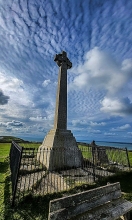
In 1897, a memorial to the poet was erected on Tennyson Down, a clifftop high above Farringford and Dimbola. Designed by JL Pearson, it is a tall stone Celtic cross mounted on a stepped base. A gently sloped footpath leads from Dimbola to the memorial, but we did not use this. Instead, my friend Martin and I laboriously climbed a steeper path closer to it. The cross is impressive and dramatic against the wide-open sky – almost Wagnerian. The views from the clifftop were magnificent on the clear day we visited it.
Our descent from the clifftop was somewhat adventurous. This was not intentional. Because we could not remember the place the path (and staircase), which we ascended, began, we had to create our own route down the steep, almost vertiginous, wooded slopes. We had to be careful not to trip over the numerous tree roots and fallen branches that were hidden under fallen leaves that lay all over the place. I was quite relieved when we reached the car park without having fallen or strained our ankles. Next time I visit the poet’s memorial, I will use the lengthier but safer footpath.
You can read more about Tennyson and Julia Margaret Cameron, “Between Two Islands. Julia Margaret Cameron and her Circle”, available from Amazon sites such as:
BY THE END OF the last Ice Age (which occurred 1800 to 8000 years ago approximately), there was a huge landslip on the south coast of the Isle of Wight (‘IOW’). This resulted in the formation of an almost level strip of land about 5 miles long and between ¼ and a ½ mile in width. South of it is the sea, and to the north it is flanked by a steep hillside. Known as the ‘Undercliff’, the town of Ventnor stands upon it. At the eastern end of the Undercliff, the small village of Bonchurch stands. Where this village is located the Undercliff is not exactly flat but slopes considerably, which means that many of the buildings in the place are at different levels. This part of the Undercliff is perched on a high, constantly crumbling cliff overlooking the sea.
The village of Bonchurch is mentioned in the Domesday book. The name is probably derived from the Anglo-Saxon words meaning ‘Boniface’ and ‘church’. The oldest existing building in the village is the small St Boniface Church, now known as ‘The Old Church’. A notice outside it states that it was rebuilt in 1070. In good condition, this simple building is hardly used in comparison with the newer village church built in 1848. A steep path with some steps leads from the old church to the sea front, where the crumbling cliffs can be studied. The path crosses a babbling brook, which carries water from a spring next to the Old Church. Some believe that it was the existence of this spring that encouraged the first humans to settle in this district.
Later settlers and visitors to Bonchurch included some literary figures, who have become well-known. In 1819, whilst staying in Shanklin, the poet John Keats wrote to his sister Fanny Keats:
“Bonchurch too is a very delightful Place—as I can see by the Cottages, all romantic—covered with creepers and honeysuckles, with roses and eglantines peeping in at the windows. Fit abodes for the People I guess live in them, romantic old maids fond of novels, or soldiers’ widows with a pretty jointure—or any body’s widows or aunts or anythings given to Poetry and a Piano-forte—as far as in ’em lies—as people say. If I could play upon the Guitar I might make my fortune with an old song—and get two blessings at once—a Lady’s heart and the Rheumatism. But I am almost afraid to peep at those little windows—for a pretty window should show a pretty face, and as the world goes chances are against me.”
However, the poet did not stay in Bonchurch. Amongst the celebrated literati who spent time in the village, were the historian Canon Venables (1819-1895); the novelist Elizabeth Missing Sewell (1816-1906); the author Henry de Vere Stacpoole (1863-1951); the poet Algernon Charles Swinburne (1837-1909), and, most famous of all, Charles Dickens (1812-1870).
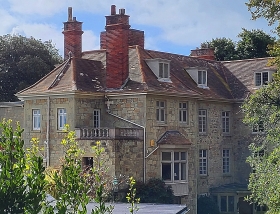
According to a booklet I purchased in the Old Church, between July and October 1849, Dickens stayed in a large house called Winterbourne (see photograph), which he had rented from his friend the writer and vicar, Reverend James White. It was here that Dickens wrote six chapters of his novel “David Copperfield”. Each of these chapters were initially published month by month, as was the case for many of the author’s other stories. In addition to writing, Dickens enjoyed rambling in and around Bonchurch and playing rounders on the seashore. Also, he spent much time socialising with James White and his wife Rosa, who lived elsewhere in the village. A website (www.bonchurchvillage.co.uk/post/a-christmas-story-the-grandfather-s-story) recorded:
“Dickens and his wife Catherine with their children became very close friends of Rev. White and Rosa White (nee Hill) and their children during their holiday at Winterbourne in 1849.”
It also noted:
“James White had already had success with plays performed in London and stories contributed to ‘Blackwells Magazine’ in Edinburgh.”
A visit to Bonchurch is a delightful experience. Climbing its steep roads and paths makes a picturesque substitute for a ‘work out’ in a gym.
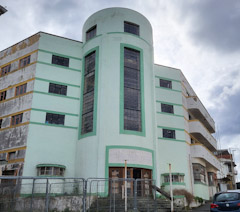
WE PARKED OUR CAR in Ryde on the Isle of Wight. I noticed that we had stopped outside a building that looked as if it had been transported from Marine Drive in Bombay to the Isle of Wight. Like many of the buildings that line Marine Drive, this one in Ryde is a beautiful example of the Art Deco architectural style, which became popular in the 1930s.
The former Royal York Hotel
The building in Ryde was constructed as the former Royal York Hotel. Completed in 1938, it was designed by JB Harrison and HP Gilkes.
When the hotel was opened, Ryde had become a popular destination for ’high society‘ holidaymakers. The then state-of-the-art hotel would have been in high demand. Partly because of the increasing ease of foreign travel, the hotel’s customers gradually decreased in number. So, in 2006, the hotel closed forever, and remained disused and looking dejected.
When we saw it in October 2023, there was scaffolding on the edifice and evidence that work was being carried out. I have read that there are plans to work on the building to create residential flats as well as a new hotel within it. Let us hope that this splendid example of Art Deco architecture will be preserved.
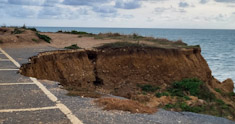
THE CAR PARK at Compton Bay on the south coast of the Isle of Wight is falling into the sea far below. The waves are undermining the cliff upon which the car park is situated. In conjunction with this, wind and rain are literally eating away the cliff. Where there had been a row of marked parking spaces, this has become unusable because the cliff has broken away. The markings are still visible, but they end abruptly at the fractured cliff edge. The local National Trust warden told us that next year, this disappearing car park will be closed and grassed over. A new one will have to be created further away from the clif edge. Seeing the damage being caused brought home how powerful are the forces of nature.
A DISTINCTIVE BUILDING stands opposite the Art Deco Winter Garden (built by 1936) high above the seashore of Ventnor on the south side of the Isle of Wight. With a tower overlooking the sea, the edifice facing the Art Deco structure was which was built in 1846 by the Reverend Richard John Shutte (1800-1860), who had once been a canon at St Paul’s Cathedral. It was named St Augustine Villa (see photograph below), and now houses a hotel and restaurant.
Several Russians opposed to the Imperial Romanov regime, including the writer Ivan Turgenev(1818-1883) visited Ventnor during the 19th century. Amongst these was Alexander Herzen (1812-1870), who was the ‘father’ of Russian Socialism’. In 1852, he and his family began living in England for several years. During this sojourn, he made some visits to the Isle of Wight. In September 1855, Herzen stayed in Augustine Villa, which he had rented. However, he was not alone as the commemorative plaque on the Villa notes. He stayed there with Malwida von Meysenbug (1816-1903).
Now, I had already heard of Herzen. I became familiar with his name when watching a trilogy of plays by Tom Stoppard about 19th century Russian Socialism. However, I had never come across Malwida von Meysenbug until I saw that plaque in Ventnor. A writer, she was born in Kassel (Germany) and was a friend of both Friedrich Nietzsche and Richard Wagner. By the time that Herzen and Malwida had their holiday in Augustine Villa, she was living with Herzen’s family and helping to look after his children. Alexander’s wife Natalia had died in 1852, and he had hired Malwida to educate his children.
Malwida was much more than a mere governess as the UCL academic Sarah J Young explained in her excellent, highly informative article (http://sarahjyoung.com/site/2011/11/10/in-herzens-footsteps-a-visit-to-ventnor/). In this essay, Dr Young gives excerpts from Malwida’s published “Memoirs”. The following is particularly interesting:
“We spent happy days in beautiful Ventnor. In the evenings we were usually with the Pulszkys, who were spending the summer there. Therese’s mother, an educated and intelligent Viennese lady, had come to visit them, and this made for many a pleasant hour with her keen humor and wit. The Kossuths were also there, and he was much more pleasant in a more intimate setting than he had been at the formal gatherings in London. At the time, our thoughts were preoccupied by the war Russia had started with Turkey. Herzen, more so than the others, was very excited. He prophesied the Russian defeat and wished for it, since he believed it would lead to the downfall of autocracy.”
The Kossuths, were members of the family of the Hungarian revolutionary Louis Kossuth, whom Herzen was extremely excited to have met during his stay in Ventnor. Another exiled Hungarian revolutionary, Ferenc Pulszky (1814-1897) was also staying with his family in Ventnor at the same time as the Herzens and the Kossuths. Pulsky’s wife, Theresa, and Malwida spent time drawing together in Ventnor, and made several competent sketches of Ventnor and its surroundings,
Dr Young also quoted Herzen, who noted in his diaries that Malwida:
“… spent all her time in the water …”
From what Dr Young and others have discovered during their research, Malwida was out of the sea long enough to create works of art depicting the seaside resort.
Herzen liked Ventnor but had some reservations as he wrote in a letter (quoted from Dr Young’s article):
“For three days the weather has been like June – and I’m bathing recklessly in the sea. But before that there were four days of storms, rain and bitter cold … If it were not so boring, I would live here, but there are no resources at all. And getting to Ryde is expensive … “
Many years have passed since Herzen and Von Meysenbug holidayed in Ventnor. Slightly less time has elapsed since the future Mahatma Gandhi visited Ventnor in 1890 and 1891. According to one source (www.bonchurchvillage.co.uk/post/bonchurch-gandhi), Gandhi:
“… had wanted to study medicine but his father had objected, and his studies were in law. He was a prominent member of the London Vegetarian Society, and that may have led to his staying at Shelton’s Vegetarian Hotel at 25 Madeira Road in Ventnor, in January 1890 and again in May 1891, on the second occasion addressing a Vegetarian meeting in Ventnor.”
In his autobiography, Gandhi wrote of the following experience in Ventnor:
“My cowardice was on a par with my reserve. It was customary in families like the one in which I was staying at Ventnor for the daughter of the landlady to take out guests for a walk. My landlady’s daughter took me one day to the lovely hills round Ventnor. I was no slow walker, but my companion walked even faster, dragging me after her and chattering away all the while. I responded to her chatter sometimes with a whispered ‘yes’ or ‘no’, or at the most ‘yes, how beautiful!’ She was flying like a bird whilst I was wondering when I should get back home. We thus reached the top of a hill. How to get down again was the question. In spite of her high-heeled boots this sprightly young lady of twenty-five darted down the hill like an arrow. I was shamefacedly struggling to get down. She stood at the foot smiling and cheering me and offering to come and drag me. How could I be so chicken hearted? With the greatest difficulty, and crawling at intervals, I somehow managed to scramble to the bottom. She loudly laughed ‘bravo’ and shamed me all the more, as well she might.”
I do not think that Gandhi made any other visits to Ventnor or elsewhere on the Isle of Wight.
Today, Ventnor is still delightful and although much has been modernised since the Victorian era, it still retains an almost unspoilt old-world charm. I fancy that were it possible for Herzen and Malwida and their revolutionary friends to return today, they would find much in Ventnor that they would easily recognise.
Seeing the plaque on Augustine Villa made me curious about Herzen’s stay in Ventnor and the identity of Malwida von Meysenbug. By reading up about it, I learned of other noteworthy visitors to the town, and as I did so my interest in Ventnor has increased considerably.
‘THE CODFATHER’ IS A NAME shared by many fish and chips shops in England. There is one such establishment opposite the railway station at Ryde Esplanade on the Isle of Wight. It is a typical traditional fish and chips place, but with one distinguishing feature.
There is a circular commemorative plaque on its external wall. This was placed to remember when this shop was raided by the police in September 1953. Then, the shop was owned by John Leigh. During the raid, the police confiscated 1087 postcards designed by Donald McGill.
By Donald McGill
McGill (1875-1962), a graphic artist, created over 12000 seaside postcards between 1904 and his death. Almost all of them had humorous pictures on them. They were prints made from his colour-washed drawings. Some of them were classed as “saucy”, which means they depicted scenes with typically British sexual innuendo.
In 1954, McGill fell foul of the Obscene Publications Act of 1857, and was found guilty. He was fined £50, and had to pay £25 in legal costs. The 1953 raid on John Leigh’s shop was only one of 5 such raids in Ryde. Mr Leigh was the proprietor of what was then ‘The Esplanade Bazaar’, which sold ‘fancy goods’. It would seem that he also stocked saucy postcards, maybe illicitly.
Today, The Codfather occupies Mr Leigh’s shop. Its polite helpful staff served us fish and chips, but seemed not to know much about the raid on their premises seventy years ago.
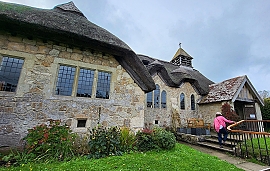
THE POET ALFRED TENNYSON made his home in the village of Freshwater Bay on the Isle of Wight (‘IOW’) from 1853 until his death. His presence there attracted many Victorian cultural figures to the village either as residents or as his visitors. In 1907, fifteen years after Tennyson died, the Bishop of Winchester visited Freshwater and decided that the village needed a better church than the rather primitive one being used at the time. The Reverend AJ Robertson, who was Rector of Freshwater in 1907, made a watercolour painting of the type of church he hoped would be built. It included a thatched roof. Such a church as he had envisaged was designed by the architect Isaac Jones of Herne Hill in London, and constructed on land donated by Tennyson’s eldest son Hallam, Lord Tennyson (1852-1928). It was Hallam’s wife Lady Emily (1853-1931; née Prinsep), who gifted the new church’s porch and suggested that the church be dedicated to St Agnes.
St Agnes is the only church on the IOW to have a thatched roof. Much of the building was built using stones from what had once been the home of the scientist Robert Hooke (1635-1703). The use of old stones makes some people believe that the church is older than it really is. One of the old stones has the date 1694 inscribed on it, a reminder of the origin of the stonework. The interior of the building is well lit by natural light through its many windows. The timber framed ceiling is fine as is the beautifully carved chancel screen. The screen with delicate bas-relief carvings of plants was created by the Reverend Thomas Gardner Devitt, who was curate of St Agnes between 1942 and 1946.
In brief, this thatched church is charming. In appearance, it manages to combine a feeling of mediaeval antiquity with the aesthetics of the Arts and Crafts Movement, which was in its heyday when St Agnes was built. Seeing it was one of many delightful experiences we enjoyed whilst spending a week on the IOW.
THE PHOTOGRAPHER Julia Margaret Cameron (1815-1879; ‘JMC’) was born in the Garden Reach district of Calcutta (now Kolkata in West Bengal). Her father, James Pattle, was a prosperous English official in the East India Company. JMC and her six sisters, the surviving children of James and Adeline Marie Pattle, had a Bengali ancestor, Thérèse Josephe Blin de Grincourt (1768-1866) She was JMC’s maternal grandmother, a Bengali woman who had married a French man, Ambroise Pierre Antoine de l’Étang (1757-1866, whose presence in Bengal was recorded in “The India Office List 1825” as “De l’Étang, Chevalier Antoine, Knt. St Louis, assist. Stud at Poosa, 1796” (Poosa is in what is now Madhya Pradesh). They married in 1788. At that time, it was not uncommon for European men to have lasting relationships with Indian women. This is well-described in William Dalrymple’s book “White Mughals”. Later, in the 19th century, such interracial liaisons were heavily frowned upon. It was expected that ‘white’ men would only marry ‘white’ women. Incidentally, Thérèse was daughter of a French colonist and his Bengali wife.
As with her sisters, JMC was sent to France to be educated. She remained there from 1818 to 1834, when she returned to India.
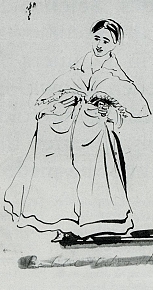
Julia Margaret Cameron by James Prinsep
In 1835, suffering from ill-health, JMC travelled to the Cape of Good Hope. This part of what is now South Africa was favoured as a place to convalesce by Europeans based in India. It was in the Cape that JMC met not only the famous astronomer and an inventor of photography Sir John Herschel (1792-1871), but also the man whom JMC would marry in 1838: Charles Hay Cameron (1795-1880). Charles was in the Cape recovering from a malarial illness. A disciple of the philosopher Jeremy Bentham, he was a reformer of law in India and education, who also invested in coffee plantations (in 1848) in Sri Lanka.
Julia and Charles married in Calcutta, where she became a prominent hostess in the city’s British Indian society. During the 1840s, she corresponded regularly with John Herschel about developments in the science and technology of photography. He sent her two dozen calotypes and daguerreotypes, which were the first photographs he had ever set eyes on. The Camerons raised eleven children: five of their own; five orphans (children of relatives); and an Irish girl named Mary Ryan (whom they found begging on Putney Heath).
The entire Cameron family relocated to England in 1845, possibly because their two older children had settled there, and Charles had retired. They settled in Royal Tunbridge Wells in Kent. They became friendly with one of their neighbours, the poet Henry Taylor (1800-1886), who had worked in the Colonial Office under Robert William Hay (1786-1861), who might well have been related to Charles Hay Cameron’s mother. Later, the Camerons moved to East Sheen, which is closer to London than Tunbridge Wells.
It was through Henry Taylor and Julia’s sister Sara (1816-1887), who was married to Henry Thoby Prinsep (1793-1878), an official in the Indian Civil Service, that JMC was introduced to a set of noteworthy Victorian cultural figures. Henry and Sara had returned to England from India in 1835, and were living in (the now demolished) Little Holland House next to the house of the artist Lord Leighton, near Holland Park in west London. Their home became a meeting place for famous artists, as will be described later. It was here that Sara held a salon for pre-Raphaelite artists, poets, and aristocrats with an interest in artistic activities. At Sara’s home, JMC encountered, amongst other worthy cultural figures, the poet Alfred Tennyson (1809-1892).
Tennyson rented Farringford House in Freshwater Bay on the Isle of Wight (‘IOW’) in 1853, and purchased it three years later. In 1860, after a long visit to Tennyson on the IOW, the Camerons bought a property next door to Tennyson’s and named it Dimbola after one of their (then coffee) plantations in Sri Lanka. TO BE CONTINUED
OUR CAR FERRY from Lymington docked at Yarmouth on the Isle of Wight after dark on a rainy evening in September 2022. As we drove to our friend’s house in Ventnor, we passed a building whose name, Dimbola, brought back memories of an exotic trip we made 28 years ago.
In February 1994, my wife and I spent a few days in Sri Lanka on our way back from India to London. It was our honeymoon and Sri Lanka was riven by civil war. Our host in Sri Lanka sent a car and driver to Colombo airport, which, despite its excessively high security presence, was attacked by terrorists soon after we departed for London. For several hours, we drove through the countryside after nightfall. Every few miles, we stopped at police check posts. Unlike bus passengers, who were obliged to leave their vehicles at each of these stops, we did not have to disembark. Our car was fitted with a bright lamp that the driver turned on so that the police could see his passengers without them having to leave the vehicle. It was also likely that our driver and his employers were well known to the authorities. About halfway through our long journey, we stopped at a tea stall in a village. The golden tea was fragrant and delicious. Even now, I believe that it was one of the best cups of tea I have drunk during my long life.
We continued driving through the darkened landscape. Every now and then, animals’ eyes reflected the illumination coming from the car’s headlights. It was only when we made the return trip to Colombo in daylight that I realised our driver’s great skill. The narrow road had many potholes and other defects and wound perilously up and down hillsides and close to deep ravines. Eventually, we arrived at the home of the manager of the tea plantation where we were going to spend about a week. We had met him and his wife at the home of a mutual friend, who lives in Ootacamund (‘Ooty’) in south India. This kind couple, having met us only once, had invited us to stay with them in Sri Lanka.
Mr Jain, our host, had been invited by the Sri Lankan government to revitalise a failing tea plantation. Situated about 4 miles northeast of the small town of Hatton, the estate where we stayed was called Dimbula – and still is. Seeing the name Dimbola on the house on the Isle of Wight made me remember Dimbula in Sri Lanka. I wondered whether Dimbola was a name chosen at random, or whether it was in some way related to Dimbula, where we stayed in Sri Lanka.
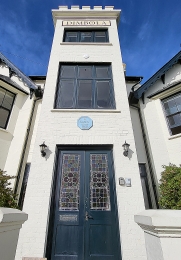
Dimbola house, Freshwater Bay, IOW
On our first full day on the Isle of Wight, the sun shone brightly, and we decided that it was perfect weather to visit Alum Bay to see its famed coloured cliffs and views of the Needles Rocks at the western end of the Isle. To reach this place we drove back along the road we had travelled the previous night. This road runs along clifftops close to the south coast of the island and provides many exciting views. We stopped at a couple of places to enjoy the spectacular coastal scenery, and before reaching Alum Bay, we made yet another stop at Freshwater Bay. By then, we were yearning for mid-morning coffee. Not seeing anywhere open close to the seafront, we drove a little further and noticed that Dimbola has a café.
Dimbola is a two-storey Victorian house with four full height bays, each of which is beneath a roof gable. In the middle of the long southeast-facing façade there is a tall square tower topped with crenellations. This separates the bays into two pairs. The east half of the ground floor houses a second-hand bookshop, which is now closed because its owner does his business on-line only. The west half houses a café, which serves excellent coffee made from beans roasted on the Isle of Wight. Most of the rest of the ground floor and much of the first floor is a museum and its shop. I will go into more detail about this museum soon.
Almost as soon as the waiter came to take our order, I asked him about the name Dimbola. He was not sure, and suggested I asked someone at the museum. After enjoying my coffee – it was so good that we returned for more on a couple of other days – I found someone working in the museum. I told her that I was interested in the similarity of the name of the house and that of the place where we had stayed in Sri Lanka. She told me that a former owner of Dibola had been married to a man who owned coffee (and then later tea) plantations in Sri Lanka when it was British Ceylon, and that the house was named after one of them called Dimbola. I was told that the house at Freshwater Bay was named after the plantation at Dimbula, which is exactly where we stayed in February 1994.
By 1994, Dimbula was a long-established tea plantation. However, it had begun life as a coffee plantation. It had been owned by Mr Charles Hay Cameron (1795-1880). A follower of the great philosopher Jeremy Bentham, Cameron became a barrister, having been called to the bar at Lincoln’s Inn in 1830. In 1835, he went out to India to serve on the Supreme Council of India (which had previously been known as ‘The Council of Bengal’). In 1838, he married Julia Margaret Pattle (1815-1879), whom he met in The Cape of Good Hope (now ‘South Africa’). Their marriage took place in early 1838 in Calcutta (now Kolkata). In 1848, he and his family left India and lived in their homes in London’s Putney and Freshwater Bay on the Isle of Wight. In 1875, he and Julia travelled to Sri Lanka, where Charles owned plantations. They lived there until their deaths. I will return to Mrs Cameron shortly.
The reason that Dimbula now grows tea is that during the 1870s, the market for coffee slumped. The Cameron, both in a poor state of health moved to Sri Lanka because the cost of living there was far lower than in England. During their stay in England, they spent much time at Dimbola between the years 1860 and 1875.
Interesting as was Charles Cameron’s life, that of his wife Julia was exceptionally outstanding. I had never heard of her before having coffee at Dimbola, but our art historian daughter was most excited to learn that we had stumbled upon and visited the former home of the famous photographer, Julia Cameron. TO BE CONTINUED SOON!




 yamey
yamey 