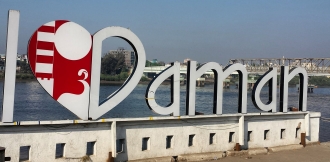
Tea and dining in Daman (India)

YOU MIGHT WONDER why we spent a few days Daman in 2018.

Enclaves have always fascinated me. For many years before that, I had been interested in Daman, which had been until 1961 a tiny Portuguese possession, an enclave surrounded by Gujarat, on the west coast of India.

Even though my wife is of Gujarati heritage, neither she nor I had ever visited Gujarat before 2018, and Daman was one of the places on our itinerary.

The small district of Daman, now a part of the Union Territory of Daman and Diu (that also includes Dadra and Nagar Haveli) is surrounded by Gujarat and the Arabian Sea. The city of Daman lies on both sides of the mouth of the Daman Ganga River. From 1559 until 1961, when it became incorporated into the Republic of India, Daman was a Portuguese colony. The Portuguese captured Daman from the rulers of the Gujarat Sultanate. Daman was one of several Indian coastal colonies of Portugal. Other important colonies included (moving from north to south): Diu, Cambay, Bassein, Chaul, Goa, Anjediva Island, Cannanore, Calicut, Cochin, Quilon, and Galle (now in Sri Lanka). For a while, Portugal’s naval fleet used these bases not only for trade but also to regulate access of other nation’s boats to the valuable spices that could be obtained from the Indian subcontinent. The Portuguese in the 16th century wanted to create a monopoly of the spice trade. They imported spices via the Cape of Good Hope. Their Muslim rivals imported them via Egypt and Venice. So, to stifle this competition, the Portuguese established bases along the coast of East Africa and the Arabian Gulf (for a while they held Hormuz Island at the mouth of the Persian Gulf).

Daman city is divided by a river into two parts: Nani Daman and Moti Daman. Although in Gujarati ‘nani’ means small and ‘moti’ means large, Nani Daman is larger than Moti Daman.

Here is how we spent one of our evenings in Daman:

After visiting the fortress in Moti Daman, we headed back to Nani Daman. The sun was setting, and there was not much traffic. Eventually, an autorickshaw (‘auto’) already crammed full, with four passengers, stopped to pick us up. Two of the passengers moved to the front of the vehicle squatted hazardously on either side of the driver, and we squeezed onto the narrow passenger seat next to the other two passengers. After a short distance, the auto stopped. The two men squatting beside the driver disembarked and walked ahead of us. We drove on, weaving our way around a police check post, and then stopping again when we had passed out of sight of it. The two men, who had disembarked, retrieved their positions beside the driver, and we continued across the river to Nani daman. The driver explained to us, in Gujarati (which my wife understands), that the two men had to walk ahead of us past the check point in order that the auto would not be stopped because of being overloaded.

Later that afternoon, we returned to the bazaar in Nani Daman. We bought bananas and oranges from one of the many women squatting on the pavement surrounded by piles of neatly arranged fruit and vegetables. Amongst these, there were vendors with mountains of garlic bulbs and ginger roots, and others with tidy little mounds of fresh green chillies.

We took tea at two different tea-stalls near the bus stand (bus station). One served a strong tea favoured with ginger, lemon and cardamom. The other provided a very milky, sugary tea, whose taste resembled like caramel. Everywhere in Daman, and, we were to discover, all over Gujarat, tea is served in tiny cups, that can be finished in two or three swallows. It is invariably sugary. These minute cups provide ‘sugar bursts’ (as our daughter describes them) rather than quenching thirst. Often, two men will share a tiny cup of tea. Half of the tea is poured into a tiny saucer, and one of the men then slurps it noisily. The other man drinks the rest of the tea from the cup. Tea shared this way is known as ‘cutting chai’.

The tea provided at tea-stalls is prepared by vigorously boiling milk containing handfuls of tea leaves or tea powder, and usually much sugar. Grated ginger and/or powdered cardamom might also be added to this bubbling mixture. When the milky tea mixture has been boiled sufficiently, it is strained either through a fine (plastic) sieve or through a cloth. The damp residue in the cloth is then squeezed using the hinged metal handles of a ‘sansi’, which is a pair of hinged tongs (used for lifting heavy pots off the fire or cooker). Every tea-maker produces a differently tasting tea. Some of them have high reputations amongst local people for the tea they produce.

After our teas, we waited for Daman’s only newsagent to open his stall. Newspapers arrive in the evening, so there is no need for the newsagent to be open at other times during the day. We ate dinner at the Gurukripa Hotel. Even between the frequent power outages, the dining room was so dark that the waiters brought portable electric reading lamps so that guests can read the menu. We asked to keep ours throughout the meal so that we could see what we were eating. Both the service and the food were above average. When we left the hotel at 9.30 pm, the streets were deserted. An hour earlier, they had been as busy and bustling as in a large city.

Despite the late hour, quite a lot of shops and food stalls on wheeled barrows were still open. On our walk back to our hotel, we passed a parking area containing at least twelve Ambassador taxis, with black bodies and yellow roofs. Although they do not conform with current trends in car design and economic fuel consumption, these vehicles, which are ‘descendants’ of the British Morris Oxford (series III model), are ideally suited for rough terrain and the hazards of driving in India. They are, it seems, almost indestructible, but many taxi drivers are replacing them by newer, more fuel-efficient types of cars.

This is a short, adapted extract from my book “TRAVELS THROUGH GUJARAT, DAMAN, AND DIU”, which is available from Amazon. I hope to post other extracts from my book in the near future.

A chance encounter in the pavilion and a suitable boy

I HAVE NEVER MET the Indian author, Vikram Seth, who wrote the long novel “A Suitable Boy”, but today, 30 July 2026, my wife and I met his sister, Aradhana, quite by chance while visiting the beautiful brickwork Serpentine Pavilion in London’s Kensington Gardens.

In about 1968, my wife was awarded a scholarship to study for her A-Levels (university entrance examinations) in the UK. That year, she was not the only one to receive such an award, which allowed her to travel from India to study in England. Another awardee that year was Vikram Seth, now a renowned author.

In 1994, a few months before my first ever visit to India, my then fiancé, now my wife, suggested that I read Vikram Seth’s “A Suitable Boy” because it might have helped me to ‘acclimatise’ to Indian ways of life before I arrived in the country. The book, first published in 1993, is well over 1400 pages long. Dutifully, I began reading it, but then little of it made much sense to me, and I gave up reading the book by the time I reached page 300. Thereafter, I have not touched the book until this month, July 2026.

Since 1994, I have visited India at least 50 times, often for long sojourns, and have become familiar with many aspects of life in the country. A few days ago, I started reading “A Suitable Boy”, and I am finding it both enjoyable and incredibly engaging. Much of what Seth has written makes much more sense to me than it did in 1994. And despite it being published without a glossary, many of the Hindustani words (transliterations of Devanagari and Urdu scripts) now mean something to me.

Seth has managed to write an epic novel whose pages contain a brilliant portrait of life in certain social circles in India. Although I have only just passed page 230 (in four short episodes of reading), I feel that by the end of the following few weeks, I will have read the whole book.

Meeting Vikram Seth’s sister by chance was only one part of an amazing encounter today. My wife thought she looked vaguely familiar, and that is why we engaged her in conversation. It turned out that Aradhana and my wife had attended the same school, Loreto House, in Kolkata (Calcutta), and although they differ in age, their times at the school overlapped. In addition, Aradhana, was with her friend, Amrit, whose father, we discovered, had worked in the same company as my wife’s father.

Although India’s population is about one and a half billion, I am always amazed how often we ‘bump into’ Indians, with whom my wife can find some not too distant connection.

I should have known better in Bikaner (Rajasthan, India)

One of my aunts believed if something is cheap, it cannot be good. I have never shared her opinion, but as I will reveal below, occasionally what my late aunt believed, turns out to be correct.

IN DECEMBER 2024, we made a trip to Rajasthan (India). Of the places we visited (Ajmer, Jodhpur, Jaisalmer, Jaipur, and Bikaner), I enjoyed Bikaner the most because apart from being full of interesting nooks and crannies, it attracted less tourists than the other cities. When planning the trip, I made use of the booking.com website to find accommodation. At Bikaner, we booked an air-conditioned bedroom with an ‘en-suite’ bathroom-cum-toilet in a guest house (homestay) and breakfast included. I will not reveal its name in public. The homestay was extremely well reviewed by numerous previous guests from all over the world, and the price was remarkably reasonable: £28 (Sterling) for five nights. It was much cheaper than any of the other places we stayed in Rajasthan, which charged between £30 and £45 per night.

The accommodation was in the maze of tight thoroughfares in Bikaner’s old walled city. It was difficult to find using Google mapping. Eventually, we fought our way through the dense traffic on the narrow Teliwara Road, one the old city’s main streets, until we got within about 100 yards from the guest house. Our driver looked at the lane which led to our accommodation. It was more like an alleyway than a road. He refused to drive any further. We rang the landlord of the guesthouse, a young man named ‘S’. This cheerful fellow came rushing to meet us, and carried our baggage from the car to his tall, slender building.

S took us up two treacherous staircases with wobbly handrails, and showed us our tiny room. Most of its floor space was occupied by an ageing double bed with a blanket and a single sheet fitted around the mattress. The sheet was, we discovered later, torn in places, and either well-worn or not very clean. There was a small, attached bathroom – actually, a tiny toilet with a shower.

After ‘settling’ in our room, which was devoid of cupboards or anywhere to hang clothes, we were told that dinner was ready, and that we could eat it either in our room or on the roof terrace. As the outside temperature was well below 10 degrees Celsius and we did not want food on our bed, we persuaded S to let us eat on the ground floor, where we had to squat on what must have been one of his family’s beds. To be fair, although he charged us a lot (by local standards) for the dinner, his mother cooked delicious north Indian food.

Throughout most of the night, I heard a roaring sound coming from somewhere above our room, and in the morning, there was no hot water. We informed S, who casually remarked that he had forgotten to turn on the geyser (hot water heater). That morning, we noticed that one side of the bathroom, had no wall. Instead, there was a deep cavity that extended beneath the staircase. This was filled with litter, including discarded cosmetics containers, plastic shampoo bottles, wastepaper, and other dust covered, distasteful rubbish. We did not spot any rodents lurking there. The included breakfast, which we ate in another bedroom, windowless and even more spartan than ours, consisted of a greasy paper napkin containing an omelette wrapped in a piece of soggy toast.

We decided to leave S and his guest house, and find accommodation elsewhere. S, who seemed upset that we had not enjoyed staying in his family home, reluctantly directed us down his lane to a much more comfortable guest house, the Moon Haveli, where for £10 per night we had a large, clean, well-lit room with a satisfactory, spacious bathroom.

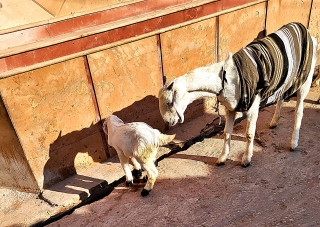
The lanes in the part of the town where we were staying were populated with plenty of street dogs, goats, and a few cows. Many goats spent a lot of time lurking around the Moon Haveli, and great care had to be taken not to let any of these creatures, which investigated everything they could reach, enter the building. Some of the goats were wearing grubby, ill-fitting discarded human clothes; others were without these garments. A lady, who lived in a house close to the Moon Haveli and used to stand in the street, feeding the goats every morning, told us that her goats with clothing spent the night outdoors. Her unclothed goats spent the cold nights within her house. She told us her goats’ names, which included: Munnu, Sonu, and Ronu. During the day, the goats climbed all over the place and licked everything (including motorbike handlebars and mirrors) just in case they proved to be something tasty and edible. The goats and the street dogs seemed to ignore each other and the occasional cows that wandered past. We ate our breakfasts at a series of street stalls where jalebis, bhajias, and other tasty delicasies were prepared while we waited. We befriended a tea maker, who was happy to be photographed while at work. As we wandered around the town, we spotted working camels and craftsmen making things in their shops. It was everyday things like this that endeared me to Bikaner.

To this day, I cannot understand why so many people (from all over the world) gave S’s establishment so many glowing recommendations. When we met S’s father, an artist, in the street a day or two later, it was obvious that he was annoyed that we had not liked his family home. But what annoyed me was that I had not been suspicious of the accommodation’s much lower than average price per night. I should have known better.

[This piece of writing is adapted from my book “88 Days in India: A Journey of Memory and Discovery”, which is available from Amazon.]

A scooter on a wall in central India

Here is another extract – a ‘taster’ – from my forthcoming book “ROAD TO HEAVEN – a passage through India”, which has reached the final editing stage. This sample relates to Maheshwar in Madhya Pradesh, a state in central India

+ + + + + + +

Maheshwar is a 58-mile drive south of Indore, a journey that took us about 2 ½ hours. Much of the way was through hilly countryside. In places the road goes through rock faced cuttings. Every now and then we saw distant high peaks, that looked bluish in the heat haze. During our journey, we passed pedestrians carrying bags and bedding rolls on their backs. These people walking in the hot sunshine were pilgrims, about whom I will tell you more soon. Occasionally, we had to slow down when we met flocks of goats and herds of cattle being led along the road – a common sight on country roads, including motorways, in India.

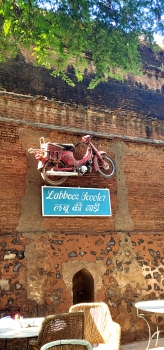
When we arrived in Maheshwar, our driver had difficulty both navigating and negotiating the maze of narrow, winding lanes in the lower, newer districts of the small town. Eventually, we drove up the steep, straight road leading to the main gateway in the walls that surround Maheshwar Fort. Traffic is not generally allowed into the heart of the fort, but as our accommodation, at Laboo’z Café and Lodge, was in the traffic-restricted zone, a barrier was lifted to allow us through. Nestling within a corner of the fort’s walls, Laboo’z is an attractive café with outdoor tables and chairs. An old motorbike is attached high up on the tall stone wall facing the seating area. Below it, there is a sign that reads: “Labooz’s Scooter”. The cafe was established in 2002 by Richard Holkar, a scion of the Holkar family that once ruled the Kingdom of Indore. Richard is the son of Yeshwant Rao Holkar II (reigned 1926-1948), who commissioned, and had built, a Modernist style palace in Indore, which was designed by the German architect Eckhart Muthesius (1904-1989).The palace, Manik Bagh, still exists. Stripped of its Modernist furnishings and sculptures by Constantin Brancusi, it now houses governmental offices. When Richard and his half-sister were children, they used to be ferried around Maheshwar on the bike now adorning the cafe. The driver who took them on the motorbike was tall (‘lambu’ in Hindustani). Over the years, he became known affectionately by the nickname ‘Labboo’. The scooter on the wall commemorates him.

Larger than life. Traditional yet contemporary.

INDIA FASCINATES ME. One aspect of this fascination is the ever-present fusion of the present and the past. Almost every Indian I have met embraces at any one moment both unscientific ideas and beliefs, which date back many millennia, and the concepts of today’s world. As the writer Pavan K Varma put it in his book ‘Becoming Indian’:

The mistake one should never make is to accept the amiable Indian as a monolith. He is a most well-adjusted split personality, capable of living simultaneously and effortlessly on two mutually opposed planes. He can make a quantum leap from one epoch to another without showing any strain.”

This ability to decompartmentalise the past and the present is well exemplified in some artworks I saw at an exhibition organised by Bombay’s Sakshi Gallery, and showing at London’s Mall Gallery until 8 July 2026.

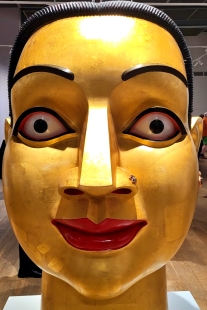
The works to which I am referring are sculptures by Ravinder Reddy, who was born in 1956 at Suryapet, Andhra Pradesh (southern India). Each of his sculptures on display at the Mall Gallery are larger than life sized female heads. Each of them is stunningly attractive and although not completely lifelike, very engaging. They are adorned with what recalls traditional south Indian decoration. They look like traditional images, yet at the same time, there is something contemporary about them. As an article (www.astaguru.com/blogs/legacy-of-artist-ravinder-reddy-influencing-future-generations-257)  by Yungming Wong noted aptly:

Reddy’s work is a rare phenomenon because it fuses tradition and innovation together … [His] sculptures often contain strikingly modern interpretations of traditional forms … His famous busts, for instance, advance classical portraiture to new heights by super-sizing the heads to monumental proportions. This exaggeration gives the sculptures grandeur and presence and leads the viewers’ eyes to the face that is the ultimate icon of humanity. In this sense, he connects the timelessly traditional approach of portraiture to the contemporary sensitivities for his works to be relevant in their local and global contexts.”

Although the show at the Mall Gallery contains excellent paintings and sculpture by other Indian artists, all of them well worth seeing, it was Reddy’s work that kept engaging my eyes. It was not merely the great size of his works, but their alluring presence, which grabbed my attention. Although products of the present, they suggest age old traditions of southern India. More than anything else on display at the exhibition, Reddy’s artworks exemplified what fascinates me about life in India: it occupies a space in which the past and present overlap, in which one exists inseparable from the other.

Does this description make my forthcoming book sound appealing?

COMMENTS AND OBSERVATIONS, PLEASE

My forthcoming book will be called “ROAD TO HEAVEN – A passage through India”.

Would the following ‘blurb’ attract you? Would it make you want to read the book?

“This book follows Adam Yamey’s engaging journey through parts of western, central, and southern India. Since marrying into an extended Indian family in 1994, Adam has visited the country more than 50 times and now sees it as both a second home and a rich cornucopia of remarkable people and places. His narrative moves between India’s past and present, weaving everyday details into the broader fabric of its culture and history. Along the way, his own impressions are set beside those of earlier writers who visited the same places. Unlike many travel books on India, this one reflects the perspective of someone who spends longer than the average tourist in each destination, allowing him to absorb and convey its distinctive atmosphere. It also offers rare views of life in some of India’s exclusive ex-colonial clubs. And, in case you are wondering, The Road to Heaven is a real place. In this illustrated account, Adam describes travelling along it and exploring many other memorable aspects of his journey.”

An Indian king who defeated the Dutch in southern India

BEFORE THE YEAR 1729, a part of southern India, now part of the State of Kerala, was a collection of distinct small kingdoms. Often, they fought with each another, and life in that part of the world was disorganised and easy prey to the activities of hostile regimes, such as the Dutch colonists and armies from other parts of India.

In 1729, Marthanda Varma (1706-1758) became Maharaja of the Kingdom of Venadu in what is now the southernmost part of Kerala. A brilliant military strategist, who employed Europeans to update his army, he conquered most of the small states in southern Kerala, and created the Kingdom of Travancore, which existed from 1729 until about one year after India became independent in 1947. Just as Otto von Bismarck united the myriad German states, Marthanda did the same kind of thing in Kerala. Marthanda was not only a successful military man. He was also a successful ruler who brought orderly government to his kingdom. As with all rulers who have suppressed rival states, he had enemies, who plotted against him, but many of these were either banished or killed.

One of the problems that Marthanda solved successfully by both diplomatic and military means were the Dutch, who had settled on the Malabar Coast, and were desperate to purchase pepper. After the Dutch had conspired with the ruler of Cochin, which was never incorporated into Travancore, Marthanda defeated them at the Battle of Colachel in 1741. This was one of the few battles in which an Indian army defeated a European force. Following the battle and others, Marthanda often persuaded some of his enemies’ soldiers to join his army, and they helped to improve his military capabilities.

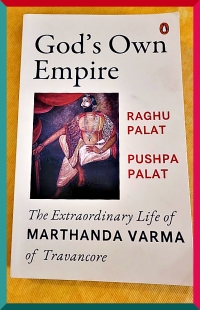
Marthanda was a canny fellow.  Worried about whom would succeed him and also how to maintain  the integrity of his kingdom after he died, Marthanda conducted a ceremony at a temple in Trivandrum during which he surrendered Travancore to the god Sree Padmanabhaswamy. This happened in January 1750. From then on, Marthanda ruled Travancore on behalf of the god. As the authors of a brief but excellent biography of Marthanda, “God’s Own Empire”, Raghu and Pushpa Palat, put it:

Regardless of how one views it, it was undeniably a masterstroke. The nation and realm now belonged to Lord Padmanabhaswamy who was worshipped with the most profound reverence across the entire kingdom. It meant that anyone taking up arms against Marthanda was, in fact, taking up arms against the deity

The strategy was successful.

Raghu and Pushpa Palat have achieved something remarkable in their short book. Not only have they described Marthanda’s life both beautifully and at times excitingly, but also, they have unravelled the extraordinarily complex history of southern Kerala, making it accessible to the lay reader.

A shop selling booze in Kerala (India)

AT PRESENT I am working on the text of my forthcoming travel book, which will be called “Road to Heaven -A passage through India”. Here is a brief excerpt from the chapter about Fort Kochi (Fort Cochin) in Kerala:

No description of Fort Kochi would be complete without describing a visit to the Kerala State Beverages store, a state government run alcoholic drinks store – the only place in Fort Kochi (apart from some expensive restaurants and hotels), where bottles of spirits can be purchased. Located some distance away from the centre of Fort Kochi in a residential suburb with many trees, this establishment has two floors beneath its rooftop terrace. The ground floor has barred windows, a metal grille, behind which the storekeepers work, surrounded by a crowded collection of piled up crates containing bottles of booze. A crowd of (mostly) men gather around a small aperture in the grille, and buy bottles of beer and small bottles of spirit. This part of the shop looks depressing, as if someone wants to give the message that alcohol is evil, and you need to be desperately in need of it to approach the place. We were directed to the upper floor, which was a complete contrast to what was below it. Bottles of alcohol, gins, brandies, liqueurs, and whiskys, both Indian and imported, were nicely displayed, as in any well-organised supermarket. Customers select what they want, and pay at a cash desk. The drinks that were on sale on this floor were different from, and much more expensive than what was available from behind the barred windows on the ground floor. Buying one’s own booze is far cheaper than ordering it in a bar or restaurant in Kerala.

Bandhani: special textiles made in Kachchh (Kutch) in the west of India

HERE IS ANOTHER EXTRACT from the draft of my forthcoming book, “Road To Heaven. A Passage through India”. about recent travels in west and south India. This sample describes a type of textile that is made in Kachchh (Kutch) in the west of India. This piece relates to the town of Mandvi.

One type of fabric, for which Kachchh is noted is bandhani.   It is a method of tie-dyeing that is frequently used by textile workers in Kachchh. Knots are tied in the piece of material that is to be dyed, and then the knotted fabric is dipped into a vat of dye. The dye colours all the material except the parts enclosed within the knots. Let me explain the procedure.  Starting with the ‘raw’ cloth that is usually whitish in colour, craftworkers gather small amounts of the material using their fingertips, and tie these small bundles with thread. The bundles are tied according to a predetermined pattern drawn on the cloth.  The tied cloth is then dipped into a dye. When the dyeing is completed and dried, a new set of knots is tied on the already knotted cloth. The cloth is then dipped into a different coloured dye. A new set of knots is sometimes then tied according to the kind of design that has been planned, and the cloth is dipped into yet another colour dye. This process of tying and dyeing can be repeated several times. After the several cycles of tying and dying are completed, the cloth is stretched, the knots undo noisily (a crackling sound can be heard as the threads break), and a textile with a fascinatingly complex and beautiful pattern is revealed. The bandhani process is complicated and very demanding. Consequently, the these fabrics are quite highly priced and highly prized.

On our visits to Mandvi, including during our most recent one, we have visited an old shop where bandhani fabrics are made and sold. Its current owner, Mr Ashraf Katri, always remembers us when we stop at his shop. He told us that the business has been in existence for at least 150 years. That means the present generation of the family working in the establishment is the fourth or fifth since it first opened. On a couple of occasions, Mr Katri has shown us some bandhani cloth that was made over 100 years ago. The patterning on this old cloth is far more intricate and finely detailed than any bandhani produced today. Mr Katri explained that it must have been made by someone with very tiny fingers, possibly a young child, because only someone with such small digits would have been able to tie the minute knots needed to create such an exquisitely detailed pattern.”

This artist shines lights on life in modern India

BORN IN MYSORE (Mysuru) in 1969, the Indian artist NS Harsha lives and works in that city. He studied art first at Mysore’s Chamarajendra Academy of Visual Arts, and then at Maharaja Sayajirao University in Baroda (Vadodara). Until 31 July 2026, there is a wonderful exhibition of his large paintings at the Victoria Miro Gallery in London.

Almost all of Harsha’s beautifully executed paintings in the show contain depictions of lighted oil lamps (diyas), often many in a single work. In some paintings, the oil lamps are arranged to form regular patterns. In others, they are interspersed with images of people, animals, food, and items used in daily life. The numerous people who appear in these works are frequently workers in their overalls and hard hats (helmets), animals, and people planting crops. From a visual point of view, the paintings are very pleasing even if one has no idea what, if any, message the artist is attempting to convey. Although they depict contemporary subjects and far from being miniature, they hark back to the historical traditions of Indian Miniature paintings.

In a web page produced by the Chemould (Prescott Road) Gallery in Bombay, I read that:

Like a chronicler, often drawing from popular stories and local perceptions of international news events, Harsha depicts in his canvasses small town/city Indian life in our increasingly globalized times. His intricately detailed canvasses juxtapose seemingly disassociated images of scenes of small town and village India with those of more recognizably international ones. Harsha’s multi-layered narratives strongly suggest that the global is always already located within the local imagination.”

Regarding the lamps in the paintings, the Victoria Miro website explained:

The works, which elaborate on the artist’s celebrated, ongoing ‘lamp grid’ series, feature diyas – lamps traditionally made from clay that are lit during rituals, prayers, ceremonies, celebrations and during power cuts – with flames and trails of smoke together creating patterns that guide the eye around each canvas …  In Harsha’s work they represent energy, forces perhaps unseen.”

This interesting interpretation is useful enough, but the paintings alone speak for themselves, and throw an intriguing light on contemporary life in India.

I enjoyed viewing this exhibition, and becoming aware of a fascinating artist, whom I had not come across before.