[This note was inspired by reading an article by Beck Sharron on Substack( https://substack.com/home/post/p-222992593)]
Every summer, Robert and Margaret Harkness, my PhD supervisor and his wife, travelled overland from near London to Platamona in northern Greece. They drove a Land Rover and towed their caravan. The journey took about 9 days. In 1975, I joined them, and suggested a variation from their usual route, which was via Skopje and the Gevgelija border crossing into Greece. They agreed to travel via Lake Ohrid and the border crossing at Medzhitilja. For various reasons, they were always anxious crossing Yugoslavia. However, this anxiety did not curb Robert’s natural curiosity about everything.
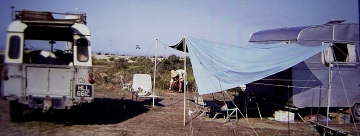
One morning, we headed from Ohrid towards the Yugoslav border post near the Macedonian village of Medzhitilja. Before we reached that place, we stopped briefly in a small town to look at a street market. It was Bitola. Robert, who was always keen to improve his Serbo-Croatian vocabulary and was also passionately interested in insects, noticed a fly or wasp crawling on some grapes at a fruit stall. Notebook and pencil in one hand, he pointed at the creature with his other hand and asked, in English, what the creature was called in the local language (which, incidentally, would have been Macedonian or even Albanian, rather than Serbo-Croatian). The seller, who began getting excited thinking that he was about to sell his fruit, could not understand what Robert was saying and why he was not reaching for his money.
A short time later, we arrived at the Yugoslav border post and parked beneath a canopy that shielded the border officials from the sun. Whilst they were examining our documents, Robert noticed some birds nesting in the eaves of the roof of the shelter. He found a tiny dictionary and frantically looked up the Serbo-Croatian word for ‘nest’, all the time asking himself and the officials,
“I wonder what the Yugos call ‘house martins’”
Margaret, a member of her local Conservative Party, was anxious about being in a ‘communist’ country. Moreover, she was itching to reach the Greek seaside. She shouted urgently from her seat behind him,
“For heaven’s sake Robert, let’s get on.”
I believe that the Yugoslav officials, whose border crossing we were blocking, were also keen that we got a move on.