FORT KOCHI IN Kerala was occupied by three European powers: first by Portugal, then ny the Netherlands, and then by the British until 1947. It was whilst the British were in charge that a small jail was built on what is now Tower Road. Next to a police station and close to a string of roadside seafood restaurants, there is a gate that leads into the Jail of the Freedom Struggle. This prison was built by the British at a forgotten date during the 19th century. One clue to its age is that some of its roof tiles can be dated to 1865. The prison has a row of eight cells, each equipped with a 6 foot long concrete bed.
The prison, which might have been used as a transit establishment for prisoners waiting to be taken elsewhere, is said to have held leading freedom fighters such as Mohammed Rehman, Accamma Cherian, and K J Herschel, A K Gopalan, E M S Namboothiripad, and Abdurahiman Sahib. However, this is not known for certain. The prison, which had become disused and dilapidated, was restored in 2009, and opened as a museum.
In February 2023, we visited Fort Kochi to explore the 2022 Kochi Muziris Art Biennale. Unconnected with this major event, we visited an exhibition of artworks being displayed in the former prison. This included both paintings and sculptures. What made it an usual exhibition is that the exhibits are all contained within the cells behind strong iron doors with vertical bars. The doors that once prevented the prisoners from leaving the cells now prevent visitors from entering them.
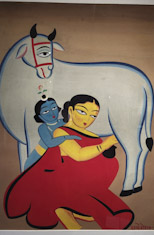
SURVEYING THE REPRESENTATION of women by artists in a single exhibition might seem a daunting task, if not impossible. Yet, this is what the exhibition “Visible/Invisible” achieves successfully. Curated by Kamini Sawhney, Arnika Ahldag, Vaishnavi Kambadur, Riya Kumar and Arshad Hakim, this magnificent display of artworks can be viewed at the recently opened (in late February 2023) Museum of Art and Photography (‘MAP’) on Kasturba Road in Bangalore (Bengaluru). The exhibition, which is displayed in most of the rooms on one floor of MAP confines itself to works created by artists, both male and female, from the Indian subcontinent and its diaspora. However, this did not hinder the curators’ aim of demonstrating the female in art over the centuries.
The 130 artworks on show range in date of creation from the 10th century AD to the present. MAP’s website reveals that the various artworks: “… are interwoven into four key sections based on narratives and counter-narratives: Goddess and Mortal, Sexuality and Desire, Power and Violence, and Struggle and Resistance. Each section presents how women’s lives have been portrayed, the spaces that they occupy and challenges that women have faced in the Indian subcontinent. The themes and ideas explored in Visible/Invisible hopes to encourage audience awareness of the history and role of women and gender in art.” And the exhibition successfully raised my awareness of the multiple ways in which the lives of women have been portrayed by artists of both genders over the centuries,
The artworks include sculptures, paintings, photographs, film posters, textiles (some created by female artists and others woven in traditional patterns by craftswomen), and prints. Almost every exhibit was a joy to behold, What was particularly interesting were examples of artworks created within the last few decades that demonstrate how Indian women artist have taken control of the way they portray women and their lives, What the viewer sees is how women see themselves, which is a contrast to what has happened in earlier times when women have often been shown in the way that men have viewed their lives.
All in all, this exciting exhibition is compelling both visually and conceptually. The curators have expressed their ideas beautifully and powerfully, but not without considerable subtlety.
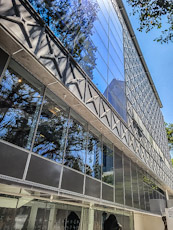
THE MUSEUM OF ART and Photography (‘MAP’) in central Bangalore has just opened (on the 18th of February 2023. Facing the Visvesvaraya Industrial & Technical Museum, MAP is housed in a brand new building with some attractive architectural features.
The edifice has five floors and a basement, which is home to an exorbitantly priced café, run by a company called Smoor. The ground floor has a reception area, a book/gift shop, and some gallery space. This is currently housing an exhibition of fascinating, attractive sculptures by LN Tallur. Some of the works of this contemporary artist allude to Hindu deities in a novel way.
The first floor is home to an auditorium, named after one of MAP’s major donors, Mazumdar-Shaw. Kiran Mazumdar-Shaw, a childhood friend of my wife, is a keen collector of art and has helped finance many other cultural establishments. On the same floor, there is a digital exhibition, whose subject matter can be chosen by the visitor.
The second floor is dedicated to offices and a library. Above this on the third floor, there is currently an exhibition of photographs by Jyoti Bhatt (born 1934), who began his artistic career in the famous art school in Baroda (Vadodara) in Gujarat. His works range from excellent straightforward documentary photography to highly creative artistic photography and collage work.
On the fourth floor, we enjoyed a beautiful exhibition called “Visible/Invisible”. Curated by Kamini Sawhney, Arnika Ahldag, Vaishnavi Kambadur, Riya Kumar and Arshad Hakim, this show explores the visual representation of women in artworks through the ages. Words alone can not do justice to the impactful nature of the display, but I will give you a rough idea of its range. In addition to paintings, modern and old, there are sculptures; photographs; tapestries,; traditional textiles; prints; and a video installation. Most of the artworks in this show were created by Indians or members if the Indian diaspora. The show successfully demonstrates how women have been portrayed over the centuries and how this has changed, especially more recently.
The fifth floor has a terrace from which there are some great views. There were some tables and chairs up there, but the café, if it exists, was not open.
Some years ago, we were in Bangalore when its branch of the National Gallery of Modern Art (NGMA) was opened in a restored palatial mansion near the Bangalore Golf Club. A beautifully designed annex was built next to the old building. When it was opened, I decided that it was a ‘must-see’ attraction in Bangalore. It remains so, but MAP in its newly constructed home will join NGMA amongst my suggestions of what should not be missed by visitors (and inhabitants) in Bangalore.
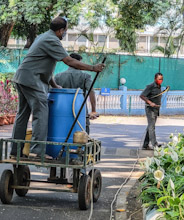
One man pulls the trolley. Another stands on the trolley, pulling a lever back and forth. The lever operates a pump that sends water from a tank (on the trolley) along a hosepipe to a third man, who is holding its end and spraying the flowers.
In India, there is no shortage of manpower and wages are not high. So, employing three men to do what a costly sprinkler system would do in Western Europe makes sense and gives employment to those who have families to feed.
IT IS ALWAYS WISE to ward off the Evil Eye. The Turks use characteristic amulets known as ‘nazar’. They are usually flat and almost circular with a design that resembles a stylised eye. This is now to seen on the homes of many people with no connection with Turkey. The Arabs and some Jewish people use an amulet, the ‘hamsa’, depicting a hand with five outstretched digits, to protect against the malevolent effects of the Evil Eye.
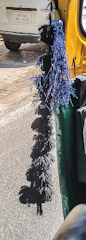
During road trips in India, I have often seen lorries (trucks) and other vehicles with thick, black, plaited tassels attached on the left and right sides of the driver’s cab. These things fly out sideways as the vehicles speed along.
One of our driver’s, the highly educated and informative Raheem, explained that these tassels are nazars. The drivers attach them to their vehicles to ward off the Evil Eye – an especially wise precaution on many roads in India.
During a recent (December 2022) visit to Panjim in Goa, my wife bought a couple of scarves from a female street vendor. The seller was so happy that my wife had bought from her that she immediately attached a bracelet on my ‘other half’s’ right wrist. The bracelet has a Turkish style Eye nazar and is made of black beads, which might well be designed also to protect against the Evil Eye.
Even more recently, I noticed that an autorickshaw, which we had hired in Bangalore, was adorned with two hefty black tassels just like those seen on lorries. I was struck by these because on the whole autorickshaws in the city do not have them.
I have one minor concern about vehicles whose drivers have attached things to ward off the Evil Eye. That is, I wonder whether the knowledge that their vehicles are equipped with such protection might drive more recklessly than those who do not put any faith in objects that might possibly have a protective value.
WHEN SOMETHING GOES WRONG with a product in the UK, it is usually simpler and cheaper to discard it and buy a new one. In my experience of visiting India many times since 1994, I have discovered that there is often someone, who can mend what would normally be thrown away in the UK. Only recently, I spotted a poorly dressed man sitting by the side of MG Road (in Bangalore). He was painstakingly repairing what looked like totally decrepit umbrellas.
We use combination locks (‘number locks’ in Indian English) to secure our baggage whilst travelling. In December 2022 when we were in Panjim (Goa), we found one of ours, which would not open, even when using the correct combination. It looked as if it had become corroded.
Because we have great faith in the ingenuity of Indian craftsmen, we took it to a locksmith in Panjim. He was unwilling to work on our lock, and another lock seller advised us to throw it away. Undeterred, we carried the defective item to Bangalore.
In the Commercial Street district of Bangalore we approached a couple of locksmiths, who were unwilling to spend time on our lock. A third one accepted it, and said he would have a go. We told him the combination, and left him whilst he fiddled with the lock as if it were as enjoyable as a Rubik Cube. On the 2nd of January 2023, we set off on a long trip, returning to Bangalore on the 15th of February 2023.
A few days later, we visited the locksmith, who remembered us and fetched our lock from a glass-fronted cupboard. He had managed to open the lock, but could not remember which combination allowed him to unlock it. He said: “You take it home and try a few numbers.” He refused to accept any payment for his efforts.
Back at our accommodation, I tried what I remembered had been the lock’s combination, and discovered that the locksmith had rendered the once useless lock fully functional. As the tourist board slogan (Incredible!ndia) suggests, the country is truly incredible.
PS These locks are cheap to buy new in India. It was not to save money that we visited so many locksmiths, but it was for the enjoyment of the challenge to find someone to do the job that we spent the time going from one to another. Some people enjoy passing time playing games on their phones. We choose to have our timepass (Indian English) in other ways
THE COCHIN CLUB’S main, long, single-storey building is a lovely example of British colonial architecture. The club, located near the sea in a large well-maintained garden was officially recorded as having been established in 1914, but might have been in existence before that.
Originally established as “The English Club”, its members were mainly the British elite of Kochi and European tea planters. Some individuals, high level Indians, might have also been welcome. The Club’s Presidents all had British surnames until at least 1969. However, there was one exception – Honourable Justice P Govindan Nair who was President 1963-64. After 1969, the Presidents had Indian surnames.
Today, the Club is a tranquil spot. Usually, there are more crows and egrets than humans in its compound. The Club has five spacious, bedrooms, which can be hired. Their occupants are almost the only people using the Club. There are plenty of staff members, but few people for them to serve.
The Club has a splendid bar with windows overlooking the sea in one direction and the garden in the other. But it is a bar with a difference. Instead of shelves being lined with bottles of booze, they are used to display cups and other prize trophies. And this might be a clue as to why the Club is so often so empty.
The Club does not have a liquor licence. Therefore, it cannot sell alcoholic drinks. The cost of buying an annual licence is so prohibitively high in Kerala that the Club might not be able to break even. The availability of alcohol is one of the factors that brings life to the exclusive clubs of India.
On special occasions such as Diwali and Christmas and Onam, the Club buys a costly 24 hour licence. The rest of the time, the Club is ‘dry’. However, food and soft drinks are available in the bar. The South Indian filter coffee served there is the best we have found in Fort Kochi (Fort Cochin).
Largely because liquor is not available and because there are few members (about 500), this charming Club has acquired a certain unintended (undesired?) tranquillity.
ASPINWALL HOUSE IN Fort Kochi is the epicentre and largest exhibition space of the Kochi Muziris Art Biennale. We have attended this event four times to date – 2014, 2016, 2018, and 2022. Outside the main entrance to Aspinwall House, there is a list of those companies, organisations, and individuals, who have donated money to the Biennale. The current (2022/23) list has the following heading “Principle supporters”. Is this wording an undetected typographical error, or is it intentional, or is it a Freudian slip? I ask this question because the sentiments expressed in many of the exhibits question the consequences of the activities of some of the donors.
Far too many of the exhibits in Aspinwall House are more like well-made documentaries than what has until recently been regarded as art. The documentary exhibits are mostly well put together with superb still photography and cinematography, and quite a few of them are highly informative – akin to, for example, National Geographic productions.
The majority of the documentary-like exhibits have elements of political protest, often leftward leaning. Now, I have no objection to political protest in art, but I wonder whether some of these exhibits have strayed too far from what used to be considered art, and have become more documentary than artistic. In the past, to mention but a few, artists such as Picasso, George Grosz, Otto Dix, Joan Miró, Subhi Tagore, Diego Riviera, and currently William Kentridge, have made artworks with political content. These artists and some of their contemporaries produced artworks which are not purely political or polemic, but can also be enjoyed as purely visual experiences; knowing the message is not important to the impact the works make on the viewer, but can add to that. Much of what is on display at Aspinwall House during the current Biennale simply thrusts political messages at the viewer. There is little else to appreciate but often depressing messages and images.
As for the abundance of photography it is mostly superb. Since the invention of photography, it has been used highly creatively by some photographers. Examples of these include Julia Margaret Cameron, Charles Dodgson, László Moholy-Nagy, Ansel Adams, and Alfred Stieglitz. Artists like these were competent photographers who exploited the camera to create original images that would have been difficult if not impossible to produce with other artistic materials. In contrast, many of the beautiful photographic works in the current Biennale seem to be aiming at documentary or archival accuracy rather than creative images – works of ‘pure’ art.
Having blasted at what I did not like about the Biennale, I must point out that there are many artworks that satisfied me purely visually. Some of them are in Aspinwall House, but many of them are elsewhere, notably in the Durbar Hall in Ernakulam. The works that impacted me positively because of their purely aesthetic 7characteristics might also be conveying political sentiments, but the nature of these did not impede my immediate, visceral rather than cerebral enjoyment of them.
Returning to the predominantly documentary exhibits, those that made most impact on me were housed in the TKM warehouse complex in Mattancherry. Some of the works there are not only political or polemical, but also highly creative and artistic (in the old sense of the word).
As for the odd use of “principle” on the list of donors mentioned above, I found this not only careless but ironic. Many of the artworks in the current Biennale question the principles of some of the donors, who funded the show.
Having read this, you can call me ‘old-fashioned’ or ‘politically incorrect ‘ if that makes you feel better. I might well be both, but I was brought up by my artistic parents to appreciate the works of both old masters and contemporary artists equally, be they works by Piero della Francesca or JMW Turner or Brancusi or Barbara Hepworth or Rachel Whitehead or Anish Kapoor.
Visit the Kochi Muziris Art Biennale if you can before it ends in early March 2023, and judge it for yourself. Almost all of the exhibits are housed in heritage buildings, which are alone worth seeing. I look forward to the next show in 2024/25.
I VISITED INDIA at least 50 times over the last 29 years. It was not until this trip (2022-2023) that I began noticing letter boxes of historic interest. I spotted three of interest in Bangalore, and now I have found one outside the post office in Fort Kochi in Kerala.
Painted green with some gold coloured details it is hexagonal with a decorative top. Between the words “Post” and “Office”, there is a British royal cipher with the lion and unicorn. Beneath this is a V and a R entwined, a logo I have seen on Victorian letter boxes in the UK.
The old letter box, now sealed up so that nothing can be put in it, stands close to the verandah at the front of the post office. Within the verandah, there is a panel giving some information about postal services in the former Kingdoms of Cochin and Travancore
Postal services began in the Kingdom of Cochin in about 1864. It was known as the Anchal Service. The letter box described above might have been an Anchal post box originally, although it is unlikely.
The post office outside which stands the historic letter box is on Ridsdale Road opposite the east end of the church of St Francis (Church of South India), and was constructed in May 1928. At that time, Fort Kochi was in the Kingdom of Cochin. In 1949, it and its neighbour, The Kingdom of Travancore, were integrated into India and merged to form the State of Thiru-Kochi. In 1956, this state was renamed Kerala and its postal service became incorporated into the Indian Post system.
Interestingly, the post box outside the Fort Kochi post office bears the intertwined V and R. The information panel has a drawing of an anchal letter box. Similar in shape to the Victorian post box, the one in the drawing bears a different logo and the words “Travancore Anchal” and something in Malayalam script. If I am not mistaken, Cochin, unlike Travancore, became a British Protectorate. In which case it might well have become part of the British Indian postal system. This could explain why the historic letter box in Fort Kochi has a British logo instead of that used in the Anchal system. There might also have been Anchal boxes in the Kingdom of Cochin, but I am uncertain about that.
Today, letters are posted in a simple red cylindrical letter box not far from the historic one. The Victorian letter box is one of a huge number of interesting historic survivals that can be seen whilst wandering around Fort Kochi.





 yamey
yamey 