Get a taste of my latest book about travelling in India

Recently, I published a book, “THE HITLER LOCK & OTHER TALES OF INDIA”, which is about some of my experiences of frequent visits to India over a period of thirty years. It consists of an introductory prologue and 101 short pieces of prose. To get some idea about what the book contains, here is one of them.

“IMPROPERLY DRESSED

In August 2008, we spent a few days at a beachside hotel just north of the city of Calicut (Kozhikode) in Kerala. Our accommodation was in the village of Kappad, where it is said that the Portuguese Vasco da Gama might have first set foot on Indian soil in 1498. Whether he did or did not, we had a good holiday in the area despite the occasional monsoon downpours.

One afternoon, while we were being driven through the countryside near Calicut, we spotted an isolated Hindu temple in the middle of a wooded area. It was surrounded by a fence and looked interesting from the car. We stopped, and found an open gate through which we entered the temple compound. The place was deserted – there was not a soul to be seen. Out of respect for Hindu traditions, we removed our footwear before wandering around. I took photographs of what was clearly quite an old temple.

We were on the point of leaving this holy place when we spotted a pandit entering. He walked towards us, not looking too pleased to see us. Speaking in Hindi or English – I cannot remember which – he said that I was not properly dressed to be in his temple. We apologised, and then he asked me to remove my shirt. I did as he requested, hoping that this would improve his mood. After I had taken off my shirt, he asked me to remove my trousers. To be charitable to him, I guess he would rather have had me wearing a lunghi or a dhoti instead of trousers. When he asked me to take off my trousers, we decided to leave the temple compound speedily.

Had I done as he had asked and put on traditional clothing of Kerala, the priest might have felt obliged to make us feel welcome in his temple. But it is likely that he knew full well that a westerner like me was unlikely to do what he wanted, and instead would leave his compound. His actions were a subtle way of getting us to leave without needing to sound impolite or unwelcoming.”

And here is another excerpt:

“DIPLOMATIC AMNESIA

Almost immediately after I first arrived in India (in late December 1993), and a few days before our Hindu wedding ceremony, my father-in-law recommended that I visit his tailor – Mr Krishnan – to get measured up for some new suits. One of these was to be a white ‘Prince Suit’, and the other two were western style formal suits in greyish materials. The Prince Suit, a traditional Indian design with a high neck collar, was to be worn at our wedding reception after the marriage ceremony. The other garments would be useful for the many formal occasions, which my father-in-law anticipated both in India and England. He loved such occasions.

When he worked in an upmarket tailoring shop in Bangalore’s Brigade Road, Mr Krishnan had made suits for my father-in-law. When I met him, he was semi-retired and worked from his home in a small, old-fashioned house on a short lane in a hollow several feet beneath the nearby busy Queen’s Road. He was a short, elderly gentleman – always very dignified and polite. He measured me up for the suits in his front room, which served as part of his workshop. After a couple of visits to try the suits whilst they were still being worked on, I picked up the finished garments. Each of the suits fitted perfectly – ‘precision-fit’ you could say quite truthfully. Despite being so accurately made, they were not in the least bit uncomfortable. Everybody admired them. I could understand why I had been sent to Mr Krishnan.

Our next trip to India was made 20 months later when our recently born daughter had had sufficient vaccinations to allow her to travel safely. During the interval between these two holidays, my dimensions had changed significantly because of my good appetite and happy marriage. Notably, my girth had increased greatly. Sadly, the suits that Mr Krishnan had so carefully crafted no longer fitted me. We returned to see Mr Krishnan, who told us that in anticipation of my dimensions changing, he had left extra cloth within the garments for adjusting them. Without comment, he took my new measurements, and noted them down in a book. My wife, who had accompanied me, said to the tailor, mischievously:

“Just out of curiosity, Mr Krishnan, would you be able to look up Adam’s previous measurements to see how much he has changed.”

He put down his pencil, sighed, and said:

“I am very sorry, Madame, but I have unfortunately lost them.”

Mr Krishnan was not only a wonderful tailor, but also a perfect diplomat.”

If you enjoyed these, and want to read more, then please obtain a copy of my book, which is available in paperback and Kindle from Amazon sites such as

[For those who live in India, the paperback can be ordered here:

https://store.pothi.com/book/adam-yamey-hitler-lock-and-other-tales-india/]

An unusual title for my latest book about India

SOME PEOPLE MIGHT RAISE THEIR EYEBROWS in surprise when they learn of the title of my new book. Called “The Hitler Lock and Other Tales of India”, it consists of an explanatory prologue and 101 short pieces describing some of my many and varied experiences whilst visiting India frequently during the past 30 years.

My book’s name was inspired by my discovery of a company, Hitler Lock Enterprises, which manufactures padlocks in India. Despite my choice of the book’s title, only three of the vignettes contained in it are related to Germany’s former notoriously monstrous Führer. In these few pieces, I have described how I believe that Adolf Hitler is perceived by many Indians today.

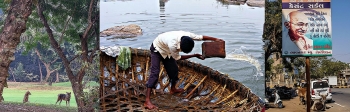
The rest of the book has nothing to do with Hitler. It contains pieces with deal with topics such as: travelling in coracles; problems with monkeys; peculiarities of club life; dress code; encounters with jackals and crocodiles; teamakers and politicians; children called Lenin and Stalin; meeting maharajahs; fabulous booksellers; the City of Joy; Gandhi and his optician; and ‘love marriages’ (including my Indian wedding) – to give but a few examples. The aim of the book is to both inform and entertain, and it is written for those who are familiar with India as well as those who are not.

To be frank, I chose the name of this book to make it both eye-catching and slightly provocative. I hope that by including the word ‘Hitler’ in my title, it will not deter people from reading my text. That despicable genocidal madman is not mentioned much in the book.  And I should emphasise that my text does not glorify him at all.

So, now that you know that my book is about India and its delights, rather than yet another tract about Hitler, you can obtain a copy, and enjoy it.  My text is available as a paperback and a Kindle (e-book) on Amazon’s websites, including (for example):

https://www.amazon.co.uk/HITLER-LOCK-OTHER-TALES-INDIA/dp/B0CFM5JNX5/

Sleeping tightly in Cornwall and India

DURING A WANDER through the rooms of Trerice House in Cornwall, which was constructed in the 15th and 16th centuries, we came across a 16th century four-poster bed in one of the bedrooms. Unlike most four-poster beds, which can be seen in many National Trust properties, this one was missing its mattress. What could be seen is a rope threaded through holes drilled around the rectangular base of the bed. A long single rope was threaded through the holes so that a lattice of ropes formed a set of adjoining squares – a grid. The mattress would have been supported on the rope lattice. From time to time, the lattice would have become loose, -and the mattress would have sagged. The solution was to untie a knot at one end of the rope, and tighten the latticework before re-tying the rope.

My wife pointed out that this latticework arrangement resembled what is commonly seen in India: charpoys. A charpoy looks like a bed frame with four legs, but without a mattress. Ropes or strips of plastic are tied to the frame to produce a latticework very much like what we saw at Trerice. In India, charpoys are used to rest upon. Mattresses are not usually used.

A lady volunteer in the room at Trerice told us that the phrase “sleep tight” originated from the process of tightening the rope that supported mattresses on beds made long ago. This is the most common explanation of the expression. However, there is another (www.straightdope.com/21342710/what-s-the-origin-of-the-expression-sleep-tight), which is based on a definition in the Oxford English Dictionary:

“… what they say: ‘It seems that tight in this expression is the equivalent of the only surviving use of the adverb tightly meaning ‘soundly, properly, well, effectively.!’”

So, it is up to you to decide which of these two explanations sound most likely to you. Or, perhaps, you know of another.

When less became very much more

IN JANUARY 1994, we had a Hindu wedding ceremony in the Indian city of Bangalore. Although the ceremony was attended mostly by family and a few close friends, the reception that followed it had about 350 guests, most of whom I had never met before. So, as an attempt to introduce me to some of them, my parents-in-law arranged a series of parties to introduce me to some of them before the ‘big day’. The gatherings were held in the spacious living room of my in-laws’ home in Koramangala – a suburb of Bangalore. As with many parties held in India, the proceedings began with a long session of drinks and snacks (‘finger food’). The parties end with food served at a buffet. Once, this late supper has been consumed, the guests leave, and the occasion ends abruptly.

My in-laws had a bar counter in their living room. At each party, an off-duty employee from the Bangalore Club was hired to serve as barman. Back in 1994, my preferred alcoholic drink was vodka. I enjoyed drinking it either with lumps of ice or with a drop of water.

At one of the series of parties, I went up to the bar and asked for vodka with water. I was handed a tall glass (approximately 330 ml, I guess) filled with a transparent, colourless liquid. I sipped it. It was rather dilute vodka – not very exciting! When I had finished the glass, I returned to the bar, and said:

“Another vodka, but less water this time, please.”

I did not watch the barman preparing my drink. He handed me a freshly filled glass, which was the same size as the one I had just emptied.

I took a small taste of my second drink. I could not believe what I tasted: it was neat vodka. The barman had poured me a third of a litre of pure vodka. I could not believe my luck. As the evening moved on, I took sips of my reservoir of vodka, and chatted to various people – I hope reasonably coherently.

Eventually, the drinking part of the evening’s proceedings were over, and people began to partake of the dishes on the buffet. Being a member of the family, I waited until the guests had taken their food, before approaching the tables where it was displayed. As I reached a counter, I felt my ankles weakening, and I thought that I might have been just about to topple over, which would not have looked good. Luckily, the vodka had not affected my brain. So, sensing the imminent risk of falling, I gripped the counter with my hands, and thereby averted embarrassing the family.

Now, my drinking habits are not the main point of this short tale. It is the meaning of the word ‘less’ in English spoken in India that is important. If, for example, you want to order coffee without sugar in India, you should say:

“Sugar less.”

That does not mean that you want less sugar in your coffee. It means you do not want any sugar in your beverage. It has taken me years of visiting India to realise this meaning of ‘less’. That is, ‘less’ means ‘none’. I did not know this in January 1994 when I asked for less water in my vodka. I suspect what happened was that English was not the barman’s mother tongue. So, hearing, the word ‘less’, when I had asked for ‘less water’, he had believed that I wanted not a drop of water in my drink.

Farewell to an old friend in the heart of London

OVER THE PAST 45 YEARS (or more), we have eaten at least once a year at the India Club restaurant in London’s Strand. Occupying the first and second floors of the old-fashioned Hotel Strand Continental, the Club’s bar on the first floor is reached via a steep, narrow staircase. Opposite it, there is an office and reception area where our friend Mr Marker, or one of his daughters, greets us. Another narrow staircase ascends to the dining area on the second floor.

The Club was founded either just before India became independent in 1947, or in the very early 1950s. Close to the Indian High Commission, Bush House, and the London School of Economics, it was designed to be a home-away-from-home for Indians in London. The Club’s website (www.theindiaclub.co.uk/our-story) mentioned that the Club:

“… was originally set up by the India League, to further Indo-British friendship in the post-independence era, and it quickly became a base for groups serving the Asian community … The Indian Journalist Association, Indian Workers Association and Indian Socialist Group of Britain were just some of the groups which used 143 Strand for their events and activities. The building was also a base for the new wings of the India League which ran a free legal advice bureau and a research and study unit from this address.”

One of its founding members was Krishna Menon (1896-1974) who was independent India’s first High Commissioner to London. Soon after it was founded, the Club became popular with non-Indians as well as those for whom it was founded. Supplying Indian cuisine at very reasonable prices, the restaurant became a popular eatery. Until a few years ago, alcohol was only available to paid-up members of the Club. To become a member, and thereby have the use of the bar, an annual membership fee of only £1 was payable. Later, the Club’s restaurant must have obtained an alcohol licence because the requirement to become a member (for the purposes of purchasing booze) was dropped.

Both the restaurant and the bar have always looked like they must have done when the Club was first opened so many decades ago. Consequently, the place has an old-fashioned look about it. Should one of its founding members wander in today, they would have found little changed, except the prices. For us, and I suspect many other regulars, part of the charm of the Club was its unchanging appearance. It seemed to me that the management have deliberately not done anything to spoil the early postwar atmosphere of the place. The Club is adorned with paintings and photographs, mainly depicting notable Indians who lived during the period when India was becoming independent. To quote the website again:

“The interior of 143 Strand, particularly the characterful and distinct entrance, stairwells, reception area, first floor bar and second floor restaurant, remain in the same condition as they were during the occupation of the property by the India League. As a result,143 Strand’s interior allows it’s historical and cultural associations to be experienced first-hand by the public. It is the only building in the capital connected to the India League that has not been redeveloped or re-purposed. It therefore remains living history.”

As for the food served at the Club, over the years it has varied in quality according to who was working in the kitchen. Always satisfactory and good value, the Club’s food could never be described as exceptionally good. The menu included both vegetarian and non-veg dishes. I always enjoyed rounding off the meal with the excellent kulfi they served.

A few weeks ago in August 2023, a friend in Bombay (Mumbai) sent me an upsetting newspaper article. It quoted the Club’s owner Mr Marker as saying:

“It is with a very heavy heart that we announce the closure of the India Club, with our last day open to the public on September 17.”

Bearing this in mind, yesterday (Monday, the 4th of September 2023), a small group of us decided to have a last supper at the Club – to say farewell to this wonderful relic. When we arrived at the Club at 6pm, I could hardly believe my eyes. There was a queue of people waiting to dine at the Club. The line stretch from the pavement, up both flights of stairs, to the restaurant, which was chock full of diners. I had never seen the dining room with such a large crowd. The bar was also full of people waiting to get a table. When we learned that we would have to wait at least 45 minutes to be seated, we decided to go elsewhere (to Sagar Indian vegetarian restaurant in Panton Street).

It was various news items about its imminent closure that drew us and all the other people to the Club. Some of them, like Lopa and I, were regulars, but I wondered how many of the other folk queuing that Monday evening had ever eaten at the Club. Did its impending closure, like the film “Oppenheimer” and the play “Dr Semmelweis” – both about figures known mostly to scientists, draw the crowds to a fairly unfamiliar place that had suddenly become attractive because it was soon to be no more?

Kutch from kingdom to district

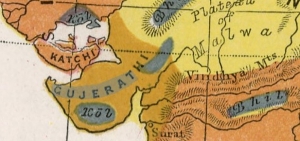
MY WIFE’S COUSIN lives in a part of the Indian state of Gujarat called Kutch (‘Kachchh’). He and his wife have a lovely farmhouse near the port city of Mandvi, where you can watch huge wooden dhows being constructed along the riverbank. Although Kutch is now a part of the state of Gujarat, it has not always been. The people of Kutch (‘Kutchis’) speak a language quite distinct from Gujarati. The Kutchi language has closer similarity to Sindhi than to any other Indian language (Kutch is bordered to its north by Sindhi speaking people*). It is a spoken language, but not written. Even though Kutchi people can speak and write in Gujarati, they will proudly inform you that they are Kutchis and definitely not Gujaratis. During our several visits to Kutch, my wife’s cousin’s driver, who can speak good Gujarati, insists on speaking to my wife in Kutchi, which she cannot speak as well as Gujarati.

Many people with whom I have discussed my travels, look puzzled when I say that we have been to Kutch. Just in case you are wondering, it is the furthest west part of India. Most of the north of the region is bordered by Pakistan, from which it is separated by the arid Rann of Kutch. To the south and separated from it by the Gulf of Kutch (a part of the Arabian Sea) is the peninsula of Saurashtra – now also a part of Gujarat.

Until 1947, Kutch was a kingdom founded by unifying three separate kingdoms, ruled by branches of the Jadeja family, in the 16th century. In 1819, having suffered a military defeat (at The Battle of Bhuj in March 1819), the Kingdom of Kutch accepted the sovereignty of the British East India Company. Under the watchful eyes of the British, members of the Jadeja family continued to rule Kutch – it became one of India’s many ‘Princely States’. On the 16th of August 1947, one day after India became independent, Kutch voluntarily acceded to the new Indian state.

Kutch became a state of India. In November 1956, as a result of the State Reorganisation Act (1956), Kutch ceased to be a state in its own right, but became a part of the then huge Bombay State. The latter was effectively a bilingual region, most people were either speakers of Marathi or of Gujarati. The Marathis and the Gujaratis began to clash. In 1956, the Mahagujarat Movement began campaigning for a state for Gujaratis, which was separated from that for Marathis. The movement was spearheaded by Indulal Yagnik (1892-1972). His nephew, who lives in Bangalore is a family friend, whom we meet whenever we are in the city. As the Gujaratis clamoured for their own state, so did the Marathis, Blood was shed, and much property was damaged. On the 1st of May 1960, the old Bombay state was divided along linguistic grounds. The states of Maharashtra and Gujarat were formed. The latter includes the Gujarati speaking district of Saurashtra as well as the northern part of the former Bombay State, and also Kutch. And that is how it remains today.

Since 2017, we have made several enjoyable visits to Kutch, from which my wife’s maternal ancestors hail, and enjoyed many fascinating experiences there. Some of these can be found in my new book – a collection of true stories about life in India seen through my eyes. The book (also Kindle) is available from Amazon websites including https://www.amazon.co.uk/HITLER-LOCK-OTHER-TALES-INDIA/dp/B0CFM5JNX5/

*When Lord Napier conquered Sindh *which neighbours Kutch) in 1843, he is reputed to have sent a single word message to London in Latin “Peccavi”, which means ‘I have sinned’.

Seeing India through the eyes of a Londoner

AMONGST THE 101 diverse topics in my book about travelling in India, you will find the following four: observing a padlock made by a company called Hitler; encountering jackals on a golf course; travelling in coracles on crocodile-infested waters; and having spectacles made by Gandhi’s optician. Since getting married in India in early 1994, I have made over fifty visits to the country during which I have spoken to many people and explored a multitude of places – both well-known and hardly known except to locals. My book, “The Hitler Lock & Other Tales of India”, contains a selection of my experiences in the country. The book aims to fulfil the idea of great Jean Molière (1622-1693), namely, “If you want to edify, you have to entertain.” I hope that you will find that I have achieved that.

You can purchase my book from Amazon (either as a paperback or a Kindle e-book) by clicking on the picture below:

DISCOVER THE EXCITING RANGE OF TOPICS IN MY NEW BOOK ABOUT MY TRAVELS IN INDIA DURING THE LAST 30 YEARS

Here is a list of the chapters in Adam Yamey’s anthology of his often entertaining travel experiences in India. The book is both for those who know India and for those who do not.

The book and/or Kindle can be bought by clicking on the picture below.

LIST OF CHAPTERS

Introduction … page 9

Prologue: A book from India … 12

Saved by a nosebleed … 14

You married him? … 16

It began with a bang … 18

Shantiniketan … 20

. Maria and Job … 23

Please use the meter … 27

Mixed couples … 29

Coracles … 31

West End Hotel … 35

Less than one degree … 39

Puncher …42

Dining with the dead … 48

A generous gratuity … 50

Miner’s sauce … 52

From Kutch to Norway … 54

Looking so lovable … 56

Beneath the banyan trees … 58

Meeting Khushwant Singh … 61

A palace by the sea … 64

Monkey business … 67

Chicken 65 … 70

Diplomatic amnesia … 72

Meeting the Mahatma … 74

Feeding the cows … 79

Montecatini Terme … 83

Hummus in Hampi … 86

Clothing can be critical … 89

Traditional but trendy … 94

Facial prejudice … 96

Paradise for bookworms … 99

Wrapped up … 105

The personal touch … 108

He worked with Le Corbusier … 111

My Ferrari … 115

From Gandhi to Hitler … 117

An unusual invitation … 121

Looking for literature … 123

Of dargahs and dyeing … 127

Before my time … 130

Improperly dressed … 132

Dining at Limra … 135

Hitler on the shelf … 139

Beefsteak not biryani … 144

Independence Day … 146

Large snakes … 148

One wife four husbands … 150

One day it might be you … 153

Waterfalls and water closets … 155

Cunning old fox … 158

Kutchi beer … 161

Albanians in India … 163

Bodies in the dark … 167

Don’t let it go viral … 169

Clubbing …171

Lopchu … 175

Threads of faith … 179

Nizam’s … 184

Teapots and politics … 187

A refreshing breeze … 190

Buried not burned … 193

Gandhi’s spectacles … 197

Tea at Lothal … 201

They came from Persia … 207

Don’t take the train … 211

Defying inflation … 215

In your face … 217

Cops and crocs … 219

A curious hotel … 222

Denmark by the sea … 225

No bill food is free … 231

Espresso in Diu … 234

Maurice and Bob … 237

An Indian welcome … 242

The pandit’s wife … 244

Royal encounter … 247

Unlocking a secret … 253

Curious coffee … 255

Do they speak Hindi in Russia? … 257

Dashiki … 260

Field of cars … 263

I love Stalin … 267

Jeremy Bentham and Calcutta …269

India’s first mosque … 273

Eggs excepted … 278

Saving their necks … 280

Reclining on a rug … 283

Bollywood in Bangalore … 285

A coffee house … 289

Bargaining in Mount Abu … 291

Not long in Nepal … 295

An unexpected sight … 299

Four bangles … 303

On the safe side … 306

PHD … 308

In touch with history … 311

James and Adeline … 316

Ladies only … 318

Lost property … 320

Plants from paper … 323

A soaking in Calcutta … 325

Mapusa market … 331

Introducing my NEW BOOK ABOUT MY TRAVELS IN INDIA

SOME SOUVENIRS FROM MY VISITS TO INDIA DURING THE PAST 30 YEARS

 —  A new book with a curious title  —

True love drew me to India. Since my first trip there in late 1993, I have visited the country more than fifty times.

After I married Lopa in London in October 1993, we travelled to her native land, India, a few weeks later. From the moment I first landed on Indian soil, my eyes opened wide with amazement, and ever since then, India has filled me with a delightful sense of wonder. 

You might be curious about the book’s title. This relates to a chance one-off sighting (in the 1990s) of a padlock made by an Indian company with the same name as that of Germany’s former Führer. From that day onward, whenever I have been in India and seen a shop or market stall selling locks, I have always looked to see whether any of this company’s locks are on sale.

To discover some of the many things that endear me to India and whether I ever managed to find one of these curiously named locks, you need to read my new book. Illustrated with my photographs, it contains over one hundred short prose vignettes, which can be enjoyed by both those who are familiar with the country and those who are not.

Paperback: https://www.amazon.co.uk/HITLER-LOCK-OTHER-TALES-INDIA/dp/B0CFM5JNX5/

Kindle: https://www.amazon.co.uk/HITLER-LOCK-OTHER-TALES-INDIA-ebook/dp/B0CG3DX1LP/