
Since time immemorial, incense sticks have been in use. Here they are burning (for auspicious reasons) at the start of day in a mobile ‘phone shop in Bangalore … for me, this juxtaposition of ancient and modern encapsulates life in modern India.

Since time immemorial, incense sticks have been in use. Here they are burning (for auspicious reasons) at the start of day in a mobile ‘phone shop in Bangalore … for me, this juxtaposition of ancient and modern encapsulates life in modern India.
THE HAZIRA MAQBARA is an impressive octagonal structure in Baroda (Gujarat). It was built in about 1586 in the Mughal style of architecture, such as can be found in Delhi. This beautiful mausoleum houses the graves of Qutb-ud-din Muhammad Khan who was the tutor of Salim, son and successor of Akbar, and also that of his son Naurang Khan who held important posts in Gujarat under Akbar. There are other graves within the building and also nearby on land near it.
The various graves are covered with colourful cloths upon which red rose heads are placed. The roses are replaced daily, and the cloths every Thursday. This we were told by an elderly man who had been praying loudly within the main central chamber of the mausoleum.
Apart from the beauty of the building and its wonderful jaalis (latticework window screens), I was impressed by some things that I have noticed in many other Muslim mausoleums in India.

Within the mausoleum and close to the graves outside it, there were incense sticks (agarbatti) burning, releasing small clouds of fragrant smelling smoke. Within the mausoleum, I spotted at least two oil lamps (diyas), each with small flickering flames.
Agarbatti and diyas are commonly found in Hindu temples, and often at the beginning of the day in shops, restaurants, etc. I first noticed them being used in Islamic settings in India in Sufi dargahs (shrines containing graves) in Bangalore when going on excellent guided walks led by my friend Mansour Ali. Later I begun noticing these things, which I had initially assumed were only associated with Hinduism, in places associated with Islam. I have discussed this commonality of Hindu and Muslim practices in one chapter of my new book about travels in India, which is available from Amazon (eg https://www.amazon.co.uk/HITLER-LOCK-OTHER-TALES-INDIA/dp/B0CFM5JNX5/ ) AND if you live in India, from https://store.pothi.com/book/adam-yamey-hitler-lock-and-other-tales-india/ .
Other chapters in my book about my experiences of visiting India cover a wide variety of subjects. The book, which is aimed both at those who ‘know’ India and those who do not, is both informative and entertaining.
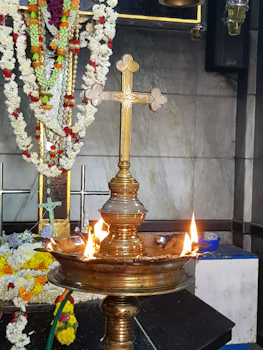
Over and over again, I am impressed by the “Indian-ness” of worshipping in India. I will illustrate what I mean by this by describing a small Orthodox Christian chapel I visited on Bazaar Road in the Mattancherry district of Cochin (“Kochi”) in Kerala.
Outside the chapel, there stands a carved stone stand with indentations for oil lamps (diyas). It looks just like any diya stand that you could find in a Hindu temple, except that it is surmounted by a Christian cross.
The crucifix that stood above a small high altar within the chapel was draped with flower garlands (malas). Again, these are commonly found draped around effigies of Hindu deities.
I saw a brass diya stand with burning oil lamps directly in front of the crucifix. Like the lamp stand by the entrance, this one was also topped with a Christian cross.
If one were to replace the crucifix with an effigy of a Hindu deity and were to remove the crosses from the diya stands, the chapel would become identical to a Hindu temple.
The use of diyas and also agarbati sticks (incense sticks) is not confined to Hindu temples. I have seen them used in Christian as well as Islamic (especially Sufi) and Jain places of worship.
At a Sufi shrine at Sarkej Rauza on the edge of Ahmedabad in Gujarat, I have seen tulsi leaves being sold. These are commonly associated with Hinduism, but the vendor in the Sufi shrine told me that they were also used by worshippers who came to the shrine.
I have seen threads tied around the trunks of peepal trees by pious Hindu women hoping to have their wishes granted. I have also seen threads tied by women around pillars in Moslem shrines for the same reason.
Hinduism was probably one of the earliest religious belief systems to become evident in the Indian subcontinent. Christianity and Islam were relatively recent arrivals. Many Hindus converted to these two religions, but, I imagine, they were reluctant to abandon their Hindu heritage completely. Hence, the Hindu-ness or Indian-ness of some aspects of other religions in India.
 yamey
yamey 