An artist who works and lives in Kolkata

WHEN VIEWING ARTWORK or listening to music, my reaction  to, and enjoyment of it is governed by my initial visceral feelings that it evokes. If these feelings are satisfactory, my interest and enjoyment of the art increases, and I might begin to delve more deeply into understanding what the creator is trying to convey with his or her work.


My initial reaction to the oil paintings and ink drawings by Kolkata based artist Debajyoti Roy were very positive. Each of his works on display appealed to me. Many of the images are in black ink on white paper. A couple of larger paintings were more colourful, created with oil colours and inks.


 Some of the works in ink reminded me a little of Chinese or Japanese calligraphy. The works are both abstract and at the same time somewhat figurative. Yet, as I studied them, they gave me the feeling that they are abstractions of reality, often of biological phenomena.  As Roy explained in the exhibition catalogue:

“When someone engages with a piece of art, it is inevitable to interpret its visual aspects. Still, the essence lies in deeper inquiries that provoke interpretation of the perception and reality.”

I felt that this was certainly the case with what I saw of his creations.


Debajyoti Roy has created a set of images that are intriguing both visually and intellectually. It is a shame that his exhibition at the Jogen Choudhury Centre for Arts in south Kolkata is ending soon (on 11 January 2025). If you happen to be in Kolkata before it ends, it is well worth viewing.

A goddess and going to jail in Kolkata

THE ALIPORE JAIL used to house political prisoners, whom the British regarded as a threat to their rule of India.  The inmates included freedom fighters such as the future Sri Aurobindo,  Jawaharlal Nehru, and Subhas Chandra Bose. The prison has been restored and is now a museum. In December 2024 and for the first few days of 2025, several exhibitions that are part of the Bengal Biennale have been held in some of the jail’s  buildings.  One of these, which I found extremely interesting and well curated, is called “Kali: Reverence and Rebellion”.


Kali is a Hindu goddess. I will not try to explain her exploits and great importance to Hindus, but will outline the subject matter of the exhibition by quoting from the website of the Biennale (www.bengalbiennale.com/):

“Divided into sections, the exhibition traces Kali’s pervasive influence across the subcontinent. It explores Kali and her cohorts of the divine feminine. Born from Durga’s angry, darkened brow as she battles the asuras Chanda and Munda, Kali decapitates the demons and assumes the form of Chamunda. Within these depictions, she is seen alongside Durga, the primordial force, as well as the ten Mahavidyas that emerge to subdue Shiva.”


Subhas Chandra Bose image

In addition to the wonderful array of images on display, which can be enjoyed without any knowledge of Kali, what fascinated me was the connection between Kali and the fight of Indians for independence. The website explained:

“During the nationalist period, Kali was invoked as a symbol of rebellion by Aurobindo Ghosh and Subhash Chandra Bose to urge their followers to fight against imperialist forces.”

In connection with this, two images fascinated me. One of them depicts Kali who has cut off her own head and she holds it in her left hand while blood shoots out of her cut neck and into the mouth of her self-decapitated head. Painted in about 1840, this image shows what Kali did after either she was unable to obtain Shiva’s blood, or she had been deprived of her conjugal rights. Known as Chinnamasta, this avatar of Kali is often shown with one foot on the chest of a god (Shiva) or standing above a copulating couple.


Elsewhere in the exhibition, there is an image of Subhas Chandra Bose created during the twentieth century. It shows the freedom fighter, Bose, standing decapitated and holding his own head in his left hand. He is standing above a group of decapitated heads. Blood pours down from his head and it falls onto a map of India on which the words “Jai Hind” (‘Victory to India’) can be seen. The image is a politicisation of the depiction of Chinnamasta.


Apart from a wonderful selection of Kali images created by Indian artists, there are a few made by early Europeans who visited India and wanted to record their experiences and to attempt to understand Hinduism. All in all, the exhibition was very well worth viewing. It was so popular with visitors to the jail that a security guard was present to regulate the number of viewers at any one time, to prevent overcrowding.

Subversion at the Serpentine art gallery: ways with words

THE ORIGINAL SERPENTINE Gallery in London’s Kensington Gardens is housed in a former tea pavilion that was built in 1934. It began to be used as a contemporary art exhibition space in 1970. Since then, it has been showing modern and contemporary artworks in a series of temporary exhibitions. I have been visiting this gallery and its newer branch, Serpentine North, regularly since the 1990s (the North branch opened in 2013). Almost without exception, the art displayed in the Serpentine galleries has been both exciting and adventurous – sometimes quite challenging. The latest exhibition, which is on until the 17th of March 2024 in the original gallery, is of artworks by the American (USA) artist Barbara Kruger, who was born in Newark (NJ) in 1945.

Kruger’s art is not purely visual. It is designed to convey ideas that challenge the viewer to question commonly held contemporary beliefs in an eye-catching, often witty way. The exhibition, “Thinking of You. I mean Me. I mean You” consists of 12 art installations that reference or parody everyday things such as advertising, magazine illustration, video art, social media, the Internet, and other media that bombard us on a daily basis. Each of them present messages that subvert political ideas, the moral code, and the meanings of words. Kruger makes much use of video techniques. Several of the exhibits have words projected sequentially to make up sentences. Often, the words change on the screen to alter the perceived meaning of the text being projected. However, her art is not simply all about words and their meanings in different textual environments. The words are harmoniously accompanied by intriguing visual images, often continuously changing.

Although the exhibition is about words and their usage and varying meanings, words alone cannot describe this exhibition adequately. Therefore, if you can, it is worth taking a look at this interesting – nay, challenging – show. Having viewed the show, I was heartened to discover this artist from America who is perceptive enough to see where her country is heading and brave enough to criticise the political direction in which it appears to be moving. After seeing her exhibition, I would hazard a guess that she will not be voting for Mr Trump.

Pioneers of making selfies?

THE LONDON-BASED ARTISTS Gilbert Prousch (born 1943) and George Passmore (born 1942) first met whilst they were studying sculpture at the St Martins School of Art, where, incidentally, my mother created sculptures in the 1950s and early 1960s. From the late 1960s onwards, most of their creations have portrayed themselves, usually together, in an incredible variety of poses and situations. One might say that they were pioneers of selfie-making.

On the 1st of April, Gilbert and George (‘G+G’) opened their new establishment, The Gilbert & George Centre, in London’s Heneage Street near Spitalfields and Brick Lane (see https://gilbertandgeorgecentre.org/). I have yet to visit this new gallery, and look forward to doings so soon. To coincide with this new venture, the White Cube Gallery in Mayfair’s Masons Yard is holding an exhibition of works by G+G until the 20th of May 2023.

Called “The Corpsing Pictures”, this exhibition at White Cube consists of G+G posing as corpses in a range of different settings. In each picture, the two artists are portrayed lying as if dead but fully dressed in their characteristic smart suits. In many pictures, images of bones have been included in the compositions. At first sight, these pictures, which look like stained glass windows, appear somewhat macabre, but soon the viewer becomes aware of the playful and often punning nature of the images. Each composition is compelling visually and together the collection is a stunningly beautiful sight.

I suspect that the crowds at the Heneage Street Centre will be great for the first few weeks after its opening. So, if you want to see some good examples of the works of G+G without being bothered by too many other viewers, I recommend that you head for the White Cube in Masons Yard.

Vanishing point

OF JAMAICAN HERITAGE, the artist Barbara Walker was born and brought up in Birmingham where she lives today. During her childhood, she was taken to see museums and galleries. She noticed that in many works (paintings and other images) of western art, Black people play a peripheral role, depicted as servants and so on, serving the ‘white’ people who play a central role in a picture. Recently (April 2022), we visited an exhibition of her works at the Cristea Roberts Gallery in London’s Pall Mall. Called Vanishing Point, this superb display contains artworks, prints, which address the issue that Barbara noted when she was younger.

At first sight, most of the framed prints appear to be large sheets of white paper with a few beautifully drawn details depicting black people or parts of their bodies. Closer examination reveals that there is more to the white spaces than first meets the eye. The white areas are embossed. The black people, who have been drawn, are surrounded by the embossed areas of the print. Together, the drawings and embossed sections of the print can be seen to be a whole picture. Walker has processed an original image to create a new one in which only Black people in the original are easily visible and the rest of the picture forms a ghostly background. Unlike the pictures she saw when a youngster, the Black people in the picture are prominent and the others are barely detectable.

I am not sure exactly how the artist achieved this interesting effect and these powerful images, but I will have a go at explaining, using my experience of having once made etchings in the past. Metal plates are first coated with a photographic material. Then images of an original painting are projected on to it and processed in some way that produces a photographic reproduction on the plate. The artist, then blocks out selected areas on the plate with an acid-resistant material to produce a pattern that includes many details of the original image, including all of the parts of it that contain depictions of Black people or the parts of their bodies in the original painting or image. The plate is then immersed in acid, which eats into all the parts of it, which have not been painted over with the blocking agent. Then, a sheet of dampened paper is placed on the plate and the two are run through a printing press. The pressure exerted by the rollers of the press force the dampened paper into the depressions on the plate caused by the action of the acid. The result is a sheet of paper with embossed indentations. When the paper has dried, the artist then draws on the flat areas, which are in fact silhouettes of the Black people (or details of them) which appeared in the original painting. The rest of the embossed area, containing details and enough outlines of the original image to make it recognisable, is left white. The result is an image in which Black people become the focus of the viewer’s attention.

Barbara Walker’s works on show at Cristea Roberts (until the 23rd of April 2022) are ingenious and extremely engaging. She has employed an interesting technique to make her statement. Rather than reinforcing the fact that Black people were often depicted as being menial as is the case in the recent display of paintings by Hogarth at the Tate Britain, she has found a way of raising their status in artworks that sought to portray them as mere subsidiaries.

Blood on the wall

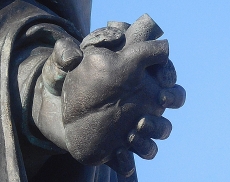
GRIPPING A HEART with the fingers of his left hand and his right hand on his chest, he stands in knee breeches, motionless on a plinth and staring out to sea. This bronze figure is a statue of the great scientist and first to give a scientific description of the way blood circulates through the heart and blood vessels, William Harvey (1578-1657), who was born in Folkestone, Kent, where his sculptural depiction stands. The commemorative artwork was created by the sculptor Albert Bruce-Joy (1842-1924) and made in 1881.

The heart in Harvey’s hand

Son of a Folkestone town official, William Harvey began his education in the town, where he learned Latin. Next, he attended The Kings School in nearby Canterbury before matriculating at Gonville and Caius College in Cambridge. After graduating in Cambridge in 1597, he enrolled at the University of Padua in northern Italy. There, he graduated as a Doctor of Medicine in 1602. Harvey became a physician at London’s St Bartholomew Hospital, and later (1615) became a lecturer in anatomy. In addition to his teaching activities, he became appointed Physician Extraordinary to King James I. It was in 1628 that he published his treatise, “De Motu Cordis”, on the circulation of the blood, work that remains unchallenged to this day. In 1632, he became Physician in Ordinary to the ill-fated King Charles I. In 1645, when Oxford, the Royalist capital during the Civil War, fell to the Parliamentarians, Harvey, by now Warden of Oxford’s Merton College, gradually retired from his public duties. He died at Roehampton near London and was buried in St. Andrew’s Church in Hempstead, Essex.

Folkestone, formerly a busy seaport, has restyled itself during the last few years. It has become a hub for the creative arts. Works by various contemporary artists, some quite well-known including, for example, Cornelia parker, Yoko Ono, and Antony Gormley, are dotted around the town and can be viewed throughout the year. Every three years, even more art can be found all over the town as part of The Creative Folkestone Triennial. This year, 2021, it runs from the 22nd of July until the 2nd of November. As one wanders around the town, one can spot artworks in both obvious locations and some less easily discoverable places. This year, the London based artistic couple Gilbert and George have exhibited several of their colourful and often thought-provoking images. And this brings me back to William Harvey.

High on a wall just a few yards behind the statue of Harvey, there are two images by Gilbert and George. Both were created in 1998. One is titled “Blood City” and the other “Blood Road”. Both relate to blood, its corpuscles, and its flow. It is extremely apt that they have been placed close to the image of the man who did so much to increase our understanding of blood and its circulation through the human body.

Photographic memories

THERE IS PHOTOGRAPHY IN MY GENES. My great-grandfather, Senator Franz Ginsberg (1862-1936) left his native Prussia to migrate to South Africa in 1880. He arrived in King Williams Town where he and his future bother-in-law Jakob Rindl established a photography studio, one of the first in southern Africa.

HAL 6

I became keen on photography as soon as an uncle, a keen amateur photographer who was closely related to Jakob Rindl and also Franz Ginsberg, had presented me with a simple Kodak Brownie camera when I was about seven years old. It was exciting taking photographs, waiting for the film to be developed at chemist or photography shops, and then opening the packet to discover whether the prints bore any decent looking images. In those early days, there were plenty of dud shots, but also a few decent ones. I graduated from the Brownie to another Kodak model, which had two lens and a viewfinder on top of the device. It was probably a version of the Brownie Reflex camera. It pleased me because it had a few things that could be adjusted whilst taking a picture.

As I got older, maybe over twelve years old, I began buying photography magazines. I soon realised that to achieve interesting results in photography, using a 35mm film camera was essential. I leafed through the issues, reading the reviews of cameras that sounded wonderful but were way beyond my budget. I was so fascinated by these sophisticated devices that I used to draw pictures, fantasising what I would have liked to have owned.

Eventually, there was a review of a camera that almost suited my pocket money budget, and which was likely to satisfy my desire to own a more complicated camera. The camera, which was given an excellent review was made by the Halina company and cost around £12.The Halina models were manufactured in Hong Kong by the Hakin Company. I cannot recall exactly which model was reviewed but it looked similar to the Halina 35x. I do remember that it did not have a built-in exposure meter.

Twelve pounds was a lot of money for me to find in the mid-1960s. I did not expect my parents to donate this sum to me for something they considered unnecessary because they never showed any interest in taking photographs. However, they did offer me a solution: I could earn the money by helping them. The task I was given was to mow the lawn in our garden once a fortnight. Please note that we only possessed a non-motorised human-powered mower. So, the £1 that I received for each quite arduous mowing was not easy money.

Eventually, I amassed the required sum to buy my Halina camera and it leather-like case. Then, I was faced with the problem of determining the appropriate shutter speed and diaphragm settings for my shots. My uncle, the one who had started off my interest in photography, gave me a circular plastic exposure calculator. By twisting the dial to three settings (weather condition, subject matter, film speed), the device produced a recommended combination of exposure time and diaphragm setting (‘f number’). At first, this was quite difficult to use. After a little practice, I became very adept. For example, I could use the calculator to work out the correct exposure settings when taking pictures of landscape from a moving car or bus, and the results were often more than acceptable.

A little more money saving allowed me to have sufficient to buy a highly recommended low-cost electronic exposure meter made by the Boots Company (the famous British pharmaceutical retailer). The meter was far easier to use, and much quicker than, the plastic calculator.

I used the Halina happily for several years until 1967. That year, my parents paid a visit to Japan, where they were hosted by various Japanese people and organizations. Moments before they were about to board the jet that would fly them back to London, their hosts handed them several generous gifts. One of these was a top of the range Canon Rangefinder camera. As mentioned already my parents had no interest in using cameras.

When my parents landed in London, they declared their gifts to a customs officer. Handing the camera to him, my mother said:

“We don’t want this. Take it so that we need not pay duty.”

The officer looked at the fine camera and said:

“The duty is only £3. Anyway, I can’t take it.”

As my parents paid the duty, the officer leant over and whispered to them:

“You’ll get at least £300 for this if you sell it to someone on Oxford Street.”

Fortunately, they did not follow the officer’s advice. Instead, they gave me the superb camera, which I used for many years until I decided to buy a Pentax single lens reflex (‘SLR’) camera. Its excellent lens and accurate built in exposure meter never let me down.

The Pentax was a disaster. I bought it to use during my first visit to what was then Czechoslovakia. A critical part of it broke two or three days into the trip. No one in Prague could fix the thing. So, I purchased another SLR camera. It was an Exacta, which had been made in Eastern Germany shortly before the Berlin Wall was demolished. The Exacta was heavy but solidly built; it was probably indestructible and produced lovely photographs.

That was all long ago. My interest in photography has continued, but it has been several years since I abandoned film cameras for digital devices, both ‘phones and actual cameras. The advent of digital photography and the editing software that can be employed to modify the images captured have eliminated the need for film developing and darkrooms. Modern digital software allows anyone to be able to do what was only possible in darkrooms and much more.

Approaching infinity?

camera_240

Have you ever wondered how many photographs are being, or have been, taken on digital cameras?

Apparently, to date over 50 billion photos have been posted on Instagram, well over 250 billion on Facebook, about 30 to 40 million images PER DAY on Twitter (that is  at least 10,950,000,000 per year), over 175 billion on Pinterest.  On New Years Eve 2017,  Whatsapp users posted 13 billion images plus 5 billion videos. This adds up to a huge number of pictures. But, not everyone uploads their digital pictures and videos to social media, or at least not every picture they have taken. So, this means that in addition to those which are uploaded, many, many digital images are being created every microsecond.

If they are not shared via the internet, what happens to the galaxy of photos and videos being created? Some are briefly looked at and then deleted. Others are kept to show selected acquaintances. A few are used to illustrate books and articles and some are printed on photographic paper.

One of the joys of old-fashioned film photography was the excitement of waiting to see how your photos or videos looked after the film was developed. Digital photography reduces the delay between snapping and seeing the result from several hours to a week (as it used to be) to a very few seconds. Yet, even with this almost instantaneous result, there is excitement to see what the image looks like. 

The ease of use of cameras installed in mobile ‘phones has resulted in the huge numbers of pictures and videos being made. The numbers of images taken already and those yet to be taken must surely reaching that impossible to reach number, namely infinity!

Sharing photos

butterfly


I was given my first camera, a Kodak Brownie’, when I was about 7 years old. Since that time I have owned a variety of cameras and camera ‘phones and I have taken many thousands of pictures. 

In the early days, I used to have prints made from negatives. Later, I became converted to colour slide (‘diapositive’) film and produced many colour slides. With the arrival of computers and the Internet into my life, I reverted to film that produced prints and when it became available, I had digital images of my photographs put on compact discs. Nowadays, I hardly ever have prints made from my digital images.

Ever since I first began taking photos, I have enjoyed showing them to other people: relatives, friends, colleagues, and whoever else showed even the tiniest bit of interest. However, when you present people with an album full of photographs or arrange a slide projection session, most folk begin to lose interest fairly fast. Many of them have agreed to look at someone’s pictures mainly out of politeness, rather than genuine interest.

All of that has changed with the advent of social media and Internet sites for displaying photographs. People need only look at pictures when they are interested and for as long as they want without risking offence to the photographer. Often, if they want to, viewers can express their approval and/or make comments. What is more, the viewers need no longer be confined to the friends and acquaintances of the creator of the images. It is possible to make images available to everyone, who uses the Internet. Some may not be happy with that, but I am. My desire to ‘show off’ my pictures to as many people as possible has been fulfilled!

I find that apart from sites like Facebook, the website ipernity.com is a superb place to post pictures. Other users of the site are often both appreciative and helpful with their comments and suggestions. My Ipernity page is http://www.ipernity.com/home/adam 

PLEASE TAKE A LOOK!