Women with many heads on canvases at an art gallery in central London

TODAY, WE VIEWED an exhibition of paintings by an artist born in India, who spent most of her life in the British Isles. The artist is Gurminder Sikand (1960-2021), who was born in Jamshedpur, but moved to the Rhondda Valley in South Wales with her parents in 1970. Her artistic training was first at the Cardiff College of Art and Design (in 1979-80) and then at the City of Birmingham Polytechnic (now Birmingham City University), where she was awarded a fine art degree. In 1983, she and her husband moved to Nottingham. Her work began to attract wide attention after one of her pieces was selected as the winner of the East Midlands Art Prize by the South African artist Gavin Jantjes.

In an obituary written by her husband, published in thegauardian.com on the 14th of February 2022, it was noted that her work:

“… was characterised by images of strong women. This was true of her many self-portraits, her paintings influenced by Indian folk art, her watercolours of women hugging trees (inspired by the Chipko anti-deforestation movement), and latterly her drawings of muscular female figures whose physiques reflected Gurminder’s workouts at her city-centre gym in Nottingham.”

The paintings we saw today (22nd of May 2024) at the Maximillian William gallery in London’s Fitzrovia were some of Gurminder’s earlier works, created between 1986 and 1992. Most of the 19 works include depictions of women. All of them are slightly mysterious, but also eye-catching. Many of them include women with several heads. I wondered whether in creating these she was thinking about Hindu deities that are often shown as having many arms. As far as I am aware few, if any, Hindu deities are shown in images as having more than one head, but seeing Gurminder’s women with many heads made me think about the multi-limbed deities in Hindu imagery.

Trees also figure prominently in many of the paintings we saw. Regarding this and her painting style, the gallery’s press release has this to say:

“Images of women drawn from Indian mythology recur throughout Sikand’s work. Her interest in the figure of the goddess – particularly the Hindu goddess Kali, who both destroys and creates the world anew, and is often pictured with a garland of human heads – is evident in her depictions of women metamorphosing into nature. In Sikand’s paintings, women are seeds buried in soil, hang on tree branches to provide shelter, or are even the earth and sky themselves. These amorphous relationships between the figure and nature were further inspired by the Chipko environmental movement, which began in north India during the 1970s, when villagers – mostly women – embraced trees at risk of deforestation, a protest that also highlighted their primary role as caregivers. Sikand’s female figures are often portrayed as strong: appearing resolute with multiple heads or acting as protectors over her landscapes.”

Although Gurminder left India when she was only 10 years old, and was then immersed in British life, culture, and education, her Indian heritage never deserted her, and is expressed in her wonderful paintings. I enjoyed viewing this well-displayed exhibition, and I recommend seeing it before it ends on the 29th of June 2024.

Memories of Gujarat (India) at a park in north London’s Golders Green

GOLDERS HILL PARK lies halfway between Golders Green and Hampstead – both in north London. It occupies what used to be the extensive grounds of a former country house that was built in the 18th century and destroyed during WW2 (in 1940). Its fine landscaping was influenced by the great garden designer Humphry Repton (1752-1818). I have been visiting the park since my early childhood in the 1950s, when, if I remember correctly, my parents used to play tennis on the still existing tennis courts. The park has many attractions including a pond with an attractive stone bridge; a walled garden; many fine old trees; plenty of shrubs and flowers; a bandstand, which was certainly in use during my childhood; a good café-cum-restaurant; a wooded area; a stumpery; a deer enclosure; and a small zoo. The deer enclosure and the zoo were in existence when I was a young child. Today’s visitors can watch the deer and view animals such as wallabies; ring tailed lemurs; at least one kookaburra; donkeys; and a variety of exotic birds. The pond mentioned above is often visited by ducks.

Today (the 3rd of March 2024), we visited the park on a crisp, cold, sunny morning. The dew-covered lawns were full of blooming crocuses, and some of the bushes had burst into flower. Most of the trees, being deciduous, were devoid of leaves. By chance, I looked up at one of these leafless trees and saw a children’s kite caught up in its branches. Seeing this, my thoughts shifted 5000 miles from Golders Hill to Gujarat (in western India).

Wherever you go in Gujarat, you are likely to see kites caught up in the branches of trees. Unlike the kite I saw today, those in Gujarat are not the toys of small children, but part of a festival celebrated once a year, The Hindu festival, which celebrates the increase of day length a month after the winter solstice is known as ‘Uttarayan’ in Gujarat. The occasion is celebrated by kite flying. During this period of kite flying, riders of bicycles, motorcycles, and other two-wheelers face a real but, to the outsider, unusual hazard that could result in serious injury, if not death. I have described this festival and its hazards in some detail in my anthology of 101 vignettes of life and travel in India –“The Hitler Lock and Other Tales of India”.

Seeing the kite in Golders Hill Park reminded me of what I have seen in Gujarat during my several visits to that Indian state. However, although this year Uttarayan began on the 15th of January – not so long ago – I find it hard to believe that the kite I saw in the park was stranded in the tree during celebration of that festival.

[The book (& Kindle) is available from Amazon:

Separated by millennia but seen together in one glance

ONE OF THE MANY things that fascinates me whenever I visit India is what often appears in one brief glance. It is far from unusual for there to be in one field of vision both something that has been in existence many centuries, or even milliennia, alongside something that is brand new.

Yesterday, I was enjoying lunch in Bangalore’s Kamath Hotel near Commercial Street when I looked up and saw the following reflected in a mirror. A man was sitting working on the restaurant’s computer – probably 21st century technology. Above his head, there were idols depicting Hindu deities, which were in place because the management hoped that their divine influence would benefit the business.

Whereas the computer is but a few years old, the abiding belief in the importance of the Hindu deities in the smooth running of life has been around for much longer than anyone can remember.

From the Ganges to the shore and then back into the river

THE CERAMIC ARTIST, our friend Falguni Bhatt, works in Calcutta. While visiting her studio, she suggested that we visit Kumartuli in north Calcutta. Close to the Hooghly River – part of the Ganges – this district of the city is a warren of narrow lanes lined with the workshops of craftsmen who make Hindu idols out of the grey clay collected from the shores of the Ganges. We went there and were amazed by the huge amount of creative activity that confronted us.

Mounds of damp dark grey clay are carried on the heads of porters to the workshops. Others carry bundles of straw to the artisans. The straw is used to make armatures – these are shaped roughly like the finished idols. A completed armature, which can sometimes include supporting metal rods, looks sufficiently like the idol being created.

Clay is applied to the straw armatures. Gradually, the straw is hidden by the clay. The surface of the clay is either smoothed to resemble fine skin and/or inscribed to create bodily details – for example finger nails and the creases on the palms of hands or facial details or clothing and footwear. Creatures and objects associated with the depicted deity – for example, veenas and snakes – are created in the same way, starting with straw armatures.

The completed idols, which are frequently very detailed and of complex shapes, are left to dry and harden. The clay idols are not fired in a kiln.

Detailing on a clay idol

Later, the idols are painted according to tradition, and then decorated with elaborate costumes and jewellery. The jewellery is made from hand cut cardboard often with sequins and mirrors applied. A small section of Kumartuli is dedicated to workshops creating these intricate, attractive ornaments.

Each of the clay idols is an exquisite work of art. Each of them displays evidence of the highly skilled workmanship that created them. They rival the superb ancient Hindu stone carvings that can be found carefully displayed and conserved in museums. Yet, each of these clay masterpieces is destined to have but a very short life.

The idols are created in Kumartuli for use in important Hindu festivals such as Durga Puja, Kali Puja, and Saraswati Puja. We saw idols being prepared for the last mentioned. Most of the idols being created include the stringed musical instrument played by Saraswati – the veena. Her puja is to be held next in February 2024.

During these ceremonies, the carefully crafted idols – fully painted and decorated with elaborate hand made ornaments – are dropped into the Ganges. When I expressed my surprise at hearing about this, Falguni said something like:
“Life is transient.”

Feeding the spirit of the deceased by the River Ganges in Calcutta

WHILE WALKING ALONG the well-tended riverside path that runs alongside the Ganges (Ganga) in Calcutta, we reached the Gwalior Monument – a tall tower overlooking the river. Around this edifice, which was built by the British in 1847, we saw something we had never seen before.

A craftsman was shaping the stiff dark grey mud from the holy Ganges into rectangular slabs with numerous small regular depressions. The finished product looked a bit like an oversized old fashioned Casio calculator. There were quite a few of these to be seen on the flat ground surrounding the monument.

Small groups of men, often with shaven heads, congregated around these mud slabs. The men were chanting prayers and placing grains of rice, sweets,and other food substances into the depressions in the slabs. We asked a bystander what was going on, and he explained it to us in perfect English.

The groups of men were performing ‘shraddha’ on the eleventh day following the death of a family member. Our informant was also attending a shraddha being held because of the recent death of a friend or relative. The son of the deceased was performing the shraddha puja. I have read that it is very important for Hindu couples to have a son because only a son can do shraddha for his parents

On the eleventh day following death, the spirit (atma) of the dead person is still in contact with his or her loved ones. The food being placed on the mud slabs will not, of course, be physically touched by the spirit, but it is believed that it will sustain him or her on the next stage of its eternal journey. A similar shraddha is performed on the first death anniversary and, sometimes, at other times.

Our informant told us that he was not entirely clear about the deep significance of shraddha, but he was happy to believe in its necessity. It was, he felt, an important part of the passage of life.

The eleventh day and one year ceremonies are observed by many Hindus, but until today, neither my wife nor I had ever come across these mud thalis for feeding the spirit of the deceased.

A year after my father-in-law died, there was a special ceremony in which I played an active role, but it was completely different from what we saw next to the Gwalior Monument.

An old white painted temple in the heart of Bangalore and a reformer of Hinduism

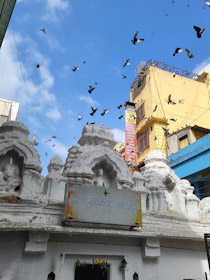
WHILE WALKING ALONG Bangalore’s Avenue Road, which runs from City (KR) Market to Palace Road, I spotted a mandir (Hindu Temple) down a side street. It was painted white, and its facade was surmounted by three tall niches, each containing a sculpture.

So many layers of paint had been applied over the years that the details on the sculptures had disappeared from view. At the rear of the mandir, I saw a tower like structure – part of the mandir’s roof. This was a popular landing place for pigeons. Within the building there were crudely carved stone pillars supporting the ceiling. These looked very old. Two rows of pillars lined a central ‘aisle’ leading to a shrine at the far end of the temple.

Above the entrance, there was a sign written in the script of the Kannada language, which I am unable to read. I showed a photograph of this sign to a bearer (waiter) in the dining room of the Bangalore Club. He deciphered it for me. The mandir is ‘Sri Belli Basavanna Devasthana”. This means ‘The Sri Basavanna Silver Temple’. Located in Basavannagudi Street in the Chickpet district, this is one of the oldest mandirs in Bangalore.

Born in Karnataka, Basavanna lived from 1131-1196 AD. A Shaivite (follower of Shiva) and social reformer, he was a founder of Lingayatism. His reforms included rejection of both social and gender discrimination. According to Wikipedia:
“Basava championed devotional worship that rejected temple worship and rituals led by Brahmins and replaced it with personalized direct worship of Shiva through practices such as individually worn icons and symbols like a small linga (sic). This approach brought Shiva’s presence to everyone and at all times, without gender, class or caste discrimination.”
Thus, we can see that Basava(nna) was a forward thinking person. He made religious worship personal rather than mediated by caste-conscious Brahmins.

Had my eye not been attracted by the flocks of pigeons flying around the small white mandir, it might have been many years before I became aware of Basavanna and his important ‘democratisation‘ of Hinduism.

Towers of light at a water tank in Mumbai

HAPPY CHRISTMAS

A DEEPSTHAMBH IS a Hindu architectural feature found near temples or temple compounds. It is a tower with many small niches into which small oil lamps (diyas) are placed and lit to celebrate special Hindu occasions. A good place to see a number of these is at Bombay’s Banganga Tank in the Walkeshwar area.

Two deepsthambhs next to Banganga Tank

The tank is a rectangular pool surrounded by steps that lead into the water contained within it. At one corner of the tank water flows from a spring vigorously into the pool. The tank is full of large fish, which the locals feed. Being in a strictly vegetarian neighbourhood, these fish are safe from being caught and eaten. The tank is surrounded by houses and many smallish temples. The Tank is a few yards from the rock strewn seashore.

The tank was first built in 1127 AD by Lakshman Prabhu, a minister in the Sihara Court of Thane. This makes the Tank one of the oldest surviving features of what is now Mumbai. It was rebuilt in 1715. According to legend, the spring that now feeds the Tank appeared suddenly when Rama stopped at this spot during his search for Sita.

Banganga Tank is a pleasant spot at which to linger. So near to the hustle and bustle of Mumbai, here is a place that us both beautiful and relatively peaceful. It gives me a good feeling.

Temple bells and a stepwell in Surat (Gujarat)

NOBODY KNOWS WHEN the Bahucharaji stepwell was constructed. Legend has it that this well, located in Surat’s Vishal Nagar area, was built by Vanjara people, who came from outside Surat. These people used to visit the city, and set up camp there. This stepwell is said to have been dug by them to provide a supply of water.

The Vanjaras (Banjaras) are descendants of nomadic traders. Found in many parts of India, they used to have an important role in the economy of the Subcontinent. Wikipedia related that:
“… the Banjaras had a monopoly on the movement of salt prior to the arrival of the East India Company. More generally, they also traded in cattle, moving the beasts around the country’s bazaars, and they rented out their carts. Although some older sources have suggested that they did not use credit, Habib’s analysis of historic sources suggests that they did and that some were reliant on it.”

A Hindu goddess called Mataji appeared in the dream of a Vanjara and inspired the construction of the stepwell. After the vav (stepwell) was constructed, a temple was built within it. This is dedicated to Mataji.

The entrance to the stepwell is within a temple compound, in which footwear must be removed. We visited the place on a Sunday morning in December 2023. A steady stream of worshippers of all ages entered the stepwell’s ground level entrance. As they descended the steps towards the water in the bottom of the vav, they sounded the temple bells suspended above the staircase. Before reaching the water, the steps pass two shrines each containing effigies of Hindu deities. At one of them, a lady in a beautiful sari was involved in a lengthy puja conducted by a priest. She was accompanied by a large-ish group of people. I noticed that some of them were holding on to her sari.

We squeezed past the group and descended further into the vav until we reached a railing from which we had a clear view of the water far below us. Several tortoises were resting on the step closest to the water in the well.

After admiring the beautifully maintained vav, we left the temple compound. Outside it, we spotted some beautiful cockerels wandering around. A few days earlier in Surat when we were visiting another temple dedicated to Mataji, we saw cockerels and were told that the goddess favoured these creatures. Above the entrance to the Bahucharaji Stepwell compound, there is a bas-relief depicting Mataji astride a cockerel.

As for Mataji, I will not try to explain her because, for me trying to explain anything about Hinduism is nearly impossible. All I can say is that for Hindus, it seems that their beliefs and rituals are simply a part of the rhythm of daily life, rather than something compartmentalised as is often the case for Europeans.

Faith healing in a well in Baroda

ACROSS THE MAIN ROAD from the 16th century Hazira Maqbara – a mausoleum – there is a small stepwell – the Hazira Vav. We have visited it before but never saw it in use.

A flight of tiled steps leads down to the water in the stepwell. To put it mildly, the water looks filthy and completely uninviting.

At the top of the stairs, there is a small Hindu shrine. The small courtyard surrounding the top of the staircase is decorated with coloured images depicting various Hindu deities. A few coconuts hang between them. These nuts are considered auspicious by Hindus. At our Hindu wedding in 1994, coconuts were included on the complex ceremony, which lasted several hours.

While we were looking at the well, a lady in a sari and her husband arrived. The woman descended the steps to the waters edge. Her husband explained to us that she was suffering from itchiness and that the curative waters of the well might help cure her condition.

The lady picked up one of the bucket on the step beside the water, and filled it from the well. Then, she began dowsing herself with the water. Fully dressed, she poured several buckets of the unwholesome looking water over her whole body.

Having watched this, we felt that it was unlikely that the water itself would heal her, but more likely, it was her faith in its curative properties that might have helped. Having seen the water, my thought was that if one bathed in the well, it is likely that you would end up less healthy than before you entered it.

Piles of stones and prayers by those seeking to build a home

THE PUARESHWAR MAHADEV Shiv temple is about 24 miles west of Bhuj. Built about 1200 years ago, it is possibly the oldest surviving Hindu temple in the Kutch region of Gujarat. Partially restored, this attractive small mandir is still in use but has lost most of its roof.

At Puareshwar

As we approached the temple, I noticed that near it, there were numerous small piles of stones. Each of the precarious looking piles consisted of several rock’s or fragments of masonry piled carefully, one on top of another. I asked our driver, who had suggested we visit this temple on our way to Narayan Sarovar, about these small piles. He said that they were constructed by people, praying to obtain or build a home of their own.

After visiting, Narayan Sarovar, its lake and mandir, we stopped to see the mandir at Koteshwar, which is on a spit of land near India’s border with Pakistan. Outside this temple, there were many piles of stones just like we had seen at Puareshwar.

Although I have visited many Hindu temples in India during 30 years of travelling to the country, it was only yesterday, the 27th of November 2023, that I first became aware of these small stone offerings. According to one online article I found (https://medium.com/six-word-photo-story-challenge/prayer-stone-stacks-a-belief-b7fc0edc5d9a), stones are piled outside temples all over India by people hoping to build their own homes. I will now look out for them whenever I visit a mandir.