EVERY NOW AND THEN, we feel the need to leave London, and sample the country life. Recently, we decided to visit Buntingford, a small town in Hertfordshire and to eat lunch at a pub nearby. Using the Internet, we chose one at random. It was the Sword Inn Hand in the hamlet of Westmill, which is a few miles south of Buntingford.
It was an excellent choice for two reasons. First, Westmill is a neat, picturesque little settlement. Secondly, the pub served excellent food in a pleasant ambience and, more importantly, the staff were friendly and extremely obliging. The pub has been in existence since the 14th century but looks as if it has been modified considerably since then. It is next door to the grounds of the medieval parish church, which was locked when we were in Westmill.
After visiting some family members in nearby Baldock, we returned to London, having had a satisfactory few hours’ experience of country life.
HITCHIN IN HERTFORDSHIRE is the home of the North Hertfordshire Museum. Until 25 May 2025, it is holding an exhibition of the ceramic artworks of Abdo Nagi (1941-2001). He began life in Yemen, where during his early years he was a goatherd. When he was 12 years old, against his father’s wishes, he moved to Aden, where he worked for British ‘ex-pat’ families living there. In 1967, he moved to the UK with his then employer, and eventually settled in Letchworth (Hertfordshire). To earn a living, he worked in a Wimpy bar, then a hotel, and then an engineering firm.
After passing O’level and then A’ level examinations in art, Nagi was appointed Assistant art Technician at North Hertfordshire College. It was here that his creativity began to flower. He began creating ceramic artworks that were inspired by his Yemeni background, and made money by selling them. Then he took a degree in ceramics at Middlesex, graduating in 1988. From then on, his artistic career took off. His work was exhibited in important shows all over the country. The North Hertfordshire Museum bought three of them for their collection. Sadly, a heart attack killed him at the age of 60.
The works currently on show in Hitchin’s fine museum are well-displayed alongside pictures of Abdo at work and various portraits of him painted by local artists. I liked almost all of the works on display. Some of them are unusually shaped, possibly inspired by the crafts of his native land. There is nothing in the exhibition that I would not like to possess – and some of the works are on sale. If you happen to be passing anywhere near Hitchin (a lovely historic town), making a detour to see this show would be worthwhile.
I FIRST BECAME AWARE of Birra Moretti when I visited the city of Udine in northeast Italy in the late 1960s. This brewery was founded in Udine in1859, Its logo includes a man in a hat, holding a glass tankard of beer in his right hand.
Today, I visited a pub near Hatfield in Hertfordshire. Within the gents’ toilet, I noticed a sticker attached to a cistern. At first sight, it looks like the Birra Moretti logo, After a moment, I saw that it is a parody of the logo issued by a football (soccer) club in Stevenage, Hertfordshire. Where the original logo is topped with the words ‘Birra Moretti’, the parodied version has the name ‘Steve Evans’.
And who, you might be wondering, is Steve Evans? Between 2022 and 2024, he was the manager of Stevenage Football Club. During his time in this role, the team won 57 out of 120 matches.
WARE IS AN ATTRACTIVE small town on the River Lea in Hertfordshire. Coaches travelling between London and Kings Lynn passed through Ware because it was on the route of the Old North Road (now followed approximately by the modern A10). The parish church of Ware, St Mary the Virgin, is large and spacious as befits the size of the town. Much of what we can see today was built over several centuries, from the 12th to the 15th. It was the church’s stone font that attracted my attention.
The octagonal font is believed to have been donated to the church in 1408 by the then Lord of the Manor, Thomas Montagu (1388-1428), Earl of Salisbury. Each of its eight sides contains fine bas-relief carvings. Many of them depict saints connected with birth, baptism, and childhood. For example, ther is a carving of St Christopher carrying the young Jesus across a river. Most of the faces on the carvings are in remarkably good condition considering their age and that they were in place long before the iconoclastic activities of Protestants took place. The church’s guidebook mentioned that in the 1540s, the faces of the statues were attacked, but fortunately the workmen, who might well have been men of Ware, responsible for defacing did a “token job”, only defacing the faces of the Virgin and St Margaret because they could be seen by people entering the church. Luckily for us living in the 21st century, these workmen managed to protect what is an attractive piece of church art.
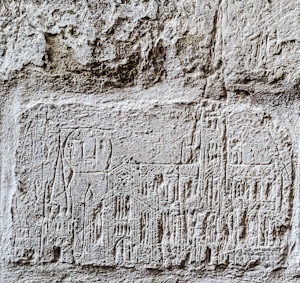
I HAVE WRITTEN ABOUT this before, but because I found it so interesting I will write about it again. In August 2024, we revisited the picturesque village of Ashwell in Hertfordshire on our way between London and Cambridge. Apart from being an extremely attractive place, its parish church of St Mary ccontains an intriguing image scratched into the internal surface of the north wall of the bell tower.
The image is a drawing of London’s old St Paul’s Cathedral, which was destroyed during the Great Fire of London (1666). By comparing this picture with other pre-1666 drawings of the old cathedral, it can be seen to be an accurate depiction of the long since destroyed edifice. It is likely that the drawing in Ashwell was scratched into the wall sometime before 1930s, when the old cathedral was modified by Inigo Jones.
Above the image of the old cathedral, there are some inscriptions recoding plagues that occurred during the 14th century, including what is known as the Black Death.
Apart from the drawing and the inscriptions described above, the church contains a few other inscriptions, which have been partially deciphered.
For the information of those visiting the church, it is near to Day’s bakery, where delicious snacks can be purchased. The village also contains a small museum, part of which is housed in a half-timbered building. However, for me, the highlight of the village is the drawing of old St Paul’s Cathedral in the church.
HE WAS PASSIONATE about sketching and painting. However, his father, a wealthy Quaker brewer in Hitchin (Hertfordshire), insisted that his son should dedicate himself to working in the family business and use his spare time to create his art. The artist was Samuel Lucas (1805-1870). There is a wonderful exhibition of his creations at the beautifully laid out North Hertfordshire Museum in central Hitchin until the 12th of November 2023.
After schooling and an apprenticeship in London’s Wapping, Samuel worked in the family business in London before returning to work in Hitchin in 1834. As for his artistic ability, this appears to be self-taught. However, he was a keen visitor to the Royal Academy exhibitions in London. In 1837, he married Matilda Holmes, who had been a pupil of the artist John Bernay Crome (1794-1842). She was keen on sketching, but none of her works have survived. I speculate that it is not beyond possibility that Matilda, a water colourist, might have helped Samuel develop his superb water colour techniques.
Samuel’s sketches range from extremely detailed to impressionistic, resembling the work of JMW Turner to some considerable extent. The finished oil paintings, some of which were displayed at the Royal Academy, are beautifully composed, full of detail, and of great visual interest.
Two of the exhibits interested me more than the others. One of them is a pen and ink sketch depicting Thomas Whiting of Hitchin reading Harriet Beecher Stowe’s anti-slavery novel “Uncle Tom’s Cabin” (published 1852) to a gathering of people in a hall in Hitchin. Nearby, there was one of Samuel’s oil paintings. This shows seven men seated around a small table listening to a man standing with his left hand on the table. The standing man is Bishop Samuel Wilberforce (1805-1873). He is addressing members of the Oxford Mission amongst whom is the novelist Lord Lytton of Knebworth (Hertfordshire). The bishop was a son of the anti-slavery activist William Wilberforce. Bishop of Winchester from 1870 until 1873, he was both against slavery and Darwin’s Theory of Evolution. Samuel Lucas’s painting depicts him when he was Bishop of Oxford, which he became in 1845, and remained until he was shifted to Winchester. The Oxford Mission was an Anglican missionary organisation, which became important in Bengal in the late 19th century.
The two pictures described relate to Samuel Lucas’s involvement of the anti-slavery movement. In 1840, he was Hitchin’s delegate to the Anti-Slavery Convention held in London at Exeter Hall on the 12th to 23rd June 1840. During this period, he and his wife hosted some of the delegates who had come from the USA. The convention is portrayed in a painting by Benjamin Haydon (1786-1846), which is now in the National Portrait Gallery. The gallery’s website has a photograph of this painting, which has been displayed so that the viewer can identify each of the people in it. Samuel Lucas can be found near the back of the gathering near a pillar.
Lucas was against slavery, as were many of his fellow Quakers. In addition to this activity, his artistic creations, and his involvement in the family business, he was also an active contributor to the life and development of Hitchin. One of the largest of his paintings in the gallery, but not included in the exhibition, is a depiction of Hitchin’s Market Place. Each of the many people shown in the painting is a portrait of an actual person. The museum has an interactive guide to identify the people. One of them was Isaac Newton (1785-1861). This gentleman was not the famous scientist but the owner of a family firm of painters, plumbers, and glaziers. One of the many folks in the picture has a dark complexion. This is a portrait of Samuel ‘Gypsy’ Draper (1781-1870). He was a violinist, who played for dances and fairs in the area in and around Hitchin for about 20 years. Some of the local Quakers disapproved of him, but Samuel Lucas placed him at the front of the crowd in the centre of the painting. Had we not visited the North Hertfordshire Museum out of pure curiosity, I doubt that we would have ever come across the life and works of Hitchin’s Samuel Lucas. We spent most of our time looking at the superb exhibition about him, so that we had hardly any time left to see the rest of the museum. A fleeting glimpse of the other galleries in the lovely modern building was enough to persuade us that we need to return to see more.
HITCHIN IS A SMALL, attractive town in Hertfordshire. When we first visited it in 2020, despite an easing of the covid19 lockdown rules, we were unable to enter the town’s 14th to 15th century church of St Mary’s. On the 26th of August 2023, we spent a couple of hours in Hitchin and were able to enter the church. It contains many items of interest including a large painting created in the studio of Ruben’s.
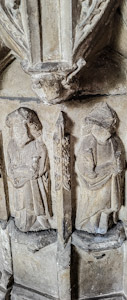
It was the 15th century carved stone font that particularly interested me. The column supporting the bowl, which contains water with which children are baptised, has twelve carved figures. These depict the 12 apostles. Looking at these closely, you will see that they are all mutilated. Their faces have been chipped away, leaving the figures faceless.
The very helpful and informative gentleman who was looking after the church was not sure whether the faces were obliterated by Thomas Cromwell during the Reformation of Henry VIII or during the time of that other iconoclast Oliver Cromwell.
Luckily the carved angels that adorn the ceiling of the Chapel of St Andrew and a finely carved 15th century wooden screen escaped the attention of the iconoclasts. In one or two Suffolk churches we have visited, angels such as these were destroyed as part of the attempts to ‘purify’ the English Church.
Apart from what I have described, there are plenty of other things that make a visit to Hitchin’s church worthwhile. And if you enjoy ‘Olde Worlde’ British buildings, the town centre is rich in them.
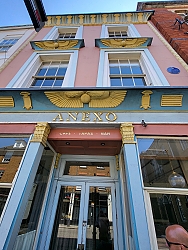
THE TOWN OF HERTFORD is full of delightful old buildings. A house on the town’s Fore Street has a façade decorated with features that bring to mind Ancient Egypt. Known as the Egyptian House, it was built in about 1825 for the grocer JM Gilbertson, who was Mayor of Hertford in 1832. In many ways it resembles a building with an Egyptian style façade. which I have seen in Penzance (Cornwall), This was constructed in about 1835. Both of the house in Hertford and that in Penzance were built later than the now no longer existing Egyptian Hall London’s Piccadilly, which was built in 1812, and was the inspiration for the Egyptian Revival Style of the later edifices in Hertford and Penzance.
The Egyptian House in Hertford is colourfully painted, as is the building in Penzance. Sadly, the Egyptian Hall in Piccadilly was demolished in 1905 to make space for the construction of a block of flats. The Egyptian Revival Style became fashionable during the time of the Egyptian campaigns (end of the 18th century) in the Napoleonic Wars.
Currently, Hertford’s Egyptian House is home to Anexo – a “tapas restaurant and charcuterie bar”. It serves fare that would have been unknown in Ancient Egypt. I wonder what the Pharaohs would have thought about a place like this.
HAILEYBURY SCHOOL WAS founded by the East India Company (‘EIC’) in Hertfordshire in 1806. It was an institution where young British men heading out to India to become British colonial administrators were given training. It was not the first of such establishments. In 1800, Fort William College (in Fort William, Kolkata) was founded by the Governor General Richard Colley Wellesley (1760-1842) to teach Indian languages, laws, and so on, to young recruits to the EIC. This school continued until it was closed in the 1830s. For various reasons, the EIC decided to open a training school in England – The East India College.
The East India College was first housed in Hertford Castle, where it remained whilst bigger premises, designed by the architect of University College London, William Wilkins (1778-1839), were being built nearby in Haileybury. When it was completed, the college moved from the castle to the new building, where a school has been located ever since then. Teachers at the East India College included well-known people such as Thomas Malthus and the Sanskrit scholar Monier Monier Williams.
It is ironic that one of the former students of the EIC college at Haileybury was Allan Octavian Hume (1829-1912). After studying at London’s University College Hospital, he was nominated to the Indian Civil Service. He went out to India in 1849 having passed through the course at the EIC college at Haileybury. After returning to England in 1894, having worked in the Indian Civil Service, he recognised that there was a sense of hopelessness and unrest amongst the Indian population and that the people were held in contempt by their British rulers. To try to remedy the plight of the Indians and to provide a ’safety valve’ for relieving unrest that he perceived in Inda, he founded what soon became the Indian National Congress. Little was he to know that eventually this organisation would play an important role in getting Britain to leave India.
Taking a rather circuitous route from Cambridge to London, we stopped for lunch in Hertford. I wanted to see the castle because I had just read about it and its brief connection with the EIC in an interesting book, “The Colonial Subjugation of India”, by Amar Farooqi. After enjoying a portion of splendid fish and chips, we entered the small park in which the castle is located.
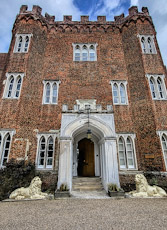
What can be seen today is a well preserved brick building with crenellations and windows in gothic style frames. When viewed face on, the edifice can be seen to consist of a tall central portion flanked by two lower wings. The tall central part, which was constructed in the 15th century was the gatehouse to the castle, which was fell into disuse and was demolished long ago (in the 17th century). The two wings were added during the reign of George III. Today, the so-called castle, erstwhile gatehouse, houses Hertfordshire council offices. We entered the lobby and noticed the gothic revival interior décor within the castle. We will revisit the castle on one of its open days and see some more of the building.
Hertford Castle played a short role in the history of British India and the EIC. The school at Haileybury continued its imperialistic function until 1857/8, when the EIC was wound up after the Indian Mutiny (First Indian War of Independence) of 1857-58. The present school, Haileybury College, a private school with boarding facilities, opened its doors to pupils in 1862 and occupies the old college’s premises.
SAWBRIDGEWORTH IS AN ATTRACTIVE small town with many picturesque old buildings and a parish church, St Mary’s, whose construction began in the 13th century. It is an unusual edifice, being about as wide as its length, rather than longer than its width as is the case for most English churches. It contains a fine selection of elaborate funerary sculptures.
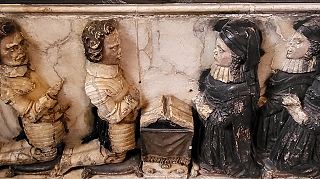
The most impressive funerary monument is the memorial to John Leventhorpe and his wife Joan, who died in 1625 and 1627 respectively. Within a multi-coloured marble frame, both of the deceased are depicted reclining on their left sides with their heads propped up by their left hands. John holds a sword in his right hand and Joan a small book in hers, Beneath the two statues, the couple’s six sons (one of whom, Arthur, died as a baby) and eight daughters are depicted in bas-relief, all kneeling in prayer. Baby Arthur is also present on the memorial but has been sculpted much smaller than his brothers. The whole sculptural ensemble is magnificent, and if you had time to see only one thing in Sawbridgeworth, this should not be missed.
High on the wall facing the Leventhorpe memorial, there is a smaller one, commemorating Jeremiah Milles (died 1797) and his wife Rose, who died in 1835. It is typical of early 19th century memorial art. It shows a female mourner in Hellenic dress kneeling in front of a sarcophagus. It was sculpted by John Termouth (1795-1849) of Pimlico (London).
The sculptor of the Leventhorpe memorial has been forgotten, but Termouth, who sculpted the Milles memorial, has not been consigned to obscurity. A notice in St Mary’s revealed that Termouth was:
“… an uninteresting artist whose symbolism was always obvious, hackneyed, and uninspired.”




 yamey
yamey 