The superfast express train from Ahmedabad to Bhuj

THE EXPRESS TRAIN, Indian Railways number 22903 (the Bhuj AC Superfast Express), runs between Bombay and Bhuj (in the Kutch district of Gujarat). On its way, it stops at Ahmedabad Junction Station at 630 am. To catch the train, we arrived at Ahmedabad Junction at about 530 am – I always prefer being early at the departure point of a train, aeroplane, bus,  etc.


It was dark as our autorickshaw drove speedily along the empty streets of central Ahmedabad. The sun only rises after 7 am in the west of India.


Ahmedabad Junction Station

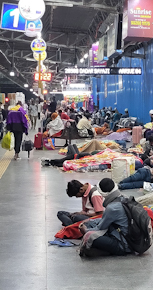
The well-lit station platforms were covered with rows of people wrapped in blankets, sleeping on the floor. The sight of these sleepers reminded me of the images that Henry Moore made of people sleeping on the platforms in London’s deep Underground stations during WW2. Of course, the people sleeping in Ahmedabad’s Station were awaiting trains, not sheltering from bombs dropped by the German’s Luftwaffe.


These sleepers were not disturbed by the endless series of train announcements, each of them were made in three languages: Hindi, English,  and Gujarati. One of them that was repeated at regular intervals informed those who were listening that the Shalimar Superfast Express (it runs between Kolkata and Bombay) was running 12 hours and 50 minutes late. Fortunately, our train 22903, pulled into platform 3 almost exactly on time.


We had reserved places in the first class, air-conditioned carriage, and had a coupé (compartment) to ourselves. Although comfortable,  it was a rather spartan little cabin. I believe that first-class rail travel in India is aimed at those who wish to travel secluded from the ‘madding crowd’. Frankly, I prefer travelling in a carriage in which one can see and, sometimes,  interact with one’s fellow travellers and the endless stream of vendors, who move up and down the trains in India.


The six-hour journey from Ahmedabad to Bhuj is through terrain as flat as in the Netherlands,  but much dustier. All along the route we passed factories, both small and large, many with chimneys emitting smoke. For the first half of the journey,  we travelled past well-tended fields in which crops were growing. After crossing into Kutch, we passed numerous vast water features containg seawater that was being dried to produce salt. Every now and then, white, conical mounds of salt could be seen. The train runs for a long way parallel to a main highway in Kutch.  This connects Kutch and its important port Kandla with the rest of India. An endless stream of large trucks moves along this road.


At Gandidham in Kutch, the train’s engine was changed. We began moving in a different direction as we travelled along the stretch of rail track between Gandidham and Bhuj, where we disembarked.  Outside the station there was a sea of men offering to drive us in taxis, jeeps, and autorickshaws.


Eventually, our driver met us, and drove us through the hilly, almost arid hills between Bhuj and Kutch Mandvi, where we were going to stay with my wife’s cousins.


Even though train 22903 traverses terrain that few would regard as picturesque, I always enjoy long land (rather than air trips) journeys through  the countryside of India.

Epstein, Gill, and Moore on Broadway

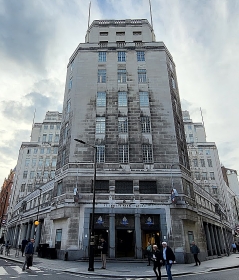
THE ARCHITECT CHARLES HOLDEN (1875-1960) designed many stations for the London Underground, mainly on its Piccadilly Line. Each of these incorporates features of Art Deco and Modernism. Holden designed a new headquarters building for the forerunner of London Underground, the Underground Electric Railways Company of London. Now known as 55 Broadway, it was built between 1927 and 1929. The Underground company occupied it from 1933 until 1984, when it became the headquarters of London Regional Transport, and then its successor Transport For London. After 2020, it has served other purposes. The ground floor is occupied by both a shopping arcade and the entrance hall to St James Park Underground Station.

55 Broadway is a tall, cruciform building surmounted by a clock tower. One of the reasons for this shape was to ensure that all of the offices within the cruciform tower, the bulk of the edifice, were close to the external walls, and therefore had access to plenty of daylight. Apart from looking impressive, the building is not highly decorative, and not as attractive as some of its architect’s designs for Underground stations.  Having said this, it is not entirely devoid of decorative features.

What makes 55 Broadway of special interest is the set of sculptures attached to its exterior. Near to ground level, there are two large figurative works by the artist Jacob Epstein (1880-1959), one called “Day” and the other “Night”. When they were unveiled, prudish members of the public objected to them, as is revealed in an article on Wikipedia:

“The modernism and graphic nakedness of these sculptures created public outrage on their unveiling. Newspapers started a campaign to have the statues removed and one company director, Lord Colwyn, offered to pay the cost. Frank Pick, the managing director of the UERL at the time, took overall responsibility and offered his resignation over the scandal. In the end, Epstein agreed to remove 1.5 inches (38 mm) from the penis of the smaller figure on Day and ultimately the furore died down.”

Much higher up the building, between the fifth and sixth floors, there are bas-relief sculptures depicting the four winds. Two are by Eric Gill (1882-1940), one is by Samuel Rabinovitch (Samuel Rabin: 1903-1991), and another by Henry Moore (1898-1986). And within the Underground station, I noticed four mosaic panels. Called “Angels of History”, they were created by London-based Hannah Quinlan and Rosie Hastings, and installed in 2024.

What was once an important headquarters building is still a place where fascinating works of art can be seen, as well as being an example of Modernist architecture in London. Soon after 55 Broadway was completed, Holden designed the University of London’s Senate House. Like 55 Broadway, it impresses the viewer, but lacks the visual appeal of Holden’s Underground stations.

Knife Edge outside the Houses of Parliament

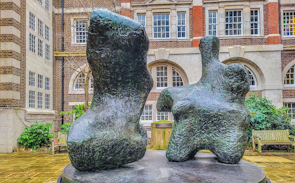
THERE ARE MANY sculptures by Henry Moore (1898-1986) in London’s public spaces (see: https://londonist.com/london/art-and-photography/where-to-find-henry-moore-sculptures-in-london). One of them, “Knife Edge Two Piece”, can be seen on College Green, opposite the Houses of Parliament.  Consisting of two huge pieces of bronze, this was created by Moore between 1962 and 1965. Its form was inspired by a fragment of animal bone, as are many of his other sculptures. When we visited Moore’s home in Perry Green (Hertfordshire), we saw display cases filled with bits of bone the artist had collected over the years,

The sculpture outside the Houses of Parliament is one of three casts of the same work. The other two are in Canada and the USA. Moore donated the sculpture that stands in Westminster, to the Nation in 1967.  In 2011, it became part of the Parliamentary Art Collection. It is now a listed object. It is one of only 41 post-WW2 sculptures in Britain to have been awarded the listed status.

Henry Moore is one of the greatest of British twentieth century artists. It is fitting that his sculpture should stand amidst buildings that have played, and continue to play, important roles in the life of the country.

Some sculptures at an auction house in London’s Mayfair

THE FAMOUS SCULPTOR Elisabeth Frink (1930-1993) was a regular visitor to our family home in Hampstead Garden Suburb during the 1960s. During that period, I met her whenever she was invited home for dinner, but then I was too young to realise how famous an artist she had become. She was a good friend of my mother, Helen Yamey (1920-1980), who was also a sculptor. Elisabeth and my mother got to know each other when they were both creating art in the Sculpture Department of the St Martins School of Art, when it was in Charing Cross Road.

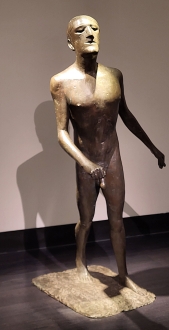
By Elisabeth Frink

Today (15th of November 2024), I was reminded of my mother’s friendship with Frink when we entered Christie’s auction house in Mayfair. We always enter this place when we are passing near it to see some of the works of art that are on display prior to being auctioned. You never know what gems you are likely to see. Today, there was a small collection of British art created during the past 100 years. Amongst the works on display were two by Elisabeth Frink. There were also some pieces by Henry Moore (1898-1986) and by Barbara Hepworth (1903-1975). One of the works by Hepworth was a painting, the other two were sculptures. Each of these artists has become some of the greatest of 20th century British artists.

During the first half of the 1960s, my mother’s sculptures were chosen to be exhibited in prestigious exhibitions, mainly in London. In these various exhibitions, her work was selected to be exhibited alongside the creations of the three artists mentioned above, as well as other artists, who have now achieved fame (e.g., David Hockney, Paula Rego, Michael Ayrton, and Bridget Riley). Despite this, my mother’s artistic work is now largely forgotten. In my recent book about her, “Remembering Helen: My Mother the Artist”, I describe her life, her character, and consider why her art, which was judged worthy of display with the best artists of the time, has faded into obscurity.

[The book is available from Amazon: https://www.amazon.co.uk/REMEMBERING-HELEN-MY-MOTHER-ARTIST/dp/B0DKCZ7J7X/]

Much Moore to be seen at Kenwood House in north London

INSIDE KENWOOD HOUSE (in north London), the visitor can see a glorious collection of paintings by famous artists such as (to name but a few): Vermeer, Rembrandt, Constable, Gainsborough, Reynolds, Cuyp, Romney, and Van Dyck. These works are part of the Iveagh Bequest, which was the collection of paintings bought by the art collector, Irish brewing magnate, and philanthropist Edward Cecil Guinness, 1st Earl of Iveagh (1847-1927).

In the grounds of Kenwood House, there are two sculptures created after Iveagh’s death. They are both by sculptors, who are considered as some of the greatest British artists of the 20th century. One of them, which is near the house, is by Barbara Hepworth (1903-1975), and the other, which we examined when we walked past it today, illustrated above, is by Henry Moore (1898-1986). His large bronze sculpture is called “Two Piece Reclining Figure No. 5”, and was completed in 1963-1964. It has been lent to Kenwood by the Tate Gallery.

Apart from being superb sculptors and having works at Kenwood, Hepworth and Moore have other things in common. Both studied at the Leeds School of Art, where they met. And both lived in Hampstead, which is close to Kenwood, for a while between the two World Wars. While they were in Hampstead, they had studios close to each other: Hepworth in Mall Studios, and Moore in nearby Parkhill Road. You can find out more about their lives in Hampstead in my book “Beneath a Wide Sky: Hampstead and its Environs”.

Moore and the atomic mushroom cloud at the Tate Gallery

LAST YEAR, THE exhibits at Tate Britain were re arranged – or ‘rehung’ as the gallery likes to put it. In addition to rearranging the paintings and sculptures – very excellently I might add – previously unseen exhibits were added to the galleries. One of these is in a small gallery containing sculptures and some drawings by the British artist Henry Moore (1898-1986).

The additional exhibit in this gallery devoted to Moore is a glass cabinet containing a Ban the Bomb poster – a photomontage – designed by Henri Kay Henrion (1914-1990). I went to school in Belsize Park with one of his sons for a few years. The rest of the contents of the cabinet are documents – mainly press cuttings – about one of the sculptures near to the cabinet. They relate to a sculpture Moore created for the University of Chicago. The bronze sculpture, which at first sight resembles a combination of an atomic ‘mushroom cloud. with a distorted face beneath it, is called “Atom Piece (Working Model for Nuclear Energy)”. The Tate’s website (www.tate.org.uk/art/research-publications/henry-moore/henry-moore-om-ch-atom-piece-working-model-for-nuclear-energy-r1171996) explained:

“As its subtitle suggests, Atom Piece (Working Model for Nuclear Energy) 1964–5 represents the intermediary stage in the development of a much larger sculpture, Nuclear Energy 1964–6, which Moore was commissioned to make for the University of Chicago to mark the twenty-fifth anniversary of the first controlled generation of nuclear power, conducted by the Italian physicist Enrico Fermi in 1942.”

The sculpture next to the cabinet is one of 13 bronze castings that Moore had made from one of his plaster maquettes that were created whilst planning the larger sculpture commissioned by the University of Chicago. Moore donated it to the Tate.

The photomontage by Henrion shows a human skull superimposed by a mushroom cloud. He created it in about 1959. The Tate’s website mentioned that Moore was most probably aware of Henrion’s terrifying image long before he created the sculpture for Chicago:

“Moore is likely to have been familiar with Henrion’s photomontage: in 1950 he had signed a letter published in the Times protesting against the potential use of atomic weapons, and in 1958 had become one of the founding sponsors of the CND.”

Although I have seen the ‘atomic’ sculpture by Moore at Tate Britain many times, I had not taken any special interest in it. However, thanks to the superb ‘rehang’ at the gallery and the addition of the glass case containing Henrion’s image, I began to appreciate the atomic sculpture, and strangely also began to enjoy Moore’s sculptures even more than I had before.

The force of ambition standing in Kensington Gardens

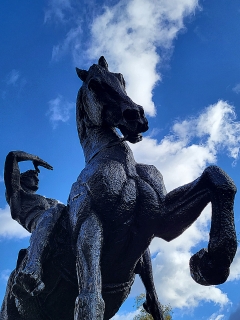
CAST IN BRONZE, he sits aside a rearing horse. He looks west towards Kensington Palace and uses his right hand to shield his eyes from the setting sun. I am describing a cast of a sculpture by George Frederic Watts (1817-1904), which bears the name “Physical Energy”. The sculptor was born on the birthday of the conductor George Frederic Handel – hence his two first names.

Watts began work on an equestrian sculpture in 1870, when it was commissioned by Hugh Lupus Grosvenor, who became 1st Duke of Westminster. It was to depict Hugh Lupus, 1st Earl of Chester. This was at Eaton Hall near Chester. In the early 1880s, Watts began working on “Physical Energy”, which was inspired by this sculpture. The first bronze casting of “Physical Energy” was made in 1902, and transported to southern Africa.   

Watts had been principally a painter until the 1870s, when his interests moved towards sculpture. “Physical Energy” was the high point of his efforts. A plaque next to the bronze horse and rider explained that this sculpture depicted:

“… a universal embodiment of the dynamic force of ambition …”

One man for whom these words might well be applied was the mining magnate and a Prime Minister of the South African Cape Colony, Cecil Rhodes (1853-1902), who ruthlessly let nothing get in the way of his ambitions. Therefore, it was particularly appropriate that one of the casts of Watts’s “Physical Energy” (that made in 1902) was placed at Groote Schuur (in Cape Town) as part of a memorial to Rhodes after Rhodes’s death. Unlike a bust of Rhodes placed nearby, which was vandalised recently, the equestrian statue has survived … so far.

An article published by Artnet News (https://news.artnet.com/art-world/watts-sculpture-royal-academy-ideological-baggage-1155971) made the following remarks:

“Watts, like Rhodes, believed in British imperial might to back its right to rule … the artist “plied” a leading politician with suggestions that military service should be introduced. (The colonial statesman Lord Grey was the man who suggested Watts turn the equestrian sculpture into a memorial to Rhodes after he died…)

… Watts’s imperialism was “liberal” and that the sculpture’s ideological meaning is open-ended. Socialists used the image, too. In fact, Watts had multicultural references in mind when he first conceived the statue: It was due to be dedicated to great empire builders including Mohammed, Attila the Hun, and Genghis Kahn. (Trowmans adds that May Watts, the artist’s second wife and a fellow artist, was much more sceptical of Rhodes.)”

The quotation mentions that Watts married twice. His first wife was the young actress Ellen Terry (1847-1928). They married when she was 16 years old. They separated after 10 months. During that brief period, she met, and was photographed by the Victorian pioneer of artistic photography, Julia Margaret Cameron (1815-1879). I have written about both Watts and his young bride in my book about Mrs Cameron (“BETWEEN TWO ISLANDS: JULIA MARGARET CAMERON AND HER CIRCLE”).

In addition to the cast in Cape Town, at least two others were made. One of them was produced in 1959. It now stands outside the National Archives in Harare (Zimbabwe). The cast which stands in Kensington Gardens was cast by AB Burton (a founder) in Thames Ditton in 1905, and was put in its present location in 1907. It stands on a line that runs between a Henry Moore sculpture on the bank of the Serpentine and Kensington Palace. Another cast was made in 2017 to commemorate the 200th anniversary of Watts’s birth. Briefly, it stood in the courtyard at the Royal Academy. Now, it stands at the Watts Gallery near Guildford.

We pass “Physical Energy” on our frequent strolls through Kensington Gardens. From it, there is a fine view of Henry Moore’s tall concrete sculpture across the Serpentine Lake. Watts was a contemporary of the French sculptor Auguste Rodin (1840-1917). However, sadly, neither Watts nor Moore produced works as fine as those of Rodin.

[My book about Julia Margaret Cameron is available from Amazon, e.g.,

https://www.amazon.co.uk/dp/B0BZFCVLX9/ ]

The underground artist

THE BRITISH SCULPTOR Henry Moore (1898-1968) moved to London’s Hampstead district in 1929. Between that year and 1940 he lived in Parkhill Road, close to the Mall Studios, where the great sculptor Barbara Hepworth had her home and workshop. Many of Moore’s other close neighbours were in the forefront of the modern art world of the years between the two world wars. Not far away, the designer Jack Pritchard (1899-1992) and his family lived in Belsize Park Gardens, having moved there from Hampstead’s Platts Lane.

By Henry Moore, 1941

Quoting from my book “Beneath a Wide Sky: Hampstead and its Environs”:

“In 1929, he [Pritchard] and the Canadian architect Wells Coates (1895-1958) formed the company, Isokon, whose aim was to build Modernist style residential accommodation. Pritchard and his wife, a psychiatrist, Molly (1900-1985), commissioned Coates to build a block of flats in Lawn Road on a site that they owned. Its design was to be based on the then revolutionary new communal housing projects that they had visited in Germany, including at the influential Bauhaus in Dessau.”

The modernist building, now known as the Isokon, still stands on Lawn Road, which is close to Parkhill Road. It is still used as a block of flats. Completed in 1934, the building included communal areas including a restaurant and a bar called The Isobar where (to quote from my book again):

“… exhibitions were held in the Isobar and, according to an on-line article in ‘The Modern House Journal’ these were attended by artists including Adrian Stokes, Henry Moore, Barbara Hepworth, Ben Nicholson and Naum Gabo. The article also noted that this refreshment area was frequented by modernist architects such as Erich Mendelsohn, Serge Chermayeff and, Wells Coates, as well as by left-wing politicians.”

The Lawn Road Flats (the Isokon) was an early British example of a ferro-concrete building with a steel frame. This made it far more resistant to being damaged by bombs than its many brick-built neighbours. In fact, the only damage it suffered during WW2 was a few broken windowpanes. Various people, including the author Agatha Christie, moved into the Isokon to seek protection from the Blitz. Another person doing the same was Henry Moore, who moved there in 1941.

Many people, who were not lucky enough to be able to live in a relatively bomb-proof edifice, sought shelter from the bombs by spending nights on the platforms of Underground stations such as Belsize Park and Hampstead, all of which are far beneath the ground. Henry Moore created a series of dramatic drawing of the people taking shelter on Underground station platforms. It is quite possible that while living in Hampstead, he visited the stations mentioned above to find subjects for his drawings, which provide a vivid record of the terrible times when London was under attack from the air.

Recently, whilst visiting the Tate Britain art gallery, which houses a great deal of British art, I saw two of Moore’s Underground drawings, both dated 1941, and several of his sculptures. The drawings are not accurate depictions of what the artist saw, but they illustrate his reactions to what he witnessed, and as such they emphasise the atmosphere of those fearful times.  Although there is no doubt that Moore was a great artist, on the whole I prefer the works of his contemporary and sometime neighbour in Hampstead: Barbara Hepworth.

Painting in the Mall

BETWEEN HAMPSTEAD AND Belsize Park, there is a narrow footpath running north from Tasker Road. One side of it is lined with a terrace of low buildings known as Mall Studios. Built in 1872 by Thomas Battersby, they were designed as artists’ studios. Each of them contained small waiting rooms; costume rooms; and a lobby. Each studio had three skylights and large north facing windows to capture the kind of light favoured by many artists. Following the advice of the artist Walter Sickert, who had lived there, the artist John Cecil Stephenson (1889-1965) settled into number 6, Mall Studios in March 1919.  It was to remain his home until he died. In 1927, Barbara Hepworth became his neighbour in number 7, and at around that time, the influential art critic and writer Herbert Read moved into number 3. Nearby, Parkhill Road became home (for various lengths of time) to other artists including Henry Moore, Ben Nicholson, Naum Gabo, Piet Mondrian, Hans Erni, and other artists who have since become famous.

By John Cecil Stephenson

Whether it was the proximity of his artistic neighbours, who were pioneers of 20th century modernist art, or something else in his artistic evolution, Stephenson departed from his previous ‘straightforward’ portraiture and landscape painting and created works characteristic of what is now known as the ‘Modernist’ style. Although some of his works created after the late 1920s are to some extent figurative, most of his output was mainly abstract and constructivist. During WW1, Stephenson left London’s Slade School of Art temporarily to work in munition factories in Bishop Auckland (County Durham), the town where he was born. His experiences of working with industrial machinery and observing the efficiency and speed of the mechanised production processes is reflected in some of the paintings he produced later.

Stephenson, son of a grocer, was less well known than his neighbours. He produced art that bears favourable comparison to the works produced by them. Until the 18th of September 2022, there is a wonderful small exhibition of his works in a gallery within Hampstead’s charming Burgh House. The catalogue, edited by Sacha Llewellyn, Paul Liss, and George Richards, not only contains a fine collection of photographs of the exhibits but also provides a superb introduction – better than others I have seen – to the story of the pioneering role of Hampstead in the evolution of modern art in England. Burgh House, which contains several rooms comprising a museum of the history of Hampstead, also hosts excellent exhibitions such as the current survey of Stephenson’s works. Its well illuminated Peggy Jay Gallery provides a space for contemporary artists, many of them local, to display their works. Beneath the two storeys of cultural experiences, the basement of Burgh House is home to a pleasant café where anything from a cup of coffee to a wholesome meal can be obtained. And amongst the interesting range of books in the small bookshop, you can find copies of my book “Beneath a Wide Sky: Hampstead and its Environs” on sale (if they have run out, tell them to ask me for more, and then get your copy from Amazon).

Hampstead and the Tate Britain Gallery

THE TATE BRITAIN pleases me far more that its younger relative, The Tate Modern, and its cousins in Liverpool and St Ives. I do not know why, but I feel far more comfortable in the old institution on London’s Millbank. Today (31st of March 2022), I took a leisurely wander through some of the Tate Britain’s galleries. I was on the lookout for works by artists, who have been associated with Hampstead in north London. My only disappointment was that there were no works by John Constable (1776-1837) on display. Buried next to Hampstead’s parish church, he worked and lived (for several years) in Hampstead. I had better luck with one of his contemporaries, George Romney (1734-1802). His “A Lady in a brown Dress: The Parson’s Daughter” hangs in the Tate. “Roadside Inn” was painted in about 1790 by George Morland (1763-1804), who used to visit Hampstead to teach. The gallery also contains a picture, “Punch or May Day”, by the painter Benjamin Haydon (1786-1846), who is known to have visited Hampstead, where he met the essayist and critic Leigh Hunt and walked with the poet Wordsworth.

By Mark Gertler

It was the painter William Rothenstein (1872-1945), who found accommodation for, and looked after the great Indian literary genius Rabindranath Tagore, when he stayed in Hampstead briefly in 1912. The artist, who also lived in Hampstead for a while, is represented by at least two of his paintings in the Tate Britain: one was painted in 1891 and the other in 1899-1900.

It was during the first five decades of the 20th century that Hampstead became a mecca for artists, who are remembered today and whose works are displayed in Tate Britain. “The Merry-Go-Round”, a colourful painting created by Mark Gertler (1891-1939), who had a studio in Hampstead, depicts a fairground attraction on Hampstead Heath. It was painted in 1916. Gertler studied at the Slade School of Art at the same time as the painter Stanley Spencer (1891-1959), who had a studio in Hampstead’s Vale of Health for a while. It is therefore apt that Gertler’s painting hangs next to one by Spencer: “The Resurrection, Cookham”.

Another juxtaposition is a wooden sculpture by John Skeaping (1901-1980) and a painting by Ben Nicholson (1894-1982). Both worked in Hampstead in the 1930s and both were married to the sculptor Barbara Hepworth (1903-1975). She divorced Skeaping to marry Nicholson. One of her sculptures is on display close to another artwork by her second husband. I spotted one more work by Hepworth. That was a painting, a sketch for a sculpture she was planning in 1957. The three artists all worked at various times in the Mall Studios near Parkhill Road.

David Bomberg (1890-1957), who, like Gertler and Spencer, studied at the Slade, lived in West Hampstead between 1928 and 1934. There are several of his dazzling, colourful paintings hanging in the Tate Britain.

Henry Moore (1898-1986), who lived for a while in Hampstead, is the best represented of all the artists who lived or visited that locality. Tate Britain has many of his sculptures on display and some of the sketches he made during WW2. These images depict people sheltering in deep Underground stations to be safe from the bombs being dropped by the Luftwaffe. Moore lived for a while in the modernist and relatively bomb-resistant Lawn Road Flats (‘The Isokon’) near South End Green (and, incidentally, near the Mall Studios). I have read that it is likely that Moore made some of his dramatic wartime sketches in the nearby Belsize Park and Hampstead Underground stations.

It was fun visiting the Tate and seeing pictures by some of the artists, whom I have written about in my new book about Hampstead: “Beneath a Wide Sky: Hampstead and its Environs”. This work contains two chapters detailing Hampstead’s myriad artistic connections. If you wish to learn more about this and about other aspects of Hampstead and its surroundings, my book (and Kindle edition) can be obtained from Amazon (https://www.amazon.co.uk/dp/B09R2WRK92).