When Kensington was a country town

ANYONE FAMILIAR WITH London will know that except for some parkland, the city is a built-up urban environment all the way west from Marble Arch to Acton and further beyond. This is also the case from Hyde Park Corner to Heathrow Airport. However, this has not always been the situation.

When John Rocque (1709-1762) drew his detailed, accurate maps of London in the 1740s, Paddington was a small village separated by open countryside from what was then London. In those days, Kensington was a village reached from London by a country road flanked on its northern edge by Hyde Park. And from Kensington to Hammersmith would have been a ride along a road running between a series of agricultural fields and orchards. And to the north of Hammesrsmith, Shepherds Bush was an open space around which there were only a few well-separated houses. And as for Notting Hill Gate, Rocque did not even bother to name this road junction in the middle of the countryside.

By 1826/27, when  C & J Greenwood published their detailed map of London, Earls Court was still a country hamlet; Kensington a small town; and there was barely any development around what is now Notting Hill Gate. However, by 1826 Paddington was beginning to grow and was no longer separated from Marylebone by open countryside. Additionally, the northern edge of the eastern end of Bayswater Road was losing its rural nature and being built upon.

In brief, as the 19th century progressed, London spread west. As it did so, urban development covered what had been open countryside and places that had been separated from London began to become part of it. Places like Kensington, Earls Court, Shepherds Bush, Hammersmith, and places further west were no longer separated by open countryside. Instead, they became engulfed by the expanding metropolis.

My book “BEYOND MARYLEBONE AND MAYFAIR: EXPLORING WEST LONDON” describes in detail how the villages and towns to the west of Park Lane and what is known as ‘The West End’ became engulfed by London’s westward growth. It reveals the history of these places; what they are like today; and what remains of their existence before they became joined to London, as it spread from Mayfair and Marylebone to Heathrow and beyond.

BEYOND MARYLEBONE AND MAYFAIR: EXPLORING WEST LONDON

By Adam Yamey

is available as an illustrated paperback and Kindle from Amazon:

Dr Who and me

CHICAGO WAS MY HOME for the last few months of 1963. My father was a visiting professor at the University of Chicago during that period. While we were in Chicago, President John F Kennedy was assassinated. However, that was not the only momentous event that I recall from that time,

My best friend in London, whom I had known for about seven years, Nicholas Gilks who is no longer alive, sent me an airletter in which he wrote that he could not wait for me to come back to London, not because he was just missing me, but because he wanted me to watch the new, exciting television programme that had begun whilst I was away. The programme, which still runs today in 2022, was “Dr Who”. It was first broadcast on the 23rd of November, the day after Kennedy was shot.

Well, “Dr Who” was certainly a fine programme. I used to watch it at the Gilks’s home because we did not have television at our family home, and never ever did. To reach my friend’s home, I walked. On the way, I used an unlit pathway that runs between Hampstead Way and Temple Fortune Lane, where Nicholas lived. Frankly, the ominous Daleks that starred in the programmes every week terrified me so much so that I was afraid of walking home along that pathway in the dark. So, Dr Gilks, my friend’s father, used to accompany me to that dark passageway and waited till I reached the far end of it. For this, I was very grateful.

Today, a sunny Sunday morning, the 20th of November 2022 (almost 59 years after Kennedy’s death), we walked along the Hammersmith riverside and reached the Riverside Studios, where we stopped for a coffee in its superb new café. Standing next to the doorway and pointing its weapons at the tables in the café stands a real-life Dalek. Why is it there you might ask. The answer is that between 1964 and 1968, “Dr Who” was filmed in the Riverside Studios, which was then a BBC studio complex. Furthermore, and worryingly, it was from the water beneath the nearby Hammersmith Bridge that the Daleks commenced their attempt to invade the Earth.

Luckily, the sun was shining brightly and there were plenty of people out and about. So, there was little chance that my childhood fears about the robotic Daleks would be awakened.

A Persian carpet and a Socialist

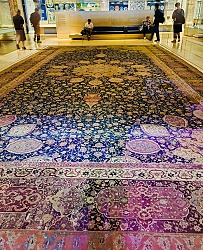
The Victoria and Albert Museum houses a huge, antique carpet from Ardibil (in Persia).It was made in about AD 1539, and is one of the oldest accurately dated carpets.

You will need to read my book “Beyond Marylebone and Mayfair: Exploring West London” to discover the link between this carpet and a Socialist activist, who lived in Hammersmith.

Buy your copy of my book at Lutyens & Rubinstein (Kensington Park Road) OR from Amazon (https://www.amazon.co.uk/BEYOND-MARYLEBONE…/dp/B0B7CR679W/)

A bridge in London waiting for repairs

In the middle years of the 1720s, Daniel Defoe described Hammersmith as a village that was growing into a small town:

“… and some talk also of building a fine stone bridge over the Thames …”

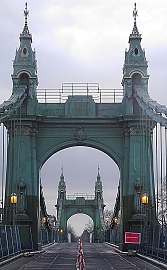
It was almost 100 years after Defoe speculated that a bridge across the Thames would be built at Hammersmith. A suspension bridge was constructed between 1824 and 1827. It was the first of this type of bridge to be constructed anywhere near London and the first to span the Thames. James Thorne, writing in 1876, that in outline and simplicity of style, it:

“… remains the best-looking-bridge of its kind on the Thames …”

The bridge was designed by William Tierney Clark (1783-1852), who had been guided in his development of bridge construction techniques by Thomas Telford and John Rennie, who designed the old London Bridge that now stands in Lake Havasu City in Arizona. Clark also designed the suspension bridge (1832) across the Thames at Marlow and the impressive Széchenyi (Chain) Bridge which crosses the River Danube to link Buda and Pest. The latter resembles Clark’s Hammersmith Bridge as depicted in old engravings.

In 1883-37, Clark’s Hammersmith Bridge was replaced by a newer one designed by Joseph Bazalgette (1819-1891). According to Cherry and Pevsner in The Buildings of England. London 2: South, Bazalgette:

“… re-used the piers and abutments. Iron-framed towers clad in cast iron partly gilt, with Frenchy pavilion tops, and elephantine ornament at the approaches … The deck stiffening girders were replaced in a major overhaul in 1973-6.”

This bridge, which was built for use by horses and carts, pedestrians, and the occasional cyclist, long before the advent of heavy motor vehicles such as busses and lorries. It has been closed for repairs several times, causing much nuisance for those who live on both sides of it. In April 2019, Hammersmith and Fulham Council closed the bridge to all motorised traffic. This was done following the discovery of serious cracks in the pedestals that support the bridge. It remained open for pedestrians and cyclists until August 2020, when a heatwave caused further deterioration. Then, the bridge was closed to all users.  

A variety of schemes have been proposed for repairing the bridge and there was some disagreement as to who would pay for the work. In June 2021, Hammersmith and Fulham Council came to a cost-sharing deal to complete the rehabilitation of the Victorian bridge. In July 2021, the bridge was reopened for use by cyclists and pedestrians until 2027. In February 2022, I stepped on the bridge for the first time since it closed. The view from it is marvellous, especially upstream where one gets a good view of the historic buildings lining the waterfront between Hammersmith and Chiswick.

A riverside café

SITUATED CLOSE TO the River Thames footpath between Hammersmith Bridge and Chiswick’s St Nicholas Church, in whose cemetery the artist William Hogarth is buries, is the popular Elder Press Café.

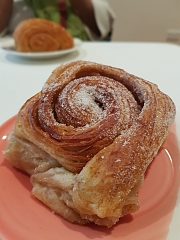
A ‘breakfast bun’ at the Elder Press Cafe

From the outside, it seems that this is a small establishment, but this is misleading. Behind the narrow shopfront facing the the Black Lion pub, the café extends a long way. It surrounds an inner courtyard with tables and chairs.

In addition to drinks and delicious patisserie items, the place offers a range of savoury dishes, which I saw being served to those on tables neighbouring ours. The food looked healthy as well as delicious. Service was attentive and friendly and prices were not exorbitant.

From Norway to Bengal

Doll hse


We were attracted to the latest theatrical production at the Lyric Theatre in Hammersmith (West London) because it was a play set in Calcuttta (Kolkata) in the late 1870s. It was not any old play set in Victorian Bengal, but a new adaptation of Henrik Ibsen’s the Dolls House (first performed 1879), which was originally set in a Norwegian town in the 19th century.

What we saw at the Lyric was a new version of Ibsen’s play created by the playwright Tanika Gupta. In Ibsen’s play the main protagonists are Nora Helmer, her husband Torwald Helmer, Dr Rank, Nora’s school friend Kristine Linde, and one of  the employees in Torwald’s bank, a desperate widowed father, Nils Krogstad. In Gupta’s play Torwald becomes Tom Helmer, an Englishman, who has married Niru,  a Bengali beauty, and has become a senior official in the British administration of India. Dr Rank remains Dr Rank, but is also an Englishman. Kristine becomes Krishna Lahiri, an impoverished widow and schoolfriend of Niru. Nils Krogstad is transformed into Mr Kaushik Das, a widowed Bengali father of four children and a lowly employee in Tom’s office.

In its new guise, Gupta’s Dolls House sticks to the spirit and main ideas in Ibsen’s plot but causes it to be played out in the steamy tropical climate of Calcutta. Gupta explores the relationship between the representative of British imperialism and his very sweet Indian wife. The arrival of Krishna and then Mr Das on the scene soon unsettles the happy home life that the Helmers had been enjoying. Without giving the story away, Mr Das, whom Tom does not like, holds a secret that could bring about Tom’s downfall if revealed. Tom is blisfully ignorant of the threat that Das poses, but the opposite is the case for Niru, whose great anxiety Das stimulates.

Although I had some reservations about the new version of the play, I enjoyed it and the often excellent performances of the actors. What fascinated me was how successfully Ibsen’s play had been ‘relocated’ from the gloom of Norway to the colourfulness of Bengal without losing the feeling that it was a play inspired by Ibsen. By translating the play from one cultural milieu to another, Gupta has preserved and enhanced Ibsen’s messages about the role of women and social class. She has added another fascinating ingredient: the portrayal of British racism towards Indians in pre-independence India. I feel that many of the Anglo-Saxon members of the audience might have been blissfully unaware of their ancestors’ unpalatable attitude to Indians they ruled. They would have left the theatre better informed about this blot on Britain’s history.


The play is on at the Lyric until 5th October 2019.

See: https://lyric.co.uk/shows/a-dolls-house/


Image adapted from lovetheatre.com