A Swiss hut in the centre of Chennai

OPPOSITE THE APOLLO Hospital in the Thousand Lights district of Chennai, my eyes alighted on a sign I was least expecting to see in southern India.  The sign adorned the panel beneath the eaves of what resembles a Swiss chalet. It read “Swiss Hütte”. It is a restaurant. It was closed when I first spotted it, but we returned the same evening when it was open. We decided that it was such an unusual find that we had to eat something there.


The restaurant was founded about 19 years ago by a chef Joe Lobo. He lived in Switzerland for 25 years, working as a prize-winning chef. On returning to India, he established the Swiss Hütte restaurant. It is located in the verdant grounds of his family’s home.


The restaurant has an extensive menu with dishes inspired by various national cuisines, both European and Asian. We ate at the Hütte  several times, and everything we ate was delicious and perfectly prepared.


We asked Joe if he ever served Swiss food. Occasionally, if given sufficient notice, he will make fondue. However, in his opinion, Swiss food is bland and tasteless. These adjectives can not be used to describe what Joe cooks in the kitchen for his guests. Eating Joe’s food, it is easy to see why he has won prizes for his cooking.

Cloud with a silver lining

AFTER A VERY DISAPPOINTING experience at a café we have often enjoyed when staying in Fort Kochi, we went to another eatery, which had been recommended by our friend Sharada S , when we visited Kochi at Christmas in 2019.

Our friend had introduced us to Oceanos. In this pleasant but unpretentious restaurant, we have enjoyed some of the best prepared sea food in Kochi. The dishes served at Oceanos are not only tasty but also authentic, by which I mean that they are not prepared to be ‘fine dining’ fancy; instead they give a good experience of genuine Keralan food.

Currently (February 2023), In addition to an á la carte menu, there is a seafood set lunch – a seafood thali. This included deep fried mackerel; clams (vongole) out of their shells; Aleppey fish curry; roasted prawn curry; sardine steamed in a banana leaf; Malabar paratha; rice; chhaas (buttermilk); and payasam (a local dessert). Every item was exquisitely prepared and tasted very fresh. This wonderful, faultless meal was 390 INR (£3.90) per head. We plan to explore the rest of the menu at Oceanos in the next few days.

Had it not been for the incompetent management at Kashi Art Café today, we would have eaten lunch there. However, as we had not been served our food for almost one our after ordering it, we asked for an explanation of the delay, and were told that there was a problem with the gas in the kitchen. Having been told that we would have our food “in about 10 minutes”, we walked out. If we had been served our food sooner, or been given an explanation without having to ask for one, we might have missed out on the superb lunch at Oceanos.

A long way from Paris

BANGALORE IS ABOUT 4800 miles from Paris (France). The French capital is noted for its gourmet delights, but on the whole the same cannot be said for Bangalore. One exception to this statement is Sunny’s restaurant currently located on Lavelle Road.

Arjun Sajnani created Sunny’s at least 25 years ago. Then, it was in a tall narrow house on a lane leading off Lavelle Road. The kitchen was on the ground floor and there were dining areas in the two floors above it. Often, Arjuna could be standing, working in the kitchen. Back in those early days, Sunny’s was one of Bangalore’s few suppliers of imported Western European cheeses, such as genuine parmesan.

Later, Sunny’s shifted to larger premises on the corner of Lavelle and Vittal Mallya Roads, next to a petrol filling station. The dining area was elegant.

For a brief period, Arjun ran a restaurant serving delicious Sindhi dishes in his original premises. Sadly, he decided to discontinue this interesting eatery.

Even later, Arjun shifted his restaurant to its present location – a two storey villa constructed about 20 years ago. The balconies on the upper floor are supported by stout carved timber pillars which remind one of pillars that you can see in much older traditional South Indian edifices. Diners can sit at tables within the building, or in the garden surrounding it, or on the first floor balconies. At lunchtime on Christmas Day 2022, every table was occupied.

At each of Sunny’s different locations, the food has been magnificent. As our daughter correctly said, eating at Sunny’s is as good as eating in a good Parisian restaurant. Also, Sunny’s Italian food (mainly pasta and pizzas) is above average in quality.

Arjun is an actor and director of theater and films, in addition to being a restaurateur. Dramatic productions require many skills. The same is the case for running a restaurant. Some of the required skills are the same for restaurants and for stage/screen. A restaurateur has to perform well both in the kitchen and the dining room to satisfy his or her clientele. Arjun achieves this successfully. If you have never been to Sunny’s, give it a try!

Claim your steak

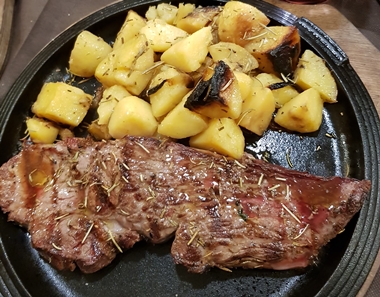
STEAK

When I was much younger, my parents often took my sister and me to eat dinner in restaurants.

Before we looked at the menu, my late mother used to examine the plates and cutlery on our table. If there was a blemish on the cutlery or a crack or chip in the porcelain, the waiter would be summoned to replace the defective item(s). Often this delayed the arrival of any food. If we looked reproachfully at my mother, she would say:

“You can eat off cracked plates if you like, but I am not paying good money to eat off bad plates.”

She said this in such a way that meant that really there was no way that any of us could eat off damaged crockery, even if we wanted to.

As the years went by, I used to look at my plate and cutlery carefully as soon as we sat down. If I spotted a defect, I used to casually lay my hand on it so that my mother would not see it. I was always hungry before a meal and wanted to get on with it rather than having to wait for perfect eating utensils to be fetched. Once any defective cutlery/crockery was replaced, the meal could be ordered.

My mother was fond of beef steak. Rather unfashionably for London in the 1960s, she preferred her steak rare, almost what the French call ‘bleu’. This simple request was the real test for a restaurant. Frequently, the rare steak would arrive cold. My mother would then summon the waiter or maitre d’hote.

“My steak is cold.”

“Madame, I will ask the kitchen to heat it for you.”

The steak would then be returned, and my mother would begin cutting it. Soon the waiter would be called again.

“My steak is no longer rare; it is overcooked. Take it away and bring me another one cooked rare and warm.”

Any restaurant that could get this right without fuss, won my mother’s custom. She would then return there frequently.

Today, rare steak is the ‘in thing’. Most good chefs and discerning diners prefer the insides of steaks to be red, if not bloody.

Writing of steaks reminded me of Monty Modlyn (1921-94), a radio presenter and journalist. Occasionally he would speak on the early morning Today programme on the BBC Home Service (now ‘Radio 4’). He would report on steaks and other meat he had eaten. He had a metal ball that he would drop onto pieces of meat. The depth of the indentation made by the ball’s impact was his measure of the meat’s quality. It all sounded a bit mad to me when I listened to him when I was a young boy. Apparently, what he was doing was quite sound. The quality of raw meat can be judged by indenting it with a finger tip and then watching how quickly the indentation disappears. If the meat recovers quickly, then the quality is likely to be lower than if it recovers slowly.
