There is more to Wigan than Orwell’s famous Wigan Pier

WHEN WE VISITED Wigan in Lancashire in 2022, we saw hoardings that advertised the forthcoming opening of an “artisan deli”, and wondered what George Orwell would have made of it.

We returned to Wigan Pier in September 2025, and headed for the site of the proposed artisan deli. However, it has not been built and the signs advertising the plans to build it are no longer to be seen. The area around the Pier looks similar to what it did in 2022. The warehouses that were to have been redeveloped stand empty. Peering through their windows all that could be seen were huge, dusty empty spaces.

During our second visit to Wigan, we took a stroll in the town’s Mesnes Park. This beautifully maintained park was laid out in 1878 on glebe land (terrain set aside to provide income and support for a parish priest). Apart from a lovely pond, lawns, and carefully tended flower beds, the park contains several interesting features. One of these is the octagonal pavilion built in 1880. Now containing a café, it stants on a raised mound, and can be approached by elegant stone staircases. In fron of its main entrance, there is a statue of a soldier, which is part of a memorial to those men of Wigan who fought in the 2nd Anglo-Boer war (1899-1902). And a few steps down from this, there is the elegant cast-iron Coalbrookdale Fountain. This is a replica of one which stood in the park until 1921. Near the pavilion, there is a 10-sided Victorian bandstand.

Between the Pavilion and the main entrance to the park, there is a statue of a seated man. It depicts the Conservative politician Sir Francis Sharp Powell (1827-1911). He held a seat in the House of Commons from 1863 until 1910.   He was born in Wigan, but represented several different constituencies during his long parliamentary career. The bronze statue in the park was created by Ernest George Gillick (1874-1951), and erected in Wigan in 1910.

Just over two miles northeast of central Wigan, lies Haigh Hall (built between 1827 and 1840), which was undergoing restoration in 2025. It is surrounded by Haigh Woodland Park, which is a vast parkland area containing a variety of leisure facilities including eateries, adventure playgrounds, a golf course, a mini-golf course, and a fine walled garden. It is hoped that when the restoration of the Hall is completed in 2028, it will provide opportunities for a whole range of activities for visitors.

Our second visit to Wigan has shown us that there is much more to the place than Orwell’s famous Wigan Pier.

A busy market in a street in west London

CROWDS OF TOURISTS swarm to west London’s Portobello Road Market, especially on weekends. But how many of these visitors from all over the world know anything about the history of the place?

Here is an excerpt from my book “BEYOND MARYLEBONE AND MAYFAIR: EXPLORING WEST LONDON”. Beginning with Kensington and Paddington, it describes London from west of Park Lane and the Edgware Road to (and including) Heathrow Airport, and from Wembley south to Chelsea.

Here is an extract from the chapter dealing with Portobello Road:

“Before the mid-19thcentury Portobello Lane, as it was then called, was to quote the historians Florence Gladstone and Ashley Barker (writing in1924):“‘… one of the most rural and pleasant walks in the summer in the vicinity of London’, and within living memory it led ‘through fields to Kensal Green… cornfields and meadow land on each side… ‘”

Well, Portobello Road is no longer bucolic. It is lined with buildings along its length. Currently, it begins with a short section that leads off Pembridge Villas. It is here that you can stop for a drink at the Sun in Splendour pub, which was built in the early 1850s.Afterrunning a few yards westwards, Portobello Road heads off in a north-westerly direction, which it maintains with barely any deviation for the rest of its length. Number 22 was the first London home of the writer George Orwell. He lived there as a lodger in the winter of 1927. After crossing Chepstow Villas, the road slopes downwards and soon after this the market area commences. On most weekdays, much of the market is dedicated to daily needs, mostly food. On Fridays and Saturdays, the number of stalls and the variety of goods on offer increases dramatically. In normal times (i.e., when there is no pandemic),Portobello Road is choked with crowds of people from all over the world on Saturdays. In the 1860s, the Metropolitan Line (now the ‘Hammersmith and City Line,) was built. It crosses Portobello Road …”

To discover more about London, from west of Park Lane and the Edgware Road to Heathrow Airport, buy a copy of my book/kindle from Amazon website, e.g..:

The road to Wigan Pier and …

WIGAN PIER WAS made famous by the author George Orwell, who published his “The Road to Wigan Pier” in 1936. Recently, we were staying in Widnes (Cheshire), which is not far from Wigan, a town that was in Lancashire when Orwell wrote his book. So, we decided to see Wigan Pier for ourselves.

A quick glance at a map reveals that Wigan is not on the sea, which is where most piers are to be found. The town is inland, and the so-called Wigan Pier is neither a pier nor on the seaside. It is on a part of the Leeds and Liverpool Canal in central Wigan. It was originally a landing stage where locally mined coal was loaded onto barges.

The name ‘Wigan Pier’ might have originated when a train carrying excursioners to the seaside was delayed at Wigan and they saw a structure that looked like a pier, as the following (from http://www.wiganarchsoc.co.uk/content/Projects/WiganPier.htm#Folklore )  described:

“…not long after leaving Wallgate Station, an excursion train from Wigan to Southport, was delayed on the outskirts of Wigan and passengers saw a long wooden structure that reminded them of Southport Pier. This structure would have been the 1,050 yard long wooden gantry … It was built in the late 1880s and carried a double line of rails from Lamb and Moore’s Newtown Colliery high across the River Douglas, the canal and the Wigan to Southport Railway line, to Meadows Colliery by Frog Lane … It certainly would have been easy to see this wooden gantry from a train heading towards Southport.”

I cannot say whether or not this is the true origin of the name, but it is a good story.

We took a road to Wigan Pier and after going around the town’s one-way system and several roundabouts, passing a huge Asda store a couple of times, we arrived at a series of old warehouses labelled Wigan Pier, and parked next to the canal. The Orwell visitor centre, which we were led to believe existed, is no more. A passer-by, with whom we chatted, told us that any memorials to Orwell and his book had disappeared a few years ago. Likewise, the collieries: these have been closed down long ago. Where they were there are housing estates, factories, and shops.

The warehouses close to where the coal used to be loaded many years ago, were inaccessible. They are being redeveloped to create a leisure ‘hub’. This will include (according to hoardings surrounding the old buildings): a beer tap house; conferences; live music; canal tours; festivals; a food hall; and an ‘artisan deli’. I am not sure what is meant by an artisan deli, but whatever it is, I am sure that should George Orwell ever make his way back along the road to Wigan Pier, he would be truly astonished by it.

Blue notes

I ENJOY ENTERING HOUSES in which famous characters once lived. It gives me a thrill to think that I am entering rooms where, for example Samuel Johnson or Benjamin Franklin, once lived and worked. But, how does one know where these personalities once resided? In London, that is quite easy because the homes and places where famous historical characters lingered are marked with blue (usually) plaques recording their occupation of these buildings. In other parts of the world, signing is often attached to the places which were occupied by well-known or, sometimes once famous, men and women.

BLUE BLOG

In London, many of these plaques which are circular with white writing on a blue background. They are known as “blue plaques”.  According to that font of all knowledge, Wikipedia, the first blue plaque scheme was started by the Society of Arts in 1867. The first of these was installed in 1867 (on a house which has since been demolished). It commemorated the birthplace of Lord Byron. Another early one (in King Street, London SW1) commemorates Napoleon III, who “lived here, 1848”. He lived there from February 1847 until September the following year. It is one of, if not the only, blue plaque to be put up whilst the person named on it was still alive.

We are fortunate to live in a part of London rich in blue plaques and similarly purposed plaques of different colours. Kensington was favoured by the rich and famous (in all fields of activity) and remains so. The names on the plaques differ, and that is not surprising, but so do the words describing the nature of the person’s occupancy of the marked buildings. A small plaque in Sheffield Terrace in Kensington, records that the author GK Chesterton was “born” in a house on that street but gives no indication of how long he stayed in that place. In contrast, there is a house not far away which records that “Dame Agatha Christie … lived here 1934-41”, a good length of time, accurately recorded. Incidentally, I have enjoyed strolling through the rooms of Greenway, the house overlooking the River Dart, which she used to own and occupied during her holidays.

Much vaguer than Agatha’s is the plaque in Palace Court, which reads “ALICE MEYNELL 1847-1922 POET AND ESSAYIST lived here”, because it gives the passer-by no clue as to how long the building was home to Ms Meynell (actually she was ‘Mrs’ but as a promoter of women’s rights, she would have probably liked the title ‘Ms). Not far from this plaque, there is another one in Portobello Road. It informs someone walking past that “George Orwell … lived here.” Again, we are not made privy to how long the author of “Animal Farm” and “1984” lived on this street, which in normal, virus-free times is flooded with tourists heading for the Portobello Road street market. It would fill me with a sense of well-being to know I was sharing the same roof as someone as illustrious as, in this case, George Orwell (the pen name of Eric Blair). And, no doubt it would impress some of my friends and family. However, if they knew that Orwell had only lived there for one winter in 1927, they might be less awed.

One of my favourite composers of western classical music is the Finnish Jean Sibelius (1865-1957). The first classical LP I ever bought was his Second Symphony. So, I was excited to find a blue plaque with his name in Gloucester Walk in Kensington. It is a “lived here” plaque. However, according to the memorial, he only lived in this lovely part of London in 1909.  A little research reveals that it was only a few weeks in that year. I think the wording “stayed here” would have been more appropriate than the wording on display. There is a brown circular plaque in Kensington Square, which reveals that “WM Thackeray … lived here”. This is an honest record because the novelist did live in the house from 1846 until 1854. Close to Thackeray’s former home, we can find a blue plaque recalling “TS Eliot (1888-1965) … lived and died here.” He lived there from 1957 until his death. This is also an honestly worded plaque.

I have long been interested in Hungary and the Hungarians. I was excited to discover recently that the Hungarian patriot Louis Kossuth (1802-1894; ‘Kossuth Lajos’, to use the correct Hungarian version of his name) had spent time near where I live in Kensington. His blue plaque is on a house in Chepstow Villas, not far from Portobello Road. According to the plaque, he “stayed here”, rather than “lived here”. He stayed there in 1851, whilst on a three-week lecture tour in England, during which he spoke to the English about Hungarian independence and his exile. Of these three weeks, maybe only a few nights were spent at this address in Kensington, or, he and his family, who did spend another seven years in England, might have lived in the house in Chepstow Villas. Possibly, the plaque should be worded “lived here”, rather than “stayed here”.

Number 18 Melbury Road, near Holland Park and the oddly-shaped Design Museum (formerly, the Commonwealth Institute), offers us two blue plaques, one a “lived here” and the other a “stayed here”. The pre-Raphaelite painter William Holman Hunt (1827-1910) “Lived and died here”. The other plaque on the building records that Cetshwayo (c. 1832-1884), King of the Zulus, “stayed here in 1882”. When I first spotted this plaque several years ago, I was intrigued, and wrote a little about it (https://londonadam.travellerspoint.com/41/ ) , which I will repeat here:

“Earlier in 1882, this house, built in 1877, hosted a very important guest, King Cetshwayo (Cetshwayo, ka Mpande, c1832-1884), King of the Zulus. After being defeated by the British in the Anglo-Zulu War of 1879, Cetshwayo was held captive in Cape Town. During his exile, he visited London in 1882:

“On his arrival, 18 Melbury Road … was made more appropriate to his needs and those of his chiefs. The beds, for instance, were reduced to floor level. On waking on 5 August, the ex-king ‘made his way through the various rooms of the house, examining them with curiosity’.

Outside, a huge crowd of people had gathered, eager to see Cetshwayo. The Times described how ‘at times the ex-king would appear for a moment at one of the windows, and he was invariably greeted with cheers’. Cetshwayo himself looked upon the throng ‘as a display of friendly feeling towards him’. By the close of his visit, he had become something of a celebrity.

In an interview given while at Melbury Road, Cetshwayo said that he regarded the war as ‘a calamity’. He had made it clear that the purpose of his visit to England was his restoration to the throne, reasoning that his people wanted him and that there would be another war if he didn’t return. Following a meeting with Gladstone and a visit to Queen Victoria at Osborne House, his reinstatement was agreed.”. The British allowed him to return to Zululand in 1883.”

Would the famous artist have met the African king in Melbury Road? I doubt it because Holman Hunt only moved into his final home from 1903 onwards. However, Cetshwayo might have seen or been seen by another artist Colin Hunter (1841-1904), who lived nearby on Melbury Road from 1877 until his death. His home was destroyed by bombing in 1940. Woodsford Court, built on its site, bears a blue plaque, appropriately of the “lived here” variety. By the way, if you are ever near to it, a leisurely stroll along Melbury Road will delight those fascinated by late Victorian domestic architecture.

For my favourite memorial placed on a building to commemorate its occupancy by a notable person, we must transport ourselves to Palermo in Sicily. The island of Sicily is full of plaques celebrating the temporary presence of Giuseppe Garibaldi (1807-1882) in this place or that. This might not be surprising because he did travel a lot around western Sicily while fighting the Bourbons. In a square in Palermo, I spotted a grand marble plaque carved with the words: “In questa illustre casa il 27 Maggio 1860 per sole due ore poso le stanche membra Giuseppe Garibaldi”, which loosely translated means ‘Garibaldi, rested his weary limbs in this illustrious house for only two hours on the 27th of May 1860.” So, it sems that a two-hour stay is enough to bring fame to a building, providing the temporary occupant is worth remembering. I am not sure whether it would be justifiable for one of our local supermarkets used by a former Prime Minister  to put up a plaque with the wording “David Cameron stayed here”, or even “Peter Mandelson shopped here”,  but one can never tell what the future holds.



Foolish on foot

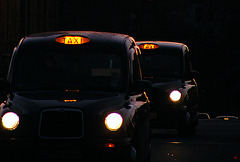
Taxi!_240


Years ago, I had friends who lived south of Hampstead Heath in South End Green, near where the writer George Orwell lived during the 1930s. I often visited my friends there and usually stayed with them until long after public transport ceased working late at night – those were the days long before 24 hour bus services. In those days, I was a student with limited means. Taxi and minicab rides to my home in Hampstead Garden Suburb to the north of Hampstead Heath were costly and if used too often would eat too deeply into my meagre funds.

So, often I used to walk through the darkness to my home, a distance of well over 2 miles. Most of this walk was across the wooded stretches of Hampstead Heath. Even back in the 1970s, this vast expanse of urban woodland was far from safe. Murders and attacks were not unknown. My parents and others would have been horrified to learn that I was risking my life to save paying a cab fare. Was I scared? The answer was both yes and no. I was concerned because of the news stories I had read. Yet, on the other hand I was not so afraid.

I felt that anyone encountering me on my nocturnal wandering deep in the secluded heart of Hampstead Heath might have had one of two reactions. Either he or she might have imagined that I was up to no good and possibly on the prowl for victims and would therefore steer clear of me, or that the person  whom I encountered was up to no good. If he or she was ill-intentioned, the person would have still had to be a little bit cautious because I might have turned out to be more than a match for him or her. This reasoning would have done me no good had the person I met been severely evil. 

Fortunately, luck was on my side. I never encountered anyone, innocent or evil, on my nocturnal strolls. However, I would never even dream of making this kind of journey across Hampstead Heath again, and would not advise anyone else to attempt it because London has become more dangerous than it was in the 1970s and before.

No contact

skying


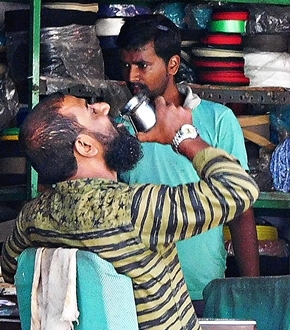
In India, many people ‘sky’ their drinks. This means that they take a drink from a container without letting it contact their lips or mouth. To ‘sky’ a drink means literally pouring a drink into your mouth from a distance. This method of drinking allows many people to drink from the same container without risking contamination of the drinks by any of the drinkers’ germs. 


PORRON

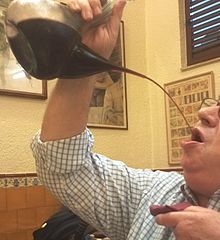
Drinking wine from a porro (source: wikipedia)

Spain, which is many miles away from India, uses special vessels known as porron (porro, singular) to ‘sky’ wine. These traditional vessels, popular in Catalonia, allow many people to imbibe from the same vessel without making any contact between it and the mouth. The design of the porro is such that the drink container can be held at a much greater distance from the mouth than in the Indian mode of sky-ing a drink. 

George Orwell was not keen on using porron. He wrote in his Hommage to Catalonia (published 1938):

A porron is a sort of glass bottle with a pointed spout from which a thin jet of wine spurts out whenever you tip it up; you can thus drink from a distance, without touching it with your lips, and it can be passed from hand to hand. I went on strike and demanded a drinking-cup as soon as I saw a porron in use. To my eye the things were altogether too like bed-bottles, especially when they were filled with white wine.

I have no idea when or where the habit of drinking without contacting the vessel originated. If anyone has any ideas, please let me know.


The top photo was taken in Mattancherry, Kerala, India