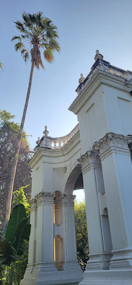
A LARGE WHITE MANSION stands in lovely grounds not far from the Sidi Saiyed mosque in central Ahmedabad. If you look carefully, you will see that in various places the outside of the building has cartouches consisting of an A intertwined with an S.
This edifice was a home of the textile magnate and philanthropist Ambalal Sarabhai (1890-1967).
Ambalal’s sister was Anasuya Sarabhai (1885-1972). She became a pioneer and founder of the women’s labour movement in India. Also, she helped Gandhi set up his Sabarmati Ashram in Ahmedabad.
Initially, Anasuya studied medicine, but gave it up. She was a Jain and dissecting corpses was abhorrent to her. She gave it up, and went to London where, in 1912, she studied at the London School of Economics, where many years later my father became a professor.
In 1914, she organised a textile workers strike in Ahmedabad. No doubt, her brother’s factories would have been affected. In 1917, the Ahmedabad Textile Labour Association (Majdoor Mahajan Sangh) was formed and Anasuya was made its lifelong president by Gandhi.
I do not know where Anasuya lived in Ahmedabad, but seeing her brother’s house made me think of her. [It is possible that she resided in Ambalal’s mansion.]
The villa is now the home of the Shanti Sadan institute.
I FIRST CAME ACROSS the name Indulal Yagnik when I was researching my book (“Indian Freedom Fighters in London:1905-1910”) about the less well-known Indian Freedom Fighter, Shyamji Krishnavarma (1857-1930). Indulal Yagnik (1892-1972), who was a writer and political activist, published a biography of Krishnavarma in 1950. Yagnik wrote many other things, amongst which were the first 30 chapters of Gandhi’s autobiography that were dictated to him by the Mahatma whilst they were both imprisoned in Yeravada jail.
Between 1915 and 1947, Yagnik was active in the Indian struggle for freedom. Amongst his many activities, he carried the first tricolour Indian flag from Germany to India. This flag had been designed by Madam Cama, a leading proponent of Indian independence, and had been displayed to the world (for the first time) at a meeting of socialists in Stuttgart (Germany). Yagnik was imprisoned by the British at least twice on account of his anti-British activities and publications.
After Independence, in 1956, Yagnik led the Mahagujarat Movement for a separate Gujarat state, which led to the separation of Gujarat from Maharahtra that occurred in 1960.
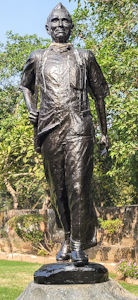
Close to the east end of the Nehru Bridge in Ahmedabad, the city in which Yagnik died, there is a small, well-maintained park in which there is a fine statue of Indulal Yagnik. It was created by the late Kantibai B Patel, who also made many other statues of well-known Gujarati people, including many of Mahatma Gandhi. The statue of Yagnik depicts the man striding forward, his shirt pocket filled with a spectacles case and a pen.
I was keen to view the statue not only because I had read Yagnik’s biography of Krishnavarma but also for another reason. His nephew, who lives in Bangalore, is a good friend, whom we got to know because his wife is related to members of my wife’s wider family.
Even if you do not have the sort of ‘connection’ we have with Indulal Yagnik’s nephew, the statue is worth seeing because it is a good piece of sculpture.
THE GUJARAT VIDYAPITH is an educational establishment, now recognised as a university, founded by Mahatma Gandhi in 1920. Until he created the university, most higher education in India was, according to plans laid down by Lord Macaulay, dedicated to training Indians to be useful in the service of the British Empire.
The Vidyapith was, according to its website, part of: “… a great response to Gandhiji’s command to vacate the English teaching schools and colleges. Now, in order to see that the students who left their education half-way are not deprived of the education, it was decided to estalish National Vidyapith. Out of those five Vidyapiths established during that period, Gujarat Vidyapith was one, estalished by Gandhiji himself on October 18, 1920. Gandhi wanted his Vidyapith to prepare the youths for the task of national reconstruction and usher in ‘Hind Swaraj’, the India of his dream”
The establishment, based in a very peaceful leafy campus, still functions today. Many of its students are members of underprivileged families.
Gandhi on the Salt March in 1930
As we were wandering around the campus, we came across a photograph of Gandhi taken while he was on the Salt March (1930) to Dandi during which the Mahatma and his followers were protesting against the government monopoly on salt production. Underneath the photograph, there was a caption that read as follows: “Pranjivan Vidyarthi Bhavan was first stop of Historic Dandi March 12/03/1930”
This Bhavan was one of the first buildings on the Vidyapith campus. When the Vidyapith was started, it was located close to Gandhiji’s first ashram, the Kochrab Ashram. However, as an article in the Indian Express explained: “With space constraints in the bungalow along with looming threat of plague, Vidyapith was shifted to Aga Khan Estate near Nehru bridge, where a building stands now. It ran from there briefly till the foundation stone of Pranjivan Vidyarthi Bhawan was laid by eminent scientist Prafulla Chandra Ray on March 9, 1923 which after completion was inaugurated by Gandhi in 1925.”
Our friend, Arthur Duff, showed us around the campus. Apart from seeing the memorial to the Salt March, we saw the models of villages outside the university’s folklore museum, which was sadly closed when we arrived. As the sun began to set we walked around the campus, a peaceful oasis in a busy part of Ahmedabad across the river from the old city.
A FEW MONTHS AFTER Mahatma Gandhi was born in India in October 1869, Jan Smuts was born in South Africa’s Transvaal Republic (in May 1870).
In 1893, the young barrister Mohandas K Gandhi, the future ‘Mahatma’, arrived in Durban, South Africa, from Bombay. This was the year before Smuts graduated in law at Christ’s College in Cambridge, England. After passing the Bar examinations in late 1894, he returned to South Africa, where he became involved in politics.
Gandhi remained in South Africa from 1893 until 1915. During his time there, he practised law as a qualified barrister, fought for the rights of Indians in the country, and gradually developed his non-violent approach to protest, which he later practised during the struggle to free India from British domination. During the Second Anglo-Boer war (1899-1902), Gandhi assisted the British with caring for casualties. Meanwhile, Smuts fought with his fellow Boers.
After that war, Smuts was involved with negotiations that led eventually to the union of the four territories, which then became unified as the South Africa we know today. In 1914, the First world War broke out. Smuts fought for the British, most notably in what was then German Southwest Africa, now Namibia. Meanwhile, in 1915 Gandhi returned to India, and the rest is history.
Both Gandhi and Smuts are commemorated by statues in London’s Parliament Square. They stand near each other, but not next to each other. Jan Smuts stands on the north side of the square, and is depicted as striding towards Westminster Abbey. Mahatma Gandhi stands on the east side of the square quite close to the statue of another South African, Nelson Mandela. Gandhi appears to be gazing at the Houses of Parliament.
Seeing those statues standing in the same square today made me wonder how, if at all, Gandhi and Smuts felt about each other. I found an article in a website called “The Observation Post”, which helps understand their relationship. Here are some quotes from it:
“It’s a common misconception that Jan Smuts and Mahatma Gandhi’s relationship was one of animosity. It is a little known fact that both men actually respected each other, remaining life long admirers of one another … Gandhi tried, at all times, to look for the positive in Smuts and said of him that he had a ‘high place among the politicians of the British Empire and even of the world’.”
When Gandhi was about to leave South Africa in 1915, he sent Smuts a pair of sandals that he had made at Tolstoy Farm, a cooperative colony he set up near Johannesburg, from which he ran his campaign of satyagraha (non-violence). Smuts wore these every day when at his farm, and is recorded as having said on Gandhi’s seventieth birthday:
“I have worn these sandals for many a summer, even though I may feel that I am not worthy to stand in the shoes of so great a man.”
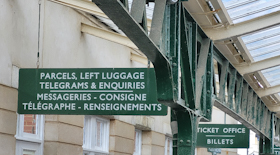
WHEN MAHATMA GANDHI came to England in 1931, he disembarked at Folkestone in Kent. In those days there boats docked alongside a pier, and then boarded trains at a station on the pier. The pier has long since ceased to be used to service cross channel and other passenger boats, but it and the station have been preserved and converted into a tasteful leisure amenity.
THERE IS A GARDEN close to the Wilberforce House Museum and other museums in the old part of Hull (Yorkshire). At one side of this well-tended space, the Mandela Gardens, with his back to the Wilberforce House, there is a bust of the Indian freedom fighter Mahatma Gandhi (1869-1948). The bust was created by an artist from Maharashtra, Jaiprakash Shirgaonkar (born about 1952). When I saw it, I wondered whether Gandhi had ever visited Hull. I do not think he did. On the back of the plinth that supports the bust, there is an inscribed plaque, facing Wilberforce House, with some words spoken (or written) in May 1983 by Sir Sridath (‘Sonny’) Ramphal (1928-2024), who was born in what was British Guiana. They read:
“I invite each and every one of you, citizens of Hull and other friends, to question whether any can take pride in the work and achievements of Wilberforce and the Anti-slavery Movement if, as a nation, as a world community, we fail to take a righteous and uncompromising stand against apartheid. By what quirk of logic, what twist of values can we celebrate emancipation and tolerate apartheid? …”
These words were spoken (or written) in 1983, and apartheid ended in South Africa only in 1994.
The bust of Gandhi was unveiled in October 2018. The following year, Gandhi’s grandson Gopal Gandhi (a former IAS officer and diplomat who was the 23rd Governor of West Bengal, serving from 2004 to 2009) visited Hull to celebrate what would have been the Mahatma’s one hundred and fiftieth birthday. In anticipation of his visit, one of Hull’s then councillors Dave Craker said:
So, even if the Mahatma never visited Hull, at least one member of his close family managed to get there.
Returning to Ramphal, whose words are at the back of Gandhi’s monument, he did have a significant connection with Hull, and visited the city. In 1983, this former Commonwealth Secretary General (from 1975 to 1990) gave a lecture at the University of Hull, which had awarded him an honorary degree.
JUST OVER SEVEN years ago, I bought a book, which I put on a bookshelf without reading it, and then forgot about it. This September (2024) I found it whilst sorting through our book collection. It is a biography of the British politician Stafford Cripps (1889-1952), who visited India in March 1942. Winston Churchill had sent him there to negotiate with leading Indian Nationalists (including Gandhi, Jinnah, and Nehru) to keep them loyal to the British war effort in exchange for self-government when WW2 was over. It was up to Cripps, then a Labour politician, to formulate the proposed deal. The mission was not a success because Churchill thought that Cripps had offered the Indians too much, and the Indians thought his offer was not enough: they wanted independence immediately.
There have been many books written about Stafford Cripps. The one I found in my collection, “Stafford Cripps. A biography”, was published in 1949, when Cripps was still alive. When I looked at the book after ‘discovering’ it, what surprised me was the name of its author: Eric Estorick.
Until I looked at the book today (3rd of September 2024), I had only associated the name Estorick with a fine museum of 20th century Italian art – The Estorick Collection of Modern Italian Art. This is housed within Northampton Lodge, a Georgian building which was once the home and offices of the architect Sir Basil Spence (1907-1976), who was born in Bombay. This is in Canonbury, which is just north of Islington. The collection was established by the American Eric Estorick (1913-1993) and his German-born English wife Salome (1920–1989) after WW2.
Eric Estorick was none other than the author of the biography of Cripps, which I ‘unearthed’ today. Born in Brooklyn (NY), son of Jewish emigrés from the Russian Empire, he was awarded a PhD in sociology at New York University. In 1947, he married Salome (née Dessau), who was an artist. Eric’s interest in art began before that when he met the American photographer and gallery owner Alfred Stieglitz (1864-1946). The Estoricks began collecting art soon after the end of WW2. During their honeymoon, the Estoricks were introduced to the works of the Italian Futurists. The Collection contains several good examples of their works. In 1960, Eric opened the Grosvenor Gallery in London’s Davies Street. His first exhibition was a display of modern sculpture. It was in his gallery that my mother exhibited some of her sculptures in 1965, in an exhibition called “Fifty Years of Sculpture. Some aspects 1914-1964”. She must have been introduced to Eric at the time.
Apart from his interests in art, Eric Estorick was a prolific author. In addition to writing three books about Stafford Cripps, he wrote others about politics as well as art. One of his books, which was published privately, was a history of the Marks and Spencer firm, in which he worked for some time. It was in that company that Salome Estorick had worked. Marks and Spencer had been a customer of her father’s textile manufacturing firm.
Having found my copy of Estorick’s book and skimmed its contents, I will not be putting it into our storage unit as I had originally intended, but will begin reading it soon.
THERE ARE MANY statues depicting Mohandas K Gandhi (the Mahatma; 1869-1948) all over the world. There is one in Manchester close to the city’s cathedral. A small notice next to it notes that it was gifted by the Kamani family to honour their grandfather Bhanji Khanji Kamani (1888-1979). Inaugurated in 2019, it is a project by the Shrimad Rajchandra Mission in Dharampur (Gujarat).
Shrimad Rajchandra (1861-1901) was a Jain philosopher, scholar, and reformer. Gandhi was introduced to him in Bombay in 1891, and the two men wrote to each other when the Mahatma was a lawyer and activist in in South Africa. Gandhi wrote in his autobiography that Shrimad was his “guide and helper” and his “refuge in moments of spiritual crisis”. Well, I did not know that.
As for Bhanji Khanji Kamani, the notice next to the statue in Manchester notes that he was “… a Fellow Scholar of Gandhi.” I am unclear about the meaning of this because Bhanji was about 19 years younger than the Mahatma. I wonder whether he was actually a disciple of Gandhi, rather than a Fellow scholar.
We saw the statue representing a man who advocated peaceful protest on a day when violent protests were predicted all over England.
WHAT IS YOUR EARLIEST memory of a news item? In my case, I remember my parents discussing something about Cuba. This was The Cuban Missile Crisis of October 1962. I had little or no idea about it, but later I learned that US President John F Kennedy was involved in its resolution. A year later, when we were staying in the USA, we were there when he was assassinated. I well recall that and my feelings about it at the time. That remains in the forefront of my memory, but far back in the fleshy recesses of my grey matter, the name Grunwick resides. While visiting an exhibition at the Tate Britain recently, I saw several photographs that brought this vague memory back into my consciousness.
Grunwick Film Processing Laboratories (‘Grunwick’), located at Willesden in northwest London, processed photographic films and produced finished prints from them. Photographers (mostly amateurs) put their undeveloped exposed films into an envelope along with payment, and sent them to Grunwick, who later returned the developed film and the prints made from it. In 1973, some workers at Grunwick joined a trade union and were subsequently laid-off by the company. The company employed many workers of Asian heritage – including a substantial number of ladies. As the then Labour politician Shirley Williams pointed out, the Asian ladies were being paid very much less than the average wage, and conditions were bad – hours were long, overtime was compulsory (and often required without the employer giving prior notice).
On the 20th of August 1976, Grunwick sacked Devshi Bhudia for working too slowly. That day, three other workers walked out in support of Devshi. Just before 7 pm that day, Jayaben Desai (1933-2010) began walking out of the factory. As she was doing so, she was called into the office and dismissed for leaving early. When she was in the office, Jayaben said (see guardian.com, 20th of January 2010):
“What you are running here is not a factory, it is a zoo. In a zoo, there are many types of animals. Some are monkeys who dance on your fingertips, others are lions who can bite your head off. We are those lions, Mr Manager.”
Thus began a two-year long strike, which was supported not only by the company’s workers but also by many politicians and trade unions, including, for a short time, the Union of Post Office Workers, who refused to cross the Grunswick picket lines.
Jayaben was born in Dharmaj, now in the Anand district of the Indian state of Gujarat. Soon after marrying, she and her husband migrated to what is now Tanzania. Just before the Commonwealth Immigrants Act (1968) made it difficult for Commonwealth citizens to settle in the UK, the couple moved to England. There, she was obliged to take up poorly paid work, first as a sewing machinist, and then as a worker at Grunwick.
Not only did Jayaben initiate the strike, but she helped keep it going until the dispute was resolved. In November 1976, when the Post Office workers stopped supporting the strike, she told an assembly of Grunwick’s workers:
“We must not give up. Would Gandhi give up? Never!”
Later, like Gandhi, she employed his tactic – the hunger strike – outside the Trade Union Congress in November 1977. During the court of enquiry led by Lord Justice Scarman, she gave powerful evidence against her erstwhile employer. When the strike was over, she went back to sewing, and then later became a teacher of sewing at Harrow College. After passing her driving test at the age of 60, she encouraged other women to do so to increase their freedom. After her death, some of her ashes were deposited in the Thames, and the rest in the Ganges.
The reason that Grunwick came to mind at Tate Britain was that its current exhibition “Women in Revolt! Art and Activism in the UK 1970-1990” (ends 7th of April 2024) includes several photographs taken at Grunwick during the strike. Three of them include portraits of Jayaben in action.
As I wrote earlier, I had heard of Grunwick, but I could not recall why until I saw the exhibition. As for the remarkable Jayaben Desai, I am happy that I have become aware of her and her amazing achievements.
A DISTINCTIVE BUILDING stands opposite the Art Deco Winter Garden (built by 1936) high above the seashore of Ventnor on the south side of the Isle of Wight. With a tower overlooking the sea, the edifice facing the Art Deco structure was which was built in 1846 by the Reverend Richard John Shutte (1800-1860), who had once been a canon at St Paul’s Cathedral. It was named St Augustine Villa (see photograph below), and now houses a hotel and restaurant.
Several Russians opposed to the Imperial Romanov regime, including the writer Ivan Turgenev(1818-1883) visited Ventnor during the 19th century. Amongst these was Alexander Herzen (1812-1870), who was the ‘father’ of Russian Socialism’. In 1852, he and his family began living in England for several years. During this sojourn, he made some visits to the Isle of Wight. In September 1855, Herzen stayed in Augustine Villa, which he had rented. However, he was not alone as the commemorative plaque on the Villa notes. He stayed there with Malwida von Meysenbug (1816-1903).
Now, I had already heard of Herzen. I became familiar with his name when watching a trilogy of plays by Tom Stoppard about 19th century Russian Socialism. However, I had never come across Malwida von Meysenbug until I saw that plaque in Ventnor. A writer, she was born in Kassel (Germany) and was a friend of both Friedrich Nietzsche and Richard Wagner. By the time that Herzen and Malwida had their holiday in Augustine Villa, she was living with Herzen’s family and helping to look after his children. Alexander’s wife Natalia had died in 1852, and he had hired Malwida to educate his children.
Malwida was much more than a mere governess as the UCL academic Sarah J Young explained in her excellent, highly informative article (http://sarahjyoung.com/site/2011/11/10/in-herzens-footsteps-a-visit-to-ventnor/). In this essay, Dr Young gives excerpts from Malwida’s published “Memoirs”. The following is particularly interesting:
“We spent happy days in beautiful Ventnor. In the evenings we were usually with the Pulszkys, who were spending the summer there. Therese’s mother, an educated and intelligent Viennese lady, had come to visit them, and this made for many a pleasant hour with her keen humor and wit. The Kossuths were also there, and he was much more pleasant in a more intimate setting than he had been at the formal gatherings in London. At the time, our thoughts were preoccupied by the war Russia had started with Turkey. Herzen, more so than the others, was very excited. He prophesied the Russian defeat and wished for it, since he believed it would lead to the downfall of autocracy.”
The Kossuths, were members of the family of the Hungarian revolutionary Louis Kossuth, whom Herzen was extremely excited to have met during his stay in Ventnor. Another exiled Hungarian revolutionary, Ferenc Pulszky (1814-1897) was also staying with his family in Ventnor at the same time as the Herzens and the Kossuths. Pulsky’s wife, Theresa, and Malwida spent time drawing together in Ventnor, and made several competent sketches of Ventnor and its surroundings,
Dr Young also quoted Herzen, who noted in his diaries that Malwida:
“… spent all her time in the water …”
From what Dr Young and others have discovered during their research, Malwida was out of the sea long enough to create works of art depicting the seaside resort.
Herzen liked Ventnor but had some reservations as he wrote in a letter (quoted from Dr Young’s article):
“For three days the weather has been like June – and I’m bathing recklessly in the sea. But before that there were four days of storms, rain and bitter cold … If it were not so boring, I would live here, but there are no resources at all. And getting to Ryde is expensive … “
Many years have passed since Herzen and Von Meysenbug holidayed in Ventnor. Slightly less time has elapsed since the future Mahatma Gandhi visited Ventnor in 1890 and 1891. According to one source (www.bonchurchvillage.co.uk/post/bonchurch-gandhi), Gandhi:
“… had wanted to study medicine but his father had objected, and his studies were in law. He was a prominent member of the London Vegetarian Society, and that may have led to his staying at Shelton’s Vegetarian Hotel at 25 Madeira Road in Ventnor, in January 1890 and again in May 1891, on the second occasion addressing a Vegetarian meeting in Ventnor.”
In his autobiography, Gandhi wrote of the following experience in Ventnor:
“My cowardice was on a par with my reserve. It was customary in families like the one in which I was staying at Ventnor for the daughter of the landlady to take out guests for a walk. My landlady’s daughter took me one day to the lovely hills round Ventnor. I was no slow walker, but my companion walked even faster, dragging me after her and chattering away all the while. I responded to her chatter sometimes with a whispered ‘yes’ or ‘no’, or at the most ‘yes, how beautiful!’ She was flying like a bird whilst I was wondering when I should get back home. We thus reached the top of a hill. How to get down again was the question. In spite of her high-heeled boots this sprightly young lady of twenty-five darted down the hill like an arrow. I was shamefacedly struggling to get down. She stood at the foot smiling and cheering me and offering to come and drag me. How could I be so chicken hearted? With the greatest difficulty, and crawling at intervals, I somehow managed to scramble to the bottom. She loudly laughed ‘bravo’ and shamed me all the more, as well she might.”
I do not think that Gandhi made any other visits to Ventnor or elsewhere on the Isle of Wight.
Today, Ventnor is still delightful and although much has been modernised since the Victorian era, it still retains an almost unspoilt old-world charm. I fancy that were it possible for Herzen and Malwida and their revolutionary friends to return today, they would find much in Ventnor that they would easily recognise.
Seeing the plaque on Augustine Villa made me curious about Herzen’s stay in Ventnor and the identity of Malwida von Meysenbug. By reading up about it, I learned of other noteworthy visitors to the town, and as I did so my interest in Ventnor has increased considerably.





 yamey
yamey 