19th century photographers in Madeira and elsewhere

ALMOST WITHOUT REALISING IT, it seems that I have developed an interest in 19th century photographers. A visit to the Isle of Wight in 2022 led to me becoming interested in the life and work of the pioneer of artistic photography – Julia Margaret Cameron (1815-1879). She lived at Dimbola Lodge in Freshwater on the Isle of Wight between 1860 and 1875. It was here that she produced most of her highly creative photographs. I have written a book about her: “Between Two Islands: Julia Margaret Cameron and Her Circle”.

Five years after Julia left the Isle of Wight, my great-grandfather Franz Ginsberg travelled from the German Empire to King Williams Town (‘KWT’) in the eastern part of what was then the southern African Cape Colony. Aged 18, he arrived there with his future brother-in-law Jakob Rindl. The two men set up what became a successful commercial photographic studio in the town, which they might have chosen because many of its European inhabitants were German speakers. Although Jakob continued the studio after 1885, Franz diversified his activities by founding soap, match, and candle factories in the town.

I believe that despite becoming a successful industrialist and politician, Franz continued taking photographs as a hobby. Because of his success in KWT, other members of his family came out from Germany to work in the town. Amongst these were Franz’s nieces, Anna and Else Ginsberg. These two intrepid ladies founded a photographic studio in KWT. They were the first ladies to have opened a commercial photography studio in what was to become South Africa. Of interest, amongst each of the generations of Franz and Jakob’s descendants, there have been keen photographers including myself,

In May 2023, when we visited the city of Funchal on the Portuguese island of Madeira, we came across a museum that helped to bring 19th century photography back to life for me. It is the Museu de Fotografia da Madeira in Rua de Carriera. The museum is housed in what had been the premises of the commercial studio founded by Vicente Gomes da Silva (1827-1906) in 1863. The studio remained in business until 1978. In 1982, the Regional Government of Madeira purchased the building – Atelier Vicente – and used it for a museum of photography.  

Vicente Gomes da Silva became interested in photography in 1856, and by 1859 he was recorded as an amateur photographer in a local newspaper published in the June of that year. By 1863, he had made photography his business venture, and moved into the Atelier on Rua Carriera in 1865. A year later, he was appointed photographer to the Empress of Austria. His son, also called Vicente, continued the business, and was appointed photographer to the Portuguese royal family in 1903.

The museum is interesting not only because it exhibits the sorts of cameras that must have been used by my ancestors in South Africa and by Julia Margaret Cameron, but also because features that were characteristic of early photographic studios have been maintained and explained. The Atelier was opened before there was electricity on Madeira. The main studio area was arranged so that it was lit by northern light that filtered through skylights and curtains designed to make it a homogenous light source. Part of the studio’s laboratories had skylights that allowed ingress of sunlight that was required at various stages of preparing the photographic plates. At the back of the studio, there are a set of sliding panels, each painted with a different scene that could be used as a background to the people being photographed. The desired scene could be slid out behind the area where the subjects posed for their pictures. In other rooms, there are exhibits illustrating the history of cameras and photographic processes, as well as a fine collection of reproductions of images captured by some of the many photographers – both Portuguese and others – who worked in Madeira.  Some of the foreigners who took photographs on the island included British photographers such as Russell Manners Gordon (1829-1906) and Alexander Lamont Henderson (1837-1907).

Although I have no information about the appearances of the photographic studios used by my relatives in 19th century KWT, seeing the museum helped to give me an inkling of how their workplaces must have been. In the case of Julia Margaret Cameron, the places where she created images in her home, Dimbola, were far more makeshift from what I can gather.

Except for Julia Margaret Cameron, all the photographers I have mentioned, and many others working in the nineteenth century, aimed to create visually accurate images of their subjects. Often crystal clear, these pictures are fascinating but usually lifeless. What made Julia Cameron’s photography both unusual and full of life was her experimentation with focussing and processing. She used the camera not as equipment for capturing real life accurately on film but as a tool for creating works of art, in the same way as a painter uses the brush and the sculptor uses chisels. By doing this, she was far in advance of her time; experimentation with photography as a creative art form really only took off in the 20th century. The portraits and other composition that she created on film successfully captured not only their external appearance but also her astute interpretations of her subjects’ personalities.

My book about Julia Margaret Cameron can be obtained from Amazon: https://www.amazon.co.uk/dp/B0BZFCVLX9/ ,

and at the museum shop at Dimbola at Freshwater Bay on the Isle of Wight

Arrival and departure and the weather

UNDOUBTEDLY, MADEIRA IS a wonderful place to visit – a gem in the middle of the Atlantic Ocean. Unless you are travelling on a cruise liner or own your own seagoing boat, the only way to reach the place is by air. There is only one airport. This is on the coast east of Funchal. The runway is close to the sea and has sea close to each of its ends. The problem with the airport is that it is frequently affected by local wind conditions, which make both landing and taking off difficult, if not occasionally quite hazardous or even impossible. Only specially trained pilots can use this airport.

The air currents – mainly cross-winds – make landing a challenge. When we flew to Funchal in 2022, our ‘plane had to make two attempts because on the first approach, we were blown away from the runway towards the sea. We were told that this was not at all unusual. Sometimes, conditions are so bad that aircraft must be diverted to the Portuguese island of Porto Santo, which is across the sea about 35 miles northeast of Madeira. A couple whom we met in Funchal this May (2023) told us that they had visited Madeira by air eight times. On two of their trips, their in-bound flights were diverted to Porto Santo. On one of these occasions, they waited a few hours on the island before their flight continued to Funchal. On the other, they disembarked on Porto Santo, and had to continue to Madeira by ship.

If flying into Madeira has its difficulties, so does leaving the place. For, if a ‘plane cannot land, or is delayed by adverse winds, then those hoping to leave the island will also face problems including delays and cancelled flights. This year, our flight from Funchal to London was scheduled for Wednesday, the 10th of May. On the evening and during the night of Monday the 8th of May, Funchal was hit by strong winds. Flights were unable to land or take-off from Funchal for most of Tuesday. The couple I mentioned were due to fly to England on Monday evening. To our great surprise, we met them at Funchal’s airport on Wednesday afternoon. Their flight had been cancelled on Monday, and then again on Tuesday. Their airline, Jet2, had arranged for them to be put up in comfortable hotels for both Monday and Tuesday nights. In addition, they had been given vouchers to cover their meals. Other people we met at the airport had been less fortunate.

When we arrived at Funchal’s airport on the afternoon of the 10th of May, the check-in hall was full of people, many of them lying on thin mattresses that the airport had provided. Many of them had spent one or two nights sleeping on the floor, waiting for flights to replace those which they had had to miss because their ‘planes were unable to land. We spoke with several Ryanair passengers whose flights had been cancelled. They had either been offered only one night’s accommodation or none at all. Because their delays were due to weather rather than failings of the airline, Ryanair did not offer to accommodate or even feed their delayed passengers. They had been offered places on replacement flights, which were scheduled to leave several days after the 10th of May, or to try to get last-minute stand-by places on earlier flights. Many of the delayed passengers, who were uncertain when they could leave Madeira, had jobs to return to and/or connecting flights to catch. A young couple from Canada were particularly unfortunate. Their Ryanair flight had been cancelled, and they had to reach London to board a flight to Vancouver. They missed the flight to Canada. Because their tickets from Funchal to London were not connected with those to Canada, the transatlantic flight tickets from London were wasted and they had to pay for another flight a few days later. In addition, because they preferred to stay in a hotel rather than on the floor at Funchal’s airport, they managed to book “the last remaining hotel room in Funchal”, which set them back 400 Euros. Luckily for them, they managed to get standby tickets on the same Ryanair flight as ours. They had been told that had this not been possible, they would have been assigned seats to fly out on the 20th of May.  

We were lucky. By the 10th of May, the weather had calmed, and flights were back to more or less normal.  Our flight was delayed by one and a half hours because the ‘plane which was to take us to London had to circle many times before being permitted to land at Funchal.

So, much as I would highly recommend spending time on the beautiful island of Madeira, you must understand that because of the vagaries of the weather far out in the Atlantic, you should be prepared to spend less or more time than you planned on the island. Finally, in an age when tourist travel has become almost as reliable as clockwork, it is fascinating to find a place where, as in centuries long past, travelling is subject to the same factors that affected voyagers of yesteryear.

English Church in Madeira

THE FIRST RECORDED Anglican service in Madeira was held on a British ship passing by in 1774. Randomly occurring services were officiated by chaplains of passing ships until about 1807 when some British soldiers were stationed on Madeira as part of the war against Napoleon. Thereafter, the British garrison’s chaplain held services for British residents in the island’s British consulate.

In 1813, a plot of land was purchased close to the already established English Cemetery. The land is where the English Church stands today. Designed by Henry Veitch, the church was completed by 1822.

From the outside, the domed neoclassical building does not much resemble a church. Square in plan, inside it contains two concentric circles of supporting pillars. The top of the dome is above the central point of the church’s floor. The interior of the church is simple but elegant. Veitch, who was a freemason, might have been influenced by freemasonry in his choice of design, or possibly by the round style of temples favoured by the former Knights Templar.

When the church was built, it was attended by members of Madeira’s British residents, who numbered about 700 in 1822. Currently, there are only about 70 British residents. It was not until William Reid opened his hotel in the 1890s that the flood of tourists from Britain and elsewhere began in earnest.

Currently, the English Church, set in its lovely gardens, hosts many musical events – classical and otherwise.

Imported from India

IN THE FIFTEENTH century, the Portuguese made an important set of discoveries, which were kept a closely guarded secret. These discoveries brought great wealth to Portugal. The Portuguese navigators found routes from Portugal to India via the Atlantic Ocean and the Cape of Good Hope. By using these, they were able to transport spices and other valuable commodities from Asia to Portugal directly. Prior to the discovery of this sea route, goods from India and further east arrived in Europe via Egypt and the former Ottoman Empire. This overland route undoubtedly added various middle-man costs to the goods.

Once the Portuguese began sailing in the Indian Ocean, they successfully created a monopoly over trading in this area. However, after a period of uninterrupted use of the Indian Ocean, competition arrived in the form of mainly Dutch and British trading vessels.

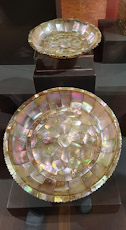
Mother of pearl bowls from India

Madeira was one of the places that the early Portuguese ships called in at during their voyages. This was brought home to me during a visit to Funchal’s superb Museum of Sacred Art. In two of its rooms we saw religious artefacts – sculptures and two mother of pearl bowls – which were labelled as having come from India. There were others that came from ‘Portuguese Asia’. One item, a beautiful inlaid tortoise shell box, came from Japan.

Unlike the religious sculptures we have seen in old Portuguese churches in Goa, which often feature Indian looking faces, those in the museum had European facial appearances. An exception is a 16th century carved panel depicting St Francis Xavier asleep on the Island of Shangchuang. He is accompanied by two saints – one Indian and the other Chinese.

Seeing these beautiful old sculptures and other objects, which were made in Asia and then brought to Madeira, helped make the history of Portugal’s former pioneering navigational achievements a little more vivid for me.

Franco and Franco in Funchal

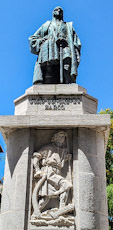
MOST VISITORS TO central Funchal in Madeira will pass, and probably notice, a bronze statue high up on a square based plinth outside the Bank of Portugal and the Golden Gate Grand Café. It depicts Joao Goncalves Zarco, who began the Portuguese settlement of Madeira in the 15th century. Very few people who pass this statue will know that it was created by a Madeiran sculptor, Francisco Franco (1885-1955). His older brother Henrique Franco (1883-1961) is one of Madeira’s most famous painters.

Both brothers studied at the Lisbon School of Fine Arts. They also spent time in Paris. Henrique returned to Madeira where he painted many of his pictures. Many of them are of Madeirans and scenes of the island. His paintings are beautifully executed and visually pleasing. Although the influence of Cezanne can be detected, Henrique did not seem to have affected by the innovative trends that were occurring in Western art during the 20th century.

Francisco visited Mussolini’s Italy in the 1920s and was impressed by the way that the state produced sculptures, which promoted the ethos and aims of the regime. He returned to Portugal, and began creating sculptural works that boosted the image of his country. Many of his important works were created for the Salazar government, which began in 1932.

Until our second visit to Funchal, I had never heard of the Franco brothers. Today, the 8th of May 2023, we visited a small museum in Funchal. It contains a fine collection of the works of both brothers. The museum contains many fine paintings by Henrique and sculptures by his brother, including a bust of Portugal’s former dictator Salazar. A video showing in the museum seems to suggest that far from being hostile to the Salazar dictatorship, Francisco was happy to create sculptures for it and its institutions.

Francisco attended an industrial school in Funchal. Its building is next to the museum. Over its main entrance is a carved stone sculptural frieze created by Francisco. The edifice now houses the Escola Secundaria de Francisco Franco, which opened in about 1976. Within its entrance lobby, we saw a bas-relief depicting the sculptor.

Although it is not one of Funchal’s main tourist attractions, the Museu Henrique e Francisco Franco deserves to be better-known.

Mahatma on Madeira

UNTIL AIR TRAVEL really ‘took off’, travelling between South Africa and London involved a long sea voyage, either via the Suez Canal or via the Atlantic Ocean. Boats carrying passengers up and down the Atlantic often called in at Funchal in Madeira. Aged three, I travelled with my parents to South Africa by sea. I have seen a photograph of me dressed in a toga made from a sheet from our cabin. I was taking part in a fancy dress party to celebrate crossing the Equator.

Many years before that – in 1906 – a barrister, Mohandas Karamchand Gandhi, travelled by ship from London to South Africa. He was on his way back to South Africa, having petitioned young Winston Churchill, then Under Secretary of State for the Colonies, against the Black Act – a law promoting racial segregation. Apparently, when his ship docked in Funchal, the future Mahatma received news that his efforts had been successful, but this news turned out to be false.

On the 5th of September 2019, a bust of Gandhi was unveiled on the seafront in Funchal, close to the harbour where liners dock today. The bust, which unusually shows Gandhi without his characteristic round lens spectacles, was sculpted by Ram Vanaji Sutar (born 1925 in Gondur, Maharashtra). Sutar is also the sculptor of the massive Statue of Unity, depicting Sardar Vallabhai Patel in Gujarat. Beneath the bust there is a quotation incorrectly attributed to Gandhi; it was actually said or written by the Dutch American pacifist AJ Muste (1885-1967). The artwork was unveiled by HE Miguel Albuquerque, President of the Regional Government of Madeira and HE Nandini Singla, Ambassador of India to Portugal. It celebrates the 150th anniversary of Gandhi’s birth.

I am grateful to our friend Claus for telling us about the bust, which is not easily visible despite its position so near the waterfront: it is partially hidden by plants.

Over the years, I have visited Porbandar where the Mahatma was born; Rajkot where he went to school; Bhavnagar where he went to college; West Kensington where he lodged when studying for the Bar; Mumbai where he attempted to work as a lawyer; and the Gujarat Club in Ahmedabad where he first met Vallabhai Patel, and also set up his ashrams. So seeing him on Funchal has added to my attempts to follow in his footsteps.

Islets on the island

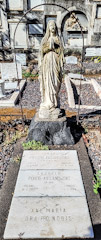
MANY PEOPLE VISIT Madeira to improve their health or to retire. Some of these people die on the island and are buried there. Today (5th of May 2023), we took a look at the small English Cemetery in central Funchal. This well tended burial ground, founded in 1770, contains graves of British and some Portuguese people – Protestants mainly. In addition, there are graves of men and women born outside Portugal in places including Germany, Finland, Romania, USA, Holland, Sweden, and Poland.

One of the Americans buried in the cemetery is Harry C Stone “Late Captain Cavalry USA”. His simple yet moving gravestone bears the date 1972 and the words:
“He believed in God”

Three graves particularly intrigued me. One of them marks the burial place of Lady Sarah Bonetta Davies (née Forbes). She was born in Ogun State in 1843 and died in Funchal in 1880. The gravestone informs that she was: “Princess of the Egbada Omoba people, West Africa. God-daughter of HM Queen Victoria.”
She was born an aristocratic member of the Egbada clan of the Yoruba people and was enslaved by King Ghezo of Dahomey, who ‘gifted’ her to Captain Frederick Forbes of the British Royal Navy. She became a god-daughter of Queen Victoria, and later married the Nigerian businessman James Pinson Labulo Davies of Lagos in West Africa. She died of tuberculosis in Funchal.

Another black African, George Oruigbiji Pepple, also lies buried in the cemetery. Between 1866 and 1883, he was the King of Bonny which was a small state in the Niger River delta. He was deposed in 1883 and restored to the throne in 1887. Why he was buried in Funchal , I have not yet discovered.

The third grave that interested me greatly is that of Paul Langerhans (1847-1888). This German pathologist and physiologist is best known for his discovery of the cells in the pancreas that produce insulin. Although he was unaware of the function of these distinctive cells, they have been named in his honour as The Islets of Langerhans.

Langerhans came to Madeira in 1875, having contracted tuberculosis. He recovered a little, researched marine worms, and practised medicine. In 1885, he married the widow of one of his patients. They lived together until his death. According to his wishes, he was buried in the English Cemetery in Funchal.

The cemetery is a lovely place to visit. It has plenty of flowers and is peaceful. On a future visit to Madeira, I would like to spend more time investigating the biographies of those whose remains lie there.

Blooms with a view

I AM ALWAYS WARY of ‘must see’ attractions because I dislike crowds and waiting in queues. So, last year when we visited Madeira, I thought it wise to avoid seeing the famous Botanical Gardens. In any case, most of Madeira’s capital, Funchal, is full of exotic plants and flowers – a veritable botanical garden in itself.

This May (2023), we decided to ‘bite the bullet’, and visit the Botanical Gardens high above Funchal. Getting there and back by local bus was easy. At the entrance to the Gardens, there was hardly any queue for tickets. And despite plenty of large tour buses parked nearby, the Gardens were not at all crowded.

Although I once owned a house with a 180 foot long garden in Gillingham, Kent, I am no gardener, and can hardly name any plant accurately. However, I love visiting gardens. The Botanical Gardens of Funchal are on the slopes of a hillside. All of the plants or groups of them are labelled. There are several terraces from which you can enjoy superb vistas of central Funchal, the sea, and the mountainous countryside.

The Gardens, which were opened to the public in 1960, are on land previously owned by William Reid, the founder of Funchal’s Reids Hotel. A bust in the garden commemorates Rui Vieira (1925-2009), a botanist who contributed much to the development of the botanical Gardens.

The highlight of the Gardens for me was a collection of mostly huge cacti, many of them bursting into flower. Everything else was also worth seeing in this well-kept, beautifully arranged garden. I am very glad that we visited this ‘must-see’ attraction on Madeira.

In search of WC on Madeira

IN JANUARY 1950, the famous writer, painter, and politician, Winston Spencer Churchill (‘WC’) paid a short visit to the island of Madeira with his wife and his eldest daughter. They were accompanied by various British officials.

WC arrived on the island by sea, and stayed in the luxurious Reid’s Hotel in Funchal, which continues to flourish today. He left by seaplane a few days later to attend to affairs connected with an upcoming election in the UK.

While we were visiting the excellent photographic museum in central Funchal, we saw some photographs of Churchill, which were taken during his excursion to the picturesque fishing port of Camara de Lobos, which is a few miles west of Funchal. The photographs show WC painting a picture of the lovely bay surrounded by serried rows of houses. I have yet to see the picture, which I hope still exists.

We took a local bus to Camara de Lobos and disembarked close to a small bar named after WC. This is located close to a terrace overlooking the bay and its fishing boats. It was from here that he painted. A monument records this episode.

In 2019, a new hotel opened, the Churchill Bay. Outside its entrance, there is a sculpture depicting WC with cigar held between his lips. He is shown seated at an easel. Within the hotel’s lounge and bar, there is a fascinating collection of Churchilliana – photographs; letters signed by WC; a portrait by Felix Topolski; and contemporary artworks relating to WC.

Whether or not you are a fan of the Great WC, Camara de Lobos deserves a visit. Although there are plenty of tourists there, it manages to retain the feeling of a traditional fishing village.