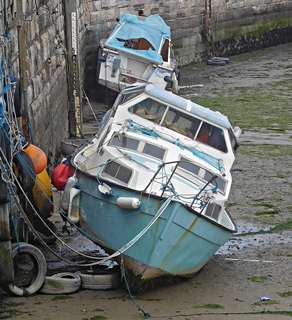
An almost abandoned dock by the River Dee

WHEN I WAS A child, I had a jigsaw puzzle, whose pieces were shaped like the counties of England and Wales, as they were in the 1960s. When you put the pieces together correctly, you ended up with a map of England and Wales. The county of Flintshire always fascinated me because it was then divided into two separated parts. Today, the 27th of May 2024, we made our first ever visit to Flintshire. Amongst the places we looked at was Connahs Quay, which is on the Welsh bank of the River Dee.

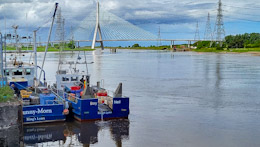
In the early 18th century, the Dee silted up. This put an end to Chester being used as a port. Instead, Connahs Quay, which is close to the mouth of the Dee became an important port and a place where ships were built. The place was also an important fishing port. You can still see fishing vessels at Connahs Quay. We watched two of them setting out to catch shellfish as the tide came rushing furiously up the river.

The advent of the railway in the 19th century, brought industry and prosperity to the area, and the town grew. In recent years, industry has declined in the district, and Connahs Quay has lost its former prosperity. However, there is still a large power station nearby and the Shotton steelworks, now owned by the Tata company, provide some employment.

With a fine view of the recently constructed (1998), elegant suspension bridge over the mouth of the Dee and a promenade along the river Bank, Connahs Quay is a pleasant place to linger.

There is something fishy about Hastings

THE HASTINGS CONTEMPORARY art gallery is housed in an elegant modern structure. Some of its large windows and the terrace outside its café look out over the fishing vessels moored on the nearby shingle beach. Other windows give the visitor a view of tall wooden sheds covered with overlapping planks of timber painted black. And yet other windows look towards a couple of long-established purveyors of sea food. The timberwork on the outside of the Hastings Contemporary is  painted black to match its towering neighbours.

The tall wooden structures are ‘net shop’ sheds used for storing fishing nets and other gear when not in use. They are called ‘shops’ not because they sell something, but because ‘shop’ is an old-fashioned word for ‘workshop’. A newspaper article (www.hastingsindependentpress.co.uk/articles/culture/features/the-net-shops-part-one/ ) explained further:

“The Hastings net shops are unique: tall, thin wooden sheds, up to three stories high, painted black, standing side-by-side in clear-cut rows on a part of beach near the sea. Sheds of various shapes and sizes have been on this shingle in front of Hastings Old Town for many centuries, but it was a town planning decision in 1835 that created both the remarkable architectural design and the layout that together make this group of buildings unique. The shops are the traditional storage buildings of the Hastings fishing fleet. They were used in the past to stow gear made from natural materials – cotton nets, hemp ropes, canvas sails, etc – which would rot if left in the open, especially when wet. If possible, the items would be dried on the beach first, and then kept dry inside these weather-proof stores. “

The sheds, the fishing vessels, and the fish shops are all spread along Rock-a-Nore Road, which runs between the cliffs and the seashore, which in this part of Hastings is known as ‘The Stade’. The word ‘stade’ is derived from a Saxon word meaning ‘landing place’.

The two fish shops caught my attention. One of them is called The Net Shop – a jellied eel bar. It is appropriately named because it is right next to a net shop. Established in 1943, this place sells a variety of traditional English seaside seafood delicacies such as: jellied eels, cockles, mussels, oysters, whelks, winkles, dressed crab, prawns, baby octopus, shrimps, crayfish tails, lobster, ocean sticks, and so on. With the exception of the jellied eels, all of the seafood on display looked delicious to me.

The Net Shop jellied eel bar is separated from the Rock-a-Nore Fisheries by the already mentioned timber net shop. The Fisheries shop was started by a member of a family, who had been fishermen since the 19th century. Albert and Lilly set up the shop over 30 years ago. Today, the shop is run by their son Sonny and other members of his family. Sonny’s grandmother:

“… Polly Gannon, used to push a fish cart seven miles from Hastings to Bexhill and back again every day before his parents Albert & Lilly set up Rock-a-Nore Fisheries some 30 years ago.” (https://hastingsflyer.com/hastings-old-town-businesses/).

Sonny’s shop sells wide variety of fish and other seafood. In part of the shop there is an oak-chip fired smokery for smoking seafood. One of their products is smoked salmon. Albert, who worked as a chef in the renowned Brown’s Hotel in Mayfair, enjoyed experimenting with food. He invented a smoked salmon cure, which has been used in the shop for many years – its recipe is a well-guarded secret. Smoked sea salt is also on sale.

Had we been staying for a few days in Hastings in accommodation with cooking facilities, I am certain that we would have been regular customers at both the Net Shop and its near neighbour, Rock-a-Nore Fisheries. However, on our most recent visit, we were only in this charming fishing town for a few hours.

Fish as fresh as fresh can get

OUR FRIENDS ELAINE and Kim spent a few days in the Cornish port of Looe. When we met them after their stay, they told us about the wonderful fish they bought in the town, and cooked in their accommodation. As we love seafood and had never been to Looe on any of our many visits to Cornwall, we decided to visit the town with the aim of buying fish there.

A man working in the crowded car park close to the bridge with many arches that crosses the River Looe, which runs through Looe, suggested we visit a fishmonger called Pengellys. And what a splendid suggestion that was. The shop is small but filled with a wonderful display of fresh fish and other seafood.

Pengellys was established in 1946. The friendly man, who served us, explained that because the firm was started so long ago, all of the seafood (except the salmon) sold in the shop is only a few hours old. Pengellys are able to buy their seafood directly from the fishing boats that dock in Looe. Other fishmongers, which were established more recently, are unable to do this – they have to buy their stock from wholesalers in Newlyn and/or Plymouth. Therefore, the seafood sold by Pengellys has spent less time travelling between ship and shop than that sold at other fishmongers. He told us that the mackerel fillets, which we purchased, had been caught less than two hours before we entered the shop. He explained that one could tell how fresh they were by the green sheen on the skin. This tends to fade the greater the time since the fish was caught. We purchased mackerel and plaice fillets, as well as scallops and samphire. Each of these items were as fresh as fresh can be, and were delicious when fried briefly in butter. Pengellys have certainly caught us as customers – hook, line, and sinker.

Where fishermen once lived

FUNCHAL IN MADEIRA is a place well suited for unhurried exploration. At first, I was worried that 11 days might be too long for a stay here, but this is not the case: it is far too short. There is plenty to see and do without queuing for the famous cable car or for the toboggan ride down a steep road. There are interesting museums to see, but a great deal of pleasure can be derived from wandering leisurely around the older parts of the place.

Cable car passing above Zona Velha in Funchal

One area, which despite being rather ‘touristy’, is the Zona Velha. East of the old patrician  areas around the cathedral and the university, the Zona Velha used to be the poorer part of the city, where fishermen and their  families lived in rather narrow crowded streets near the seashore and the venerable Forte São Tiago.  This fortress was one of a chain of four or five forts that used to protect Funchal from seaborne attackers.

The streets of the Zona Velha have become trendy and there has been a conscious attempt to make the area bohemian. Many of the doors have been painted with often entertaining designs and pictures. There are plenty of small bars and restaurants,  but we were advised by some ladies who work in a museum that these tend to be of poor quality and are best avoided.

High above the Zona there is a terrace overlooking a sea bathing area. Near this, there is an old church, the Igreja de Santiago Menor, which was closed when we visited the district. The café next to the terrace provided excellent coffee at a surprisingly reasonable price given the wonderful sea view from its tables: we paid 3 Euros for two coffees and a pastry.

As touristic areas go, the Zona Velha is certainly worth strolling through. It is probably best to go there earlier in the day before the roads are filled with tables  and chairs next to the eateries.

A glimpse of Mersea

SOMETIMES SUBMERGED DURING high tide, a causeway connects mainland Essex with the island of Mersea in the Colne and Blackwater estuaries. Markers with measurements are posted along the causeway so that people wishing to cross it when water covers it can tell how deep the water is. Road signs on both sides of the causeway advise drivers to test their brakes, especially if the road to and from the island is wet.

I first heard of Mersea Island in the mid-1970s when a friend of mine, with whom I have lost contact, married someone who farmed sheep on Mersea Island. However, it was only in 2021 that I first set foot on the island. The largest settlement on Mersea is the small town of West Mersea. We visited on the 12th of April, which was the first day (since the latest ‘lockdown began in December last year) that people were allowed to have drinks at pubs and eat meals at restaurants, but only in the open air. Fortunately, the sun was out and the waterfront mostly south facing.

In 895 AD, the island was known as ‘Meresig’; by 995 as ‘Myresig’; and in the Domesday Book as ‘Meresai’. The Old English word ‘mere’ usually refers to a lake (e.g., Windermere) but in the case of Mersea (and Margate) it refers to the sea. Thus, Mersea comes from words meaning ‘the island in the sea’. During the Celtic era (before the Roman conquest), the island was populated mainly with folk who fished and farmed. After the Romans established their capital at nearby Colchester, they built a causeway to Mersea Island and improved an already existing Celtic track (see: “The Shell Book of the Islands of Britain”, by D Booth and D Perrott). The Romans called the island ‘Maris Insula’ and archaeological remains of their presence there have been discovered and are now in Colchester Museum. There is a museum in West Mersea (www.merseamuseum.org.uk/) but this was closed on account of covid19 regulations. It plans to re-open in June.

The Normans also visited the island. The Domesday book recorded that in about 1086 there about 100 persons living on the island along with 300 sheep. The construction of the Church of St Peter and St Paul, which occupies the highest spot in West Mersea, began in 1046. Some of the original structure forms part of the fabric of the present church, which, sadly, was closed when we visited.

West Mersea is a holiday resort. Many fine homes, mostly modern, line the road that runs parallel to the waterfront, but which is separated from it by mudflats and salt marshes. Twenty or so large houseboats are moored at the water’s edge. Each of them has its own, often rickety-looking, boardwalk leading to it from the road. There are several pubs and eateries from which views of the boats moored by the town may be viewed. The town is famous for its oysters. We watched workmen hosing down crates filled with oysters, which look like large knobbly stones. Apparently, the Mersea oysters are highly prized internationally. Interspersed between boatyards for pleasure craft, there are yards where fishing vessels are maintained. At low tide, which is when we visited, the muddy shore is dotted with small boats of all types, some of them gently rotting away.

As it was late afternoon and we had to drive back to London and we had recently been well-fed, we spent no more than an hour in West Mersea. We hope to return when the weather warms up and then we will sample some of the local refreshment outlets. Although Mersea Island is only about 60 miles (and a lot of heavy traffic) from London’s Hyde Park Corner, it feels as if it is much further away: far away from anywhere.