Transported from Florence (Italy) to South Kensington (London, UK)

WHILE WAITING FOR an item to be delivered to me at the National Art Library, which is housed within the Victoria and Albert Museum (‘V&A’) in South Kensington, I had time to look around the museum. The V&A is a treasure house filled with fascinating exhibits from all around the world. Today, I noticed something that had not caught my eye before. It is an entire Italian Renaissance chapel, which was transported from Florence to its present location in the V&A.

This chancel chapel used to be part of the Santa Chiara convent in Florence. The convent belonged to the Poor Clares, who were female branch of the Franciscan order. Mass used to be held in this small chapel, which was constructed in the first half of the 15th century. Following the 1808 Napoleonic suppressions (of Italian religious orders), the chapel became used as a sculptor’s studio in the 1840s and 1850s. The V&A’s website (https://collections.vam.ac.uk/item/O17758/chancel-chapel-from-church-of-chapel/#object-details) revealed:

“In 1860, J. C. Robinson bought the chapel on behalf of the V&A, and it was dismantled and shipped to London, whereupon it was reassembled in the North Court of the Museum … In 1908 the chapel was moved from the North Court to the eastern apsidal end of the Aston Webb wing of the museum, parallel to Cromwell Road, where it remains today.”

Because of its relocation to London, the chapel is the only example of an Italian Renaissance chapel to be seen outside Italy. Moving this chapel was a less ambitious achievement that what can be seen at the Met Cloisters in Manhattan. At this museum, several entire cloisters, which had been removed from France, have been reassembled for visitors to see. Heaven forbid that the Italians will begin demanding to return the chapel, and that the French will seek repossession of their cloisters. I feel that these repatriations are even less likely than the Elgin Marbles being sent back to Greece.  
An interesting intersection

WHERE BURLINGTON GARDENS meets the south end of New Bond Street and the north end of Old Bond Street, there are two things that reminded me of my late mother.

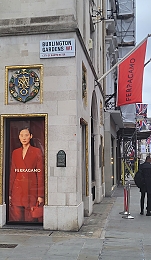
One of them is a shop in a colourfully decorated building. This edifice used to be the home of Atkinson’s – a firm that sold perfumes and beauty products. Founded in 1799, it moved to the building on the corner of Burlington and Old Bond Streets in 1832. The decorative building is surmounted by a carillon of 23 bells, which is played by hand occasionally – to celebrate both public and private special occasions. Currently, the ground-floor is occupied by a branch of Ferragamo’s. And this firm has a connection with memories of my mother.

Salvatore Ferragamo (1898-1960), born in Italy, was a designer of luxury shoes. His clients included the Maharani of Cooch-Behar, Eva Peron, and Marilyn Monroe. He died in Florence (Firenze), where he had a shop on the Via dei Tornabuoni. This shop was close to Via del Giglio, where we as a family used to spend a fortnight in the city every year until I was about 15.

One of my clearest memories of our sojourns in Florence was not the Uffizi or the famous Duomo or the Medici Chapels, or even Michelangelo’s statue of David, but Ferragamo in Via dei Tornabuoni. You might wonder why. It was not that I have a shoe fetish or any great interest in footwear. It was because of my mother. Hardly a day passed without us having to enter Ferragamo’s to watch my mother trying on several pairs of shoes. For a youngster like me this was not an interesting way to spend my precious school holidays. And what is more, I cannot recall my mother ever buying a pair of shoes in that shop.

Facing Ferragamo’s on the corner of New Bond Street and Burlington Gardens, there is a small paved open space. In the middle of it, there is a bronze sculpture of a horse and rider. This was sculpted by Elisabeth Frink (1930-1993). My mother was also a sculptor and met Frink (or ‘Liz Frink’, as we knew her) at St Martins School of Art (in Tottenham Court Road), where they both worked in the Sculpture Department. They became close friends. I used to meet Liz Frink when she was invited to our house for dinner occasionally.

The Frink sculpture has been on Bond Street since 2018. Before that, it was located at the corner of Dover Street and Piccadilly, where it was placed in about 1975. As for the branch of Ferragamo’s that faces it across Burlington Gardens, I am not sure how long it has occupied its present site. However, it was only today that it occurred to me that the intersection of the two Bond Streets with Burlington Gardens has a connection with recollections of my mother.

Freshly painted frescos at Tate Britain

FRESHLY PAINTED FRESCOS

UNTIL I WAS SIXTEEN, my parents took me to Florence (Italy) every year, except in 1967 – the year after the city had been devastated by a flood. My parents were crazy about Italy, the Italians, and Italian art. In Florence, we used to view many frescos in churches and palaces and even those removed from their original locations and placed in museums.

Traditional fresco painting was a laborious process, which produced durable images on walls and ceilings. To create a fresco, first a couple of layers of plaster are applied to a surface (wall or ceiling) and allowed to dry. Then, the artist(s) sketch the image that will eventually be created. Next, a part of the sketch is covered with fresh plaster. The extent of this is the area which the artist can paint during one day. While the plaster is damp, the artist paints that section of the picture with water-based coloured paints. As the plaster dries, the paint becomes incorporated within it, producing a surface more durable than if the paint had been painted onto dry plaster. Day by day, section by section, the process is continued until the whole image has been finished.

I mentioned that some frescoes have been moved into museums. The Italians developed a method for doing this. The fresco to be moved is covered with a cloth sheet coated with adhesive, Then the cloth is pulled away from the wall or ceiling. As it is peeled away, it takes with it that layer of the fresco that contains the paint-absorbed layer of plaster. When this layer has been removed, the artist’s sketch becomes revealed. This is of great interest to historians of art, who can learn how the artist developed his final product from his original sketch. This whole process fascinated me when I was a child, and still amazes me.

Most of the great Italian frescos were created many centuries ago, and the process has fallen out of fashion. Well, at least that is what I believed until I visited a lovely exhibition at Tate Britain. On show until the 7th of May 2023, it is a display of works created by Hannah Quinlan (born 1991) and Rosie Hastings (born 1991). They have created six large, colourful images depicting, to quote the Tate’s website:


“…street scenes showing groups of people portraying various power dynamics, class and social relations and positions of authority.”


Attractive and fascinating as these works are, what really intrigued me is the way that they were made. The paintings, which have been created during the last few years, have been executed using traditional fresco technique such as I described above. In an interview recorded on the Tate website, they were asked why they used this archaic technique, and they replied:


“Fresco painting is often found in places of political, legal and educational importance and is executed at a monumental scale. Traditionally, frescos depict scenes loaded with ideology and symbolism while presenting themselves as neutral or universal. A fresco often represents the moral code of the time within which it is painted, intended as an instructional and educational medium that reinforces dominant perceptions.”


I can understand this, and like their reasoning. I enjoyed the exhibition, and encourage others to take a look. Enjoy the frescos, but do not omit to examine the lovely drawing the artists created using graphite.

Buried no longer

THE ITALIAN WRITER and patriot, Ugo Foscolo (1778-1827) was born on Zakynthos when it was part of the Venetian Republic. He became a political activist in what is now Italy and came to London in 1816. In London, he was regarded as a literary celebrity, but this did not always keep him out of trouble. For example, in about 1813 he faced Mr Graham, the editor of the “Literary Museum” in a duel at Primrose Hill. The dispute that led to this was about his ‘Three Graces’.  These three ladies were sisters working in Foscolo’s home near Regents Park. Two of them turned out to be prostitutes, and one of them ran off with his former translator. This led to a duel, whether in Regent’s Park or Primrose Hill is not clear; fortunately, no blood was shed.

Foscolo’s monument in Chiswick

Foscolo lived another few years until 1817, when he died in Turnham Green in west London. He was buried in the lovely churchyard next to the Chiswick church of St Nicholas, where the artist William Hogarth was also interred. The cemetery contains Foscolo’s elegant, well-maintained grave, which is surrounded by a cast-iron railing.

However, Foscolo’s remains are no longer in the old cemetery at Chiswick.

In June 1871, ten years after the Unification of Italy, Foscolo’s remains were dug up and transported to Florence (Firenze). There, they were reburied but within the church of Santa Croce. This is all recorded by words carved on the monument in the Old Chiswick Cemetery.

Bridges over troubled waters: the Florence Flood 1966

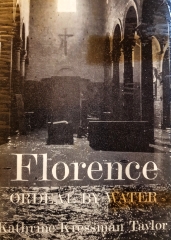
I HAVE JUST finished reading a book about an incident that made a great impression on me and my close family many years ago. The slender volume, “Florence. Ordeal by Water” was written by Kathrine Kressman Taylor (1903-1996), who was an eye-witness to the event that troubled our family so much. The book was first published in 1967.

During my childhood, my parents, who were keen on the art of the Italian renaissance and Italy in general, took my sister and me to the city of Florence every year (until about 1969), except 1967. Visiting churches, museums, and art galleries was not exactly my ‘cup of tea’ when I was a child, especially when I knew that my best friend was enjoying what sounded to me like a far more exciting holiday than mine. Now with the benefit of hindsight, I realise that the experiences that my parents gave me were actually far more valuable than anything I could have gained from annual holidays at a seaside resort in North Wales, where my friend went every summer.

I mentioned that in 1967, we did not make our annual visit to the city on the River Arno, Florence (Firenze). This was because the city was severely affected by a flood in November 1966. This inundation was caused by heavy storms and ill-advised opening of a dam on the River Arno upstream from Florence. The water caused much damage. I remember that when my parents heard that it had happened, they appeared to be as devastated as if a close, much-loved friend or relative had died suddenly.  They decided that visiting the stricken city in 1967 was inadvisable, so we returned in 1968. What we found in 1968 was distressing. The flood water, which had become mixed up with central heating fuel oil, had stained the walls of the city’s buildings, leaving a tide line at the often-high levels that it had reached. These marks remained for several years. In low-lying parts of the city, the water had reached the upper floors of buildings. In addition to damaging the buildings, the water also destroyed many irreplaceable works of art. Dad was particularly upset about the heavy damage suffered by a crucifix painted in about 1265 by Cimabue, which hung in the Church of Santa Croce. He used to mention this often. I felt that this affected him more than the damage to the rest of the city.

Miraculously, the surging waters of the Arno in spate and laden with tree trunks and other heavy debris did not significantly damage any of the many lovely bridges that cross the river. This is unlike what happened at the end of WW2 when the retreating Germans destroyed all the bridges except the Ponte Vecchio.

Kathrine Kressman Taylor, whose book I have just read, was living in a palazzo in Florence when the great flood hit the city. Her book is a diary of what she and the Florentines experienced when the waters of the Arno almost destroyed the city, and the aftermath. It is a compelling account of the tragedy, filled with vignettes and anecdotes that illustrate the true horror of what happened. What shines out in her account was that despite overwhelming odds, the Florentines refused to be defeated by the events that rendered many homeless and caused an even greater number to lose all their worldly possessions and their livelihoods. As soon as the oil-filled, filthy waters began to subside, the citizens of Florence as well as foreigners who had become trapped there began to work on restoring the city.

Reading Kressman Taylor’s account has given me a much clearer idea of the extent of the disaster than I had as a youngster just after it had happened.

By the way, I must mention how I ‘stumbled’ across this marvellous book about Florence. A friend had given me a copy of the recently republished novella, “Address Unknown”, by Kressman Taylor. First published in 1938, this book subtly drew her readers’ attention to the plight of Jewish people in Nazi Germany. Having read and enjoyed it, I looked to see what else the author had written. When I saw that she had written about the flood that had upset us so much in 1966, I had to read it, and I am pleased that I did.

Cups of ice-cream and…

Remembering the 1960s in Florence, Italy

florence

The short Via dei Tavolini was another of our regular morning destinations in Florence. Situated in the heart of the city between the Duomo and the Uffizi, we visited this street frequently during each visit to the city. It contained 3 important shops: the ice-cream shop called Perché No? (‘Why not?’), a dress material shop, and a shop with the name  ‘Busti Biondi’. It was in the latter that my mother had her brassieres made to measure.

During my earlier visits to Florence, when my parents were less confident of their spoken Italian, they were assisted by Giorgio, who owned the material shop between the ‘bra’ shop and the ice-cream parlour. Giorgio, who had learnt English from British soldiers during WW2, translated for my parents. Like so many Italians, he was fond of children, and we grew to like him. For years, he used to send my sister first day covers of newly minted Italian postage stamps. His patience must have been impressive because my mother was not an easy customer. She and my father spent what seemed like hours in Busti Biondi whilst the bras were tried on, discussed, and returned for endless
alterations.

My mother was buxom, a trait shared by many ladies in her family, and extremely particular that things should be just right. As far as I was concerned, the positive feature of these visits to the Via dei Tavolini was seeing and talking with Giorgio as well as the chance to enjoy cups of some of Florence’s best ice-cream. We thought that Perché No? was the best ice-cream place in the city, but others favoured Vivoli, a gelateria close to the church of Santa Croce. We did try that place, but it failed to change our high opinion about our favourite place close to my mother’s bra shop. If it had not been for my mother’s breasts we would not have met Giorgio and might have never discovered Perché No.


This is a brief extract from my book “Charlie Chaplin waved to me” available on Kindle and also as a paperback by clicking HERE


photo source: wikipedia

Learning the lingo: Italian

aerial photography of city


Until I was 16 years old, I accompanied my parents on annual holidays in Florence (Italy). We always stayed at the Pensione Burchianti, which was run by two ageing sisters. Almost every evening, we ate dinner in a nearby restaurant (the Buca Mario). This excerpt from my book CHARLIE CHAPLIN WAVED TO ME describes how I began to acquire some limited skill in speaking Italia. Here is the excerpt:

” … After dinner we would walk back to the Burchianti. It might have been during one of these evening strolls that my father came up with a new version of the saying ‘a penny for your thoughts’, namely: ‘a penne for your sauce’. The traffic in the streets would have quietened down by the time that we had eaten, and all of the traffic signals, or ‘robots’ as my South African parents called them, had flashing amber lights instead of the usual sequence of three coloured lamps. The pedestrian signals, which alternated between the red ‘Alt’ and the green ‘Avanti’ during the day, simply flashed both messages at the same time at night.

When we arrived back at the Burchianti, the residents, who had been eating supper, were usually still lingering at their tables. Many of them almost lived in the Burchianti. There was an elderly commendatore, who took all his meals there but slept elsewhere. There were also a number of business people who spent the week working in Florence, but resided some distance away in the weekend. They lived in the pensione during the week. One of these was a lady pharmacist from Parma who spoke Italian with a curious accent, rolling her ‘r’s in an exaggerated way.

On entering the dining room, we would be greeted like old friends, which I suppose we were. We would be invited to sit at the sisters’ table, and then I had to perform. One of the sisters would ask me in Italian what I had eaten for dinner, and I had to reply in Italian. Everyone listened to my reply which usually went something like this:
Primo piatto o mangiato spaghetti con pomodoro. Dopo o mangiato bistecca con patate fritte. E dopo, profiterole.”

It was not difficult to relate what I had eaten because every dinner I ordered the same thing or substituted lombatina di vitello (veal chop) for the bistecca. This nightly recitation gave me the confidence to try to speak in Italian, even if badly. When I did not know a word, I tried using a Latin word but pronounced it in a way that I believed made it sound Italian. Often, this worked! ...”


If you want to know whether Charlie Chaplin really did wave to me, grab a copy of my book from:

https://www.bookdepository.com/Charlie-Chaplin-Waved-Me-Adam-YAMEY/9781291845051

OR

http://www.lulu.com/shop/adam-yamey/charlie-chaplin-waved-to-me/paperback/product-21611544.html

OR Amazon or Kindle store


Photo by Josh Hild on Pexels.com

St John’s finger

finger

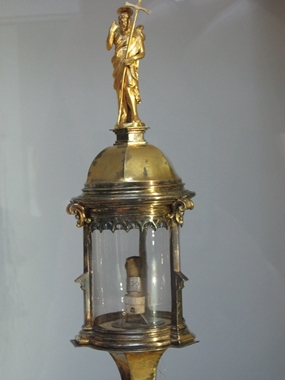
It might have been in the Bargello, or more likely in the Museo dell’Opera del Duomo, both in Florence (Italy), that there was (and probably still is) an exhibit that captured my imagination when I was a young child. Amongst a collection of holy relics housed in elaborately crafted silver and glass containers, there was one holy relic that looked a bit like the stub of a discoloured cigar. It was, so the museum label stated, a bone from the index finger of St John the Baptist. Whether it was or was not, this item fascinated me, and even haunted me.

Many years later when I was looking into the story of St Appolonia, the patron saint of dentists, I read that one of the miraculous properties of the body parts of dead saints is their ability to reproduce themselves – a feature that must have been useful for those who used to sell such things. I am glad that I had not known this when I used to stare fascinated at St John’s finger, which I then believed to be exactly what it claimed. That would have spoilt my amazement, which I always felt when I saw that piece of bone in its ornate container.


Photo from flickr

Train to Florence

Settebello_power_car


Until I was about 17 years old, my parents used to take my sister and I for long trips to Florence and Venice every year. Often, we would fly from London to Milan, and then take a train to Florence. Frequently, our reserved seats were occupied by other passengers, who would only shift elsewhere when we had got the carriage’s conductor to intervene on our behalf.

Here is an extract from my reminiscences of childhood travel in Italy from my book “Charlie Chaplin waved to me“:

“Once we were seated in our reserved seats, we began to enjoy the 3 hour journey to Florence. Within minutes of entering our carriage or compartment, my mother would begin to strike up a conversation with whoever was sitting nearby. My mother and two of her three brothers, one of whom lived in London and the other in Cape Town, were always happy to initiate conversations with complete strangers. Her only sister and other brother were less inclined to do this. Mostly, our fellow passengers were Italian, but once I recall sharing a compartment with an elderly American lady who was considerably older than my parents. After a few minutes of friendly conversation, she revealed that her son was none other but the world-famous violinist Isaac Stern (1920-2001), who was born 3 months before my mother.

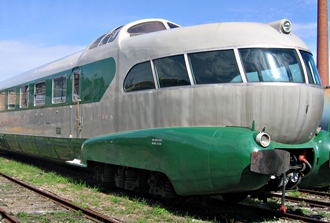
Occasionally we were lucky enough to travel on a Settebello train. These high speed streamlined electric trains, which plied between Milan and Rome and stopped briefly in Florence, were the pride of Italian State Railways. At each end of the train there was an observation saloon. The driver’s cabins were located above these. When travelling in the front observation cabin, one experienced a driver’s view of the track ahead. As a child who loved trains, sitting in these was a great treat for me. I still gain great enjoyment sitting at the front of trams and trains. One of the attractions of London’s Docklands Light Railway, which weaves its way through London’s former docklands and other reclaimed parts of the East End, is that there are seats at the front of the train where a driver would normally be seated had the train not been automated.

About an hour away from Florence after passing through Bologna, the train entered a long tunnel. Even the fastest trains took almost half an hour to travel through this. Soon after we emerged from it we sped through the town of Prato, and then the suburbs of Florence (Firenze in Italian) began. I knew that after we had passed the marshalling yards at Firenze Rifredi, we would soon be entering the huge terminal, Florence’s Stazione di Santa Maria Novella.


Charlie Chaplin waved to me is available from:

Amazon, bookfinder.com, lulu.com, and on Kindle


Picture: Front of a Settebello train showing the observation lounge and the driver’s cabin above it. Source: it.wikipedia.org

Nothing changes

Palermo

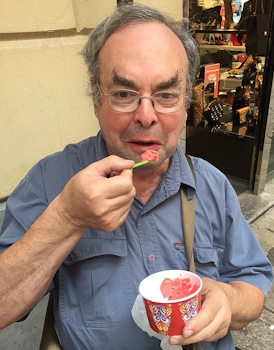
It is 2018, and I am eating ice cream in Italy after the ladies in my family have just visited a shop selling brassieres.

60 years earlier, aged 6, I was doing the same thing. We used to visit Florence annually during my childhood. Every year, my mother used to buy her bras in Florence at a shop close to an excellent ice cream shop called “Perché no?” (IE Why not?). After every visit to the bra store, I was rewarded with an ice cream.

Now, here in Palermo, the same thing has happened six decades later?

Nothing changes.