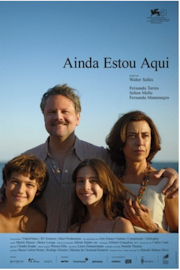
WE HAVE JUST WATCHED a superb film from Brazil, “I am still here”. It was released in 2024 and has deservedly just won an Oscar for being ‘the best foreign film’.
Sensitively and beautifully, it charts the catastrophic life of a family after one of its members is kidnapped during Brazil’s military dictatorship (mid-1960s until the 1980s). This film based on the life of one of those who was ‘disappeared’ by the military authorities, Rubens Paiva (1929-1971), is both terrifying and moving. Each character in the film acts perfectly. This is docu-drama at its best.
MOST FILMS WE have watched at the Garden Cinema near London’s Holborn have been excellent or extremely excellent. Today, we watched a Taiwanese film called “Days”, directed in 2020 by Tsai Ming-liang. It is one of the slowest moving films I have ever seen. It was not devoid of interest, but it was almost sleep inducing. Lasting about 2 hours, it felt like months, not days.
GEORG WILHELM PABST (1885-1967) was a film director born in Austria. His film “Westfront 1918” was produced in 1930. This harrowing film vividly portrays the horrors of trench warfare and its effects on both the active German soldiers and their families back home in Germany. It is really an anti-war film. It was banned by the Nazis because it did not portray German soldiers as victorious heroes. Today, the 11th of November 2023 (Armistice Day), we watched a screening of this horrifying film about the last months of WW1 at Bangalore’s Max Mueller Bhavan (a branch of the Goethe Institute).
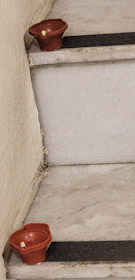
After the screening and interesting discussion about the film were over, we walked down the staircase instead of using the lift in which we had ascended. On each of the steps, there were small terracotta oil lamps (diyas), such as are typically lit during the Hindu festival of light – Diwali. Seeing this charming set of lamps placed to celebrate the imminent festival raised my spirits after having watched such a depressing film about the futility of warfare.
THE PHOTOGRAPHER BALDWIN Lee, a Chinese American, was born in Brooklyn (New York) in 1951. He studied photography at MIT and then at Yale. In 1982, he was appointed Professor of Photography at the University of Tennessee, where he established the university’s photography course. As a New Yorker born and bred, he was amazed at the contrast between living conditions in the southern states and where he had come from. He began making tours of the south, photographing members of various African Americans at home, at work, and at play. Over the years he took more than 10000 photos. All of them are in the black and white format. Apart from being fascinating glimpses of the everyday lives of low income ‘black’ Southerners, they are beautifully composed, superbly detailed images – well worth seeing, as we did recently at the David Hill Gallery in London’s Ladbroke Grove.
At his gallery, David Hill discussed Lee’s work with us. What particularly interested me was that Lee used (still uses) an old-fashioned field camera with a lens made before WW1. He chose this old lens because unlike modern lenses its glass has no coating. Also, and this is something I learned long ago, many of these older lenses were hand ground, rather than machine made. This resulted in the lens having a far better resolution than many of the best quality lenses that were available in the 1980s. The type of camera that Lee used to make his splendid photographs was not dissimilar to the kind of camera that early photographers such as Julia Margaret Cameron (1815-1879) used to create images. The lens on the simple camera that Lee used projects an image onto a ground glass screen at the back of the camera. In Victorian times, a prepared glass photographic plate used to be attached to the rear of the camera to capture the image. Lee, working more that 100 years later, captured his images on sheets of 5×4 inch high quality, fast negative monochrome film. Using these, Lee was able to create high resolution photographic images, and his subjects did not have to hold their poses for nearly as long as was the case when Cameron was creating her photographs. Because Lee’s subjects did not have to maintain their poses for more than a few seconds, his images are far clearer than Cameron’s whose subjects often had to try to remain still for many minutes. This meant that in addition to the deliberate artistic manipulations that Cameron made in her dark room, the inevitable slight movements that her subjects made added to the interestingly other-worldly images she created.
The advantage of using an old-fashioned camera and lens, such as Lee employed, was that it was a high-quality pin-hole camera. Unlike modern cameras, these present hardly anything that might alter the light entering the camera and affect the images. I found it fascinating that apart from taking advantage of the improvements in film quality this superb photographer prefers to use a camera that would have been familiar to Julia Margaret Cameron rather than a modern one that made the light entering it take a complicated path from the outside world to the film surface.
You can read more about Cameron in my book, which is available here:
AFTER WATCHING THE trailer for Wes Anderson’s latest film “Asteroid City”, which was released in the UK in June 2023, I could barely wait to see the movie. We chose to view it in a cinema that I had passed several times in the past, but never entered – Genesis in London’s Mile End Road, not far from Stepney Green Underground station. It has an Art Deco façade and a long history (described in full on https://genesiscinema.co.uk/GenesisCinema.dll/Page?p=3&m=mm).
In brief, the site occupied by Genesis was first the location of a pub called Lusby’s, which opened in 1848 and later became a music hall. After it was destroyed by fire, the Paragon Theatre, designed by Frank Matcham (1854-1920), opened in 1885. Matcham was responsible for the design of many of London’s theatres. Between 1912 and 1989, the theatre was used as a cinema, and had many different owners. It closed in 1989. The cinema’s website includes the following episode which occurred in 1963:
“Princess Margeret was scheduled to attend the royal premiere of Barbara Windsor’s film ‘Sparrows Can’t Sing’. However, as notorious East End gangsters, The Kray twins were also attending, royal protocol meant that her husband Lord Snowdon had to attend in her place. So, needless to say, everyone ended up at the afterparty at the pub over the road… the Kray twins’ Kit Kat Club.”
In 1998, Tyrone Walker-Hebborn, an electrician, fell in love with the deserted cinema, refurbished it, and opened it as the Genesis Cinema in 1999. Having seen multiplex cinemas in the USA, he converted Genesis into a multi-screen cinema complex. During the covid19 pandemic, Tyrone took advantage of the fact that nobody could enter his cinemas, and refurbished many aspects of the building including the foyer and bar. Today, Genesis is a pleasant place both to enjoy a drink and to watch a film – and the ticket prices are reasonable by London standards.
As for “Asteroid City”, which has received many rave reviews, I was disappointed. Although the film has many wonderful moments, I did not think it was as wonderful as Anderson’s films such as “Darjeeling Express” and “Grand Hotel Budapest”. On a positive note, the Genesis cinema complex is a place I hope to visit often.
CONSTRUCTED IN 1974, it was 221 feet tall. It overshadowed the homes of many people including many of the wealthier inhabitants of West London’s Kensington. And I imagine that the wealthy inhabitants of the elegant crescents and other thoroughfares near it did not appreciate the views from their windows being spoiled by this Brutalist block of flats containing less well-off people, about whom they would rather not think. Between 2015 and 2016, the block was refurbished and made less of an eyesore by the addition of cladding – ostensibly to improve insulation – to its exterior.
On the afternoon of the 13th of June 2017, I was walking around North Kensington, taking photographs as usual. I stopped to take pictures of the recently built Kensington Leisure Centre and its near neighbour the Kensington Aldridge Academy – both are interesting examples of contemporary architecture. While I was taking these photos, I had my back to the tower block I have just described. Had I looked at it then, I would have thought that it would have been of little interest to me. How wrong I was.
Just after midnight on the following day, a fire broke out in that tall block – Grenfell Tower – that edifice which overlooked the homes of the wealthy residents of Kensington. The fire spread rapidly because of the highly inflammable nature of the cladding used to make the tower more attractive to its neighbours. Seventy-two people died in the conflagration; many were injured; and all the surviving residents were not only badly scarred psychologically, but also lost their homes and possessions.
From wherever you looked in a large area around Grenfell, including from the homes of the prosperous residents of Holland Park and Notting Hill, one could see the horrifically charred tower block – a fear-inspiring eyesore – the result of local government officialdom ignoring repeated warnings about the already known potential fire hazards that the cladding presented and inadequate planning for escape during a fire. I felt – and I am not alone in thinking this – that the local council hardly cared for a few impecunious residents in a tower block. What was more important was to save money so as not to impose high local taxes on people who could have easily afforded to pay them.
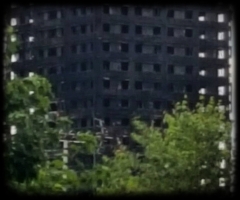
Soon after the fire, the charred tower was covered with protective wrapping to assist forensic investigations and to contain debris, which might otherwise have flown away and dropped in the neighbourhood. It also removed from sight the scarred, charred remains of the building – a 24 hour a day reminder of the avoidable, tragic loss of life, which was not altogether disconnected with civic and possibly criminal negligence. The remains of the tower are still covered up. Before the heart-rending remains of the conflagration were covered up, filmmaker Steve McQueen (born 1969 not far from Grenfell Tower) made a short film about the tower. It is currently on show at the Serpentine South Gallery in Hyde Park until the 10th of May.
The film is without words in its soundtrack and without any captions. It looks as if it might have been filmed with a drone or a camera held within a helicopter. It begins with a flight over beautiful countryside far beyond the edge of London. The camera moves above the scenes of rural serenity and slowly the city of London comes into view. We pass over London’s sprawling suburbs, and then the charred Grenfell Tower begins to be seen in the centre of the screen. The camera moves closer and closer to the blackened building, and then slowly circles around it many times. Each time the tower is slowly encircled, and the camera moves closer to it, more and more details of the destruction entered my consciousness, and my understanding of the horror of what had befallen Grenfell and its inhabitants gradually increased. As the camera moved around the wreck, you could catch glimpses of the parts of London surrounding it – the houses and flats of those who must have witnessed the fire, but were not affected by it, at least not physically. As the camera moved, one could see trains moving on nearby tracks and vehicles travelling along roads. I felt that I was witnessing life going on as usual at the same time as witnessing the horrors of a disaster. The absence of commentary added to the powerful impact that seeing these images of a lethal incineration simultaneously with scenes of normality made on me. There was a soundtrack, which consisted of recordings of everyday sounds – both natural and man-made. However, while the camera encircled the tower of death, there was no sound at all. I wondered whether this signified the fact that the victims, who had died, will no longer be able to enjoy the sounds of everyday life.
McQueen’s film is a sophisticated and solemn memorial to an event that could easily have been avoided. Without a soundtrack or explanations, the viewer is left to ponder the tragedy in his or her own way.
THE RIO CINEMA in London’s Kingsland Road district (in Dalston) is a fine example of a film theatre constructed in the Art Deco style. It was designed by Frank E Bromige, who specialised in designing cinemas in that style, and constructed in 1937 on the site of an earlier Edwardian-style film theatre, which first opened in 1909. The Rio has been showing films ever since then. Since 1976, the Rio has been run successfully, and independently of any cinema chain, as a not-for-profit charity. The cinema’s Art Deco exterior has been faithfully maintained and the interior’s original design has been reconstructed. There are two screens. The largest one, the main auditorium, looks much as it might have done when it was built in the late 1930s. There is a smaller auditorium in the basement. This has a large screen and comfortable raked seating.
Today, the 18th of March 2023, we watched a film in the smaller auditorium. Called “Lunana: A Yak in the Classroom”, this film was shot mainly in the tiny Himalayan Kingdom of Bhutan. It is a beautiful film, beautifully made. Without giving the story away, it is about the experience of a young Bhutanese teacher sent from the capital to teach in a remote village called Lunana. The tiny elementary school in that high altitude settlement surrounded by breathtakingly attractive mountain scenery is the remotest school in the world. The film shows how Lunana impacted on the young teacher and vice-versa.
Apart from having a good story, some humour, and much emotion, the film provides a fascinating view of Bhutan. “Lunana” allows the viewer to realise the spectacular nature of the country’s landscape and rural traditions. What particularly interested me was the depiction of a lifestyle so remote and different from what we are used to here in the west and in many parts of India, even also in the urban areas of Bhutan’s neighbour Sikkim. The subject of global warming is introduced, but in a quite subtle way. The villagers in Lunana are portrayed as being simultaneously innocent, playful, spiritual, and philosophical. Although “Lunana” is a highly enjoyable film and Bhutan is portrayed in an affectionate and appealing way, I felt that the country, which is undoubtedly spectacularly attractive, is not one that I am in a hurry to visit. It is an unusual and unique film, and it was appropriate to have watched it in one of London’s unique individual cinemas.
THE ARTIST WILLIAM Kentridge (born 1955), son of a prominent lawyer, is a South African. His creations are usually highly imaginative and often politically challenging and critical of the subjugation of non-European African people. This is fascinating given his privileged background – having been brought up in a South Africa where the ‘white’ people were a highly advantaged section of the population until the ending of the apartheid regime (and maybe even now to some extent).
His artworks are frequently dramatic, often employing cinematographic and sometimes theatrical techniques. The messages they convey to the viewers can be both disturbing and humorous, sometimes both simultaneously. Whenever I have seen them, I have been both fascinated visually as well as moved emotionally.
The Royal Academy of Art in London’s Piccadilly has a large retrospective exhibition of Kentridge’s work until the 11th of December 2022. Apart from numerous drawings, tapestries, and other static artworks, there are plenty of his cinematographic installations on display. In fact, there are too many of these installations. Each one is amazing to see, but having so many together in one place spoiled their intended impact. Just as the first chocolate from a box is wonderful, eating all of them at once gives one indigestion, and this was the case with the Royal Academy’s crowded assemblage of Kentridge’s works. Too much was crammed together in insufficient space. To be fully enjoyed, each of his installations should be seen on their own in a sufficiently spacious environment – they need ample room to breathe and express themselves.This overcrowding was a pity because the exhibition does not allow his works to shine in their full glory.
A COLOURFUL FABRIC artwork, a tapestry, by the artist Sonia Delaunay (1885-1979) hangs on a wall overlooking the grand staircase at the Institut français (‘IF’) in London’s South Kensington. Born in Odessa (Russian Empire) as Sarah Elievna Shtern, she spent most of her working life in Paris (France) after having studied art in both Russia and Germany.
Sonia Delaunay at Institut Francais in London
The stairs lead from the ground floor to the first. It is at this level that the IF’s main and biggest cinema, the Ciné Lumière 1, is located. This airy cinema has rows of comfortable seats each with enough legroom to satisfy even the tallest person. We had come (on the 3rd of September 2022) to watch a Spanish film called “Official Competition”, starring amongst others Penelope Cruz. Frankly, I found this much-hyped film dull, disappointing, and somewhat puerile. The plot revolves around filmmaking and competing egos. The audience is treated to too much philosophising (actually, navel contemplating) about acting and moviemaking, the content of which would be considered almost infantile by high school children. However, the cinema’s comfortable seating made watching the film almost bearable. In the past, we have seen far better films at the Lumière, to which we will return to see other films in the future.
Apart from the poor film, the visit to the IF was fun. It was great seeing the Delaunay and we enjoyed cool drinks in the pleasant Café Tangerine on the ground floor.







 yamey
yamey 