From Cairo to Kent and Karl Marx

IN RECENT YEARS, the seaside town of Margate in Kent has become much more of a “trendy” destination than it used to be. From being yet another coastal resort, it has become a magnet for those interested in contemporary art. This is because of the presence of the Turner Contemporary Gallery, Tracey Emins’s gallery, and the Carl Freedman gallery … to mention but a few places. With the influx of tourists with sophisticated tastes, the town has become home to a range of restaurants, which is more varied than in many other seaside towns in north and east Kent.

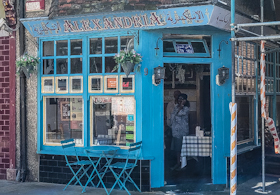
About 6 years ago, a husband and wife from Cairo (Egypt) set up a tiny restaurant on a corner plot in the old centre of Margate. It is called Alexandria Café. The owners chose the name not because they come from Alexandria, but because like the Egyptian city, Margate is by the sea.

Only open on Fridays, Saturdays, and Sundays at present, this restaurant serves beautifully prepared, tasty Egyptian dishes at very reasonable prices. We tried koshari, falafel, baba ganush, pickled tomato salad, and mint tea. Although these are all without meat, non-veg dishes are also available.

The tiny, comfortable eatery is decorated with photographs of Egyptian film stars. A small television screen was showing old Egyptian films.

A few doors away from the lovely Egyptian cafe, there is an ice cream parlour. What makes it special is that in 1866, Karl Marx stayed in the building.

We did not try the ice cream, but I can safely say that of all the places I have eaten in Margate, having visited the place many times, Alexandria is the best.

AN artist born in Egypt who makes sculptures in Switzerland

THE WADDINGTON CUSTOT Gallery in Mayfair’s Cork Street puts on excellent exhibitions and the current show, which goes on until 10 April 2025, is no exception. It is an exhibition of sculptures by Yves Dana, who was born in Alexandria (Egypt) in 1959. He moved with his family to Switzerland in 1961. It is there that he lives and works. In the early 1980s, he set up a sculpture studio in Lausanne (Switzerland). In 1996, he paid a return visit to Egypt. Following that, his approach to sculpture changed dramatically. The sculptures on display at Waddington Custot were made long after that visit to the land of his birth; they date from 2004 until 2024.

Each of the works we saw, both at the gallery and outdoors in Smithson Plaza (near Bury Street), is pleasing to the eye. Many of the sculptures allude to the art of Ancient Egypt in subtle ways. Several of the artworks brought to mind the simple beauty of Cycladic sculptures and others evoke the harshness of desert climates.  The gallery’s website revealed that Dana:

“… sources the best quality stone from around the world, including limestone from Egypt, France and Turkey, serpentine from Italy and diabase from Germany. He combines innovative carving techniques with traditional tools to create precise planar forms. With each work created over several weeks or months, the physicality of carving stone, with deep sensitivity to its tones and texture, is evident in the subtlest details of each work.”

This is very evident as one looks at the often sensuously shaped abstract forms of his sculptures. Where there is an interesting detail inherent in the material, he shapes the sculpture so that the viewer’s eyes are drawn to it. Although Dana imposes his artistic will on the materials he employs, he is also sympathetic to their original forms and textures and does not force them to submit totally to his compositional ideas. `Put another way, it seems that Dana’s compositions are guided by the physical properties and shape of the materials he is using.

As you can gather from what I have written, brief though it is, I enjoyed seeing this show and getting to know the work of an artist, whom I had not known about before.

AN OBELISK IN THE HEART OF OLD ISTANBUL

COVERED WITH HIEROGLYPHS, and standing close to Istanbul’s Sultanahmet Mosque, there is a tall obelisk mounted on 4 metal brackets, which rest on a stone block covered with bas-relief carvings. It is called Dikilitas in Turkish, and The Obelisk of Theodosius in English.

Over 65 feet tall, it is only a small part of an obelisk that was commissioned by the Egyptian Pharaoh Thutmose III (1549-1503 BC), and it stood opposite Thebes. The fragment that stands in the former hippodrome of Istanbul was brought to what was then Constantinople in the 4th century AD. It was erected in its present position by Emperor Theodosius the Great in 390 AD.

The carvings on the plinth that support the obelisk depict Theodosius and his officials involved with the races that were held in the hippodrome. The obelisk and two other vertical structures marked the cental line or long axis of the race course.

During our current visit to Istanbul, we often walk past the obelisk on our way to our nearest tram station. We usually do this in daylight. However the best time to see the obelisk is after dark when it is beautifully illustrated with spotlights that enhance the appearance of both the hieroglyphs and the sculptures below it.

Inspired by the Pharaohs

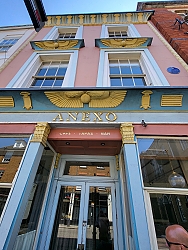
THE TOWN OF HERTFORD is full of delightful old buildings. A house on the town’s Fore Street has a façade decorated with features that bring to mind Ancient Egypt. Known as the Egyptian House, it was built in about 1825 for the grocer JM Gilbertson, who was Mayor of Hertford in 1832. In many ways it resembles a building with an Egyptian style façade. which I have seen in Penzance (Cornwall), This was constructed in about 1835. Both of the house in Hertford and that in Penzance were built later than the now no longer existing Egyptian Hall London’s Piccadilly, which was built in 1812, and was the inspiration for the Egyptian Revival Style of the later edifices in Hertford and Penzance.

The Egyptian House in Hertford is colourfully painted, as is the building in Penzance. Sadly, the Egyptian Hall in Piccadilly was demolished in 1905 to make space for the construction of a block of flats. The Egyptian Revival Style became fashionable during the time of the Egyptian campaigns (end of the 18th century) in the Napoleonic Wars.

Currently, Hertford’s Egyptian House is home to Anexo – a “tapas restaurant and charcuterie bar”. It serves fare that would have been unknown in Ancient Egypt. I wonder what the Pharaohs would have thought about a place like this.

Digging for riches

SWAFFHAM IS A SMALL town in Norfolk, west of Norwich. Two of its former inhabitants enriched their lives by digging. One of them is more widely known than the other. The lesser known one was a pedlar, who lived in the 15th century and was most probably called John Chapman.

The pedlar had a dream in which he was told to go to London Bridge to receive some good news. He ignored it at first but after it had recurred several times, he set off for London with his pack on his back and his dog at his side. When he reached London Bridge, he found nothing, and received no good news. After a few days of lurking on the bridge, one of the shopkeepers on that ancient crossing of the Thames asked him what he was doing. The pedlar related his dream and the shopkeeper replied:

“How foolish you are. You should not believe such dreams. Why, only last night I dreamt that I should go to Swaffham in Norfolk and dig under an apple tree where a pot of treasure was buried. Do you think I should believe that? Of course not, my friend. If I were you, I would go home and ignore such dreams.”

Hearing this, the pedlar realised that he had just heard the good news for which he had come to search.

Back in Swaffham, the pedlar dug beneath his apple tree and discovered a pot of gold. After emptying the pot, he added it to the wares he was peddling. The pot had a label attached. As the pedlar was illiterate, he asked a local priest to read it to him. The words on the pot said:

“Beneath me, thou shalt find even greater riches.”

The pedlar returned to his apple tree and began digging again. Lo and behold, he discovered another pot filled with gold, far more than in the first.

Whether or not this tale is true, there was a John Chapman in Swaffham, who lived in the town and was a church warden in 1462, at the time when the parish church was being rebuilt. He donated a huge amount of money towards building both the church’s tower and its north aisle.

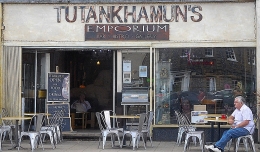
The existence of the digging pedlar and his story might possibly be questioned by sceptics, but that of Swaffham’s other famous digger is beyond doubt. When we visited Swaffham recently, it was hard to miss seeing an eccentric looking café-cum-curio shop called ‘Tutankhamun’s Emporium’, with the subtitle  ‘Bar, Bistro, Gallery’. In addition to a Russian restaurant called Rasputin, the choice of an Ancient Egyptian’s name for a café in Norfolk struck me as odd until we visited the town’s small museum.

Samuel John Carter (1835-1892), a noted Victorian animal artist and illustrator, was born in Swaffham. After studying at the Royal Academy, Samuel lived both in London and Swaffham. He married Martha Joyce Sands, born in Swaffham, and the couple produced 11 children, the youngest of whom was named Howard. They lived most of the time in London, where Howard was born (in Kensington). Howard, a sickly youngster. Was sent from London to live with Samuel’s sisters in Swaffham.

Howard Carter (1874-1939) spent most of his childhood in and around Swaffham. Like his father, Howard had great artistic talent. He used to visit local country houses with his father when the latter was up in Norfolk. One of these was Didlington Hall near Swaffham. Its owner, William Amhurst Tyssen-Amhurst (1835-1909), an MP, was a great collector of books and antiquities. The collection included many Ancient Egyptian artefacts, which fascinated young Howard. In 1890, the Amhursts were visited by Percy Newberry (1869-1949), who worked for the Egypt Exploration Fund. Discovering Howard’s talents as an artist and interest in history, Newberry invited him to work at the British Museum, copying tomb and other wall paintings that had been discovered in Egypt. Soon, Carter was sent out to Egypt on archaeological expeditions to work alongside the archaeologists. In 1922, Howard discovered the tomb that contained the remains of the boy king (pharaoh) Tutankhamun (c1341-c1323 BC). This discovery brought great fame to Howard: a digger brought up in Swaffham.

The local museum in Swaffham has displays relating to Carter and Tutankhamun. Both might be flattered if they were to learn that a small town in Norfolk, many thousands of miles away from the River Nile, has a café named after the short-lived pharaoh. As for the pedlar, the town is full of images of him trudging along with a pack on his back. In the parish church, which he might well have helped to finance, there are woodcarvings of him and his dog.

We visited Swaffham whilst travelling around Norfolk because we had read that it has an attractive parish church and an unusual 18th century circular market cross. However, learning about the pedlar and the archaeologist, two famous diggers, were unexpected bonuses for us.

From Egypt to Dorset

CLEOPATRA’S NEEDLE IS a familiar landmark in London. It was originally erected at Heliopolis in Ancient Egypt in about 1450 BC and brought to London in about 1877. Less well-known is another hieroglyph covered obelisk in the gardens of Kingston Lacy near Wimborne in Dorset.

The pink granite obelisk at Kingston Lacy arrived in the grounds of this rich family’s dwelling in about 1827. Like Cleopatra’s Needle, this monument is inscribed with hieroglyphics. Because there is a mixture of Greek words and hieroglyphics, the obelisk, discovered on an island in the River Nile, became important in the early attempts to decipher the Ancient Egyptian writing.

In Banke’s collection of Egyptian artefacts at Kingston Lacy

Kingston Lacy has been owned by successive generations of the Bankes family since the 1660s, when John Bankes (1589-1644) took possession of the estate and built the present grand house. One of his descendants, William John Bankes (1786-1855), who met Lord Byron when they were both studying at Cambridge University, first travelled in Spain and collected a vast number of Spanish paintings, many of which are hanging within Kingston Lacy House. Later, during the early part of the 19th century, William travelled extensively in the Middle East and along The Nile. During his travels, he collected many valuable Ancient Egyptian artefacts, some of which are beautifully displayed in a former billiards room within Kingston Lacy House.

The obelisk was found by Bankes at Philae in Upper Egypt in 1815. According to Wikipedia (https://en.wikipedia.org/wiki/Philae_obelisk), the inscriptions on the object:

“… record a petition by the Egyptian priests at Philae and the favourable response by Ptolemy VIII Euergetes and queens Cleopatra II and Cleopatra III, who reigned together from 144-132 BC and again from 126-116 BC. The priests sought financial aid to help them deal with the large numbers of pilgrims visiting their sanctuary and the king and queens granted the sanctuary a tax exemption.”

Both the Greek and the Egyptian inscriptions deal with the same topic but are not direct translations of each other.

The Egyptian House

WE WERE NOT EXPECTING to see anything like it when walking down Chapel Street in the centre of the Cornish town of Penzance. What we saw immediately recalled the pseudo-Egyptian, art deco Carerras Building near Mornington Crescent in London. The building in London is far larger than that we found in Penzance, the Egyptian House. The Carreras Building was built in 1926-28. The Egyptian House was built far earlier, in 1835-36. Admittedly, the two buildings hardly resemble each other but when I saw the one in Chapel Street, I immediately thought of the structure in Mornington Crescent.

The Egyptian House is a regularly shaped building with an extraordinary façade. The front of the building is decorated in colourfully painted bas-relief with ornamentation that evokes thoughts of Ancient Egypt. The windows of this three-storey building are not rectangular. Each of them is framed in isosceles trapezoids (the top and bottom of each frame are parallel, the top being shorter than the bottom, and the sides of the frames form truncated isosceles triangles). All three layers of windows are framed in a large decorative isosceles trapezoid. This creates the illusion that the façade is tapering rather than rectangular. An informative merchant, who spoke to us from his shop across the road from the Egyptian House, pointed out that although the windows on the three floors look different in size, this is also an illusion; they are the same size on each floor.

The decorative features on the building include pillars with lotus capitals, sculpted human heads, a royal coat of arms and an eagle. Above the centrally located front door there is yet another feature, which I will describe soon. But first, a little bit of history.

Numbers 6 to 7 Chapel Street, the building now known as the Egyptian House, stands on the site of an earlier building that had been pulled down by 1835, when John Lavin (1796-1856), a Cornish mineralogist, purchased the site.  According to one source (https://medium.com/the-history-of-collecting/the-sir-russell-collection-of-cornwall-mineral-collections-439cfdb2ae2d) Lavin was:

“… was a stationer and bookbinder in Penzance, Cornwall, who was also dealing in minerals by 1830. Such was his success that he was able to build the famous Egyptian Hall, “Lavin’s Museum”, in Chapel Street in 1835–36.”

The building he created was typical of the early 19th century craze for building in the ‘Egyptian style’. It is said to resemble the now long-since demolished Egyptian Hall in London’s Piccadilly and the Oddfellows Hall in Devonport (constructed 1820s). Also, some of the tombs in the older, spookier, part of London’s Highgate Cemetery were designed to evoke the architecture of Ancient Egypt.  When Lavin died, his son Edward sold his father’s collection to Baroness Burdett-Coutts for £3,500.

The building became neglected and fell into disrepair. By the 1960s, the façade was in a poor state, In the 1970s, the building was restored, and its original colouring reproduced. Now, it is maintained by the Landmark Trust, which rents out rooms within it to visitors at a high price, so we were informed by a local.

The decorative feature that intrigued me most is on the lintel above the front door. It is a bas-relief depicting two outstretched wings attached to a centrally located sphere from which a pair of bird’s heads each, on their own curved necks project. The bird’s heads are shown in profile with their beaks pointing in opposite directions, one to the left and the other to the right. The style of the depiction of the birds is pseudo-ancient-Egyptian as are many other of the ornaments on the building.  As I am fascinated by the double-headed eagles that are used as the symbols of many places including, for example Albania, Serbia, Montenegro, Russia, and Karnataka, I was immediately curious as to whether what is above the doorway is a depiction of a double-headed eagle (‘DHE’).

Greatly simplifying matters, the earliest archaeological evidence of the DHE is in sites in Ancient Mesopotamia (3000-2000BC). The civilisations that thrived there were contemporary with Ancient Egyptian civilisations. Although DHE motifs have been discovered in Ancient Egyptian sites, they are not as prevalent there as in the lands between the Tigris and Euphrates. Without getting bogged down with the history of the usage of the DHE, I want to speculate on why Lavin included the two-headed bird decoration on his Egyptian-style building.

Was the centrally located motif simply chosen for its decorative symmetry or was John Lavin aware of some connection of the DHE with Ancient Egypt? Or was he making some reference to Cornish families, such as the Killigrews and the Godolphins, that included the DHE in their coats of arms? Sadly, I have no answer to these questions yet.

Our ‘discovery’ of the Egyptian House in Penzance was just one of many lovely things we saw during our brief first visit to the town. I have already written about the Turks Head pub in Chapel Street and I hope to reveal more of the town’s interesting sights in the near future.

The saint and her teeth

SAINT APOLLONIA WAS born in the 2nd century AD. She was one of a group of virgin martyrs who was killed in 249 AD during an uprising against the Christians in the Egyptian city of Alexandria. Prior to being murdered, she was tortured by having her teeth pulled out and damaged. Since then she has been regarded as the patron saint of dentistry and those suffering from toothache and other dental problems.

St Apollonia by M Landy

When I was a dental student back in the early 1980s, I did some research with a view to writing an article about Apollonia for the dental school’s journal. While carrying out my investigations, I came across an article (I cannot remember where) which described a sacred relic, one of Saint Apollonia’s teeth, which is held in a church somewhere in northern France. I cannot recall where this tooth resides, but I have not forgotten something that was written about relics in general in that article. That is, according to the writer, one of the miraculous properties of sacred relics is that they can self-replicate.

Since working on that unfinished article, I have hardly given Saint Apollonia a moment’s consideration until today when we visited an exhibition based around the works of the German artist Lucas Cranach the Elder (1472-1553). This wonderful exhibition is being held at Compton Verney, a fine old house built 1714 in Warwickshire and set in gardens very capably designed by Lancelot ‘Capability’ Brown (c1716-1783), until the 3rd of January 2021.

One of the rooms of the exhibition is devoted to works of art inspired by Lucas Cranach the Elder. Two such works by Pablo Picasso are on display alongside various other fabulous modern artworks by slightly less well-known artists. One of these pieces is a mechanised sculpture by Michael Landy (born 1963). This was inspired by the depiction of St Apollonia in a painting by Cranach which is held in London’s National Gallery. In Cranach’s work, Apollonia, dressed in a long, pleated dress coloured red, stands beside St Genevieve (martyred in what is now France), dressed in green.

Landy has created a wooden sculpture, a three-dimensional version of what appears in Cranach’s painting. In the latter, Apollonia is depicted with her hands clasped together around the long handles of a pair of pliers whose beaks are wrapped around an extracted tooth. Landy’s three-dimensional version, which is about twelve feet high, looks remarkably similar to Cranach’s. A foot pedal is attached to the sculpture by a cable. When a viewer presses the pedal, Apollonia’s hands move the pliers towards her mouth and then fall back again. It appears as if she has just pulled out her tooth. I wonder what Cranach would have thought about this rather gory adaptation of his original image.

You have now been warned. If you are a dental phobic and happen to visit this marvellous exhibition, do not, I repeat, do not press that pedal beside Landy’s sculpture. Also, try not to miss visiting this superbly curated show.

A myth


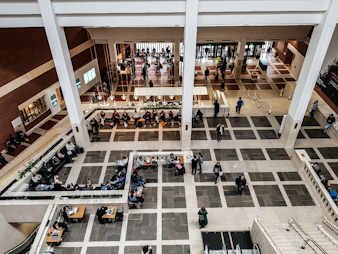
Recently, I renewed my Reader’s Card at the British Library, currently housed in superb premises on Euston Road, next door to the Victorian Gothic St Pancras railway station. This building was opened by Queen Elizabeth II in about 1998. Prior to this, the library’s Reading Room was a huge circular structure in the heart of the British Museum.

When our daughter was at primary school, she was taught about the Ancient Egyptians  including a female Pharaoh called Hatshepsut. One Saturday, I took our daughter to the British Museum in the hope of finding an image of the pharaoh in the Egyptian Galleries. After a desultory search, we gave up and walked acoss the the lovely covered Great Court, created relatively recently. The central circular structure within it contains the unused but well-preserved round Reading Room, which was designed by Sidney Smirke and opened in 1857, the year of the First Indian War of Independence. 

We entered the old Reading Room and I asked the attendant sitting there:

“Where exactly did Karl Marx used to sit when he used the library?”

“It’s a myth, sir,” replied the attendant, “He did not have a particular place because it has always been the library’s policy that places can not be reserved from day to day.”

I was a bit disappointed with his reply, but had to accept it.

When we got home, my wife asked our child how we had got on. She replied:

“You know Mummy. Daddy asked about his friend at the big old library?”

My wife asked which friend. Our daughter replied:

“I don’t know, but the man said he was a myth really.”


Picture shows foyer of current British Library in Euston Road