A museum that once existed in London, but is no more

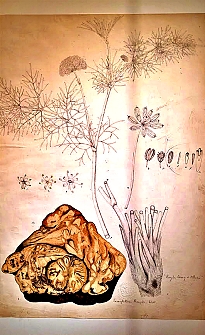
DURING A VISIT to the Victoria and Albert Museum’s recently opened Store at London’s Olympic Park, I spotted an interesting vitrine containing artefacts from India. The small collection was accompanied by an informative label, which tells the viewer that these objects were once housed in a museum that no longer exists – London’s India Museum. This establishment existed from 1801 until 1879.

The India Museum was founded by the British East India Company (‘EIC’). Designed to acquaint visitors with India’s resources and industries, it was housed in the company’s headquarters in Leadenhall Street. After the so-called Indian Mutiny (1857-1858: First War of Independence), the EIC lost its role as the British administrator of India. It was replaced by the government-controlled India Office.  

In 1851, the India Museum was a major contributor to the Indian section of Great Exhibition at the Crystal Palace in Hyde Park. Later, the museum continued to participate in international exhibitions that followed. In 1861, the museum moved to Fife House in Whitehall, then to the attics of the newly built India Office in 1869, and from 1875 then to the ‘Eastern Galleries’ on the exhibition site to the west of the present Exhibition Road in South Kensington.

The India Museum was closed in 1879. Then as related in the Victoria and Albert’s website:

“… the collections were dispersed. In broad terms, the natural history specimens were divided between the Royal Botanic Gardens and the nascent British Museum (Natural History) – today the Natural History Museum – according to their nature. Antiquities and some parts of the ethnographic collections went to the British Museum. The bulk of the manufactured objects, however, were transferred to the South Kensington Museum, forerunner of today’s V&A.”

It is a few of those 19,000 objects transferred to the Victoria and Albert Museum that we saw in the vitrine at the V&A’s amazing open access warehouse at the V&A Store at Olympic Park. While we were at the Store, we saw many other objects that must have been brought from India. No doubt, some of those had once been on display in the museum that exists no more.

Almost nothing remains, but this palace and its owner have not been forgotten

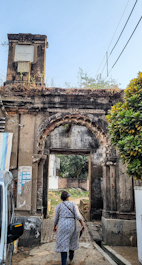
ALL THAT REMAINS OF A MAHARAJAH’S PALACE … IS ONLY A FEW ARCHES.

Not marked on Google maps, but mentioned in a guidebook to Murshidabad (in West Bengal), this remnant of a palace is extremely difficult to find. Our toh-toh (electric autorickshaw) driver asked many locals for directions. To my surprise, all knew about the small remains of a former palace, once a home of Maharaja Nanda Kumar (1705-1775), a tax collector for the British East India Company [see: https://en.m.wikipedia.org/wiki/Maharaja_Nandakumar ], who fell foul of the Company’s law. The guidebook did not mention this or the fact that he, a friend of Warren Hastings, was hanged by the Company for alleged fraud.

Houses in England built with money made in India

DURING A VISIT TO Basildon Park near Reading, I spotted a display of photographs of “Nabob houses in the Indian Style”. A ‘nabob’ was someone who was conspicuously rich, having made his fortune in India. These were buildings constructed by people who had made their fortunes while working in India. for the British East India Company. Some, but not all of these, buildings incorporate architectural features derived from the architectural styles that the British found when they visited India.

Late 18th century Basildon Park, which was built by a Brit who had made his money in India, is a Nabob’s house, but without any features borrowed from the Indian subcontinent. It is a Palladian-style building. It was one of about 30 houses built in Berkshire for the nouveau-riche British ‘nabobs’, who had enriched themselves in India.

British soldiers on the wall in a house in Baroda

BY THE VERY EARLY 19th century, the armies of the Marathas had been beaten by the armed forces of the British East India Company. After this, from 1805 onwards until 1947, the State of Baroda was ruled by a Hindu Maratha dynasty – the Gaekwads of Baroda. Put simply, the Gaekwads controlled the internal affairs of the state in such a way that British interests were not damaged, and the British controlled the external affairs of the state.

Between 1849 and 1854, Bhau Tambekar (Vithal Khanderao) was the Diwan (prime minister) of Baroda. He lived in a large building, which was probably constructed in the early to mid 19th century. Known as Tambekar Wada, this typical Maratha-style mansion has three storeys and surrounds a courtyard. Currently, the first floor of the front (eastern part) of the building is the only part open to the public.

The part of the building that can be visited is a long rectangular hall with a wooden jaali (perforated screen) near one end of it. The walls of this room are covered with beautiful detailed paintings from floor to ceiling. Many of them depict scenes from the Mahabharata, Ramayana, and Hindu religious images. However, the north wall of the hall is even more fascinating.

Most of the north wall is covered with a mural depicting a battle between the British East India Company and the Marathas. Most of the picture shows features of the British forces in great detail. There are even several flags that resemble Union Jacks. Some British soldiers, dressed in red uniforms, can be seen riding elephants. Whoever painted this wall had a good eye for both detail and representation of battles.

On the same wall as the battle scene, there are several smaller paintings depicting European men and women. On one of these, a woman in European garb seems to be consoling another woman. In another, a man wearing a red jacket is looking at a European lady affectionately.

The purpose of the painted hall is not known for sure. It has been suggested that it was for entertaining guests. The small part enclosed by the screen might have been reserved for ladies. In its heyday, purdah would have been observed in the house. The hall has a set of windows through which one can access a narrow balcony that extends along the entire length of the eastern side of the house. This terrace has a perforated screen through which people on the balcony could look out onto the street without fear of being seen by passers-by.

Although this December (2023), we are enjoying our fourth visit to Baroda, we would not have known about the Tambekar Wada had our friend Nandita A not told us about it. I am very pleased that she introduced us to this gem hidden within the narrow backstreets of Baroda’s Dandia Bazaar district.

Hertford and the East India Company

HAILEYBURY SCHOOL WAS founded by the East India Company (‘EIC’) in Hertfordshire in 1806. It was an institution where young British men heading out to India to become British colonial administrators were given training. It was not the first of such establishments. In 1800, Fort William College (in Fort William, Kolkata) was founded by the Governor General Richard Colley Wellesley (1760-1842) to teach Indian languages, laws, and so on, to young recruits to the EIC. This school continued until it was closed in the 1830s. For various reasons, the EIC decided to open a training school in England – The East India College.

The East India College was first housed in Hertford Castle, where it remained whilst bigger premises, designed by the architect of University College London, William Wilkins (1778-1839), were being built nearby in Haileybury. When it was completed, the college moved from the castle to the new building, where a school has been located ever since then. Teachers at the East India College included well-known people such as Thomas Malthus and the Sanskrit scholar Monier Monier Williams.

It is ironic that one of the former students of the EIC college at Haileybury was Allan Octavian Hume (1829-1912). After studying at London’s University College Hospital, he was nominated to the Indian Civil Service. He went out to India in 1849 having passed through the course at the EIC college at Haileybury. After returning to England in 1894, having worked in the Indian Civil Service, he recognised that there was a sense of hopelessness and unrest amongst the Indian population and that the people were held in contempt by their British rulers. To try to remedy the plight of the Indians and to provide a ’safety valve’ for relieving unrest that he perceived in Inda, he founded what soon became the Indian National Congress. Little was he to know that eventually this organisation would play an important role in getting Britain to leave India.

Taking a rather circuitous route from Cambridge to London, we stopped for lunch in Hertford. I wanted to see the castle because I had just read about it and its brief connection with the EIC in an interesting book, “The Colonial Subjugation of India”, by Amar Farooqi. After enjoying a portion of splendid fish and chips, we entered the small park in which the castle is located.

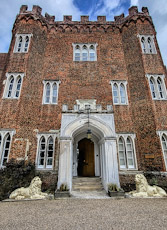
What can be seen today is a well preserved brick building with crenellations and windows in gothic style frames. When viewed face on, the edifice can be seen to consist of a tall central portion flanked by two lower wings. The tall central part, which was constructed in the 15th century was the gatehouse to the castle, which was fell into disuse and was demolished long ago (in the 17th century). The two wings were added during the reign of George III. Today, the so-called castle, erstwhile gatehouse, houses Hertfordshire council offices. We entered the lobby and noticed the gothic revival interior décor within the castle. We will revisit the castle on one of its open days and see some more of the building.

Hertford Castle played a short role in the history of British India and the EIC. The school at Haileybury continued its imperialistic function until 1857/8, when the EIC was wound up after the Indian Mutiny (First Indian War of Independence) of 1857-58. The present school, Haileybury College, a private school with boarding facilities, opened its doors to pupils in 1862 and occupies the old college’s premises.

One lady with four husbands

ALTHOUGH THERE WERE ALREADY villages on the banks of the River Hooghly where the city of Kolkata (Calcutta) now stands, the Britisher Job Charnock (1630-1693), a man of commerce, is often regarded as the founder of Calcutta. He died there and his remains are interred in a charming mausoleum (1695) of oriental design in the churchyard of Kolkata’s former cathedral, the church of St John.

Job Charnock’s mausoleum

Job does not rest alone in that structure. His companions include the surgeon William Hamilton, who died in 1717. He had cured Ferukseer, the “ King of Indostan”, and beneath his memorial, written in English, there is another written in Persian script. Job’s wife Mary lies next to him. She died in 1700. There is no mention of his other wife, an Indian named Maria. There is also a memorial to Martha Eyles, who died in 1748, having first been married to John Gumley (who died in Dhaka in what is now Bangladesh), and then married Edward Eyles, who was on the council of Calcutta’s Fort William.

Whereas Martha Eyles had had two husbands, Mrs Frances Johnson, whose remains lie in a mausoleum a few feet away from Charnock’s, had a more exciting marital record. Born in 1725, she died in 1812 at the age of 87. Frances had four husbands. First, she married Parry Purple Templer, then after his demise , James Altham. Mr Altham died of smallpox a few days after marrying Frances. Next, she married William Watts, and they produced 4 children. In 1774, after the death of Mr Watts, she married the Reverend William Johnson. He survived until Frances died.

Apart from the above-mentioned graves in the churchyard of St John’s, there are many others that commemorate the deaths of early European inhabitants of Charnock’s Calcutta, and there is also a memorial to those who died in the Black Hole of Calcutta, but more about this at a later date.

Adeline and James in Calcutta

THE CHURCH OF ST JOHN in central Kolkata was built by the British East India Company in the 18th century. Its foundation Stone was laid by Warren Hastings in 1784. We had visited it today, the 13th of January 2023, mainly to see the magnificent painting of the Last Supper by Johann Zoffany (1733-1810). We also spent time looking at the memorials that line the walls of the church. Suddenly, my wife pointed at one of them, which is of great interest to me at the moment. It commemorates James Pattle, who died in 1845 aged 68, an his wife Adeline, who died the same year aged 52. Whereas James is buried in London, Adeline was lost at sea.

My interest in this couple is related to a book I am writing about one of their daughters, who became one of the most famous British photographers during the 19th century. You will learn more about her after I publish my book.

James was born in Calcutta, as the city was named in his time. He was educated in England, and returned to Calcutta, where he became a High Court Judge. Adeline was born in French Pondicherry. Her maiden name was De l’Etang. Her father was a French nobleman who has fled from France to French India after the Revolution. He had been in charge of the French Royal stables and became important in the welfare of the East India Company ‘s horses in Calcutta . Her mother Therese had some Indian ancestry. James and Adeline married in 1811 at Bhagulpur in India. They had 10 surviving children.

⁸After James died in his home on Chowringee, he was placed in a barrel of preservative spirits so that, according to his wishes, he coukd be buried in London beside his mother in Marylebone Parish Church. Adeline travelled from Calcutta to London on the same ship as her husband’s corpse. Adeline died at sea according to the memorial in St John’s, but this might be incorrect. In any case, Adeline died a few months after James.

James’s remains did reach England, but they are interred at St Giles Church in London’s Camberwell. It is in this church, not the one in Marylebone, where his mother was buried.

The memorial in St John’s Church must have been placed because his fellow British citizens held him in high regard. The memorial was also a token of love given by their sorrowful childrenAs for his famous daughter, I will leave you in suspense!

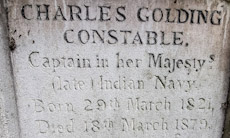
The artist’s son in her Majesty’s Indian Navy

ENCLOSED BY IRON railings, the grave of the artist John Constable (1776-1837) stands at the southern edge of the old part of the churchyard of St John’s Church in Hampstead. The famous painter does not lie alone. He is buried with some other members of his family. One of these people is his second son Charles Golding Constable (1821-1879). I became interested in him when I noticed the words “Captain in her Majesty’s (late) Indian Navy”. The inclusion of the word ‘late’ and its position in the inscription puzzles me.

Charles went to sea as a midshipman in the British East India Company’s navy when he was about 14 years old. According to a genealogical website (www.bomford.net/IrishBomfords/Chapters/Chapter33/chapter33.htm/), he:
“…took to the sea, joined the Indian Marine and eventually became a Captain. Around 1836 he left on his first voyage to China and did not return until after his father’s death so missed his large funeral in London. During the 1850s he gained a place in the reference books for having conducted the first survey of the Persian Gulf. He had to struggle with navigation as a youth so he must have shown considerable determination to be entrusted with this survey. Shortly before his survey the Arab sheikhs bordering the southern end of the Gulf gained their income largely by piracy; this was ended by a treaty or truce arranged by the British, and the Sheikhdoms that signed the truce have been called ever since the Trucial States.” A paragraph in the book “Journey to the East” (published by Daniel Crouch Rare Books Ltd.) related this in some detail:
“Commander Charles Constable, son of the painter John Constable, was attached to the Persian Expeditionary Force, as a surveyor aboard the ship Euphrates. On the conclusion of the war [the First Anglo-Persian War: 1856/57], Constable was ordered to survey the Arabian Gulf, which occupied him from April 1857 to March 1860, with Lieutenant Stiffe as assistant surveyor. The survey (Nos. 2837a and 2837b) which contains the first detailed survey of Abu Dhabi, would become the standard work well into the twentieth century. During the time that Constable was surveying the Gulf, the Suez Canal, one of the greatest civil engineering feats of the nineteenth century was under construction.”
Charles was made a Fellow of the Royal Geographical Society.

While ‘surfing the net’, I found out that sketches made by Charles during his travels have been on sale from time to time in auction houses. His drawings were competent but no match for those executed elsewhere by his famous father.

When John Constable died, his eldest son John Charles Constable became responsible for dealing with his father’s estate. He was then a medical student as well as having studied under the scientist Michael Faraday. According to a website concerning his college in Cambridge (Jesus), John Charles, died suddenly in 1839 after contracting scarlet fever at a lecture in Cambridge’s Addenbrooke’s Hospital, at which a patient suffering this disease was being examined. After his father died, he was left “… numerous paintings and works of art, some of which were known to have adorned his rooms in College.” (www.jesus.cam.ac.uk/articles/archive-month-constable-chapel).
In his will, John Charles left his collection of drawings, paintings, and prints to his younger brother Charles Golding Constable. In 1847/48, Charles was responsible for supervising the dispersal of his father’s studio collection of artworks.

Like the rest of his family, parents and siblings, Charles had lived at several different addresses in Hampstead. Although he was buried with other members of the family in Hampstead, I have not yet found out where he resided at the end of his life.

A man from China painted by Sir Joshua Reynolds

THERE IS A ROOM in Knole House (near Sevenoaks in Kent), which contains several portraits painted by Joshua Reynolds (1723-1792). One of them is a self-portrait. Near to this, there is a portrait of a man with a red cap, seated cross-legged. His youthful face has Chinese features. The sitter is Wang-y-tong (‘Huang Ya Dong’: born c 1753). Reynolds painted him in about 1776.

Wang was one of the earliest known Chinese people to have visited England. He came over following in the footsteps of an earlier Chinese visitor, the artist Tan-Che-Qua (c1728-1796), who arrived in London in 1769. Tan met King George III, and his work was shown at the Royal Academy in 1770. In about 1770, Wang was brought from Canton to England by John Bradby Blake (1745-1773), an employee of the East India Company. Blake was a naturalist and was interested in Wang’s knowledge of cultivating Chinese plants, and their uses. Wikipedia noted:

“Wang visited the Royal Society on 12 January 1775. In a letter of 1775, he is said to be about 22 years old. He was visited at Blake’s house, where he discussed the manufacture of Chinese ceramics with Josiah Wedgwood, and acupuncture with physician Andrew Duncan.”

It also describes how Wang became a page to Giovanna Bacelli (1753-1801), who was a mistress of John Sackville, 3rd Duke of Dorset, who owned Knole House. Wang lived at Knole, and was educated at the nearby Sevenoaks School. He returned to China by 1784, at which date he was working as a trader in Canton.

Wang’s portrait hangs amongst those of many famous men painted by Reynolds, including Samuel Johnson and David Garrick, as well as the 3rd Duke. The latter is said to have paid Joshua Reynolds 70 guineas (almost £76) to paint Wang’s excellent portrait. Wang was well-received in England. It would be interesting to learn what he thought about life as he found it at Knole and other places he visited in England.

A battle scene under the hammer

SRIRANGAPATNA (SERINGAPATNAM) IS A town on an island in the River Kaveri in the state of Karnataka in southern India. I have been there several times as it is near a holy spot (the ‘sangam’, where three streams meet) where ashes of deceased Hindus, including those of my parents-in-law, are ceremoniously deposited in the waters of the Kaveri. The town near the sangam was the capital of the realm ruled by Tipu Sultan (1750-1799). This former capital of a great ruler is full of impressive architectural reminders of his era. One of these, which I have visited at least twice, is a Summer Palace, the Daria Daulat Mahal (literally, ‘Wealth of the Sea Palace’) built for Tipu in 1784. This lovely, large pavilion in the middle of a formal garden is decorated with huge painted murals depicting various subjects. Some of them show scenes of battles in which Tipu was involved, often with his enemy the British East India Company. Filled with fascinating details, these are well worth visiting.

On the 30th of March 2022, a wonderful artwork was auctioned at Sotheby’s auction house in London’s New Bond Street. Created in 1784, it is a painting measuring 31.6 feet by 6.6 feet. It is one of three copies of a work commissioned by Tipu for the Daria Daulat pavilion. It depicts the Battle of Pollilur fought on the 10th of September 1780 between the British troops of the East India Company and the Mysore Army led by Haider Ali (c1720-1782) and his son Tipu Sultan. Writing for the Sotheby’s website (https://www.sothebys.com/en/buy/auction/2022/arts-of-the-islamic-world-india-including-fine-rugs-and-carpets/the-battle-of-pollilur-india-seringapatam-early), the author and historian William Dalrymple explained:

“At Pollilur, Tipu Sultan inflicted on the East India Company the most crushing defeat the Company would ever receive, and one which nearly ended British rule in India.”

He added, referring to the British:

“Out of 86 officers, 36 were killed, 34 were wounded and taken prisoner; only 16 captured were unwounded. Baillie received a back and head wound, in addition to losing a leg. Baird received two sabre cuts on the head and a pike wound in the arm. His ADC and young cousin, James Dalrymple, received a severe back wound and “two cuts in my head”. Around two hundred prisoners were taken. Most of the rest of the force of 3,800 was annihilated.”

Of the painting being auctioned at Sotheby’s, he wrote:

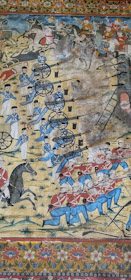
“The painting extends over ten large sheets of paper, nearly thirty-two feet (978.5cm) long, and focuses in on the moment when the Company’s ammunition tumbril explodes, breaking the British square, while Tipu’s cavalry advances from left and right, “like waves of an angry sea,” according to the contemporary Mughal historian Ghulam Husain Khan. The pink-cheeked and rather effeminate-looking Company troops wait fearfully for the impact of the Mysore charge, as the gallant and thickly moustachioed Mysore lancers close in for the kill. To the right, the French commander Lally peers triumphantly through his telescope; but Haidar and Tipu look on majestically and impassively at their triumph, while Tipu, with magnificent sang-froid sniffs a single red rose as if on a pleasure outing to a garden to inspect his flowers.”

As with all other items to be auctioned at Sotheby’s, the painting was put on display to the public for several days before the auction. We were lucky to have been able to view it, as we arrived only a few minutes before the public viewing period ended. One of the technicians at the auction house let us get close to the painting so that we could examine it much better than is possible when visiting the Summer Palace at Srirangapatna. I took the opportunity to take close-up photographs of details of this incredible record of late 18th century warfare. [You can view my photographs on the following website: http://www.ipernity.com/doc/adam/album/1319222] Some of them are quite gory, including decapitated heads with blood issuing from their severed necks. Many of the British can be seen being impaled by what looked like very thin, needle-like spears. I spotted one Indian soldier being struck on his head by a bayonet wielded by a Britisher. Some of the Mysore Army soldiers brandish rifles fitted with bayonets.

The British soldiers are mainly dressed in red jackets. Their opponents are depicted wearing clothes in a variety of colours. Most of the Indian soldiers have dark-coloured eyes but, as my wife spotted, some of the British have pale coloured (blue?) eyes.  Many animals appear in the picture: horses, camels, elephants, and bullocks. In addition to rifles and spears, there are other weapons in the painting including: cannon, swords of various kinds, and archery bows. Seen as a whole and in detail, the painting portrays great activity and a sense of the confusion that reigns in a battle. Whereas the British appeared to be maintaining orderly formations, their opponents can be seen making a terrifyingly massive onslaught in an apparently less organised, but ultimately successful, way.

Although words are inadequate to convey the impression made on me by this painting, I am glad that I was able to see it before it is sold. It was last exhibited for a few months in 1999 in the National Gallery of Scotland (Edinburgh), and before that for a few months in London in 1990. If it is sold to a private individual, it might not be available for public viewing again for a long time.