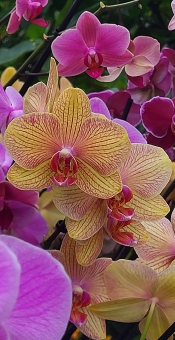
Orchids aplenty
At Kew Gardens flower show
But too large a crowd

Orchids aplenty
At Kew Gardens flower show
But too large a crowd
SOME YEARS AGO (in 1997), we attended the first performance at London’s Nehru Centre (in Mayfair) of a work, “Samaveda Opus 2”, by the composer John Taverner (1944-2013). Taverner introduced the piece. During his introduction he repeated the sentence “India wounds me” several times. I have no idea what he meant by this, but the words have stuck in my mind. Until our latest visit to Calcutta (Kolkata), which was in January 2024, India has never wounded us. However, one morning, an unfortunate incident occurred, which I will now describe.

We (my wife Lopa and I) decided that we would revisit the 18th century Armenian church of St Bortola, which is in Bara Bazar in North Calcutta. Before leaving the Tollygunge Club, where we were staying, we found out from a website on the Internet that the church was supposed to be open. After enjoying good coffee at Blue Tokay in Bahrison’s bookshop on Park Street, we hailed a yellow and black Ambassador cab. The driver knew where we wanted to go and drove us through ever increasingly congested streets to Netaji Subhas Road in Bara Bazar. In this crowded street, the traffic was so bad that vehicles could barely move. As we were quite near to St Bortola, we disembarked, having decided to walk the rest of the way. As it happened, the narrow side streets along which we wended our way were so full of people that it would have been almost impossible for a taxi to go along them.
Busy bazaars always fascinate me. The streets in the part of Bara Bazaar near to the church were no exception. As we walked along them, we realised that we were in a district that was home to the shops and stores of merchants who sold chemicals in wholesale quantities. After negotiating the crowds in a couple of lanes, we spotted to spire of St Bortola, towering above the chaotic ensemble of buildings below it. We found the entrance to the compound containing the church. There were several men, including some security personnel, sitting in the porch. They all were very sure that visitors were not allowed to visit the church, nor even to photograph it. We protested that the website had claimed it would be open. We were told that if we wanted to view the church, we would first have to get special permission from the Armenian College (which is close to Park Street).
Having failed to gain access to the Armenian Church, we decided to visit the nearby Roman Catholic cathedral – The Cathedral of the Most Holy Rosary on Brabourne Road, almost opposite the Magen David Synagogue. Brabourne Road is one of the main thoroughfares carrying traffic to and from the Howrah Bridge, which crosses the Hooghly River. To say that this road as extremely busy is an understatement. Lined with stalls, the pavements are almost un-negotiable. So, pedestrians, including us walk along the edges of the roadway. People walk in both directions, often carrying heavy loads – usually on their heads. Added to this, many people seem to be in a great hurry and think nothing of rudely pushing aside fellow pedestrians. Meanwhile, buses, cars, wagons, rickshaws, heavy trucks, bicycles, motorbikes, and a variety of other wheeled vehicles rush past the pedestrians on the street. We experienced all this on a hot mid-morning.
We had to cross Brabourne Road to reach the cathedral. Fortunately, most of the traffic came to a stop briefly at a red traffic signal, and we joined a crowd of people swarming across the road. We began negotiating the crowds in an attempt to reach the cathedral. Then, it happened.
A wagon loaded with filled white sacks approached us. The sacks projected beyond the sides of the wagon. There were so many people walking along the side of the road that it was impossible for us to get out of the way of this heavily laden vehicle. Suddenly, one of the sacks hit Lopa’s shoulder, and she was sent flying. I was horrified. Luckily, she was thrown away from the road and her fall was cushioned by soft goods on the flimsy trestle tables of some pavement vendors. Although very shocked and extremely upset, she escaped major injury. Fortunately, her only injury was a small graze on her hand. She had had a lucky escape.
Much to my surprise, after a few minutes, Lopa decided we should walk the short distance to the cathedral. This we managed without any further unfortunate incidences. The compound – a peaceful garden in front of the west end of the church was open. However, when we reached the church, it was locked up. Someone sitting on the porch informed us that it was only opened once a week – on Sundays, and only for one mass.
By now, we had had our fill of Bara Bazaar. We hailed an Ambassador taxi to take us back to the Tollygunge Club. When Lopa related her unfortunate incident to the driver, he told us that Bara bazar is a bad area filled with ‘badmashs’ (i.e., bad or unprincipled people).
This unfortunate accident in Bara Bazaar was, as far as I can recall, the first time (in 30 years) that India wounded us. Having said that, I am sure it was not a physical injury that led John Taverner to say “India wounds me”.
WE HAD DECIDED TO travel to Mandvi (in Kutch, a part of Gujarat) by taking a train to Gandidham, then going by road the 98 kilometres between there and Mandvi.
The Indore to Gandidham Express arrived 30 minutes late on Ahmedabad Junction’s platform 4. Getting on to our carriage was a veritable scrum. The problem was that people, including us, wanted to board before those alighting at Ahmedabad had reached the carriage entrance. Someone behind us shouted “Hurry up and get inside.” When a passenger who was trying to leave the train replied “We want to get off”, the irritating lout behind us shouted “You should have started getting out quicker.” We struggled along the carriage and found our window seats eventually.
We had reserved seats numbers 73 and 76. A man was sitting in seat 76. When we said it was one of ours, he said that he was occupying his alloted seat, namely seat 77. It took some considerable persuasion before he understood that seat 77 did not have the number ‘76’ above it. This incident reminded me when I used to travel by train in Italy during the 1960s.
Whenever we travelled by intercity trains in Italy long ago, my parents always reserved seats – always in the first class carriages – in advance. Invariably, our reserved seats would be occupied by passengers who should not have been in them. It was o lying after the train conductor had been summoned that the people yielded our seats to us. Moments later, these obstinate people would engage in friendly conversation with us.
Returning to the Indore to Gandidham Express, before it started, vendors selling fruit and bottled water roamed along the platform looking for customers. Meanwhile, a hot tea seller moved along the interior of the train. He and others remained on board during the journey, as did a couple of snack vendors.
Once we got going, the train sped along. There was only one intermediate station where we stopped briefly during the 4 and a 1/2 hour journey. As we traversed the flat plains of Gujarat, we saw many neatly cultivated fields and numerous industrial units of varying sizes. In the area where eastern Kutch begins, we passed vast expanses of land being used as salt pans. Every now and then, we saw conical mounds of grayish white harvested salt.
Many trains passed us, travelling in the opposite direction. Almost all of them were freight trains. The line along which were moving leads to and from the busy port of Kandla on the south coast of Kutch. What little we saw of Gandidham and its outskirts was unattractive.
The air temperature at Gandidham station was well over 30 degrees Celsius and there was little shade. To exit the station, we had to use an escalator. Once again it was a scrum trying board it. Some passengers were too frightened to step on it which made using it even more difficult.
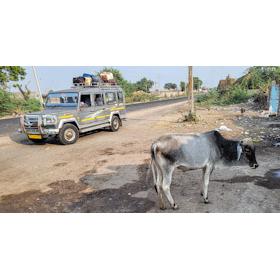
Our host in Mandvi had kindly booked us seats in a shared taxi to travel from Gandidham to Mandvi. This vehicle was like a jeep. It had a front row of seats – sofa like – and behind that there was another similar seating arrangement. Behind that, there was a far less comfortable seating space that accommodated any number of people that could be squeezed in. We were booked into the seating behind the front seats and in front of the rear ‘compartment’.
Although the middle seating had been booked for my wife and me, Lopa invited one of the three passengers who had squeezed in the front seat next to the driver to join us. He turned out to be a friendly chap. He and his friends were returning home from several days of a religious pilgrimage. Our new companion was a trader in rice, sugar, etc. He bought commodities and sold them for export. During our journey, he received a telephone call. He told us that soon after getting home, he had to go to Bombay for some urgent work. He and his business partner would have to drive for 11 hours through the night to reach Bombay from near Mandvi.
Our driver decided not use the 4 lane highway between Gandidham and Mandvi because of heavy traffic. Instead – and it made the journey far more interesting – he took us along a “short cut”, using country roads, some of them minor. This added fascination because we passed through rustic villages. At one of these, we were stopped by an elderly lady standing beside the road. She wanted to go to Mandvi, and was invited on board.
At another place, we stopped and the driver picked up a bundle tied in cloth, which he delivered to someone in another village we passed through later. After about an hour, to my great relief because my mouth was parched, we stopped for about 20 minutes at a stall where snacks and cold drinks were available.
At one point early during our journey, someone in the rear compartment asked our new companion to dial a certain number on his phone. Some conversation in Gujarati ensued. It turned out that there were some labourers travelling in the rear compartment. As they had not yet been paid by their employer, they claimed that they did not have the 300 Rupees needed to pay for the ride. Our friendly sugar trader allowed the employer to electronically transfer the required amount to his account. Our neighbour then suggested that he could electronically transfer that fare money to the driver’s account. However, the driver wanted to be paid in cash, which the trader kindly agreed to do.
Most of the way, the driver used one hand to steer, and the other to hold his mobile phone to his ear. Despite this hazardous practice, there were no scary moments along the way. We arrived at our destination safely, but somewhat cramped.
When we sat inside our host’s air-conditioned large saloon car to drive to his house, it felt as if we had moved from a stone seat into a feather bed. Never before has a modern saloon car felt so comfortable.
Despite moments of discomfort, our rail and road trip was enjoyably interesting. By the end of the journey we felt as if we had been truly travelling – a feeling that air travel often fails to provide.
I AM ALWAYS WARY of ‘must see’ attractions because I dislike crowds and waiting in queues. So, last year when we visited Madeira, I thought it wise to avoid seeing the famous Botanical Gardens. In any case, most of Madeira’s capital, Funchal, is full of exotic plants and flowers – a veritable botanical garden in itself.

This May (2023), we decided to ‘bite the bullet’, and visit the Botanical Gardens high above Funchal. Getting there and back by local bus was easy. At the entrance to the Gardens, there was hardly any queue for tickets. And despite plenty of large tour buses parked nearby, the Gardens were not at all crowded.
Although I once owned a house with a 180 foot long garden in Gillingham, Kent, I am no gardener, and can hardly name any plant accurately. However, I love visiting gardens. The Botanical Gardens of Funchal are on the slopes of a hillside. All of the plants or groups of them are labelled. There are several terraces from which you can enjoy superb vistas of central Funchal, the sea, and the mountainous countryside.
The Gardens, which were opened to the public in 1960, are on land previously owned by William Reid, the founder of Funchal’s Reids Hotel. A bust in the garden commemorates Rui Vieira (1925-2009), a botanist who contributed much to the development of the botanical Gardens.
The highlight of the Gardens for me was a collection of mostly huge cacti, many of them bursting into flower. Everything else was also worth seeing in this well-kept, beautifully arranged garden. I am very glad that we visited this ‘must-see’ attraction on Madeira.
ON THE FLIGHT FROM Stansted to Funchal, I sat next to a young man who was born in Madeira and now lives in the UK. He told me that we were just in time for the grand parade of the island’s annual flower festival. It would be happening on the afternoon of Sunday, the 30th of April (2023) at 430 pm, and that it always attracts large crowds.
At about 2.50 pm on the Sunday, we found an empty bench on the Avenida do Mar. This is a wide dual-carriageway that runs close to the seafront. Our bench was beside one of the carriageways. The parade was due to proceed along the other carriageway. By as early as 3 pm, people were gathering on the grassy divider that separates the two carriageways. They were between us and the route to be taken by the parade. More and more people assembled there, and we wondered how we would be able to see the proceedings.
At about 3.30, an elderly English couple joined us on the bench. We did not speak with them until a few minutes before 4.30. Then, the rather frail looking old lady said to us:
“We’re going to stand on the bench to watch the floats pass by.”
I had thought about doing this but had been concerned about the stability of both the bench and me. But when this older lady and her even older husband climbed on the bench we joined them.
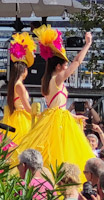
The colourful floats covered with floral decorations and lively girls and ladies moved a little faster than snail’s pace. They were separated by crowds of girls in folk costumes, who were singing and dancing as they proceeded. From our vantage point, we could see the floats easily, but the dancing girls were mostly hidden by the crowds on the grassy divider; only their headdresses could be seen.
After three floats had passed, the lady hopped off the bench, and said to me:
“We’ve got to go now. We don’t want to miss our team, Liverpool, playing.”
All this goes to show that one should never judge people by how old they look. Even some the oldest members of our species can be surprisingly full of life.
DURING THE ELEVEN days we spent in Funchal, the capital of Madeira, the city was visited by two enormous cruise ships. Resembling huge blocks of flats (apartments, my North American friends!) floating on water, they arrived in the port at night, remained a whole day, and then departed the next evening.
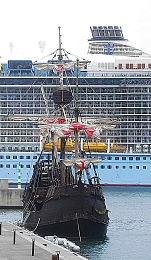
When these vessels disgorge their cargos of tourists, the centre of Funchal becomes crowded; the queue t the cable-car grows longer; and the frequency at which toboggans slide down from the Monte increases.
The port at Funchal is designed to accommodate these ‘humungous’ people carriers, so their arrival does not have the same damaging effect (on buildings and the shoreline) as is created by them in Venice (Italy). Cruising in vessels of this size appeals to many but not to me.
IT WAS EASTER Saturday (2022), the sun was shining, the air was warm, and we paid a visit to the world famous, popular Portobello Road Market. For the first time after over two years of pandemic-induced suppression of London’s ‘joie-de-vivre’, the market was buzzing with activity, crowded with foreign tourists and local visitors. As it was before Covid19, the market was bustling and business at the stalls, which offer everything from artichokes to antiques and pancakes to paella, seemed to be brisk.

A friend, who lives in rural France, said to me a few days ago when we were walking near Leicester Square:
“It’s hard to believe that there was ever a deadly pandemic in this city.”
And as we walked along a short street in the area, he added:
“There are more people out in this street than there are living in my hometown.”
Yet, Covid infection rates are high in the UK. Friends in India have been telling us that they are thinking twice before visiting the UK because the risk of becoming infected here is so great at the moment. Recently, I have heard that approximately between 1 in 12 and 1 and 15 people in the UK are likely to be infected with a Covid19 virus, and therefore capable of spreading it to others.
Apart from personal hygiene and wearing face coverings, good ventilation is considered to be useful for reducing the risk of spreading the viruses. So, when I boarded a bus in South Kensington recently, I opened the window closest to me – each window on London buses has a label saying “Open this window”. Immediately after following this instruction, which has been given for reasons of prevention of infection, the lady sitting behind me, who was not wearing a face covering, stood up and slammed it shut. I stood up, opened it, and told her not to touch it. She said, speaking angrily with an Eastern European accent:
“You don’t need to open it. You are wearing mask and have three vaccinations.”
How she knew my vaccination status, I do not know. My wife said to her:
“Don’t you know that one in twelve are infected?”
To which the lady replied:
“Believe what you like.”
Then to my great surprise, she added:
“Covid is over”
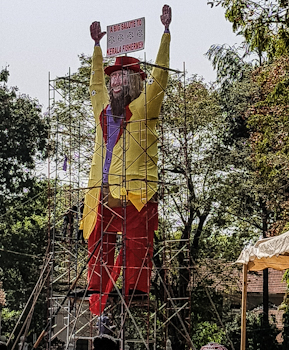
The ending of the old year and beginning of the new one is celebrated all over the world in a variety of ways and at different times of the modern calendar. For example, the Chinese, the Gujaratis, the Parsis, the Jewish people, and the Russian Orthodox all celebrate the start of a new year on different dates. People, whatever their personal beliefs, also celebrate the end of the year on the 31st of December.
Cochin, which is a historic port in the southern Indian state of Kerala, was a Portuguese colony for a while in the 16th and 17th centuries. The Papaanji (spelling varies!) is named after a Portuguese word meaning ‘old man’.
Every year, a giant Papaanji is erected in a centrally located open space in historic Fort Cochin. During the afternoon of New Year’s Eve, the Papaanji is stuffed full of dry straw and fireworks. The roads around the open space are closed to motorised traffic. Despite this, a few youths on motor bikes manage to enter illegally.
After sunset and during the evening of the 31st of December, the area around the Papaanji fills with vendors and ever increasing numbers of people. Some of these merrymakers wear masks and others wear glowing red devil’s horns.
During the few minutes before midnight on the 31st, unbelievable numbers of people gather. The strong tide of people resembles a powerful surge of water such as you might expect if a large dam has just been breached. The crowd adds much noise to the cacophony of sound being relayed over various loudspeakers. Several times, I was almost knocked over by this human tsunami.
At midnight, the crowd became even noisier when flames began leaping from the ignited Papaanji. First, I could only see billowing clouds of smoke. Soon, frightening flames became visible. Then, bursts of stars appeared as the fireworks exploded.
Within minutes, the conflagration and fireworks ended. The old year, represented by the Papaanji, had been burnt out to make way for the new one. The crowds began to thin out a little, but despite that, it was quite hazardous trying to leave the area.
For an hour or two after midnight, boisterous revellers created much noise in the streets. The whole affair seemed to be generally good natured.
I am glad that I have seen the Papaanji aflame, but once in a lifetime is enough for me.
 yamey
yamey 