WHILE WAITING FOR an item to be delivered to me at the National Art Library, which is housed within the Victoria and Albert Museum (‘V&A’) in South Kensington, I had time to look around the museum. The V&A is a treasure house filled with fascinating exhibits from all around the world. Today, I noticed something that had not caught my eye before. It is an entire Italian Renaissance chapel, which was transported from Florence to its present location in the V&A.
This chancel chapel used to be part of the Santa Chiara convent in Florence. The convent belonged to the Poor Clares, who were female branch of the Franciscan order. Mass used to be held in this small chapel, which was constructed in the first half of the 15th century. Following the 1808 Napoleonic suppressions (of Italian religious orders), the chapel became used as a sculptor’s studio in the 1840s and 1850s. The V&A’s website (https://collections.vam.ac.uk/item/O17758/chancel-chapel-from-church-of-chapel/#object-details) revealed:
“In 1860, J. C. Robinson bought the chapel on behalf of the V&A, and it was dismantled and shipped to London, whereupon it was reassembled in the North Court of the Museum … In 1908 the chapel was moved from the North Court to the eastern apsidal end of the Aston Webb wing of the museum, parallel to Cromwell Road, where it remains today.”
Because of its relocation to London, the chapel is the only example of an Italian Renaissance chapel to be seen outside Italy. Moving this chapel was a less ambitious achievement that what can be seen at the Met Cloisters in Manhattan. At this museum, several entire cloisters, which had been removed from France, have been reassembled for visitors to see. Heaven forbid that the Italians will begin demanding to return the chapel, and that the French will seek repossession of their cloisters. I feel that these repatriations are even less likely than the Elgin Marbles being sent back to Greece.
This photograph shows a cow grazing in a meadow in Cambridge (UK). Behind the animal, you can see the world famous perpendicular gothic chapel of Kings College – part of the University of Cambridge.
I posted this picture on Facebook. A few hours later, one of my friends added the witty comment:
WHENEVER WE VISIT the picturesque port of St Ives in Cornwall, we come across things we had not noticed on previous visits. On our latest visit, made in early July 2024, we discovered a monument that we had not noticed before and entered a chapel, which we had seen often, but never entered.
The monument is a bas-relief plaque mounted on one of the walls of the Roman Catholic Sacred Heart and St Ia Church. It is dedicated to the memory of John Payne, the portreeve (harbour master) of St Ives. He was executed in 1549 because he was a Roman Catholic. His demise occurred during the 1549 Prayerbook Rebellion. In case you had never heard of this – and it was news to me – the Prayerbook Rebellion (aka the ‘Western Rising’) happened because of something that happened during the reign of King Edward VI. Edward’s uncle, Edward Seymour, encouraged iconoclasm and the use of English (instead of Latin) during church services. This was unpopular in large parts of England, and when in 1549 the “Book of Common Prayer” was introduced, revolt against it broke out in Devon and Cornwall.
John Payne was hung in the marketplace of St Ives. His death was ordered by Sir Anthony Kingston, the Provost Marshal (c1508-1556). Payne was not the only Cornishman who was executed for his Catholic beliefs. The monument in St Ives is not only dedicated to him but also to:
“… all the men of St Ives who died to defend the Catholic faith in the Western Rising – 1549”
I am not sure when the memorial plaque was placed on the church, but it does bear the dates “1549” and “1949”.
Further into the town than the monument just described, one reaches the Smeaton Pier, where fishing boats unload the seafood, which they have caught. Wedged between a public toilet (for ‘gents’) and the small St Ives Harbour Master’s Office, there is a tiny chapel dedicated to St Leonard. This small building built with stones is entered via a few granite steps. Consisting of a small room (about 10 feet long and 6 feet wide. No one knows when it was constructed, but records indicate that it underwent some repairs in1577. The chapel was probably used by seamen setting out for sea and also provided shelter in bad weather. In 1971, the chapel was renovated and opened as a museum and a memorial to the fishermen of St Ives.
On the outside of the chapel, there is a plaque commemorating the record breaking 600-mile passage made by the St Ives lugger Lloyd from Scarborough to St Ives in 1902. The journey took 50 hours. Within the chapel, there are glass cabinets containing historical maritime items as well as old photographs and some models of sailing ships.
Although small, both the chapel and the memorial add to the fascination of the wonderful town of St Ives. In a future essay, I will tell you about some more of the things we ‘discovered’ during our latest visit to the place.
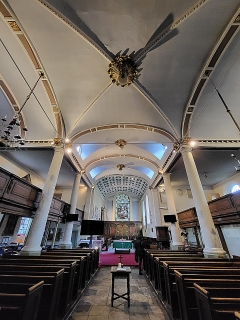
AS FAR BACK AS the 8th century, there was a priory in London’s Bermondsey district, just south of London Bridge. Like most other monastic institutions, it was dissolved during the reign of King Henry VIII. By 1296, there was a church close to the monastery, the ‘St Mary Magdalen Chapel’. This was built to serve the needs of the workers in the Priory and Convent of Bermondsey. It was the forerunner of the present church of St Mary Magdalen on Bermondsey Street. Please note that the name is Magdalen, rather than Magdalene.
In 1680, the church was deemed unsafe, and most of it was demolished. The late mediaeval tower was retained, and was encased in plaster, which hides its original surfaces. By 1690, a new church had been built. This incorporated the old tower, and is what can be seen today. There were a few later modifications made to the edifice, but most of what one sees, is how it was in 1690. The church was damaged both in WW2 and in a fire in 1971, but it has been faithfully restored. The wood carvings on the reredos beneath the Victorian stained glass eastern window might well have been created by the famous wood carver Grinling Gibbons (1648-1721), who was born in Holland and died in London.
The church feels spacious inside. We were lucky to have been able to enter it because apart from Sunday mornings, when a service is held, it is only open to the public between 12 noon and 2 pm on Fridays. We entered at about 1.45, having just eaten a tasty Vietnamese meal at the nearby Caphe House on Bermondsey Street.
I HAVE PASSED IT often, and have long been curious about it, but until today I have not bothered to find out about it. I am referring to a small chapel on the corner of Kensington Place and Newcombe Street, which leads to the south side of a space where a weekly farmers’ market is held (on Saturday mornings). Called the Bethesda Baptist Church, its congregation was established in 1866. The building resembles a style commonly used in the late 18th century. According to a history of Kensington Place (www.hillgatevillage.com/the-facts), the chapel was constructed in about 1824. Over the years, it has been used by various Baptist sects. Currently, it is the home to a congregation, who believe in Restricted Communion and Particular Redemption. This sect was founded in 1866.
Bethesda Chapel, Kensington
Currently, I am reading about a clergyman, Conrad Noel (1869-1942), who believed fervently that the church should be both democratic and all-embracing. So, it was with some interest that I stumbled across a chapel in which people believing in ‘Restricted Communion’ gather to worship. The sect is a branch of the Strict and Particular Baptists, who follow the decrees of High-Calvinism. If you are finding this a bit difficult to follow, then you are not alone. Let me take a stab at giving a simple explanation of what the congregation in the Bethesda Chapel believe: a set of beliefs that are new to me. One website that seemed to clarify them well is www.sbhs.org.uk/membership/strictbapt/, from which I have attempted to extract the following information.
‘Strict’ refers to ‘restricted communion’. Unlike many branches of the Christian Church, which permit anyone who believes and loves Jesus Christ to partake in Holy Communion, the Strict and Particular Baptists believe that Communion should only be offered to those “who have been baptised by immersion as believers”. The above-mentioned website explained:
“Strict Baptists see baptism as a rite by which believers testify to their faith in Christ, and associate it with church membership. The Lord’s Supper is for those who have joined the church in this way.”
As for ‘particular’, this lives up to the common meaning of the word. The Strict and Particular Baptists believe that:
“…Christ died to make certain the salvation of a definite number of people whom he has purposed to save, rather than to make possible the salvation of an indefinite number of people who might choose to believe.”
That is, only the ‘select’ few, known as the ‘Elect’, will be saved. The sect does not accept infant baptism, even by immersion, as being sufficient to become part of the Elect. Another website (www.baptists.net/history/2022/07/the-articles-of-faith-of-the-gospel-standard-churches/) explained what is required to become a member of a Strict and Particular Baptist sect such as that which uses the Bethesda Chapel:
“At a regularly constituted church meeting … the candidate (whether already a member of another church or not) shall make a verbal confession of faith, and declare what he or she believes God has done for his or her soul. If accepted by a vote of the majority of members present and voting, signature in the church book to the Articles of Faith and Rules will be required. Thereafter, at the earliest convenient opportunity, the person shall, unless previously baptised by immersion, be so baptised in the Name of the Father, and of the Son, and of the Holy Ghost; and be formally received into church fellowship at the next observance of the Lord’s Supper.”
The Articles of Faith, and there are many of them, are strict. Thus, despite my oversimplification, it would seem that the Strict and Particular sects are, unlike the open-door church espoused by Conrad Noel, extremely exclusive and restrictive.
PS: A little way west of the Bethesda Chapel, there is an institution that is, unlike the chapel, far from exclusive: it is open to all children regardless of faith, providing they live in its catchment area: Fox Primary School. This state school, which was founded in 1842, is housed in modern buildings. I mention it as a postscript because its walls are decorated with several attractive, colourful mosaics.
WHEN RUDYARD KIPLING (1865-1936) died in London’s Middlesex Hospital, his body was placed in the hospital’s chapel before being taken to be cremated at the Golders Green Crematorium, Charles Carrington wrote in his biography of Kipling that just as his coffin, draped with the Union Jack flag, arrived at the crematorium:
“… the followers of Saklatvala, the Indian Communist who had been cremated just before Rudyard Kipling, were singing the Red Flag.”
Kipling was not a sympathiser of Communist ideas and ideals.
Middlesex Hospital in the Fitzrovia area of London, where Kipling breathed his last, no longer exists. Founded in 1746, it provided medical care on a square plot of land bounded one one side by Mortimer Street between 1757 and 2005. In 2008, almost all of the hospital was demolished. The only part of the complex, which was preserved, is the Fitzrovia Chapel, in which Kipling’s body reposed briefly. Between 2012 and 2016, a new development, Fitzroy Place, consisting of flats and offices, was constructed on the hospital’s site.
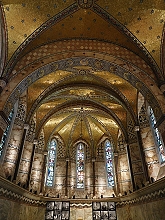
The small Fizrovia Chapel, beautifully restored, stands in a small garden in the middle of the new development, dwarfed by the buildings around it. This gem of a Victorian ecclesiastical construction was designed by the Gothic Revival architect John Loughborough Pearson (1817-1897) and was ready for use by 1892 (although the interior decoration was not fully completed until 1929). The chapel’s spectacular colourful interior must be seen to be believed. Its magnificent appearance is the result of skilful use of mosaic, marbles of different types and colours, and amazing decorative motifs inspired by early Italian, Byzantine, and Moorish architecture. Some of the metal lampshades that hang from the decorative ceiling seemed to have been influenced by the types of lamps typical of Turkish tradition.
The chapel is maintained by The Fitzrovia Chapel Foundation. It is open on most Wednesdays for public viewing as well as during the occasional exhibitions and concerts that are held within it. This charming place is also available for hire for weddings, fashion shoots, book launches, and other events.
Until we attended an exhibition in the Fitzrovia Chapel in late May 2022, we had no idea that this small architectural gem existed. Along with nearby All Saints in nearby Margaret Street, the Fitrovia, a treasure chest with its sparkling golden ceiling, should not be missed by lovers of Victorian architecture and/or fine mosaic work (as well as masterful use of inlaid stonework).
THE NATURAL HISTORY MUSEUM in London’s South Kensington district was constructed between 1873 and 1881. It was designed by the prolific Victorian architect Alfred Waterhouse (1830-1905). Almost hidden away but close to Oxford Street, there stands another distinctive building designed by Waterhouse. Dome decorative brickwork on the east side of the structure proclaims that it was built as:
“Kings Weigh House Chapel”, and:“These buildings were erected in the year 1891 for the worship and service of God”.
The complex of buildings on Duke Street faces the northeast corner of Brown Hart Gardens. They were designed to include a chapel and a Sunday school as well as other offices. The chapel derives its name from a former dissenters’ chapel that used to stand above the Kings Weigh House in Eastcheap. It was formed in about 1685 (https://en.wikipedia.org/wiki/King%27s_Weigh_House). In 1834, the site of the church was moved to larger premises at Fish Street, near London Bridge. Where it used to stand there is now an entrance to Monument Underground station. In 1882, the Fish Street site was compulsorily purchased bt the Metropolitan Railway. The Duke of Westminster offered the congregation a site on Robert Street (now Weigh House Street) and funds to construct yet another chapel (https://victorianweb.org/art/architecture/waterhouse/3.html). The church accepted his offer and their chapel designed by Waterhouse is what you can see today.
I have only seen the chapel’s decorative exterior with some Romanesque features, which were achieved using brickwork and contrasting whitish masonry, but have not yet entered it. However, I have seen pictures of its interior, which show that it is quite interesting. Apart from the impressive tower on the southwest corner of the church, I was struck by the oval structure that forms the bulk of the building. This houses the main place where the congregation worships. With the long axis of the oval running east to west, the oval ‘nave’ is surrounded above by an oval gallery with several rows of tiered benches (www.british-history.ac.uk/survey-london/vol40/pt2/plate-23). I have not seen many oval churches like this but did see one in Edinburgh (Scotland), the neo-classical style St Andrew’s and St George’s West Church. In this case the long axis of the oval also runs east to west.
The chapel was bombed during a communion service in 1940 in October 1940, when two people were killed and the chancel was damaged. During most of WW2, the chapel was requisitioned as a fire watching centre, presumably because of its high tower, and also as a ‘rest centre’. After the war, the damage was repaired, and the church was rededicated in 1953. By1965, the congregation ceased using Waterhouse’s chapel. It was decided in 1966 to disband the church at the Duke Street site and sell it.
In 1967, the chapel was bought by the Ukrainian Catholics. They have used it as their cathedral in London. Its full name is now ‘The Ukrainian Catholic Cathedral of the Holy Family’ (Українська Католицька Єпархія Пресвятої Родини в Лондоні). The church is open for services, usually either early in the morning and/or in the early evening (www.ucc-gb.com/cathedral). Sadly, we looked at the place mid-morning, but we will visit it again one day when there is a service in progress so that we can view its interior.
ALMOST OPPOSITE THE modern and magnificent Hepworth Wakefield art gallery, completed in 2011, there is a nine arched bridge, built between 1342 and 1356, crossing the River Calder. Midway across the bridge, there is a small gothic chapel. It is the oldest one of only four surviving bridge chapels in England. Between the mid-14th century, when it was built and the Reformation in the 16th century, the Chantry Chapel of St Mary the Virgin served as a place of worship for travellers crossing the bridge on their way from Wakefield to Leeds.
Two acts passed during the reigns of King Henry VIII and his successor the young and fanatically Protestant Edward VI resulted in the closure of the well over 2300 chantry chapels in their kingdom. The chapel on the bridge at Wakefield was one of them. Whereas many chantry chapels were demolished or otherwise rendered unrecognizable, that on the bridge at Wakefield survived because it is an integral part of the structure of the bridge (https://en.wikipedia.org/wiki/Chantry_Chapel_of_St_Mary_the_Virgin,_Wakefield).
The former chapel on the bridge was used for various purposes between 1547, when its religious use was terminated, and 1842, when it was restored. It was used at different times to house a warehouse, a library, an office, and a cheese shop.
In 1842, the formerly Roman Catholic chapel was transferred to the Church of England and it was restored by the Yorkshire Architectural Society, which was influenced in its philosophy by the Oxford Movement, a group of High Church members of the Church of England who wanted to reinstate older Christian traditions, which had been abolished during the Reformation, and incorporate them into Anglican theological practice. The architect George Gilbert Scott (1811-1878) was involved in the restoration of the edifice. By 1848, the bridge on the chapel was once again being used as a place of worship. For a while it became a parish church, and then after a new parish church was built in 1854, it became used for occasional rather than regular services, and peopled prayed whilst water flowed below them.
Currently, the chapel is under the care of the Friends of Wakefield Chantry Chapel, which was founded in 1991. The chapel is usually kept closed but is opened on certain days (see: www.chantrychapelwakefield.org/open-days.html). As luck would have it, we walked across the bridge on a sunny day that the chapel was open. The small chapel is on two floors. The upper chapel is well-lit both by electric lamps and light flooding through its five sets of stained-glass windows. A narrow spiral staircase leads down to a lower, poorly lit, rather dusty chamber, somewhat devoid of interest.
The decorative ancient gothic chapel on the bridge makes an interesting contrast to the elegant but puritanically unadorned exterior of the Hepworth Wakefield gallery almost opposite it. Both buildings are definitely well worth exploring.
ONE OF THE JOYS of travelling around in one’s own car is the ability to go almost anywhere one wishes and by any route, direct or indirect. Recently, we were driving along the A1141 between the Suffolk wool towns of Lavenham and Hadleigh when we noticed a small brown and white sign directing tourists to “St James Chapel”. We turned off the main road and drove along a narrow, winding by-road, which threaded its way through cultivated fields and small clumps of trees. We had no idea where the chapel is located and it was almost by chance that we noticed the small building, which is located well away from the lane. The best view of this tiny edifice is through a farmyard next to which it stands, otherwise it is well concealed by tall hedges.
Maintained by English Heritage, the chapel is approached via a narrow L-shaped passage between it and the hedges. A board close by gives the history of the place. The tiny 13th century chapel served the nearby Lindsey Castle, which was abandoned in the 14th century and now exists only as earthworks (www.heritagegateway.org.uk/Gateway/Results_Single.aspx?uid=384905&resourceID=19191). During the 13th century, a lady called Nesta de Cockfield (c1182-c1248; https://our-royal-titled-noble-and-commoner-ancestors.com/p5161.htm#i154959), who was born near Lindsey Castle at Kersey, established a tithe (tax) to maintain the chapel of St James. Along with all other chantries (usually, chapels on private land), St James was closed in 1547 as part of the religious reforms instigated by King Edward VI.
The chapel was used as a barn from 1547 until the early 1930s, when it became designated as a historic monument. The building is built with roughly cut flints held together with mortar or cement. The entrance with its gothic archway and the windows are trimmed with well-cut stone blocks. The interior walls are not plastered and look the same as the exterior. On the south wall there is a niche or ‘piscina’ (used for draining water used in the Mass in pre-Reformation church services), which, like the windows, is topped by a gothic arch. Apart from the piscina, there is nothing else left within the chapel apart from the ghosts of those who prayed there many centuries ago.
The ceiling of St James is formed of the exposed timbers that support the roof, which is attractively thatched, and looks well-maintained. The north wall of the chapel faces the road across the car park of the farm next door to it.
Without a car or bicycle or horse, reaching the tiny chapel of St James would involve a tiring walk. Without a car and plenty of leisure time we would most likely never have visited this delightful remnant of East Anglia’s rich mediaeval heritage.
KINGS COLLEGE CAMBRIDGE has a superb perpendicular gothic chapel, whose construction commenced in about 1446 and took almost 100 years to complete. Its fabulously intricate fan-vaulting makes it one of the finest buildings in Cambridge, if not in all of England. Until recently, it was the one and only building in Cambridge that visitors to the city needed to see, even if they did not have time to see anything else. Although this continues to be the case, there is another building, which visitors should make time to see in addition to the chapel. Unlike the college edifice, this is not in the historic academic part of the city but in Mill Road, not far from the main railway station. Near the eastern end of this thoroughfare, which is rapidly becoming a ‘trendy’ part of Cambridge, you will come across a wonderful modern building set back from the road and separated from it by a pleasant, small garden. This structure is The Cambridge Central Mosque.
The mosque was completed in 2019 and designed by Marks Barfield Architects (London) in conjunction with Professor Keith Critchlow (1933-2020), who was Professor of Islamic Art at London’s Royal College of Art, and the garden designer Emma Clark. The designers of the mosque aimed (in the words of Abdal Hakim Murad, chairman of the Cambridge Mosque Trust) to create:
“…a brand new sacred space … to bring together something that’s very ancient and timeless with the very latest technologies.” (https://cambridgecentralmosque.org/design/)
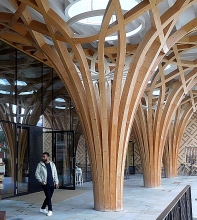
This has been achieved very successfully. The visually spectacular deep portico, reached after walking through a pleasant garden, is supported by clusters of curved timbers, which immediately bring to mind thoughts of the masonry fan-vaulting in Kings College Chapel. These clusters continue through the entire building, creating a sense of continuity of the exterior and interior spaces. The vaulting that reminds us of the mosque’s gothic relative at Kings College also evokes purely Islamic architecture such as one finds at the Alhambra in Spain. The outside of the building is covered with brickwork in two colours, the bricks being arranged to produce patterns which are contemporary versions of a traditional Islamic design. The centre of the mosque is topped by a single dome made in matt-gold coloured metal.
The glass walls that separate the portico from the interior of the mosque reflect the mundane houses opposite the mosque (across Mill Road). I do not know whether the designers intended it, but I felt that these reflections were a way of giving the impression that the garden and the world beyond the mosque is merging with the building itself, that the religious structure was merging with its secular surroundings. Whether or not this was the designers’ intention, this mosque deserves a place in the highest echelon of great British architecture alongside Kings College Chapel. The beauty of the chapel and the mosque, separated by many hundreds of years in age, both have the effect of taking one’s breath away in amazement.






 yamey
yamey 