ARTSPACE 5-7 IS A small gallery housed in a pre-WW2 Modernist building in Portugal Place, a side street that leads away from Bridge Street in the university town of Cambridge. We visited the gallery in August 2025, and viewed a collection of sculptures and drawings by the London born artist Richard Bray (born 1955). A few years after being awarded a degree in Photographic Arts at the Central London Polytechnic, he was awarded a degree in Fine Art at Norwich School of Art and Design. His exhibition at Cambridge is called “Visible Invisible”.
Whereas kinetic art depends on its movement for effect, Bray’s finely crafted sculptures and prints are static. However, as the viewer moves around his artworks, viewing them from different perspectives, what can be seen changes. Bray’s works seem to acquire internal movement that can only be perceived when the viewer moves past or around them. These effects, which add great beauty to his works, cannot be captured using still photography. Three of the sculptures were on display in the churchyard of St Clements opposite the gallery
Bray spent time in Tanzania during the 1980s. What he must have seen in the way of local design and crafts has clearly influenced the appearance of the works we saw in Cambridge. In fact, when I first entered the exhibition, I saw what I mistakenly thought was a collection of sculptures from Africa.
The gallery because of its Modernist design is worth seeking out when you visit Cambridge. The exhibition of Bray’s works, about which we knew nothing in advance, were refreshingly exciting to see.
ST CLEMENT’S CHURCH in central Cambridge began being constructed in the 13th century. It was modified in later centuries. While many Anglican churches contain one or two Orthodox-style icons, St Clement’s has many of these, including a large one depicting the Mother and Child, flanked by typical Orthodox style, sand-filled candle holders. In addition, there are several large reproductions of frescos of portraits of Orthodox saints including St Clement. Apart from the Orthodox Church features within the building, there are furnishings that one would expect to find in any Anglican church.
The reason that the Orthodox ‘fittings’ fill the church is that St Clemnt’s doubles up as a church for an Anglican congregation and also for a local Russian Orthodox congregation, the members of the Parish of St Ephraim the Syrian, which is an English-speaking Russian Orthodox parish of the Diocese of Sourozh. In the Orthodox church, a screen called the ‘iconostasis’ and usually covered with religious paintings separated the clergy from the congregation. St Clement’s contains an iconostasis, which is retractable. During Orthodox masses, the hinged screen can be unfolded to hide the chancel from the rest of the church. When the Orthodox congregation are not using the church, it is folded away, and can hardly be seen from the nave. I had never seen a retractable iconostasis until I first entered St Clement’s (in August 2025).
One other noteworthy feature in the church is a mural on the east wall above the (Anglican) high altar. It was painted in 1872 by Frederick Richard Leach (1837–1904), who was born in Cambridge and later worked with the designer and social activist William Morris (1834-1896).
I have visited Cambridge numerous times and often passed St Clement’s, but it was only in August 2025 that I first stepped inside. I am glad I did because although it is a fine mediaeval church, its use by two Christian denominations and, in particular, its folding iconostasis makes it especially interesting.
THE DOUBLE-HEADED EAGLE symbol, which dates back to ancient Babylon, and is used as the national symbol of Russia, Serbia, Albania, and other places, can be found in England. This example is on the drain pipe of The Museum of Archaeology and Anthropology in Cambridge. The building stands on the corner of Pembroke Street and Tennis Court Road. The double-headed eagles on the drain pipe can be viewed from Tennis Court Road. I have not yet found out why this symbol was chosen to decorate the drainage pipe.
PORTUGAL PLACE IS a narrow winding lane that runs east from Bridge Street in Cambridge. It contains many picturesque old cottages and in the midst of them is one that looks as if its design was inspired by the Bauhaus school of design. Occupying numbers 5 to 7 Portugal Place it is a wonderful example of Modernist architecture.
Until 1933, numbers 5, 6, and 7 Portugal Place were Victorian cottages. In 1933. The three cottages were sold by auction to Samuel Bostock. In 1935, the publisher Gordon Fraser (1911-1981) bought the properties, and demolished them. In their place, he had the present Modernist edifice constructed, which was completed by 1939. The new building served as a bookshop and a gallery for prints.
Today, this well-lit, spacious place is home to an art gallery called ArtSpace 5-7. It hs been in this Modernist building for at least 10 years. Although I have been visiting Cambridge regularly since the 1960s, I had never walked along Portugal Place until May 2025. Finding this elegant Modernist building in that tiny thoroughfare was a wonderful surprise.
MY INTEREST IN the Olympic Games is limited, but that did not stop me from visiting the Fitzwilliam Museum in Cambridge, where an exhibition is being held to celebrate the 1924 Olympic Games, which were held in Paris. The exhibition, “Paris 1924: Sport, Art, and the Body”, is on until the 3rd of November 2024. Paris was, and still is, an appropriate place to hold the Olympic Games, because the man who revived this ancient Greek festival of sport, Pierre de Coubertin (1863–1937), was born in that city. The exhibition is well laid-out. Naturally, it contains many items of interest to enthusiasts of sport and the Olympic Games. Most of these are relevant to the 1924 Paris event, which was held only 10 years after the outbreak of WW1. The exhibits which interested me most were some of the paintings.
The Paris Olympics of 1924 took place during an exciting era of artistic experimentation and development. Most of the paintings in the exhibition provide evidence of that exciting period of twentieth century art. There is a painting of a gymnast by the German artist George Grosz (1893-1959), which was painted in about 1922. Works by the Italian Futurists Gino Severini (1883-1966), Enzo Benedetti (1905-1993), and Umberto Boccioni (1882-1916), figure in the exhibition. There is also a painting by Jack Butler Yeats (1871-1957), who was a brother of the famous poet William Butler Yeats. An interesting almost Cubist painting of a tennis player caught my eye. It was created in 1917 by an artist I had not heard of: André Lhote (1885-1962). A modernistic portrayal of a female runner by Willi Baumeister (1889-1955) fitted in well with the theme of the exhibition.
The paintings and sculptures chosen for the show were what made the exhibition enjoyable for me. One painting amongst them was for me the greatest surprise. It is a huge portrait depicting the face of the tennis player Mrs Helen Wills Moody (1905-1998), created in pastels in 1930. She had won two gold medals in the Olympics of 1924. I do not know why, but it was with great surprise that I saw that the artist was the Mexican Diego Riviera (1886-1957). Although the portrait is large, I had always associated Riviera with huge murals, rather than portraits and smaller paintings, of which, I have recently discovered, he created many.
I am pleased that I have seen the exhibition at the Fitzwilliam not because it has increased my interest in the Olympic Games, but because it included some fine paintings, which I had not seen before.
This photograph shows a cow grazing in a meadow in Cambridge (UK). Behind the animal, you can see the world famous perpendicular gothic chapel of Kings College – part of the University of Cambridge.
I posted this picture on Facebook. A few hours later, one of my friends added the witty comment:
WHEN RABINDRANATH TAGORE (1861-1941) visited China in 1924, he gave a series of lectures in English, which were translated for the Chinese audiences by the talented young poet Xu Zhimo (1897-1931). During a visit to Cambridge (UK) in August 2024, in several shop windows I noticed a book called “Xu Zhimo Cambridge & China” by Zilan Wang. Even though Cambridge has many students and tourists from China, I wondered about it.
Xu Zhimo was born in Haining (China). He studied law in Beijing, then in 1918 travelled to the USA, where he studied for, and was awarded a degree at Clark University in Worcester, Massachusetts. After starting a degree at Columbia University in New York City, he left the USA because he could no longer stand the place. He then travelled to the UK, where he first studied at the London School of Economics, and then at Kings College, Cambridge. It was in Cambridge that he became deeply attracted to poetry, and began writing it. In 1922, he returned to China, where he became an important figure in China’s modern poetry movement. He was a believer in ‘art for art’s sake’ rather than the (Chinese) Communists’ belief that art should serve politics.
When Tagore came to China, the country was in turmoil: there was fighting between rival warlords and the risk of an invasion by the Japanese was great. Xu Zhimo served as one of his oral interpreters, translating Rabindranath’s romantic (English) language into vernacular Chinese. Tagore did not rate his visit to China a great success. He was met with some hostility as Huan Zhao explained in the introduction to an article entitled “Interpreting for Tagore in 1920s China: a study from the perspective of Said’s traveling theory” (Perspectives, Volume 29, 2021 – Issue 4):
“During Tagore’s visit, his initial perceptions of welcome were transformed dramatically into a feeling of rejection, resulting in an unpleasant sojourn. After forty-odd days, Tagore left China, disconsolate, with his mission unaccomplished. Exactly what happened remains unclear. The introductory flyleaf of Talks in China claims his poor reception had much to do with ‘organized hostility from the members of the Communist Party and was labeled as a reactionary and ideologically dangerous.’ Others maintain that Xu, as Tagore’s interpreter, should shoulder much of the responsibility for the visit’s outcome – that Xu’s efforts to enhance his own fame while welcoming Tagore effaced Tagore’s purposes and ideas”
And in the author’s conclusion, the following was written:
“In 1920s China, Tagore’s lectures and Xu’s interpretations faced strong resistance from Chinese intellectuals who sought radical social reform. This resistance interrupted Tagore’s visit and inflicted lasting anguish on his interpreter Xu Zhimo. Although challenged by critics, Tagore’s lectures continued to influence Chinese philosophers, thanks in large part to Xu’s unyielding efforts to expand and explain Tagore’s lectures.”
Xu Zhimo was killed in an air crash in November 1931.
On our recent visit to Kings College in Cambridge, we stopped to look at a large stone on which Chinese writing characters are inscribed. We had passed it on previous visits to the city, but had not investigated it. This time, we noticed a short path leading from the stone into a circular enclosure surrounded bushes and trees. The path is lined with rectangular paving stones on which some lines of a poem by Xu Zhimo is carved. Alternate stones are in Chinese, the others are in English. The words are from Xu’s poem “再别康桥” (Zài Bié Kāngqiáo, which means ‘Taking Leave of Cambridge once more”), which he wrote in 1928. The enclosed area has a small bench upon which we sat, watching a continuous stream of Chinese people visiting the memorial, stopping to look at it respectfully.
DURING A RECENT VISIT to Cambridge, we spent some time in the magnificent chapel of King’s College. It is difficult to avert one’s eyes from the masterpiece of gothic fan-vaulting that forms the ceiling of this edifice, but it is worth doing so because the chapel is filled with other wonderful things. These include a painting by Rubens, another by Gert van der Lon, and yet another by Girolamo Siciolante de Sermoneta. The brass lectern that stands in the choir was made in the early 16th century and is surmounted by a small statue of King Henry VI. There are many other items of great historical interest to be seen including the stained-glass windows, which have survived since the 16th century. Interesting as all of these are, what caught my attention was something in a small side chapel – The Chapel of All Souls.
This chapel was converted in the 1920s to house a memorial to those members of King’s College (academics, students, choristers, and servants) who died during WW1. The names of those who perished are listed on engraved stone panels on one wall of the small chapel. Amongst these names is that of the famous poet Rupert Brooke (1887-1915).
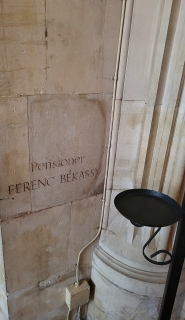
On another wall of the chapel, separate from the list of names, I spotted an inscription carved into the stone. It reads:
“Pensioner Ferenc Békassy”
Ferenc Istvan Dénes Gyula Békássy (1893-1915) was a Hungarian poet born in Hungary. In 1905, he was enrolled at Bedale’s School in Hampshire. In 1911, he began studying history at King’s College Cambridge. He was what is known as a ‘pensioner’. In Cambridge University usage, this word was used for a student, who has no scholarship and pays for his tuition as well as his board and lodging. During his time at the college, he was elected a member of The Apostles and courted the same woman as Rupert Brooke. He composed poetry both in Hungarian and English.
Just before the outbreak of WW1, Ferenc returned to Hungary, where he enlisted as a hussar in the Austro-Hungarian Army. On the 22nd of October 1915 he was killed in action whilst fighting the Russians in Bukovina. He was buried on his family’s estate in Hungary.
After the war, the memorial in King’s College Chapel was established. Because it was considered objectionable for the name of an enemy soldier to be listed amongst those who fought and died for Britain, his name was not included on the memorial. Instead, it was placed on another wall nearby.
Though separated from Rupert Brooke’s name by a few feet, this small chapel serves as a memorial to two great poets, who were killed in their prime.
THERE IS A SUPERB exhibition at Cambridge’s Kettles Yard until the end of October 2023. The beautiful exhibits are mainly garments embroidered by Palestinian women before and after 1947. There are also a few other items including Palestinian propaganda posters depicting women wearing embroidered garments. The labels next to the exhibits are full of interesting information. Several of the topics particularly interested me.
Some of the garments were made using scraps of pre-used materials – for example bits of old clothes or even sacking and other packing materials. These old textiles were stitched together to create new clothes. This reminded me of a similar recycling of old materials which I saw at an exhibition of Japanese recycling at London’s Brunei Gallery.
I saw examples of Palestinian dresses which seemed very long. The length of these skirts was for a purpose. The cloth could be raised up to produce pocket like folds in which objects could be carried. These dresses were worn by Bedouins living in the Bethlehem and Jerusalem areas.
There was a widow’s dress. It was dark blue – the colour signifying grieving – and trimmed with red threads, which signified that the wearer was ready to be remarried.
One room was dedicated to embroidery and how the troubled situation in Palestine affected it. In refugee camps, some of the traditional materials were unavailable, and women had to embroider using whatever threads they could get hold of. There were several embroidered dresses adorned with decorations including the Palestinian flag and other patriotic motifs. These were displayed in the same room as the pro-Palestine propaganda posters that show women wearing embroidered garments.
I hope that what I have written gives you something of the flavour of this fascinating exhibition. Despite the intense reactions that discussing the plight of the Palestinians often arouses, the exhibition at Kettles Yard takes a reasonably balanced view of the situation. Its emphasis is on the skills of the Palestinian embroiderers rather than the politics of the part of the world where some of them still reside.




 yamey
yamey 