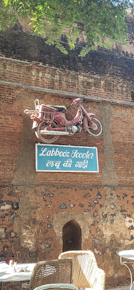
NESTLING BESIDE THE castle walls of Maheshwar in Madhya Pradesh in India, there is an attractive outdoor cafe called Laboo’z. An old motorbike is attached to the castle wall facing the chairs and tables. Below it, there is a sign that reads: “Labooz’s Scooter”.
The cafe was established in 2002 by Richard Holkar, a scion of the Holkar family that ruled the Kingdom of Indore, whose capital used to be Maheshwar.
When Richard and his half sister were children, they used to be ferried around Maheshwar on the bike now adorning the cafe. The driver who took tem on the motorbike was tall (‘lambu’ in Hindustani). Over the years, he became known affectionately by the nickname ‘Labboo”. His motorbike, now attached to a wall, commemorates him.
THE TRAINS THAT used to run into Folkestone Harbour station have not done so for many years. The station has been restored and repurposed as a pleasant, tasteful leisure amenity.
The signal box that used to regulate rail traffic in and out of the station still stands. It is now used as a café. With fine views of the harbour and Folkestone town, the signal box now contains equipment for making coffees and seats for customers. Apart from being an interesting old building, the old signal box contains the levers that used to operate the points within the station and on the bridge across the small harbour that connects it to the main land.
The café is not only housed in an original building, but also the coffee made there is above average in quality.
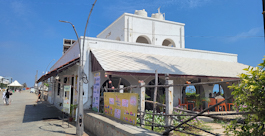
BEACH ROAD RUNS alongside the seafront of Pondicherry. It is just over 1.3 kilometres in length. There are many buildings lining the landward side of the road (its west side), including hotels, restaurants, a memorial to BR Ambedkar, the lighthouse and the Customs House. However, there is only one on the seaward side, close to the seashore. Today, this building with a veranda on its sea facing side is a pleasant refreshment outlet called Le Café. It stands a few metres south of the tall statue of Mahatma Gandhi, also on the seaward side of Beach Road.
The café contains some historical photographs of Pondicherry. One of them shows the long pier that commenced where Gandhi now stands. The pier was irreparably damaged during a terrible storm in the early 1950s, probably 1952. All that remains of it are some wooden stumps projecting from the sea some considerable distance away from the shore. Where Gandhi stands today was Place de la République when Pondicherry was a French colony.
There has been a building on the site of Le Café since at least the end of the 17th century, as can be seen on a map published in 1793. For many years, the building housing the café was the Port Office of Pondicherry. It can be seen quite clearly in a photograph taken before 1870. Then, it had only a single storey. A small upper storey has been added since then.
Sometime after the pier was polished off by the storm, the building was remodelled to serve as a café. Run by a state managed concern, food and non-alcoholic drinks can be obtained here at reasonable prices. In the intense heat of midday and the early afternoon, the veranda of Le Café is a pleasant place to relax in the breezes that pass through it.
AIRLINES HOTEL IN BANGALORE has an outdoor seating area where you can enjoy beverages and South Indian vegetarian dishes, seated beneath venerable banyan trees.
IT WAS FROM ETHIOPIA that historians believe coffee beans were first exported to Yemen, where they were roasted and processed into what we would now recognise as a coffee drink. The earliest recorded use of coffee beans for brewing the drink was in 15th century Yemen. However, soon the drink spread to other parts of the Middle East, North Africa, Turkey, and Persia. By 1600, it had reached Europe. Today, the 13th of April 2023, we were strolling along Shepherds Bush Market, which runs alongside the elevated railway tracks along which trains of the Hammersmith & City and Circle Lines run. The tracks run high above the market supported by brickwork arches. Some of these arches have been used to house shops and in one case an interesting café, which opened in 2020, just before the first of the covid19 lockdowns.
The café is called Delina and is run by Ethiopians. Beautifully decorated with Ethiopian textiles and other artworks, this place offers Ethiopian fare including coffee from Ethiopia. Customers can have their coffee prepared in various common ways such as, for example, Americano, espresso, and latte. I asked whether I could try coffee the way it is drunk in Ethiopia and was given the choice of coffee flavoured with cardamom or with ginger. I opted for the latter because once, many years ago, I had drunk coffee with ginger (and other spices) in a tiny coffee shop next to a mosque in Fort Kochi (Kerala, India), and liked it.
The lady working behind the bar first collected a ‘jebena’, which is ceramic container with a cylindrical base, a handle, and a long neck with a pouring spout. She washed it out and then placed it on a glowing charcoal to both dry it and heat it. Meanwhile, she prepared some coffee in the espresso machine, and filled a small jug with it. To this she added some ginger powder and stirred the mixture well. Carefully, she poured the ginger coffee into the heated ceramic container. Then, she loaded a small tray with the following: the ceramic container and a woven stand to support it upright; a tiny coffee cup with no handle; a bowl of sugar; and a small circular holder containing lumps of smoking incense. She explained that in Ethiopia it was believed that drinking coffee whilst being bathed in incense fumes enhanced the enjoyment of the beverage. There was enough coffee in the jug to refill the tiny cup or bowl about five times.
In Ethiopia, the coffee is usually first roasted in front of those who are about to enjoy it, ground with a pestle and mortar, and then brewed with water in the jebena being heated on charcoal. Then, it is poured into the tiny cups through a filter made with fine filaments. Although Delina has an electrically heated pan for roasting coffee beans, I imagine that roasting a fresh batch for one customer was considered too much work. I can imagine that when the place has a group of Ethiopian customers, shortcuts cannot be taken and the beans are freshly roasted for them.
As for the coffee laced with ginger, it was enjoyable. I could not taste the ginger, but I could feel it in my throat as I swallowed it. Years ago in Fort Kochi, we had been told that it was believed that ginger coffee was beneficial for the throat. Would I go to Delina again? Yes, I would. Despite the trains rumbling overhead every few minutes, the place has a delightful and visually satisfying ambience, and friendly staff. It also serves Ethiopian food, which we have yet to sample.
THE KAMAT GROUP has been operating hotels and restaurants for about forty years, if not longer. One of the branches is opposite the Jumma Masjid in the busy Commercial Street district of Bangalore (Bengaluru) in South India. I have visited this eatery many times during the 28 years that I have been making visits to Bangalore.
We usually drop in, or rather ascend the steps to, the seating area of Kamat’s to have a cup of coffee after doing errands in the crowded lanes that form the bustling area through which Commercial Street runs.
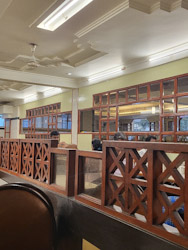
The interior of Kamat never changes. It has probably looked as it does today ever since it opened sometime before my fist visit to Bangalore. Its walls are simply decorated with mirrors and polished woodwork. A wooden barrier runs along the midline of the rectangular seating area, which comprises basic tables and chairs.
Despite not having the latest, trendy internal decor, Kamat in Commercial Street attracts many customers. The owners have done nothing noticeable to modernise the place; to make it compete with the many much more glitzy places in the city. Clearly, they understand the maxim ‘if it ain’t broke don’t fix it’
ONCE A CITY FILLED with lovely gardens and other verdant open spaces, Bangalore (Bengaluru) is growing alarmingly rapidly. So, public spaces that have been as yet saved from being built on are valuable amenities. One of these areas of greenery is the so-called Tivoli Garden, which is in the grounds of Airlines Hotel in the heart of the city.
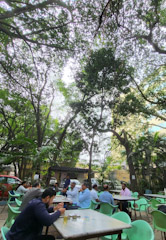
Known popularly as ‘Airlines’, the Tivoli Garden, a name by which it is hardly known, has tables and chairs set out in an open space, a clearing, surrounded by trees, several of them being elderly banyans.
Opened in 1969, the open air café and eatery is still supervised by a man who helped set it up two weeks before it opened all those years ago. Despite its rather untrendy appearance, Airlines is popular with Bangaloreans of all ages. Quite a few of them are students, but many are office workers. Very good South Indian filter coffee is served at Airlines. A wide range of South Indian vegetarian dishes is also served.
The coffee, other drinks, and food are prepared in the kitchen of the hotel. Waiters in white uniforms carry drinks and food across the car park from the kitchen, which is located at the far end of a dingy dining hall, to the garden seating area. Some customers prefer to have their orders served to them whilst sitting in their parked cars.
For my wife and me, Airlines has several attractions. One is the coffee. Another is the pleasant ambience under the trees. And yet another is nostalgia. My wife used to visit Airlines with her family in her late teens. And together with our daughter, my wife and I have been regular visitors to Airlines since when we married in 1994.
For several years, Airlines has been under threat of closure by the people who own the land. Over a decade ago, these people reclaimed half of the area occupied by the café. They built an ugly grey wall (rather like a Berlin Wall) to separate what is left of Airlines from what has now been built on. The supervisor, whom we have known for ages, assured us that as far as he knows the remaining part of the establishment will remain safe from redevelopment.
It would be tragic if Airlines were to disappear, not only because we love it but also it would be yet another example of how what was once a lovely garden city is becoming more and more of an urban jungle
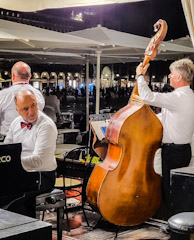
MUSIC IS A PART of what I associate with St Marks Square in Venice (Italy). Whether it be the occasional outdoor orchestral concerts that used to be held in on summer evenings in the 1960s, when we made annual family visits to the watery city, or the small bands that play on stages next to some of the square’s costly cafés. One of these ‘cafs’ is Florian’s, where a 6 Euro charge is added to your bill for the music.
Florian with its beautiful neo-baroque rooms that are entered beneath the arcade surrounding the Square was founded in 1720 as ‘Alla Venezia Trionfante’ but soon became known by its present name.
We looked at the menu at Florian, but although it is an extremely romantic place, there is a substantial price to pay to be an active part of it!
PARADISE IS A café in Great Dunmow, a small town in Essex. With several small eating areas and a cool breeze blowing through it, this comfortable eatery was a good place to eat lunch on a day when the air temperature was 32 degrees Celsius. Judging by its menu, which includes gözleme and shish kebabs, and the fact that the staff were speaking Turkish, it would be correct to say that Paradise is a Turkish run establishment.
Having noted that, it would be fair to say that this place is a well above average “greasy spoon caff”. However, the food is not at all greasy. In addition to food items usually associated with Turkey, Paradise offers the full range of English breakfast items, as well as wraps, burgers, sandwiches, and chicken curry.
One impressive feature of Great Dunmow’s Paradise, apart from the attentive and efficient staff and tasty food, was flexibility: we were able to order exactly what we wanted even if it was not on the menu.
It is always fun to discover reasonably priced, unpretentious places like Paradise. We will return there next time we are in the area.
SITUATED CLOSE TO the River Thames footpath between Hammersmith Bridge and Chiswick’s St Nicholas Church, in whose cemetery the artist William Hogarth is buries, is the popular Elder Press Café.
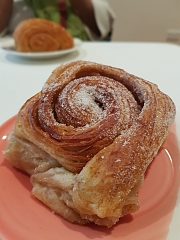
A ‘breakfast bun’ at the Elder Press Cafe
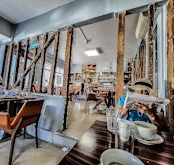
From the outside, it seems that this is a small establishment, but this is misleading. Behind the narrow shopfront facing the the Black Lion pub, the café extends a long way. It surrounds an inner courtyard with tables and chairs.
In addition to drinks and delicious patisserie items, the place offers a range of savoury dishes, which I saw being served to those on tables neighbouring ours. The food looked healthy as well as delicious. Service was attentive and friendly and prices were not exorbitant.




 yamey
yamey 