I HAVE VISITED BANGALORE regularly over the past 31 years. Each time, I have been impressed by the city’s numerous well-stocked bookshops. Many of them are now located along the short Church Street, which runs parallel to a stretch of the much longer MG Road. At the last count, I found 9 bookshops along Church Street, which is less than half a mile in length.
Bookworm
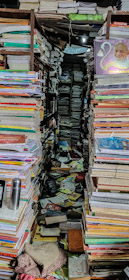
One of these shops that impresses me most is called Bookworm. Its location has changed several times since I first found it in 1994. Now, it is housed in a former mansion set back from Church Street and reached by a tree shaded pathway. It contains many rooms, each of which has walls lined with bookshelves filled with books from floor to ceiling. Much of the floorspace in these rooms is covered by piles of books. The books range from the latest releases to out of print and secondhand volumes. Recently, a small room has been added to display rare antiquarian editions. Despite this, there are many old and interesting books within the other rooms.
Bookworm is an ideal place for browsing if you have plenty of time on your hands. If you are pressed for time or know what you are looking for, the helpful staff will either know where to find what you are seeking, or will search for you.
When you have selected what you wish to purchase, some of the newer titles are subject to a discount at the cash desk. The older books and secondhand editions are priced very reasonably.
Although there are other superbly stocked bookstores in Church Street, notably Blossom Book House, Bookworm is my favourite. It is truly a magnet for bookworms.
A FEW DAYS AGO, I posted a photograph on Facebook. It shows some books displayed on a pavement bookstall in Calcutta’s Park Street. Two of Hergé’s Tintin books were placed next to a copy of Hitler’s “Mein Kampf” (translated into English). The book by Adolf H was placed next to another book – “The Intelligent Investor” by Benjamin Graham. Neither the title nor its author meant anything to me.
Seeing books by Hergé is not uncommon in India. Nor is it unusual to find copies of Hitler’s book on sale, as I have described in my book “The Hitler Lock and Other Tales of India”.
Soon after I posted the above-mentioned photograph on Facebook, my friend Andrew Sofer, whom I have known since he was born, commented on the photo as follows: “Grandpa Ben would not be happy about his neighbor.” I was staggered to read this. The author of “The Intelligent Investor” was Andrew’s grandfather. His book, which was displayed next to Hitler’s was first published in 1949, and still sells well.
Andrew’s father, Cyril, was born in South Africa and was one of my father’s best friends. Cyril was a Don at Queen’s College in Cambridge when he died at a young age. Our family used to visit Cyril and his family at their home in Cambridge regularly during my childhood and early teenage years. Benjamin Graham was the father of Andrew’s mother. I was unaware of Andrew’s connection with Benjamin Graham when I took the photograph of Hergé’s books juxtaposed with “Mein Kampf”.
What puzzles me is whether the close placement of the books by the three authors was random (ie accidental) ,or consciously arranged. Both Hitler and Hergé had fascist tendencies, but not Benjamin Graham. I wonder what was going through the bookseller’s mind when he arranged the books on that stall.
A FEW MINUTES WALK from our hotel in BARODA (Gujarat) brings you to Patel Bookstore. The owner of this small bookshop stocks ‘pre-loved’ (not ‘secondhand’) books. Some of them are arranged on surfaces under the verandah in front of his shop and on its counter. The rest of them are on shelves and on the floor of the part of his store behind the counter. The shop has a chaotic appearance, but I am sure Mr Patel knows what he has in stock.
Mr Patel, a friendly gentleman, has a huge stock of books in English – much fiction and slightly less nonfiction. He also sells books printed in Gujarati.
The owner of the shop is happy to buy back books you have bought from him. When you make a purchase, he writes the price you paid in the book, and how much he would be prepared to buy it back when you have read it. He is also happy to buy other volumes that you wish to dispose of.
Even though I could not see many books that appealed to me, I love visiting idiosyncratic bookstores like that run by Mr Patel.
I AM ADDICTED to visiting bookshops. In the heart of Madeira’s capital, Funchal, not far from the cathedral in a steep narrow street stands the Livraria Esperança. Founded in 1886, this bookshop is the largest in Portugal, and maybe one of the largest in Europe. It is housed on three storeys of an 18th century Palace. On each floor, there is a veritable warren of rooms, each filled with books and magazines.
The unique feature of this well stocked bookshop is that each book is displayed so that its whole front cover can be seen. This differs from many other bookshops in which most books are shelved so that only their spines can be seen. Many of the books in the Livraria are held between the jaws of clips hanging from pegs on the bookshelves.
Although books are arranged according to subject matter in different rooms, within each of these rooms the books seem to be randomly arranged. For example, a book about Salazar might be hanging between one about Roman archaeology and another about East Timor. I am not sure how the salespeople lay their hands on a particular volume that a customer requires.
More than 99% of the books are in Portuguese. There is a small collection of books in other languages. I do not understand Portuguese sufficiently well to read a serious text in that language. So, sadly I left the wonderful shop without having made a purchase.
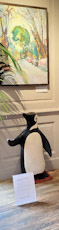
HAMPSTEAD’S BURGH HOUSE was constructed in 1704 and retains many of its original architectural features. Several of its rooms house a fascinating museum with exhibits relating to the history of Hampstead. I have visited the museum many times, but it was only today (the 9th of March 2023) that I noticed a model penguin on display. This used to stand inside High Hill Bookshop, which was located on Hampstead High Street. Founded by Ian Norrie in 1956, it remained in business until 1988.
During my childhood, in the 1950s and 1960s, I used to visit Hampstead almost every Saturday morning with my parents and my sister. We used to park the family car near to Jack Straws Castle, which is close to Whitestone Pond – one of the highest spots in London. Then, we would walk down Heath Street and along the High Street until we reached High Hill Bookshop. My parents were keen to encourage my sister and I to read. Therefore, every time we visited the bookshop, we had to choose one book each, which they purchased for us. I cannot recall all of the books I chose, many of them Puffin paperbacks, but I do remember that during these visits I gradually built up my collection of the adventures of Tintin by Hergé.
According to an article (https://jessicanorrie.wordpress.com/2017/08/04/the-best-independent-bookshop-in-london/) by Norrie’s daughter, Jessica Norrie, there was a party for Penguin Books held in the shop in 1960. The model penguin, which I saw in Burgh House today, was in attendance at that party back in 1960. I was eight in 1960, but I am afraid that I cannot remember seeing the penguin. It must have been in the shop during some of my visits, but then my interest in choosing a book was greater than looking for model penguins.
The penguin in the museum is black and white. On the white section of the bird’s belly, there are words, including “October 12th, 1960. High Hill Bookshop Silver Jubilee Party” and, also, some signatures. One of the signatures is that of Allen Lane, founder of Penguin Books. He died 10 years after the party. Another signature is that of the novelist Olivia Manning, There are several other signatures, but I found them too difficult to decipher.
Seeing the penguin at Burgh House brought back happy memories of my childhood and, at the same time, made me sad because High Hill Bookshop was irreplaceable. Waterstone’s, which followed in its wake, although well-stocked, lacks the charm of Ian Norrie’s wonderful creation.
WHEN WE LANDED at the huge airport that serves Kolkata (Calcutta), it looked much as it did 3 years ago. Only one of the 6 or 7 baggage retrieval conveyor belts was in use and the vast airport seemed almost empty. The situation was the same when we last used it in December 2019.
We made the long ride from the airport to South Kolkata in a vehicle that was not available 3 years ago: an electric taxi. While being driven in this advanced form of vehicle, I wondered whether much else had changed in the city. Although there is much new construction at the periphery, it seems that delightful old Kolkata simply looks a little older.
A visit to the busy New Market (aka ‘SS Hogg Market’) revealed little obvious change. Our first port of call was at the excellently and tastefully stocked Modern Book Depot, where we chatted with the owner and made a few purchases.
Our search for a small funnel took us around the market buildings. A small store crammed full of kitchenware was able to fulfil our quest. We had been looking for this simple item in three other cities – in vain.
To our great relief, Nizam’s restaurant looked much as it has done for many decades, although an additional dining area has been added. The walls of the two older eating areas are decorated with framed theatre (English and Bengali plays) and cinema posters (mainly films made in India).
Nizam’s was founded in 1932, and has been well-known for its tasty kabab (‘kathi’) rolls ever since. A paratha is fried in oil on a tava, and cooked mutton or chicken is placed on it plus or minus a a beaten egg. When the paratha is ready, it and its contents are rolled up and wrapped tightly in paper. According to the customer’s choice, chillies can be added before the paratha is rolled. The management of Nizam’s states that the paper wrapped rolls were invented so that in the era prior to Independence, British men and their casual, temporary, female companions could eat the rolls without getting grease on their fingers. Whatever their history, these kabab rolls are highly enjoyable.
From where we were sitting, we were able to see the paratha dough being strenuously kneaded by a young man rhythmically thrusting his hands into the stiff paste. I was also able to watch other men threading meat onto metal skewers and others grilling the meat on glowing charcoal. The dough is formed into spheres a little smaller than tennis balls . These spheres are then flattened to make circular discs, which are then fried on the tava as already mentioned.
Walking around New Market and driving between it and south Kolkata revealed that the centre of the city I love has not succumbed to the often tasteless modernisation that has affected many other cities. I enjoy the unchanging appearance of Kolkata, but many people who have lived there bemoan the fact that it is a dying city. This is not say that Kolkata lacks vitality. It is still full of life, but as far as business opportunities are concerned, both the present and the future are not looking particularly optimistic.
THERE IS SOMETHING curious about a small building on Kensington Park Road (near to London’s Portobello Road). Above its centrally located, west-facing front door, there are three tall windows topped with semi-circular arches. In each of these windows, there is a circular pane of glass painted white.
If you look at the circular panes carefully, you will notice that, almost obscured by the paint, there is a six-pointed star, the Jewish Magen David. Inside the building, there is a large hall flanked by galleries at the first-floor level. The galleries are supported by metal columns topped with decorative capitals. High up on the east wall of the building, there is a circular stained-glass window. The glass depicts a Magen David: it has not been concealed by paint.
In the former synagogue on Kensington Park Road
Did you know that this building, now much modified, was one of two synagogues in the Bayswater/Notting Hill area of west London? The other, still functioning, is on St Petersburgh Place near Bayswater Road.
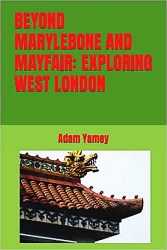
I will not tell you any more about these two synagogues, one defunct and the other working, and west London Jewish communities, because you can read about them ( and much more) in my book “Beyond Marylebone and Mayfair: Exploring West London”. You can buy the book from Amazon (https://www.amazon.co.uk/BEYOND-MARYLEBONE-MAYFAIR-EXPLORING-LONDON/dp/B0B7CR679W/), or if you prefer to support independent bookshops, you can order a copy from a lovely bookshop near the former synagogue on Kensington Park Road: Lutyens & Rubinstein (21 Kensington Park Rd, London W11 2EU).
ALL OF MY books have been self-published. Until recently, I used a ‘print-on-demand’ website called lulu. The process involved first writing my manuscript and formatting the text and any illustrations on Microsoft’s Word software, using a template (for the size of the book) downloaded from lulu. When I was happy with what I had produced, I was able to upload it to lulu’s website. Then, the fun began. Lulu converted my Word document into a .pdf file and when that was done, I could download the .pdf to proofread and make other checks. Almost always, something was lost in translation: what appeared in the .pdf was far from what I wanted. So, endlessly I had to keep adjusting my Word file and uploading it to see whether the latest version produced what I wanted in the lulu generated .pdf. It was tedious and somewhat nerve-wracking to say the least. Then, last summer, disaster struck.
I had just completed the manuscript for a book about west London and was looking forward to uploading it to lulu. It did not take more than a couple of minutes to discover that lulu was no longer accepting manuscripts in the form of Word files. The requirement was to prepare a correctly formatted .pdf file. I was stumped. I had no idea how to do this and felt despondent because I then believed that I might not be able to publish another paperback myself.
Many months passed. Then, while I was perusing some articles on the lulu website, I discovered that one can format .pdf files using software such as Adobe’s InDesign. I investigated this and found it to be quite costly. However, soon I became aware that there is a cheaper option, Serif’s Affinity Publisher, which I bought and downloaded.
At first, Affinity looked impenetrable but there are many on-line tutorials, which I watched before tackling the software. After a few false starts, I began to get the hang of the programme’s basics. Using the relevant template downloaded from lulu, I then inserted the text from my Word manuscript into the Affinity system. After several days of moving the text about and inserting some illustrations and the page numbering, I produced something that looked acceptable. I converted the Affinity file into a .pdf file using the software’s ‘export’ function. Then, with some trepidation, I uploaded my new Affinity-generated .pdf file on to the lulu site. To my great joy, the proof that lulu produced was exactly as I wanted it. So, the Affinity software has proved to be up to the job.
Having found a method to upload to lulu without the problems caused by lulu’s conversion from Word to .pdf, I moved on to finishing and pricing the book. To my horror, I discovered that lulu has increased its prices dramatically. The book, which I created could not be sold to the public for less than £ X plus at least £3.99 postage, which in my opinion was forbiddingly excessive for a book of the size I had made.
Then, I looked at Amazon, which has a book publishing service. Using a new ISBN, I uploaded my .pdf, and after looking at the proof they generated, I looked into the pricing. To my great delight, they can sell the paperback at 58% of lulu’s price excluding postage, which does not always need to be paid. I have seen a copy of the book produced by Amazon and I am happy with its quality. Amazon have captured me from lulu when it comes to book publishing.
DURING THE PENULTIMATE year of our daughter’s time at secondary school (i.e., high school), we, her parents, were invited to several early evening meetings to hear about options for her higher education. At one of these, representatives from three US universities gave talks about the delights and advantages of studying at universities in the USA. One of the Americans explained that when applying, you should only include things that you were the first to do; things that you were best at; and things that only you have done. She emphasised this by saying:
“You have to be the first, the best, and/or the only.”
Well, our daughter chose not not to move to the USA to study, but, chose to study at Cambridge University. Recently, we visited a country house managed by the National Trust, which can easily claim to be the first and the best, and maybe the the only. The property is in Norfolk and is called the Blickling Estate. Its last owner was Philip Henry Kerr, 11th Marquess of Lothian (1882-1940), who was instrumental in getting the National Trust Act passed by Parliament in 1937. At his death, he bequeathed the Blickling Estate to the National Trust. It was the FIRST large Jacobean house to become a property run by the National Trust.
Built in the 1620s for a wealthy London lawyer, Sir Henry Hobart (died 1626), who did not live long enough to see it completed, Blickling Hall is the BEST Jacobean building in the care of the National Trust. As for fulfilling the ONLY criterion, as advised by the above-mentioned lady from an American university, this is more difficult because like all other National Trust properties, Blickling Hall is unique; it is the only Blickling Hall.
However, apart from many things that makes Blickling Hall so special, there is one other aspect of it that gives it some extra kudos. Currently, it has the largest second-hand bookshop of all such outlets run by the Trust. But this is a place well worth visiting for its interiors, exteriors, and fine gardens, both formal and otherwise. I feel that it is one of the first places you should see in Norfolk, as well as being one of the best, but only you can judge whether I am right.
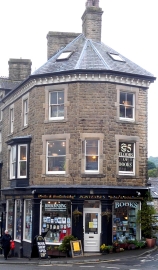
ONE OF THE SEVEN WONDERS of the Derbyshire town of Buxton has to be Scrivener’s bookshop. Located on the town’s High Street, this shop displays books on five floors including the basement. Many, but by no means all, of the books are second-hand (pre-loved). At first sight, the books seem to be crowded together in no particular order, but the reverse is true: they are arranged systematically rather than chaotically.
The books are far from being at bargain prices, but they are priced fairly, not outrageously. Those of you, who know my addiction for acquiring books, will be relieved to know that I purchased only two volumes. There were plenty more that I might have been tempted to buy had I not already embarked on on a project of carefully reducing the number of books in my possession.








 yamey
yamey 