MOST PEOPLE ASSOCIATE Varanasi (Benares) with Hindu temples and practices. However, the city is important to other religions, notably Islam.
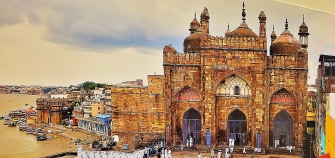
The largest mosque in Varanasi
Recently, we viewed an exhibition called “Mughal Banaras” at SOAS Gallery in London. It was a collection of excellent photographs taken by architect and photographer Jateen Lad who collaborated with historian Malavika Kasturi.
In a Hindu math (monastery) which existed during the time when the city was under Mughal rule, there is a collection of Mughal firmans (official documents) on display, including one written by Dara Shikoh, who was murdered by his brother Aurangzeb).
We were fortunate to have met Jateen at the exhibition, and he showed us around. His superb commentary brought the pictures to life, and discussed the historical importance of, and the current circumstances of the Muslims in the city.
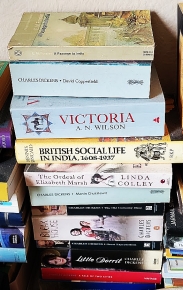
How do you know whether a book is worth reading from beginning to end?
Some people read the first few, say 10 to 20 pages, and then decide to continue or discontinue reading. Others I know read the first few and last few pages, and then choose whether it is worth reading in its entirety. Someone I knew, who was an avid and intelligent reader, told me that if she was finding a book difficult to ‘get into’, she would open the book, and read a few pages somewhere in the middle of the volume, before making a decision. My wife does all three: beginning, end, and a few pages in the middle. What ever method you use to assess the readability of a book is up to you.
In my case, if my attention is grabbed and I have reached the hundredth page, I will read to the end. If not, then I will most probably abandon the book, and move on to another.
PS Most people give up reading Ulysses by James Joyce before they reach page 30
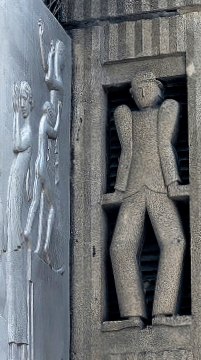
I AM ATTRACTED to the Art Deco style of architecture that had its heyday during the period between WW1 and WW2. Although there is no concentration of buildings made in this style in London, such as can be found in Bombay, there are plenty of examples scattered around the city. One of these is on Wilton Street, facing one side of Victoria railway station.
Details of decoration at the Apollo theatre
Originally built to be a cinema, it was completed in 1930. Its architects were William Edward Trent (1874 – 1948) and E Walmsley Lewis (1898–1977). Plans were made to demolish the Apollo in the 1950s, but, fortunately, they were never realised. In the 1970s, it hosted several musical events including rock concerts. In 1981, the Apollo re-opened as a theatre. Since then, it has hosted musical theatre (‘musicals’) including “Fiddler on the Roof”, “The Sound of Music”, and “Camelot”. Since September 2006, it has been showing the musical “Wicked”.
Surrounded by twenty-first century and nineteenth century buildings, this Art Deco theatre makes for a pleasing element in the architectural ensemble around the railway station.
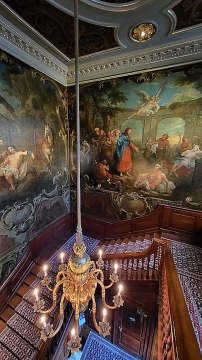
RECENTLY I WENT to a hospital, St Bartholomew’s (‘Barts’), which is near to London’s Smithfield meat market and the Barbican. I went there not because I was ill, but to view a magnificent artwork. It is in the hospital’s North Wing.
The walls of the main staircase in the North Wing are covered with huge paintings depicting scenes from stories in the Holy Bible. What makes them both attractive and interesting is that they were painted by the English artist William Hogarth (1697-1764). According to a website relating to this artwork (https://bartsnorthwing.org.uk/):
“Hogarth decorated the stair free of charge, allowing him to indulge his ambition, and giving the hospital a grand entrance to the Great Hall at no cost.”
Hogarth was a Governor of the hospital. The paintings that illustrate ‘The Pool of Bethesda’ and ‘The Good Samaritan’, were created in 1736–1737.
In 2025, the restoration of the paintings was completed, and the staircase was opened for public viewing at last – they had been hidden from public view for about 300 years. The stairs lead up to the spectacular, vast Great Hall (designed in 1732 by architect James Gibbs), which can also be visited.
And when you have admired the artwork and the Great Hall, head around the corner into Long Lane, and enjoy refreshments at Details, a charming café (near Barbican station) with interesting interior design.
THE PRINTER AND bookseller William Caxton (c1422 – c1491) is believed to be the person who brought the first printing press to England. I do not often think about him, but when we were driving from London to Cambridge, he sprung to mind when I saw a road sign pointing to a place (in Cambridgeshire) called Caxton. I wondered whether this place was in any way connected with the printer Caxton.
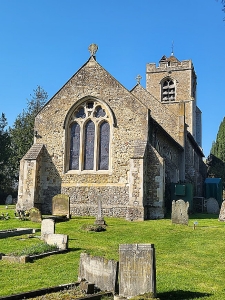
St Andrew, Caxton, Cambridgeshire
Caxton is a small village with some lovely old houses, a pub called The Chubby Frog, and a mediaeval church: St Andrews. The church is a little way out of the village. When we arrived at the place of worship, we saw that there was a sign inviting all to enter to enjoy a coffee morning. We entered, and were made to feel welcome before being served cups of coffee. We spoke with a couple of friendly church wardens, and asked them about any link between their village, Caxton, and the famous fifteenth century printer. The told us that there was no connection between them. Later, I found out that the village’s name was noted as ‘Caustone’ in the 1086 Domesday book.
As for the printer, nobody is certain where he was born, but it has been suggested that it was somewhere in Kent, possibly near (or in) Tenterden or near Hadlow. According to Wikipedia:
“One of the manors of Hadlow was Caustons, owned by the Caxton (De Causton) family.”
Now, De Causton is like the old name of Caxton village, Caustone’. I wonder whether it is remotely possible that the family in Kent might once have lived in what is now Caxton. Just wondering …
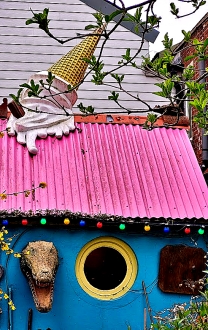
FACING THE BARMY Arms pub on the Thames riverside at Twickenham and across the water is an islet, which is 610 yards long and 122 yards wide at its broadest point. A footbridge connects the isle with Twickenham. The island is called Eel Pie Island, and it has been used by man since the Mesolithic era (15000-5000 BC), if not earlier. More recently, it was home to the Eel Pie Island Hotel, a building constructed in the nineteenth century. In the 19320s and 1930s, the hotel hosted ballroom dancing. And from the 1950s onwards, it hosted Jazz bands, and later Rock Music groups including, for example: The Rolling Stones, The Who, The Yardbirds, Pink Floyd, and other now famous groups. The hotel went into decline, and in 1969 it was occupied by anarchists who established a hippie commune in it. In 1971, the hotel was destroyed by fire.
We walked across the bridge, and along the island’s single winding footpath. On our way we passed houses and gardens, many of which have been decorated in humorously picturesque ways. At the end of the path, there is a red painted metal door, through which we passed, and entered a large covered boat repair workshop. Beyond that, there is an amazing collection of wackily decorated shacks and sheds, in which artists have studios. There is also a modern block of flats, which looks too conventional for its eccentric surroundings, and a far cry from the alternative atmosphere that prevails on the rest of the island.
Eel Pie Island, apart from being residential, is home to the Twickenham Rowing Club as well as Pie Island Art Studios, which open to the public occasionally, allowing visitors to enjoy and buy the island’s artists’ works.
Although notices proclaim that Eel Pie Island is private, nobody stopped us entering, and the few people we met there greeted us amicably.
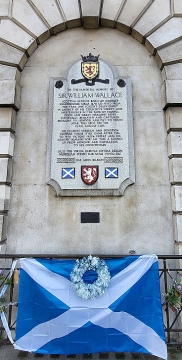
FACING SMITHFIELD MEAT market, there are three wall plaques commemorating four men who were martyred at Smithfield, which several centuries ago was an important site for executions. The four men, whose memorials I saw today (17 March 2026), were: Wat Tyler (c1320-1381), John Ball (c1338-1381) who was executed in St Albans, William Wallace (c1280-1305), and John Bradford (1510-1555).
Sir William Wallace memorial
Tyler and Ball were significantly involved in the Peasants Revolt. William Wallace, a Scot, was one of the main military leaders in the First Scottish War of Independence (1296-1328), and was captured by the English, taken to London for trial, and executed at Smithfield. And Bradford, a Protestant, was executed for alleged crimes against the Catholic Queen Mary I.
Today, Smithfield is becoming a trendy area with plenty of bars, pubs, and restaurants. It is difficult to imagine that it was once a place where these dreadful executions were carried out.
EVERY NOW AND then, when touring around England, we have spotted village lock-ups. These were small places with barred doors where prisoners could be held briefly in a cell until more suitable accommodation could be found for them. These miniature jails were:
“… used in the eighteenth and nineteenth centuries to house criminals who were apprehended on suspicion of committing petty crime … Lock-ups were only temporary forms of imprisonment, usually for one or two people, before the local authorities of the day decided how to deal with the offender. Criminals could be released or sent to the closest large town for trial.” (www.essexlive.news/news/essex-news/historic-jails-essex-you-can-3227277).
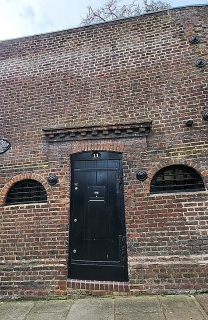
There were probably quite a few parish lock-ups in London, but now most of them have disappeared. However, if you walk along Cannon Lane in Hampstead, you will find one that has been preserved to some extent. It is within the garden wall of the grounds of Cannon Hall, which is where local magistrates held court, A plaque next to its entrance informs that the lock-up was established about 1730. Soon after the creation of the police force in 1829, the lock-house became disused, and prisoners were locked up in the Watch House that stands in Hampstead’s Holly Walk. Today, it seems as if the entrance to the former lock-house, flanked by two barred windows, is now the front door of some kind of residential accommodation.


 yamey
yamey 