Anselm Kiefer at the White Cube in Bermondsey

TODAY, I MADE MY second visit to the Anselm Kiefer exhibition, which is on at the Bermondsey White Cube gallery until the 20th of August 2023. I was pleased to visit it again because after my first visit, I left it feeling oppressed and somewhat depressed. This might be what the artist (born at the end of WW2 in Germany) intended when he created the extraordinary series of scenes of dereliction and decay on show in Bermondsey. My second visit (on the 15th of August 2023) left me with a slightly more favourable impression, but my opinion that the artist has depicted an image of a world of confusion, conflict, and decay, remains unchanged.
The works, which are distributed in several rooms and the central corridor of the gallery, are, so I read in an information sheet, Kiefer’s reactions to, and representation of, a novel by James Joyce – “Finnegan’s Wake”. The artist has written short quotations from the book on many of the items that together make up the amazing art installations. As I have not read the book, I cannot comment on the appropriateness of what he has created.

In one room of the gallery, there are mainly huge paintings, which I found attractive. On close examination, one can see that the paint has been applied to that it is far from flat. The three-dimensional surfaces create interesting illusions, which change according to from where you view the pictures.

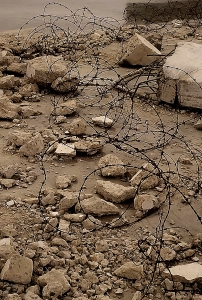
Another room has a huge pile of sand littered with discarded, corroded supermarket trolleys – an impressive but sad sight. In yet another room, most of the floor is covered with barbed wire and huge pieces of concrete – the ruins of a large building. As a friend of ours said, it looked as if it had been imported straight from a bombsite in Ukraine.

Would I recommend visiting this exhibition? It is certainly inappropriate for people who suffer from claustrophobia or depression. However, if you are of an adventurous frame of mind, do head for this show before it ends.

A movable gallows in Rutland

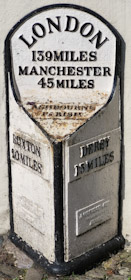
IN YEARS GONE BY, punishment by hanging was not a rare occurrence. The museum in Oakham, the capital of Rutland county, includes amongst its exhibits a mobile gibbet. This apparatus for hanging criminals is one of the few surviving movable gibbets (gallows) in Britain. When needed, it was moved from village to village. Unfortunately, it was designed badly. It had insufficient drop. This meant that the victim was strangled but not killed. I do not know what method was used to ‘finish off’ the unfortunate victims.

Impressions of India in preparation

At the moment, I am preoccupied with carrying out the final editing of my latest book, which I have described briefly below. When I publish it, which I hope will be soon, I will post more about it here in my blog and elsewhere.

A lock made by Hitler; Bollywood encounters; jackals on the golf course; teamakers and politicians; banyans and monkeys; Gandhi’s optician; coracles and crocodiles; and Denmark in India: these are just a few of the topics covered in Adam Yamey’s collection of 101 intriguing vignettes of life in India. This book with illustrations is the author’s love letter to India, a country he has been visiting frequently for almost 30 years.

So many horse shoes on the wall in Oakham Castle

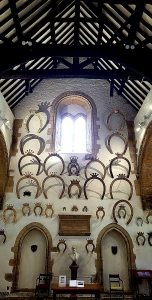
WHEN I WAS a child, I used to enjoy leafing through a book filled with black and white photographs of places in all the counties of England. One of them that stuck in my mind was of a wall covered with large horseshoes. It was only today (the 11th of August 2023) that I saw this wall in ‘real life’. It is in the great hall of Oakham Castle in England’s smallest county – Rutland. The hall, a fine example of Norman architecture, was built between about 1180 and 1190 for one of William the Conqueror’s grandsons – Walkelin de Ferrers. The name ‘Ferrers’ is related to the French word for iron and the English word ‘farrier’, who applies shoes to horse’s hooves.

The Ferrers family held Oakham for about 130 years. It might have been during that time, or certainly by the early 16th century that a curious tradition was established. It was decreed that every peer of the realm who visits Oakham for the first time must donate a horseshoe to the lord of the manor. That tradition is continued even today. Some 245 larger than life horseshoes have been donated to Oakham and many of them can be seen within the great hall. It is likely that others were donated, and subsequently lost. Most of the horseshoes on display bear the names of the donors and the date when they were donated – that is, the year the donor first visited Oakham.

Three of the horseshoes all bear the date 1921, which was when their donors (the future King Edward VIII, the future King George VI, and Princess Mary – daughter of King George V) all visited Rutland as part of a hunting party.  Also in 1921, Oakham was visited by Frederick Rudolph Lambart, 10th Earl of Cavan. In 1917, he took command of the British forces in Italy. His horseshoe is mounted on a wooden board. It surrounds a real horseshoe, which had once been worn by an Austrian pony, which he captured after a raid on enemy trenches in Asiago. Another visitor to Oakham was William Edwardes, 3rd Baron of Kensington, after whom Edwardes Square (in Kensington) was named. He visited in 1855. One could continue, but I will not because the biographies of the illustrious donors are too numerous to describe in this short essay.

Another special feature of the great hall is that it is still a working Crown Court. It is used occasionally. Of all the Crown Courts in England, this has remained housed in its original building longer than any others in the country.

Apart from the fascinating great hall, the tiny town of Oakham has many other interesting things to see including a market cross, a fine museum, a gothic parish church, and Oakham School (founded 1584). However, the hall full of horseshoes is by far the most interesting thing to visit. I was pleased to see it even if so many decades have elapsed since I saw a photograph of it during my childhood.

Was she truly naked in her horse?

LADY GODIVA WHO died sometime in the second half of the 11th century (AD), has often been depicted by artists as riding nude through the city of Coventry. She was an Anglo-Saxon aristocrat, who was married to Leofric Earl of Mercia.

According to legend, she made her famous horse ride through Coventry to protest against excessive taxation that her husband had imposed on the people.

Most artists have portrayed her as being totally nude, thus producing images or sculptures with some pornographic content.

The Herbert Art Gallery in Coventry has a small gallery dedicated to Godiva. Most of the artworks on display show her without any clothing. However, one painting shows her on her horse but wearing plain, unrevealing simple garments. This is most likely how Lady Godiva was dressed on her ride. The reason is that penitents used to wear unadorned undergarments when processing in public. It is most likely that Godiva, who would have normally worn fancy clothing and jewellery, rode through the city devoid of these trappings of wealth and position – this would have been described as ‘naked’.

Our short visit to the Godiva exhibit was most interesting because it opened our eyes to another interpretation of Lady Godiva and her protest.

Why are Hunt and Keene together in Shepherds Bush?

I FIRST CAME ACROSS the critic, writer, and poet Leigh Hunt (1784-1859) when I was collecting information for my book about Hampstead. For some years, Hunt lived in a house in Hampstead’s Vale of Health. Amongst the many noteworthy people who visited him there regularly were the poets Shelley and Keats. Later, when I was writing my book about west London, I found out that Hunt had resided in Edward’s Square, Kensington. He had also lived in Chelsea. Until today (the 7th of August 2023), I had never seen a memorial to Hunt.  Today, I spotted one, a carved stone plaque, high up on the wall of the Bush Theatre that faces Pennard Road (in Shepherds Bush).

The theatre is housed in what was formerly one of several libraries established by the newspaper entrepreneur and philanthropist John Passmore-Edwards (1823-1911). The library building was built in 1895 and its external features are well-preserved. The theatre moved into it in 2011.

Hunt is not the only person commemorated on the plaque. Below his name is that of the artist Charles Keene (1823-1891).  In his book “A Few Footprints”, Passmore-Edwards wrote (in 1906) that he placed memorials of illustrious people in places near where they died:

“I have placed medallions of Charles Lamb and John Keats in the Public Library, Edmonton; of Sir Henry Austin Layard and Sir William Molesworth in the Public Library, Borough Road ; and of Leigh Hunt in the Public Library, Shepherd’s Bush…

… Mr. A. E. Fletcher, who unveiled the memorial medallion of Leigh Hunt at the Shepherd’s Bush Public Library, said: ” Let us remember Shelley’s fine description of Leigh Hunt as one of the happy souls who are the salt of the earth.’ We have learnt enough to admire him for his genius and his marvellous industry, to honour him for his fearless outspokenness and courageous sacrifice for principle, and to love him for his splendid faith in humanity and his buoyant optimism””

However, Passmore-Edwards makes no mention of Keene.

The plaque was probably affixed to the library when it was built. But why the two names are on the same plaque is a bit of a mystery to me. The only possible connection, which makes sense in the light of what Passmore-Edwards wrote, is that both men died reasonably close to Shepherds Bush.

The importance of being methodical

I HAVE NUMEROUS albums full of photographs that I have taken in India and many places in Europe over the years since about 1993. Before that date, for about 10 years, I used to take pictures on slide film, and have them processed into slides for projecting. I still have most of these, and each one is labelled. For some mysterious reason, when I began putting my photographic prints in albums, I hardly ever labelled them. Consequently, I have a vast collection of – dare I say it – interesting photographic prints taken at locations I can either not remember or can only vaguely recall.

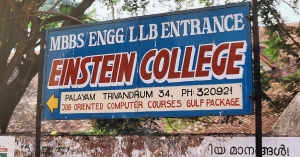
Yesterday (5th August 2023), I chose to look at one of my albums randomly chosen from a box containing several of them. As I flicked through the pictures, I came across one showing an advertisement for an institution called Einstein College, somewhere in India. The location was easy to identify because the college’s address was in the city of Trivandrum (Thiruvananthapuram) in Kerala. Having looked on the Internet, I see that the college still exists.

Two other prints were stored close to the college photograph in the album. So, I guessed they might also have been taken in Trivandrum. One of them shows a building with geometrically decorated walls and numerous small roofs. At first, I thought it might be a temple, but then I wondered whether it was the palace-like museum in Trivandrum, which houses a fine collection of paintings by the Keralan artist Ravi Varma. I checked on the Internet, and discovered my picture shows apart of the museum’s exterior. The third print shows what looks like an enormous terracotta coloured ‘multi-storey’ pigeon coop. It is a cylindrical structure with some helical decorative features. The edifice bears a sign that reads “India Coffee House”. Using that clue, I found that is one of the three branches of the India Coffee House chain in Trivandrum.

Had I labelled these photographs, I would not have needed to do any detective work to identify them and their locations. Sadly, many of my unlabelled prints do not have obvious clues that can help me identify them, and most likely they will remain a mystery. The moral of this story is that it pays to be methodical and systematic occasionally.