Portraying the appearance and politics of Kolkata

ARTS ACRE IS an artists’ village on the Eastern edge of the city of Kolkata. When there is little traffic, it takes one hour of driving to reach it from the heart of old Kolkata.  The Acre (aka International Centre for Creativity and Cultural vision)  was founded in 1984 by the artist and cultural activist Shuvaprasanna Bhattacharjee (born 1947). The beautiful modernistic campus was designed by Partha Ranjan Das.


Today, the fifth of January 2025, we visited Arts Acre where several excellent exhibitions,  part of the 2024/25 Bengal Biennale, were being held.  One of these was a large show of paintings and other artworks by Shuvaprasanna. His wonderfully executed paintings reflect his interest in, and connection with, the politics of Bengal: he has been closely associated with the current Chief Minister of West Bengal, Mamata Banerjee. One of the paintings depict her as being like the pied piper of Hamelin. The artist wrote of this painting that just as the pied piper attracted his followers with the music of his pipe, Mamata attracts her followers by “… the mesmerising music of her leadership.” This painting was placed next to two others that seemed to be critical of the Communist regime that ruled Bengal for many years before Mamata and her Tfollowers Congress party were voted into power.


Günter Grass by Shuvaprasanna

Another picture relates to the visit to Arts Acre by the German author Günter Grass. Called “In search of Oscar”, the artist depicts Grass as Oscar in the novel “The Tin Drum”. The painting is supposed to evoke solidarity with the marginalised people in Kolkata.


Shuvaprasanna paints beautifully in ways that capture the ideas he is trying to convey in a highly accessible way, but without compromising artistic and aesthetic qualities.


It was worth spending an hour in a taxi to see Shuvaprasanna’s works and the art complex he established so many years ago.
Exhibits in an exhibition at a famous landmark in Kolkata

FROM AFAR, THE VICTORIA Memorial in Kolkata looks almost magical. However, inside it is pompous and overbearing (and not particularly beautiful), just as the British must have seemed to many Indians before their country was freed from the British Empire.


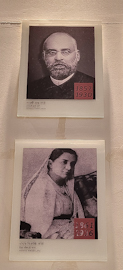
Visitors to the Memorial can explore the ground floor and the one above it. Much of the upper floor is dedicated to an exhibition of photographs and facsimiles of documents relating to the exploits of those who fought to make India independent.  Naturally, better known individuals such as Gandhi, the Nehrus, and Subhas Chandra Bose figure in this show. But they are outnumbered by lesser known freedom fighters. One of these is Shyamji Krishnavarma (1857-1930).  Many of you reading this might well be wondering why this man deserved to be includefacsimilesexhibition.


Like several other freedom fighters,  Krishnavarma went to London to become a barrister.  He returned to India and made a fortune working for the rulers of some of the Princely States.  Then, he returned to London. In 1905, when Bengal was partitioned  he conducted his own campaign against British rule in India.


Above: Krishnavarma,  below: Madame Cams

Amongst the many things he did in addition to starting an anti-British newspaper, Krishnavarma purchased a house in Highgate (northwest London), which he converted into a hostel and meeting place for Indians studying  in London. It was named India House. Soon, it became a meeting place for Indians who wanted to rid India of the British. I have read that amongst the revolutionary activities carried out in India House was experimentation in bomb making. Amongst those associated with India House was VD Savarkar (1883-1966). In 1910, he was arrested by the British and spent several terrible years in the Cellular Prison in Port Blair (Andaman Islands). Amongst Savarkar’s many achievements was the development of Hindutva.


In 1907, Krishnavarma migrated to Paris. Later, until his death  he resided in Geneva. Unlike Gandhi and his followers, Krishnavarma and his colleagues (including Madame Cama) did not believe that India could become free by relying only on non-violent protest.


I first became interested in Krishnavarma when visiting Mandvi in Kutch (part of Gujarat). Shyamji was born in Mandvi, and his ashes are kept at a memorial centre a few miles outside the town. The centre includes a full size replica of Highate’s former India House. Seeing this building standing on its own in a flat sandy semi-desert landscape intrigued me, and got me interested in Krishnavarma.  I became so fascinated that I wrote a book about Krishnavarma and what happened in and around his India House. The book is called “Indian Freedom Fighters in London (1905-1910)”, and is available from Amazon (e.g., https://www.amazon.co.uk/INDIAN-FREEDOM-FIGHTERS-LONDON-1905-1910/dp/0244270716/ ).


The exhibition at the Victoria Memorial includes several photographs and documents relating to Krishnavarma and his India House. I had seen some of these elsewhere, but a few were new to me.


Although the Victoria Memorial is not one if my favourite things in Kolkata,  I  am pleased we visited if only because there were exhibits related to Krishnavarma.  In addition,  I was pleased to see several paintings by Thomas Daniell (1749-1840) and one by an artist I like very much : John Zoffany (1733-1810). Both of these men spent several years living and working in India.

A peaceful place of rest in bustling Kolkata

 IN ITS HEYDAY, the Jewish community of Kolkata consisted of as much as 6000 people. That was in the early 1940s. Today, less than about 20 Jewish people reside in the city. Most of Kolkata’s Jewish inhabitants were members of families that had migrated mainly from Iraq, but also from Syria. They were all Sephardic, rather than Ashkenazi, Jews. They began arriving in Kolkata in the very late eighteenth century. Most of Kolkata’s Jewish people have migrated to other countries – not because of anti-Semitism, but for economic reasons (as have many other Indians of all religions).


One can get an idea of the size of Kolkata’s Jewish community of yesteryear by visiting the Jewish Cemetery on Narkeldanga Main Road. It contains at least 2000 gravestones. We visited it on New Year’s Day 2025.


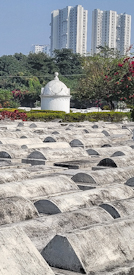
The genizah standing amongst the gravestones

The cemetery is beautifully maintained. Flowering bushes,  trellises, and trees punctuate the sea of white gravestones. According to Sephardic tradition, the stones are horizontal, rather than vertical. Most of them consist of a rectangular base surmounted by a hemi-cylinder. Each grave bears the name of the deceased in Hebrew and/or Latin script. It seemed to me that all of the graves are oriented in the same direction: roughly speaking the long axis of each grave runs in an east/west direction (more accurately,  the west end of each gravestone is slightly north of the east). The majority of the gravestones are simple, without ornament. A few of them are ornamented often with a stone carving of an open book.


Several of the stones record the deaths of military service personnel,  who died in action. Notices on these record that the bodies of these people were buried in military cemeteries elsewhere, at Ranchi.


In the centre of the gently undulating burial ground, there stands a circular tower, which is higher than all of the other graves. The tower, looking a bit like an enlarged pillar box (letter box). has a rectangular opening like that found on post boxes. This structure is a genizah.


A genizah is a place for disposing of worn out or no longer required sacred texts. These can include any documents that contain the name of God. These can be anything from holy texts to commercial contracts, legal documents,  and personal letters. If you wish to know more about the contents of a genizah, you could do well to read “In an Antique Land” by Amitabh Ghosh. I have read this autobiographical novel that includes much about a very ancient genizah discovered in Cairo,  and was very excited to see a real genizah in Kolkata.


I am not sure how easy it would have been to visit this fascinating Cemetery – a record of a once thriving community  – had we not known one of Kolkata’s few remaining Jewish inhabitants. Mentioning this person’s name persuaded the security officials to allow us to enter.

A goddess and going to jail in Kolkata

THE ALIPORE JAIL used to house political prisoners, whom the British regarded as a threat to their rule of India.  The inmates included freedom fighters such as the future Sri Aurobindo,  Jawaharlal Nehru, and Subhas Chandra Bose. The prison has been restored and is now a museum. In December 2024 and for the first few days of 2025, several exhibitions that are part of the Bengal Biennale have been held in some of the jail’s  buildings.  One of these, which I found extremely interesting and well curated, is called “Kali: Reverence and Rebellion”.


Kali is a Hindu goddess. I will not try to explain her exploits and great importance to Hindus, but will outline the subject matter of the exhibition by quoting from the website of the Biennale (www.bengalbiennale.com/):

“Divided into sections, the exhibition traces Kali’s pervasive influence across the subcontinent. It explores Kali and her cohorts of the divine feminine. Born from Durga’s angry, darkened brow as she battles the asuras Chanda and Munda, Kali decapitates the demons and assumes the form of Chamunda. Within these depictions, she is seen alongside Durga, the primordial force, as well as the ten Mahavidyas that emerge to subdue Shiva.”


Subhas Chandra Bose image

In addition to the wonderful array of images on display, which can be enjoyed without any knowledge of Kali, what fascinated me was the connection between Kali and the fight of Indians for independence. The website explained:

“During the nationalist period, Kali was invoked as a symbol of rebellion by Aurobindo Ghosh and Subhash Chandra Bose to urge their followers to fight against imperialist forces.”

In connection with this, two images fascinated me. One of them depicts Kali who has cut off her own head and she holds it in her left hand while blood shoots out of her cut neck and into the mouth of her self-decapitated head. Painted in about 1840, this image shows what Kali did after either she was unable to obtain Shiva’s blood, or she had been deprived of her conjugal rights. Known as Chinnamasta, this avatar of Kali is often shown with one foot on the chest of a god (Shiva) or standing above a copulating couple.


Elsewhere in the exhibition, there is an image of Subhas Chandra Bose created during the twentieth century. It shows the freedom fighter, Bose, standing decapitated and holding his own head in his left hand. He is standing above a group of decapitated heads. Blood pours down from his head and it falls onto a map of India on which the words “Jai Hind” (‘Victory to India’) can be seen. The image is a politicisation of the depiction of Chinnamasta.


Apart from a wonderful selection of Kali images created by Indian artists, there are a few made by early Europeans who visited India and wanted to record their experiences and to attempt to understand Hinduism. All in all, the exhibition was very well worth viewing. It was so popular with visitors to the jail that a security guard was present to regulate the number of viewers at any one time, to prevent overcrowding.

Chikkamma Tours (Pvt.) Ltd: a detective story set in Bangalore

THIS BOOK WAS RECOMMENDED to me by a bookseller in Bangalore, at Bookworm, because she said that the shop is mentioned in the book. In the novel, Chikkamma Tours is a small travel company located beneath a bookshop run by Jagat Desai. One night, he is murdered. His body is found the next morning by one of the ladies who work in the office beneath the bookshop. The police are informed, but the three women who work at Chikkamma Tours decide to make their own investigation of the murder. What they discovered about themselves and the crime are the subjects of this ‘whodunnit’ novel.

Although I enjoyed reading it, this book is not a great work of literature. However, it was fun and I liked it because it captures many aspects of life in a city I visit frequently: Bangalore. As I proceeded through it, I recognised many things I know about the city and, especially, its bookshops.

Would I recommend this book? I would to Bangaloreans and to people who know the city well. However, I am uncertain that it would appeal to those who have little or no connection with the city. That said, I am pleased that the lady at Bookworm suggested I should read it.

Hindoo Stuart and a son of  a great author

THE SOUTH PARK Street Cemetery in Kolkata was opened in 1767 and was used as a burial ground for Europeans (mainly British) until 1830. It contains a large collection of funerary sculpture (mostly mausoleums and obelisks), much of which is in the neoclassical style. This now peaceful oasis in central Kolkata with much greenery is the final resting place of many people who had roles in the British East India Company (including its armies) and their families.  Although the place contains the remains of many interesting people  I will concentrate on two of them, both of whom had military careers.

Tomb of Hindoo Stuart

Charles Stuart (c1758-1828) was born in Ireland (Dublin) and joined the East  India Company when aged 19. He served in one of its armies, reaching the rank of Lieutenant Colonel.  In India, he was attracted to, and fascinated by, Hindu culture and traditions. He adopted many Hindu ways of life including religious practices. For example, when off duty,  he wore Indian clothes and bathed in the Ganges (the Hooghly) daily. In addition,  he wrote many articles, published in the newspapers of Calcutta,  which extolled the Indian ways of living, and encouraged Europeans to wear Indian garb rather than western clothing. He felt that ladies from Europe would feel more comfortable and look better wearing saris in India. His sympathy for the Indian modes of life and admiration of Indians earned him the nickname ‘Hindoo Stuart’, but did not impede his military career.  His funerary monument in the South Park Street Cemetery is in the form of a small Hindu temple, quite different in form from all of the other monuments in the graveyard.


The other military person commemorated at South Park Street  has a very modest, barely legible gravestone. It records the death of the short-lived Walter Landor Dickens (1841-1863).  He was the fourth child and second son of the author of “Oliver Twist” and many other famous novels: Charles Dickens. Walter became an officer cadet in the East India Company armies, arriving in India in 1857, just before the so-called Indian Mutiny began. After the end of this revolutionary activity and the end of the Company’s rule in India and the start of the British government’s control of the country, he became a soldier in the British Army. Illness resulted in his death in a military hospital in Calcutta.


Walter was buried at the Bhowanipore Military Cemetery in Calcutta.  In 1987, some students at Kolkata’s Jadavpur University raised funds and had Walter’s gravestone moved to the South Park Street Cemetery. This was done because it was not being cared for and to honour his father, the famous author.


Having recently become a fan of the novels of Charles Dickens,  I  was pleased to have been able to view Walter’s gravestone.  The lettering on it is legible, but not too easy to read.


During our recent visit to the Cemetery, which we made in December 2024, we saw the two graves mentioned above and many others which we had not noticed on previous visits.  For those interested in the early history of Kolkata during its British occupation, the South Park Street Cemetery should not be missed.

From Myanmar to the garden of Eden in Kolkata.

THERE IS A MAJOR cricket stadium in Kolkata called Eden Gardens. This world renowned sporting venue is adjacent to a far less well-known park: Eden Gardens Park. Established in about 1842, its fame was eclipsed by the opening of the cricket stadium in 1864. The stadium is named after the park.


Lord Auckland, the governor-general of India from 1836-1842, had ordered the construction of this pleasure ground. The garden was named after his sisters, Emily and Fanny Eden.


For a modest entry fee (20 rupees per person) one can enter the park, which contains a bandstand, flower beds, a rather rundown Japanese garden, a lake, a café, and a surprising feature that I will describe shortly. When we visited the park on a Saturday afternoon,  there was a discotheque operating in the bandstand.  The volume of music coming from the bandstand was excessive and unbearable. A local division of the Kolkata Police Special Department were having a party. Despite the racket, we strolled through the park to the attraction, which makes the park quite distinctive: a pagoda from Burma (Myanmar).

 The wooden pagoda, which is in need of a little repairing,  stands almost surrounded by the lake. The British brought it in pieces from Prome in Burma in 1854 at the end of the second Anglo-Burmese War (1852-1853), and reconstructed it in the park in 1856. Burmese workers put it together in the park.


Prome is known as ‘Pyay’ in Burmese. Regarding the period when the pagoda was removed to Calcutta,  Wikipedia related:

“Called Prome by the British … the city became part of British territory after the Second Anglo-Burmese War in 1853. The town was taken by the British in 1825 during the Battle of Prome and again in 1852, on both occasions with hardly any opposition”. In 1862, the city was almost completely destroyed by fire. So, in a way, it was lucky that the wooden pagoda was saved from this conflagration.


The pagoda is an example of Tazoungs (idol house) architecture. It is surrounded by Burmese stone carvings. The pagoda used to contain a Buddha effigy,  but this is no longer to be seen.


Kolkata is full of surprises. The Burmese pagoda is just one of them. I am glad we put up with the background noise in the park because I would have been disappointed not to view this unusual souvenir from Burma.

Praying along a busy street in Kolkata

SEI VUI IS OUR favourite Chinese restaurant in Kolkata. It is located on Black Burn Street that runs through what remains of the city’s old Chinatown. Black Burn Street runs off a busy main thoroughfare: Khirode Vidya Binode Avenue.  On Friday, the 27th of December 2024, we walked to Sei Vui from Dalhousie Square at just after midday. 

 When we arrived at Khirode Vidya Binode Avenue,  we saw something we had never observed before. There were many Muslim men in rows of four or five lining the north side of the road for many hundreds of yards. They were all facing the same direction.  Some of these rows had many more men and extended into side streets including Black Burn Lane. Each man was barefooted and had his own prayer mat. This long line of men were performing Friday prayers. Every now and then they prostrated themselves on their mats, and then stood up again.


Our host and friend at Sei Vui explained that the local mosque is too small to accommodate the large number of Muslim men in the area. So, they pray in the street, facing the mosque.  He said that he thought that what we had seen was a phenomenon unique to Kolkata. He believed that most other Muslims would not consider worshipping out on a busy street. On special occasions, there are so many worshippers that Khirode Vidya Binode Avenue has to be closed to vehicular traffic during the prayers.


It so happens that Khirode Vidya Binode Avenue runs in a mainly east/west direction. Also, the east end of the avenue is very slightly south of its west end. This being the case, by facing westward,  as the worshippers were doing, one is looking approximately towards Mecca, which is west of Kolkata and slightly north of it.


We had an excellent lunch at Sei Vui.  After we had finished, the prayers were over, the worshippers had left, and the avenue was back to normal.


Blackening the British perceptions of India and Indians

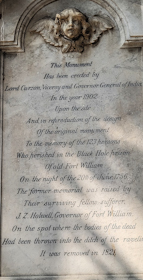
THE FIRST TIME I  heard mention of Calcutta was when I was less than 11 years old. It was in connection with the so-called ‘Black Hole of Calcutta’. Without knowing anything about it, I got the impression that whatever happened there was extremely unpleasant. Today, the 27th of December 2024, we revisited the monument to the victims of the Black Hole incident, which now stands in the churchyard of Calcutta’s St John church. Formerly, it had stood in Dalhousie Square, where the Black Hole (a small prison cell) was located before it was demolished. Originally,  there was a memorial on the spot, but this disappeared. The viceroy Lord Curzon had a new one made, and this is the one now standing near St John’s.

Part of the Black Hole memorial

 When the British, unlike the French, refused to agree to the demands of the Nawab of Bengal,  Siraj-ud-Daulah (1733-1757), the Nawab attacked Calcutta. Despite having some forewarning of the attack, the British did little to prepare their defences. On the 20th of June 1756, Calcutta’s Fort William fell to the Nawab.


The British survivors were rounded up by the Nawab’s forces and locked into the small prison now known as the Black Hole. The number of people incarcerated varies according to which account you read, but suffice it to say there were far too many people crowded into the tiny cell, and many of them died of overheating and thirst. It was a tragedy. Of that, there is no doubt.


The news of the Black Hole disaster  led to an attack on the Nawab by the British led by Robert Clive (1725-1774). The Nawab was defeated at the Battle of Plassey in 1757.


The problem is that what happened in the Black Hole damaged British perceptions of Indians. As the historian John Zubrzycki wrote:

“The Black Hole would come to symbolise Indian barbarism in the minds of English policymakers and be used to strengthen the case for British rule.”

Worse than this, events such as the Black Hole and killing of British citizens during the so-called ‘Indian Mutiny’ of 1857, could be used to justify the many horrendous acts perpetrated by the Brits on Indians. Two notable examples of this are the cruel punishments meted out to the Indian soldiers who rebelled in 1757, and later the Jallianwala Bagh massacre of innocent Indian civilians in 1919.


That the monument to the victims of the Black Hole still stands in pristine condition so many years after India became independent is remarkable.  In 1940, several leading independence activists, including Subhas Chandra Bose, campaigned to have the monument removed from Dalhousie Square. In July of that year it was moved to its present location. Today, we saw visitors, both Indian and Westerners, viewing the memorial.

Much more than 5000 years of the history of India in one short book

IT DID NOT TAKE LONG for me to read “The Shortest History of India” written by John Zubrzycki and published in 2023. I raced through the book not because it is short (264 pages) but because it is superbly written and highly engrossing.

 The author covers many of the key features of what is known about the complicated history of what is now India. He does not simply provide the reader with a simple list of facts, but also includes interesting comments about the events he mentioned. At times, he questions some conventionally accepted views and explanations of events and concepts.


The first half of the book covers the history of India from prehistoric times until the arrival of Europeans at the end of the sixteenth century.  The period from then until the 2020s occupies the second half of the book. And much of the final 90 pages (34% of the text) deals with the period from 1857 until just afternoon the covid19 pandemic. So, I  feel that if anything  needs criticism it is that too much of the book is concerned with the last 4 centuries of India’s extremely long history. That said, the book is a first class, highly readable introduction to the amazingly complex story of the jigsaw puzzle of kingdoms, colonies, and empires that became India in 1947.