
Ev-er-y day
Surely succeeds yet another
Tomorrow follows

Ev-er-y day
Surely succeeds yet another
Tomorrow follows
THE PHOTOGRAPHER Julia Margaret Cameron (1815-1879; ‘JMC’) was born in the Garden Reach district of Calcutta (now Kolkata in West Bengal). Her father, James Pattle, was a prosperous English official in the East India Company. JMC and her six sisters, the surviving children of James and Adeline Marie Pattle, had a Bengali ancestor, Thérèse Josephe Blin de Grincourt (1768-1866) She was JMC’s maternal grandmother, a Bengali woman who had married a French man, Ambroise Pierre Antoine de l’Étang (1757-1866, whose presence in Bengal was recorded in “The India Office List 1825” as “De l’Étang, Chevalier Antoine, Knt. St Louis, assist. Stud at Poosa, 1796” (Poosa is in what is now Madhya Pradesh). They married in 1788. At that time, it was not uncommon for European men to have lasting relationships with Indian women. This is well-described in William Dalrymple’s book “White Mughals”. Later, in the 19th century, such interracial liaisons were heavily frowned upon. It was expected that ‘white’ men would only marry ‘white’ women. Incidentally, Thérèse was daughter of a French colonist and his Bengali wife.
As with her sisters, JMC was sent to France to be educated. She remained there from 1818 to 1834, when she returned to India.
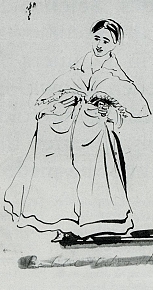
In 1835, suffering from ill-health, JMC travelled to the Cape of Good Hope. This part of what is now South Africa was favoured as a place to convalesce by Europeans based in India. It was in the Cape that JMC met not only the famous astronomer and an inventor of photography Sir John Herschel (1792-1871), but also the man whom JMC would marry in 1838: Charles Hay Cameron (1795-1880). Charles was in the Cape recovering from a malarial illness. A disciple of the philosopher Jeremy Bentham, he was a reformer of law in India and education, who also invested in coffee plantations (in 1848) in Sri Lanka.
Julia and Charles married in Calcutta, where she became a prominent hostess in the city’s British Indian society. During the 1840s, she corresponded regularly with John Herschel about developments in the science and technology of photography. He sent her two dozen calotypes and daguerreotypes, which were the first photographs he had ever set eyes on. The Camerons raised eleven children: five of their own; five orphans (children of relatives); and an Irish girl named Mary Ryan (whom they found begging on Putney Heath).
The entire Cameron family relocated to England in 1845, possibly because their two older children had settled there, and Charles had retired. They settled in Royal Tunbridge Wells in Kent. They became friendly with one of their neighbours, the poet Henry Taylor (1800-1886), who had worked in the Colonial Office under Robert William Hay (1786-1861), who might well have been related to Charles Hay Cameron’s mother. Later, the Camerons moved to East Sheen, which is closer to London than Tunbridge Wells.
It was through Henry Taylor and Julia’s sister Sara (1816-1887), who was married to Henry Thoby Prinsep (1793-1878), an official in the Indian Civil Service, that JMC was introduced to a set of noteworthy Victorian cultural figures. Henry and Sara had returned to England from India in 1835, and were living in (the now demolished) Little Holland House next to the house of the artist Lord Leighton, near Holland Park in west London. Their home became a meeting place for famous artists, as will be described later. It was here that Sara held a salon for pre-Raphaelite artists, poets, and aristocrats with an interest in artistic activities. At Sara’s home, JMC encountered, amongst other worthy cultural figures, the poet Alfred Tennyson (1809-1892).
Tennyson rented Farringford House in Freshwater Bay on the Isle of Wight (‘IOW’) in 1853, and purchased it three years later. In 1860, after a long visit to Tennyson on the IOW, the Camerons bought a property next door to Tennyson’s and named it Dimbola after one of their (then coffee) plantations in Sri Lanka. TO BE CONTINUED
THE ACTOR AND STAGE impresario Gerald Du Maurier (1873-1934) lived in Cannon Hall (14 Cannon Place in Hampstead) from 1916 until his death. His children, who lived there, included the novelist Daphne Du Maurier (1907-1989). The house was built in about 1720 and altered in the 19th and 20th centuries. Despite these changes, it remains an elegant residence in the heart of Hampstead.

Steeply sloping, narrow Cannon Lane runs alongside the eastern wall of the grounds of Cannon Hall. About halfway down it (between Squires Mount and Well Road), there is a doorway in the wall. There is one semi-circular window on each side of it. Each of the windows is behind a lattice of metal bars. A plaque nearby informs the viewer that this was once a parish lock-up in which prisoners were held temporarily in a dark cell. The lock-up was established in about 1730. In that era, magistrates held court proceedings in Cannon Hall. In 1829, when a police force was set up in Hampstead, court business and prisoners were held in the Watch House on Holly Walk.
At the bottom of the grounds of Cannon Hall, stands Cannon Cottage, which faces Well Road. This was constructed in the early 18th century. Between 1932 and 1934, Gerald du Maurier’s daughter Daphne lived in this substantial residence with her husband Frederick Browning, whom she had just married.
Further west along Well Road, there is what looks like a small factory with skylights. This was built as artists’ studios in the late 19th century. Known as Well Mount Studios, the artist Mark Gertler (1891-1939) moved into number 1 in 1915, and worked there. I am uncertain how long he remained at this address, but I know he had moved from it before he committed suicide.
The places described above can be seen by walking only about 335 yards. This is typical of Hampstead Village (or Town, according to some), which is literally packed with interesting sites, both historical and contemporary. If you wish to discover much more about this fascinating part of north London, you can buy a copy of my informative book “Beneath a Wide Sky: Hampstead and its Environs” (from https://www.amazon.co.uk/dp/B09R2WRK92).
OUR CAR FERRY from Lymington docked at Yarmouth on the Isle of Wight after dark on a rainy evening in September 2022. As we drove to our friend’s house in Ventnor, we passed a building whose name, Dimbola, brought back memories of an exotic trip we made 28 years ago.
In February 1994, my wife and I spent a few days in Sri Lanka on our way back from India to London. It was our honeymoon and Sri Lanka was riven by civil war. Our host in Sri Lanka sent a car and driver to Colombo airport, which, despite its excessively high security presence, was attacked by terrorists soon after we departed for London. For several hours, we drove through the countryside after nightfall. Every few miles, we stopped at police check posts. Unlike bus passengers, who were obliged to leave their vehicles at each of these stops, we did not have to disembark. Our car was fitted with a bright lamp that the driver turned on so that the police could see his passengers without them having to leave the vehicle. It was also likely that our driver and his employers were well known to the authorities. About halfway through our long journey, we stopped at a tea stall in a village. The golden tea was fragrant and delicious. Even now, I believe that it was one of the best cups of tea I have drunk during my long life.
We continued driving through the darkened landscape. Every now and then, animals’ eyes reflected the illumination coming from the car’s headlights. It was only when we made the return trip to Colombo in daylight that I realised our driver’s great skill. The narrow road had many potholes and other defects and wound perilously up and down hillsides and close to deep ravines. Eventually, we arrived at the home of the manager of the tea plantation where we were going to spend about a week. We had met him and his wife at the home of a mutual friend, who lives in Ootacamund (‘Ooty’) in south India. This kind couple, having met us only once, had invited us to stay with them in Sri Lanka.
Mr Jain, our host, had been invited by the Sri Lankan government to revitalise a failing tea plantation. Situated about 4 miles northeast of the small town of Hatton, the estate where we stayed was called Dimbula – and still is. Seeing the name Dimbola on the house on the Isle of Wight made me remember Dimbula in Sri Lanka. I wondered whether Dimbola was a name chosen at random, or whether it was in some way related to Dimbula, where we stayed in Sri Lanka.
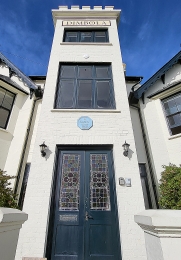
On our first full day on the Isle of Wight, the sun shone brightly, and we decided that it was perfect weather to visit Alum Bay to see its famed coloured cliffs and views of the Needles Rocks at the western end of the Isle. To reach this place we drove back along the road we had travelled the previous night. This road runs along clifftops close to the south coast of the island and provides many exciting views. We stopped at a couple of places to enjoy the spectacular coastal scenery, and before reaching Alum Bay, we made yet another stop at Freshwater Bay. By then, we were yearning for mid-morning coffee. Not seeing anywhere open close to the seafront, we drove a little further and noticed that Dimbola has a café.
Dimbola is a two-storey Victorian house with four full height bays, each of which is beneath a roof gable. In the middle of the long southeast-facing façade there is a tall square tower topped with crenellations. This separates the bays into two pairs. The east half of the ground floor houses a second-hand bookshop, which is now closed because its owner does his business on-line only. The west half houses a café, which serves excellent coffee made from beans roasted on the Isle of Wight. Most of the rest of the ground floor and much of the first floor is a museum and its shop. I will go into more detail about this museum soon.
Almost as soon as the waiter came to take our order, I asked him about the name Dimbola. He was not sure, and suggested I asked someone at the museum. After enjoying my coffee – it was so good that we returned for more on a couple of other days – I found someone working in the museum. I told her that I was interested in the similarity of the name of the house and that of the place where we had stayed in Sri Lanka. She told me that a former owner of Dibola had been married to a man who owned coffee (and then later tea) plantations in Sri Lanka when it was British Ceylon, and that the house was named after one of them called Dimbola. I was told that the house at Freshwater Bay was named after the plantation at Dimbula, which is exactly where we stayed in February 1994.
By 1994, Dimbula was a long-established tea plantation. However, it had begun life as a coffee plantation. It had been owned by Mr Charles Hay Cameron (1795-1880). A follower of the great philosopher Jeremy Bentham, Cameron became a barrister, having been called to the bar at Lincoln’s Inn in 1830. In 1835, he went out to India to serve on the Supreme Council of India (which had previously been known as ‘The Council of Bengal’). In 1838, he married Julia Margaret Pattle (1815-1879), whom he met in The Cape of Good Hope (now ‘South Africa’). Their marriage took place in early 1838 in Calcutta (now Kolkata). In 1848, he and his family left India and lived in their homes in London’s Putney and Freshwater Bay on the Isle of Wight. In 1875, he and Julia travelled to Sri Lanka, where Charles owned plantations. They lived there until their deaths. I will return to Mrs Cameron shortly.
The reason that Dimbula now grows tea is that during the 1870s, the market for coffee slumped. The Cameron, both in a poor state of health moved to Sri Lanka because the cost of living there was far lower than in England. During their stay in England, they spent much time at Dimbola between the years 1860 and 1875.
Interesting as was Charles Cameron’s life, that of his wife Julia was exceptionally outstanding. I had never heard of her before having coffee at Dimbola, but our art historian daughter was most excited to learn that we had stumbled upon and visited the former home of the famous photographer, Julia Cameron. TO BE CONTINUED SOON!
THE TELEPHONE RANG this morning. I answered it and was addressed by a lady with an accent that sounded like the way Iranians often speak English. She told me that she was calling from the British Telecom (‘BT’) technical department to inform me that there was some kind of malicious interference on our broadband connection, and that a BT technician was working on our line in the street. She said that we should have received an email from BT, and could I kindly spend a few minutes with her on my computer. Quite suspicious, I simply thanked her for calling, and hung up.

Then, I checked to see whether there was an email from BT. There was. It had been sent from “ btcomms@info.bt.com” and looked pretty authentic. It even included advice about protection against scams. The email contained a PIN number, “Your PIN is ****”. I was still suspicious and used the 1471 facility to check the number of the person, who had called on our BT landline. It was a number beginning with 07, a mobile telephone number. I felt sure that BT would never call using an 07 number.
I rang BT on 0800800150 and selected the option for suspected scamming and fraud. I explained what had happened, and an operator confirmed my suspicion that both the call and the email were dodgy. However, the email address from which the message had been sent is an official BT email address. She was relieved to hear that I had not turned on the computer and been guided by the mystery caller because she told me that what I had experienced was an attempt to gain access to the data stored in my computer.
The approach used by the lady who called and whomever she was working with was quite ingenious, and might easily have misled anyone less suspicious (or paranoid) than me.
When I was a child, before the days of internet and mobile telephones, it paid to be streetwise, to keep an eye out for people or situations that might lead to harmful consequences. It still pays to keep a wary eye, but now it is not only on the street that one needs to do so.
THE STATUE LOOKED incongruous where it was standing, in a flower garden next to Dimbola House in Freshwater Bay on the Isle of Wight. Made in bronze and life-size, it depicts Jimi Hendrix (1942-1970) strumming an electric guitar. At its base, there is a title of a Hendrix song, “Purple Haze”, and below this some poetry (not the lyrics to the song) and the words “I.O.W. lavender”. Appropriately there was a lavender bush with purple flowers growing close to the statue. Nearby, a door leading into a second-hand bookshop housed within Dimbola is decorated with stickers bearing photographs of Hendrix. Not being knowledgeable about Hendrix, I was puzzled to discover this monument to him in a place that seems to be in a different universe to that of Rock Music.

Between the 26th and 31st of August 1970, the small island off the south coast of England hosted the Isle of Wight Festival at Afton Down. This music festival was attended by between 600000 and 700000 people, that is more than met at the famous Woodstock event (USA, 1969). On Sunday, the 30th of August, the performers included, to mention but a few, Kris Kristofferson, Jethro Tull, The Moody Blues, Joan Baez, Pentangle, Leonard Cohen, and … Jimi Hendrix. Jimi played late at night and into the early hours of the 31st.
Sadly, Hendrix died a few weeks later, on the 18th of September in Notting Hill Gate. His death occurred in the still existing self-catering apartment hotel, the Samarkand at number 22 Landsdowne Crescent. He had recently moved in there with his new partner, the German artist and figure-skater Monika Dannemann (1945-1996).
The statue of Hendrix at Dimbola was commissioned by the Isle of Wight Festival organiser, John Giddings, in 2006. Why it stands at Dimbola was a mystery to us. Someone in the museum in the house explained that Giddings had wanted the statue to be placed at the site of the 1970 festival, but was refused permission. As he knew the director of the organisation housed in Dimbola, Brian Hinton, he asked whether it could be placed there. Hinton agreed. Later, he is reported saying:
“Jimi is now immortal, a man for all seasons, and it is lovely to dress him up to celebrate cultural and sporting events in the vicinity of the Afton site, where he very much helped put the West Wight on the map, as did Mrs Cameron and Alfred Lord Tennyson a century earlier.” (https://onthewight.com/dimbolas-jimi-hendrix-statue-to-get-lycra-makeover-for-tour-of-britain/)
Mrs Cameron was Julia Margaret Cameron (1815-1879), a pioneer in 19th century photography, about whom I will write in the near future. And Tennyson needs no introduction. Although the statue does not flatter Jimi Hendrix, it is wonderful to see a place, which many people think as being a 1950s-time warp, is pleased to celebrate someone who burst open cultural barriers not so long ago.
AT THE TICKET desk of the Barbican Gallery we were hesitantly asked if we knew about the exhibition of Carolee Schneemann (1939-2019) because it contains some sexually explicit exhibits. We said we knew roughly what we were heading for.
The exhibition is laid out on two floors and visitors are given a suggested route that allows one to see the gradual development of Schneemann’s work from abstract and semi-abstract painting through to highly adventurous installations and happenings (to use a word that assumed a special meaning in the 1960s).

The artist’s earlier works are on the upper floor. Dissatisfied with the relative flatness of painting on canvas, she began adding a third dimension to her paintings. Soon she was producing collections of objects in boxes, rather like the kind of things produced by Joseph Cornell. Unlike Cornell, who filled his boxes and frames with intact objects, Schneemann filled hers with damaged objects, such as rusty musical boxes and fragments of broken glass.
Much of Schneemann’s work became involved with the human body and sexual experiences, as depicted from the female point of view. In many of her creations, she used her own body as a prop. For example, there is a film recording of a ‘happening’ during which she painted glue on her naked body and then applied scraps of paper to herself, creating a human collage. Many of her other works either defy description or if described might disturb the squeamish or prudish reader.
Later in her career, she moved from depicting the body and sexual matters to political comment and protest. Most of these often powerful works are in the form of videos and installations.
I much preferred the earlier works on the upper floor. They were created as timeless artworks that could be looked at whenever. The more adventurous and innovative works on the lower floor are mostly almost static records of events that would have been seen to full and maximum effect when they took place in real life so many years ago. That said, this exhibition was both exciting and interesting.
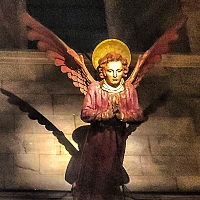
With wings outstretch’d
Hands clasp’d together piously
An angel surely
I HAD PASSED it often, but never entered it until recently when I attended a concert within it. I am talking about a church on Holland Road in West London not far from Shepherds Bush, St John the Baptist. This Anglican church is an exceptional example of gothic revival style. Designed by James Brooks (1825-1901) with John Standen Adkins (an assistant of Brooks), it was constructed between 1872 and 1910.

Although the façade facing Holland Road is not exceptional, the church’s interior is highly breathtakingly decorative. Unlike mediaeval churches, which took centuries to complete, St John the Baptist was constructed in much less time. Yet, its decorative details, which imitate what is best in many older churches, rival those found within the old ones. The workmanship and fine details in St John’s remind one of the best productions of craftsmen, who flourished many centuries earlier. However, unlike the earlier churches, which inspired the designers of St John’s, the interior of the church on Holland Road looks too good to be true. Completed in a relatively short period, the variety that adds to the charm of gothic churches built in earlier times and more slowly is lacking in St John’s and other fine examples of late Victorian gothic revival buildings. What we see at St John’s is the realisation of the architects’ concept of an ideal ‘mediaeval’ church. What was achieved at St John’s is probably something like the results early creators of (mediaeval) churches hoped to create, but never lived long enough to see fully realised.
The attention to detail in the better gothic revival churches, such as St John’s, is marvellous. The result is an ensemble of decorative features rich in meticulously executed intricate details. While I was listening to the concert in St John’s, my eyes took in the details of the church, and I began thinking it was amazing that the elaborate attention to fiddly ornate minutiae was carried out only a few years before architectural trends turned through 180 degrees from excessively decorative to the greater simplicity of much 20th century architecture.
HAMPSTEAD UNDERGROUND STATION, which was designed by Leslie W Green (1875-1908), was opened for passengers in June 1907. Green was responsible for the use of blood red, glazed terracotta tiling on many of London’s Underground stations. The station facades and interiors which he designed, including those at Hampstead, feature many aspects of the British Art Nouveau style. Examples of this style can be seen on Hampstead’s facade, interior tiling, and the ticket office counters.

While I was researching my latest book, “Golders Green & Hampstead Garden Suburb: Visions of Arcadia” (available from Amazon), I came across an interesting diagram in a book by FC Howkins (published in 1923). It shows how the Northern Line tracks rise gradually from several feet below sea level at Embankment (formerly Charing Cross) station to 192 feet above sea level at Hampstead station. However, Hampstead station’s ticket office is about 360 feet above sea level, which is 168 feet above the tracks and platforms (Wikipedia stated that the platforms are 192 feet below the surface). High speed lifts convey passengers between the platform entrances and the ticket office. Originally, these were slow lifts which were entered though brown sliding wooden doors with Art Nouveau inspired cut-outs for ventilation purposes. These old lifts still existed when I was at school in the 1960s, but the newer high-speed lifts with metal concertina doors were the main method of moving between the surface and the trains. Currently, newer lifts have replaced those which were in use between the 1960s (or maybe earlier) and 2014.
If you have a long wait before your train arrives at Hampstead, it is worth wandering to the end of the platform, where you will find the station’s original name, ‘Heath Street’, still on the wall. Today, I disembarked at Warren Street, and noticed that its old name ‘Euston Road’, is still clearly visible at the end of the southbound platform next to its exit.
By 1907, the Northern Line had been extended northward to Golders Green, whose station was opened for passenger use in 1907. It is a long journey between Hampstead and Golders Green stations. An intermediate station near the Bull and Bush pub (on North End Road) was planned. Although the platforms were constructed, they have never been used by passengers, and there is only a small hut on the surface (on Hampstead Way), which contains the entrance to shafts leading down them. Opposition by the founders of Hampstead Garden Suburb and later its residents ensured that the planned ‘North End’ station was never completed.
The Art Nouveau ticket counters at Hampstead station are no longer in use, but they have been beautifully preserved. In each of them, there are information panels detailing the aspects of the station’s history. Other decorative features have been maintained but much of the space in the ticket hall is occupied by the automatic ticket-checking entrance and exit portals. Perched at the top of the High Street, at the point where it meets Heath Street, Hampstead station is an important meeting point and a hard to miss landmark.
 yamey
yamey 