Anne Boleyn’s bowl

THE MAJOR AUCTION HOUSES in London, such as Sotheby’s, Christies, and Bonham’s, provide a wonderful service that benefits as well as enticing potential buyers. For several days prior to big auctions, the lots that are about to be sold are beautifully displayed in galleries, which can be viewed by members of the public. What makes these exhibitions so special is that the artworks and other objects on display are usually not viewable by most people because before and after they are sold, they are housed in places, which are completely inaccessible to the general public, such as private collections. Today (5th of June 2023), we paid a visit to Bonham’s in New Bond Street. In addition to seeing a superb display of paintings and prints by contemporary or recent artists from the Indian Subcontinent, there was a fascinating display of – for want of a better word – ‘antiques’ made mostly in India.

One of the lots that will be auctioned is a bowl made of mother-of-pearl. It is described as “Indo-Portuguese” from Gujarat. When it was made, there were already well-established Portuguese settlements in Gujarat – for example, Daman and Diu. Beside the attractive bowl, there was a hand-written note which read as follows:

“Given by Anne Boleyn Queen of Henry the 8th to Sir John Brereton Kt & given in 1839 by Miss Brereton of Brereton Hall Cheshire to Henrietta E Sharpe who has collateral descent from Sir John Brereton”.

Anne Boleyn lived from c1501-1507 until 1536. Brereton Hall, in Brereton, Cheshire, was built after Anne’s beheading in 1536 by Sir William Brereton (1550–1631). So, who was the person to whom Anne gifted the bowl? Before answering that question, I will tell you about William Brereton (c1487-1536) of Cheshire. One of Henry VIII’s courtiers, he was accused of committing adultery with Anne Boleyn, found guilty, and executed. He was a son of William Brereton, who died in 1485. Many historians no doubt that he was guilty. Guilty or not, there was at least some connection between him and Anne Boleyn. If the handwritten label I saw at Bonham’s is accurate, then the recipient of the bowl must have been alive when Boleyn lived.  John might have been William’s brother, Sir John Brereton (c1447 – 1527), but I cannot be certain. As for the ‘Miss Brereton of Brereton Hall’, she is difficult to identify without her first name(s). And Henrietta Sharpe, who was given the bowl is also not readily identifiable.

How exactly the bowl came into Anne Boleyn’s possession is yet another mystery, but during the reign of Henry VIII and his predecessor, England and Portugal were on friendly terms. The bowl is not only attractive but also poses many questions, which I am as yet unable to answer. One of these is: who will become its next owner? If you want to know the answer, the auction is being held on the 7th of June. But often, the buyer is anonymous.
Inspired by the Pharaohs

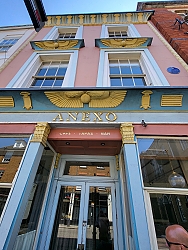
THE TOWN OF HERTFORD is full of delightful old buildings. A house on the town’s Fore Street has a façade decorated with features that bring to mind Ancient Egypt. Known as the Egyptian House, it was built in about 1825 for the grocer JM Gilbertson, who was Mayor of Hertford in 1832. In many ways it resembles a building with an Egyptian style façade. which I have seen in Penzance (Cornwall), This was constructed in about 1835. Both of the house in Hertford and that in Penzance were built later than the now no longer existing Egyptian Hall London’s Piccadilly, which was built in 1812, and was the inspiration for the Egyptian Revival Style of the later edifices in Hertford and Penzance.

The Egyptian House in Hertford is colourfully painted, as is the building in Penzance. Sadly, the Egyptian Hall in Piccadilly was demolished in 1905 to make space for the construction of a block of flats. The Egyptian Revival Style became fashionable during the time of the Egyptian campaigns (end of the 18th century) in the Napoleonic Wars.

Currently, Hertford’s Egyptian House is home to Anexo – a “tapas restaurant and charcuterie bar”. It serves fare that would have been unknown in Ancient Egypt. I wonder what the Pharaohs would have thought about a place like this.

It was the fashionable thing to do

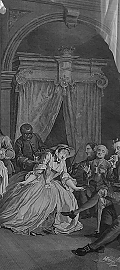
I AM READING A most fascinating book at present (June 2023). Published in 1984, it is “Staying Power: The History of Black People in Britain” by Peter Fryer (1927-2006). In it, the author described how during the 18th century, it was fashionable for wealthy British people living in England to have at least one ‘black’ servant (or slave, in some cases) amongst their teams of domestic staff. Including a black servant in a portrait painting was believed to add to the perceived status of the subject being portrayed. Putting it crudely, just as sporting a Prada handbag or driving a Maserati is supposed to enhance the status of their owners today, exhibiting the ‘black’ servant did the same for the vanity of the wealthy in the 18th century. Sadly, many wealthy British people in the 18th century did not see the ‘black’ servants as human beings but as valued possessions or accessories.  

Today (3rd of June 2023), we paid a visit to Hogarth’s House in Chiswick. Located next to the busy A4 dual carriageway and the often-congested Hogarth Roundabout, it is now hard to believe that in 1749, the artist William Hogarth (1697-1764) bought this place to use as his country home. For, in those days this 17th century house was surrounded by countryside. The house and its garden are open to the public free of charge. The visitor gets to see a series of wood-panelled rooms, very much like those I have seen a friend’s 18th century house in the oldest street in Kensington. Unlike our friend’s house, the walls of the rooms of Hogarth’s former country place are lined with a large number the artist’s wonderful, printed works. Most of these depict scenes portrayed with many fine details. They express Hogarth’s satirical views of the life and behaviour of his contemporaries.

Some of the prints portray the lives of the poor and less well-off. A few depict life in ‘high society’. In several of the latter, there are a few black faces amongst the people in the pictures. All of them are obviously servants. In one of these prints, a black woman with her back facing the viewer can be seen attending to something at her white mistress’s foot. The lady is reclining, and she is looking up from a book propped in front of her. In another print, a black man is shown carrying a cup and saucer into the room filled with white people and there is also a black child playing with a small statue or toy. I examined all the prints on display and noticed that it was only those with scenes of the lives of rich people that included black people. The people in all the other prints were white only.

The depiction of black people with rich people in Hogarth’s satirical depictions of life in 18th century England helps to back up what I have read so far in Fryer’s book. That said, and I might not have noticed what I have described had I not been reading the book, Hogarth’s House is a delightful place to visit. It does not offer refreshments but the lovely café at Chiswick House is only a few minutes’ walk away.

Edwin Lutyens and a London suburb

THE ARCHITECT EDWIN LUTYENS, who designed a set of important government buildings in India’s New Delhi, was also one of the principal planners of Central Square and its surroundings in London’s Hampstead Garden Suburb (‘HGS’). Here is a little bit about this that I have published about this in my book “Golders Green & Hampstead Garden Suburb: Visions of Arcadia”:

Designed to be the throbbing communal heart of HGS, Central Square is a failure. Pevsner and Cherry noted in their “Buildings of England: London 4: North”:

“Unwin’s first plans had included shops along the approaches, but as built by Sir Edwin Lutyens, appointed consultant architect in 1906, the shops were omitted and the square became a high-minded enclave of churches and public buildings with a fringe of smart houses.”

The writers pointed out that without shops, the square never became a true social centre. In fact, most of the time it is an almost deserted open space.  Lutyens (1869-1944) did not get on well with Henrietta Barnett. In her book “The architect and his wife: a life of Edwin Lutyens” (published in 2002), Jane Ridley wrote:

“Lutyens was no progressive. He had no interest in using architecture to change the way people lived, to eliminate servants or smooth social divisions … He disliked the bossiness of social reformers such as Mrs Barnett. Ugly, squalid towns such as Manchester depressed him, but he didn’t see town planning as a motor for change. All he wanted was to build beautiful buildings: ‘Loveliness alone is akin to godliness and whilst ugliness is countenanced and excused Hell is possible.’”

Later in her book Ridley recorded that Lutyen’s wife Emily had written to him after he had fled abroad in 1908 (having had disagreements with Henrietta):

“‘I am glad you went,’ she wrote, ‘as you needed rest and change, only you must work up the Hampstead affair and not let grass grow under your feet, or Mrs Barnett will put you in the wrong again.’”

Despite his differences with Mrs Barnett, Lutyens left his architectural mark on the square. These are his buildings built before he drew up plans for most of his buildings in British India, notably in New Delhi. As Mary Lutyens described in her book “Edwin Lutyens” (published in 1991), his work in the suburb was of importance for his future career:

“At the beginning of 1912 Lord Crewe, Secretary of State for India, approached Reginald Blomfield, President of the Royal Institute of British Architects, to recommend an architect to serve on a commission of three experts to advise the Government of India on the siting and laying out of the new capital. Blomfield recommended Lutyens on the strength of his country houses …his work in Johannesburg … and for Hampstead Garden Suburb. Sir Richmond Ritchie, Permanent Secretary for India, then sent for Lutyens and asked him if he would be willing to serve on the Commission. Incidentally, in connection with the above, Lutyens was already married to the daughter of a Viceroy of India…”

Central Square and its surroundings remain a rather sterile centre of what its founders hoped would be a garden suburb with a vibrant community spirit. If you are lucky, you can spot someone walking a dog or a few children playing on the lawns. Otherwise, this part of London is peaceful and, dare I say it, rather dull.

You can read more about Hampstead Garden Suburb in my book, which is easily available from Amazon:

An artist named Balthus

ON THE LAST DAY of May 2023, I visited the Luxembourg Gallery on London’s Savile Row. My wife and I went to see a small exhibition of paintings and drawings by an artist whose name was not familiar to me – Balthasar Klossowski (1908–2001). Better known as ‘Balthus’, he was according to Wikipedia:

“…known for his erotically charged images of pubescent girls, but also for the refined, dreamlike quality of his imagery.”

Although there were three drawings that fall into the “erotically charged” category, most of the other works on display were delicately executed, attractive paintings. Most of these demonstrate what the gallery’s website described as follows:

“Exercising meticulous control over the form and placement of models, their bodily gestures, as well as the domestic or rural settings in which they reside, Balthus sought to create, at least in appearance, dreamlike scenarios, absent of time and devoid of emotional expression. Yet the restraint in his works results in suggestive and even violent relationships between elements or figures in the picture, as well as in their relation to viewers or the artist himself.”

The results are extremely pleasing to the eye.

The Wikipedia article mentioned something that particularly interested me:

“Throughout his career, Balthus rejected the usual conventions of the art world. He insisted that his paintings should be seen and not read about, and he resisted any attempts made to build a biographical profile. Towards the end of his life, he took part in a series of dialogues with the neurobiologist Semir Zeki, conducted at his chalet at Rossinière, Switzerland and at the Palazzo Farnese (French Embassy) in Rome.”

When I was studying for my BSc in physiology at University College London in the early 1970s, one of my teachers was Semir Zeki, mentioned in the quote above. I recall that he was an excellent teacher, who was able to explain complex topics extremely clearly.

Although I did not know about Balthus nor of Professor Zeki’s connection with him, I am very pleased I visited the Luxembourg Gallery and became aware of such a fine 20th century artist.

An interesting intersection

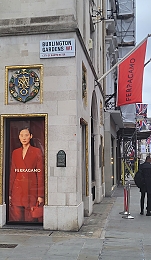
WHERE BURLINGTON GARDENS meets the south end of New Bond Street and the north end of Old Bond Street, there are two things that reminded me of my late mother.

One of them is a shop in a colourfully decorated building. This edifice used to be the home of Atkinson’s – a firm that sold perfumes and beauty products. Founded in 1799, it moved to the building on the corner of Burlington and Old Bond Streets in 1832. The decorative building is surmounted by a carillon of 23 bells, which is played by hand occasionally – to celebrate both public and private special occasions. Currently, the ground-floor is occupied by a branch of Ferragamo’s. And this firm has a connection with memories of my mother.

Salvatore Ferragamo (1898-1960), born in Italy, was a designer of luxury shoes. His clients included the Maharani of Cooch-Behar, Eva Peron, and Marilyn Monroe. He died in Florence (Firenze), where he had a shop on the Via dei Tornabuoni. This shop was close to Via del Giglio, where we as a family used to spend a fortnight in the city every year until I was about 15.

One of my clearest memories of our sojourns in Florence was not the Uffizi or the famous Duomo or the Medici Chapels, or even Michelangelo’s statue of David, but Ferragamo in Via dei Tornabuoni. You might wonder why. It was not that I have a shoe fetish or any great interest in footwear. It was because of my mother. Hardly a day passed without us having to enter Ferragamo’s to watch my mother trying on several pairs of shoes. For a youngster like me this was not an interesting way to spend my precious school holidays. And what is more, I cannot recall my mother ever buying a pair of shoes in that shop.

Facing Ferragamo’s on the corner of New Bond Street and Burlington Gardens, there is a small paved open space. In the middle of it, there is a bronze sculpture of a horse and rider. This was sculpted by Elisabeth Frink (1930-1993). My mother was also a sculptor and met Frink (or ‘Liz Frink’, as we knew her) at St Martins School of Art (in Tottenham Court Road), where they both worked in the Sculpture Department. They became close friends. I used to meet Liz Frink when she was invited to our house for dinner occasionally.

The Frink sculpture has been on Bond Street since 2018. Before that, it was located at the corner of Dover Street and Piccadilly, where it was placed in about 1975. As for the branch of Ferragamo’s that faces it across Burlington Gardens, I am not sure how long it has occupied its present site. However, it was only today that it occurred to me that the intersection of the two Bond Streets with Burlington Gardens has a connection with recollections of my mother.

A Knightsbridge landmark

FIVE YEARS AGO, I wrote the following:

In the early 1960s, my parents installed a Permutit water softening unit in our family home. I have no idea why they did this. Maybe it was to save soap and the furring up of pipework. I am not sure that they would have done it had they known of the research that shows that heart disease is reduced as the hardness of drinking water increases.

The apparatus consisted of two cream-coloured cylinders, each about five feet high, which stood next to each other in our garage by the side of the house. One of the cylinders was sealed shut and surmounted by a circular metal control wheel. Its neighbour could be opened by lifting a lid. Once a week, my father had to refresh the ion-exchange resin in the sealed container. This was done by adding salt in large quantities to the other cylinder …

… A special salt, called dendritic salt, was required for the weekly process … There was only one store that would both supply sacks of dendritic salt and, also, deliver it to our home. That store was the world-renowned Harrod’s in Knightsbridge, which brought us the salt in their silent, electrically powered delivery vehicles.  In order to get these regular deliveries, my parents had to open a Harrod’s account...”

Today, at the end of May 2023, I paid a visit to Harrod’s – a department store, which I last entered about 15 years ago. Since then, its interior has been modified considerably. The Ancient Egyptian themed central escalator hall is as it was when I last saw it, as is the superb, tiled food hall. Otherwise, it seemed unrecognisable to me.  

Rather than being what I have always believed a a department store should be – a large shop in which its various sections display different kinds of goods (for example, men’s clothing, kitchen appliances, toys, etc), todays Harrod’s is a collection of departments, each one dedicated to a brand rather than a type of product. Wandering through the store, trying to find our way out, it occurred to me that Harrod’s has become more like a shopping area in a large international airport than an ‘old-fashioned’ department store. Is this, I wonder, because today’s customers are more interested in brand names than the products to which they are attached? Also, I am curious to know whether Harrod’s still deliver sacks of dendritic salt to addresses in the Hampstead Garden Suburb, where we used to live.

A leather purse

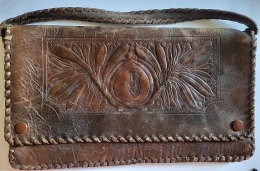
OF MY FOUR GRANDPARENTS, I met only one of them – my father’s mother. The other three died before I was born. My mother’s mother was called Ilse – her parents were born in Prussia and Baden Württemberg before the Unification of Germany in 1870. From what I can recall, my mother told me that her mother was gifted artistically. She painted and made various kinds of objects by hand. One of these came into our possession some years ago. It is a large purse made from leather. With two industrial press-studs, it is held together with stitched leather. The front flap has a leafy design tooled in it. The image has the characteristics of the art-nouveau style that was popular in the late 19th century, and the early part of the following century. In the centre of the design, there is a pair of intertwined initials tooled in the leather. These appear to be “J” and “B”.

When Germans wrote in the late 19th century, they often used what looks to our eyes like the upper-case letter ‘J’ where we would now use the upper-case letter ‘I’. To write the letter ‘J’ (as in jelly), the old German alphabets used a ‘J’ that differed slightly from the ‘J’ used to denote ‘I’. Therefore, the initials on the purse are most likely ‘IB’. Now, IB could either refer to Ilse or to her husband, my grandfather, Iwan B.

Inside the purse, there is some handwriting, which I recognise as my mother’s. It gives her name, Helen B, and the address of the farm her mother bought after having been widowed twice:

“Bantouzelle, Stellenbosch. Phone No. Stellenbosch 2646.”

Beside this, she had written “Poste restante”. I imagine that she had done this because most of the time she was living not in Stellenbosch, but in Cape Town. This would have been before 1948 when she travelled to England to marry my father.

Apart from a few old photographs, this well-made purse is one of the very few material souvenirs of a grandmother whom I never met.

Water for the public

WE TAKE IT FOR GRANTED that when you turn on a tap in your bathroom or kitchen, fresh water will flow. And when, usually for maintenance purposes, the mains water supply is turned off temporarily, we can be truly inconvenienced. There are still many parts of the world where piped water is not available to domestic users, but the UK is no longer one of these.

During a recent (May 2023) trip to Lavenham in Suffolk, my wife noticed something next to a pavement. It was a now obsolete bit of plumbing, which has been preserved to demonstrate that even as late as 1936, the small town did not have a public piped water supply for its dwellers. I suppose that before that date, the people had to rely on springs and wells.

The object that can be found on the east side of Church Street, south of Water Street, is a public standpipe. A notice near it explained that piped water came to Lavenham in 1936 to 1937. Several standpipes were erected to give the public access to the water. At that time, people had to collect water from the standpipes and take it to where they required it. However, they did not yet have the luxury of having taps that supplied water in their own homes. The standpipe, which we saw, is now non-functional, but is one of nine such items still to be found in Lavenham.

Lavenham is full of small reminders of how different life was many centuries ago. The standpipe is a small souvenir that makes us realise how different life was less than 100 years ago.